Earth apple: the misnamed artichoke
Strange name, this plant. It is not from Jerusalem. Nor is it an artichoke. It looks like a sunflower. But it isn’t.
Plant notes…
Earth apple: the misnamed artichoke
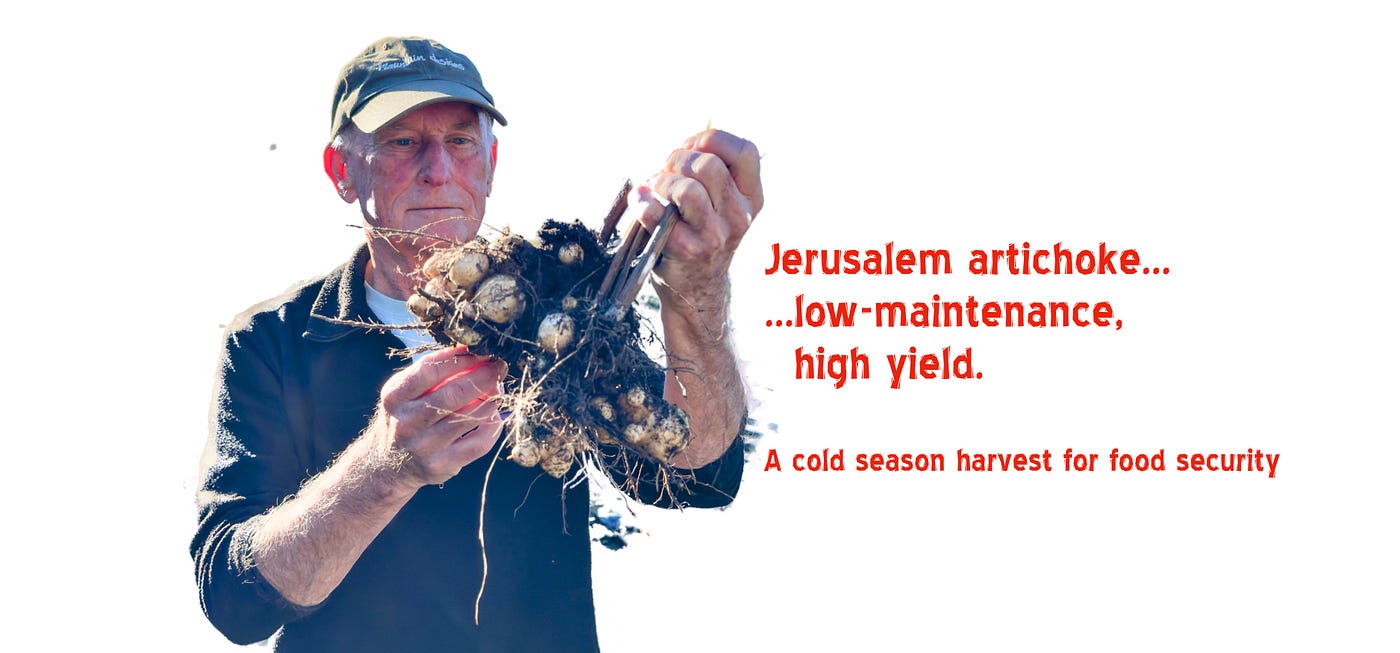
Strange name, this plant. It is not from Jerusalem. Nor is it an artichoke. It looks like a sunflower. But it isn’t.
Confusing? Maybe. Misleading? For sure. But that’s the problem with the common names of plants. They change from place to place. They’re known as one thing here, another thing there. Like, I mean, sunroot and sunchoke. They’re the same thing. And so is Jerusalem artichoke. Well, you get my drift. That’s why we use botanical names… genus, species. The name is the same wherever you are in the world. Avoids confusion.
I’ve grown Jerusalem artichoke or whatever name you prefer to call it — I’ll call it that because that is what it is known as here in Australia — in the coastal warm temperate zone as well as in Tasmania’s cool temperate coastal region. We grew it in our apartment block’s shared garden in Eastern Sydney and it grows just as well here on the shore of the bay east of Hobart in Tasmania. We planted it in a sheltered position, protected from the winds of the Roaring Forties that sweep up from the Southern Ocean, and exposed to sunward, the north, here in the southern hemisphere.
It comes back year after year. That’s a characteristic of the vegetable. It is a plant difficult to get rid of, it you really would want to do that. Leave even a tiny tuber on the soil and here comes next season’s crop.
With the geopolitical, environmental, economic and climate situation of the world at present it should not come as a surprise that people are planting gardens in case of supply chain failure. And that is another positive for Jerusalem artichoke. Its low maintenance and high productivity make it one of those plants that we can plant as an emergency food to build our food resilience.
So let’s take a look at this misnamed vegetable and think whether it is something you could grow in your own garden.
Common names:
- Jerusalem artichoke
- sunchoke
- sunroot
- earth apple (in some European countries).
Family: Asteraceae; the daisy or sunflower family, one of the largest families of flowering plants. ‘Aster’ comes from the Latin and was derived from the ancient Greek word for ‘star’, which comes from the ancient proto-Indo-European language family of 4500 BCE to 2500 BCE. ‘Aster’ means star-shaped and refers to the shape of Asteraceae flowers in which petals radiate from a central core. Genus: Helianthus. The genus contains around 70 species, most native to North America. The cultivated sunflower (Helianthus annuus) is its best-known relative. Species: tuberosus.
Centre of diversity
Eastern and central North America including southern Canada. This is where the species evolved and where its greatest genetic diversity is found.
- wild populations are still found across much of eastern North America growing on woodland edges, riverbanks and in open grasslands
- Jerusalem artichoke was domesticated and widely cultivated by Indigenous peoples long before European contact.
Climatic preference
Jerusalem artichoke does well in the southern states of the Australian continent: Tasmania, southern NSW, Victoria, the ACT, South Australia, cooler parts of Western Australia and southeast Queensland.
The humid tropics? Maybe not. Without a cool dormant season growth can be poor, flowing irregular and tuber production less.
The subtropics? Perhaps at higher elevations or where winters are cool enough to provide a period of dormancy. The humid subtropical lowlands might not be so conducive.
Growth form
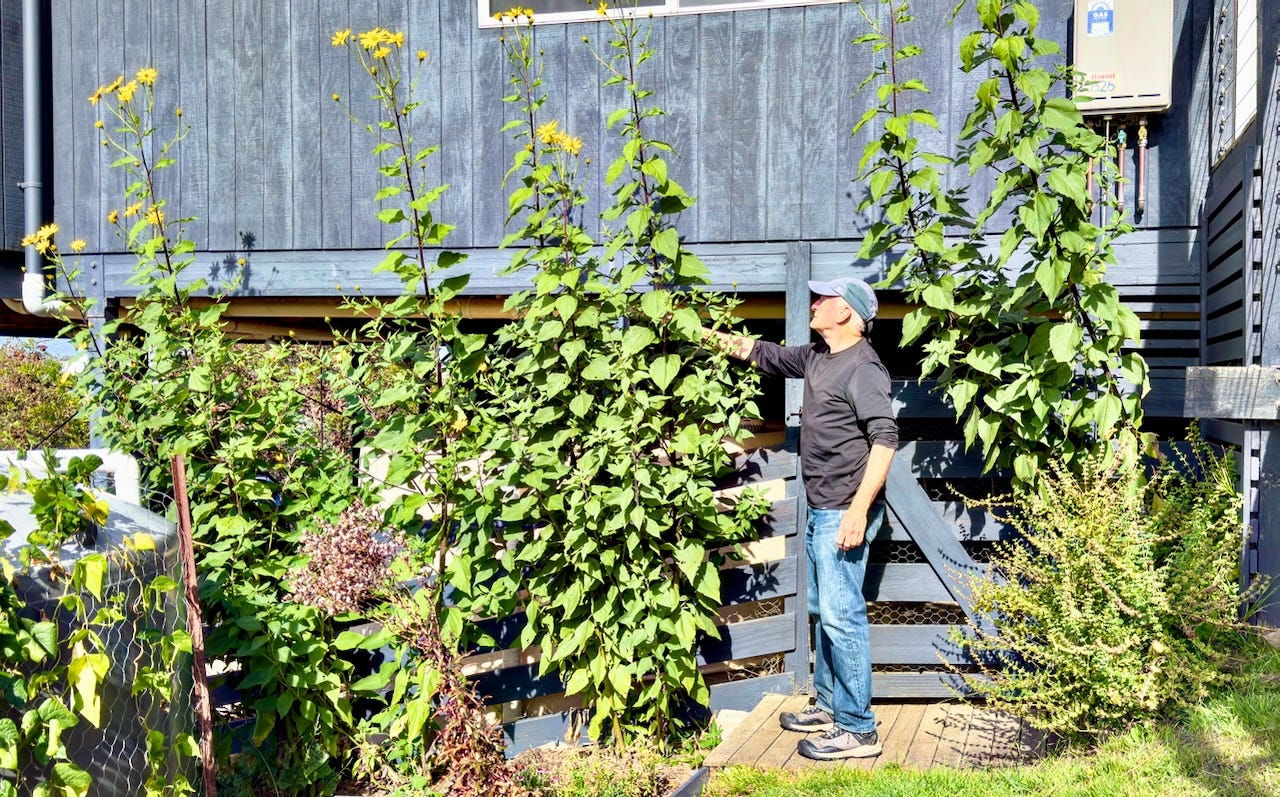
Mature Jerusalem artichoke in flower. Note its resemblance to sunflower.
Jerusalem artichoke is a perennial vegetable growing from underground tubers.
Growth habit: erect, clump-forming stems arising annually from overwintering tubers. In growth form Jerusalem artichoke resembles sunflower.
Height: 1.5–3 metres.
Tubers: irregularly shaped, typically 7–10cm long and 2–5cm thick
Leaves: 10–30 cm long; simple, broadly ovate to lanceolate with serrated margins, rough and slightly hairy; arranged opposite on the lower stem and alternately higher up the stem.
Stems: coarse, ridged, slightly hairy.
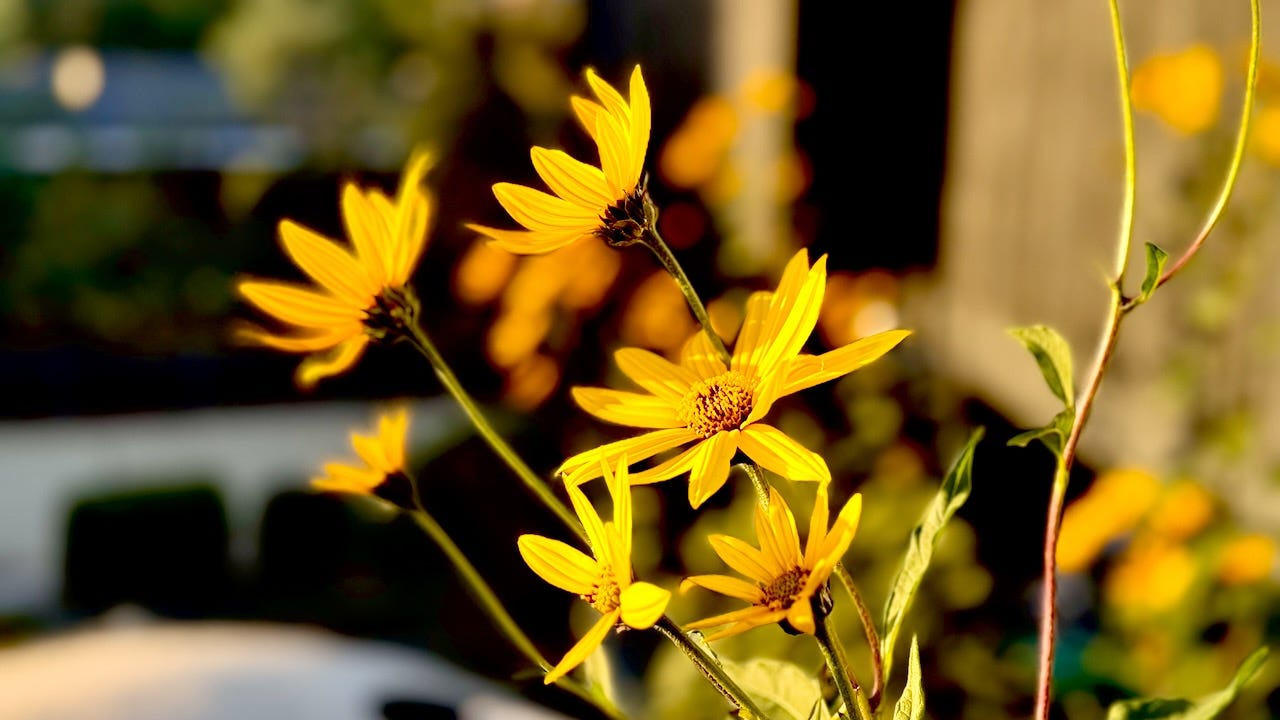

Flower of Jerusalem artichoke.
Flowers: bright yellow flowers in late summer to autumn.
Roots: fibrous, shallow; the plant sets tubers that are edible.
Jerusalem artichoke dies back completely in winter. The tubers remain dormant underground. It is ready to dig up and harvest when the leaves and stems have completely died off.
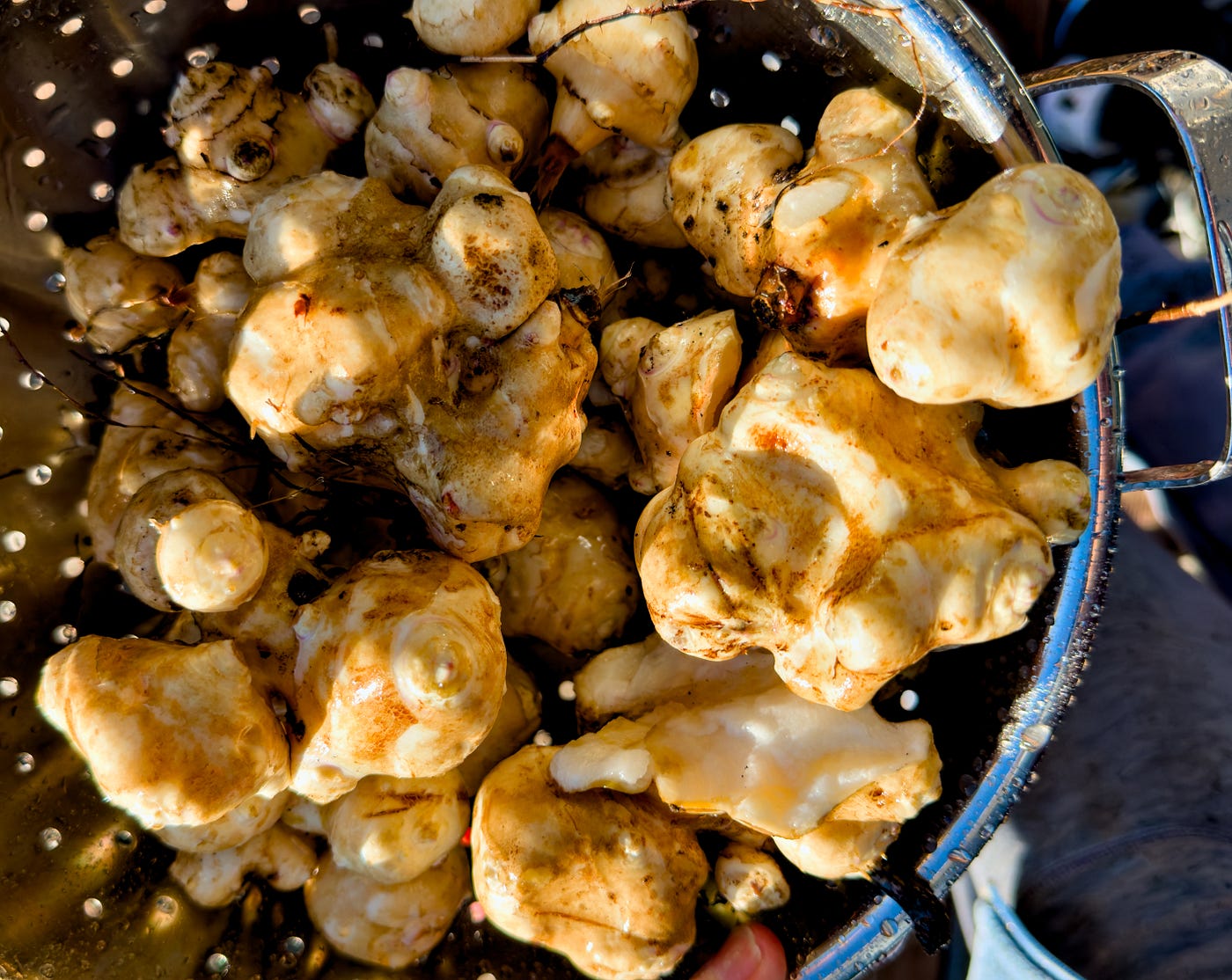
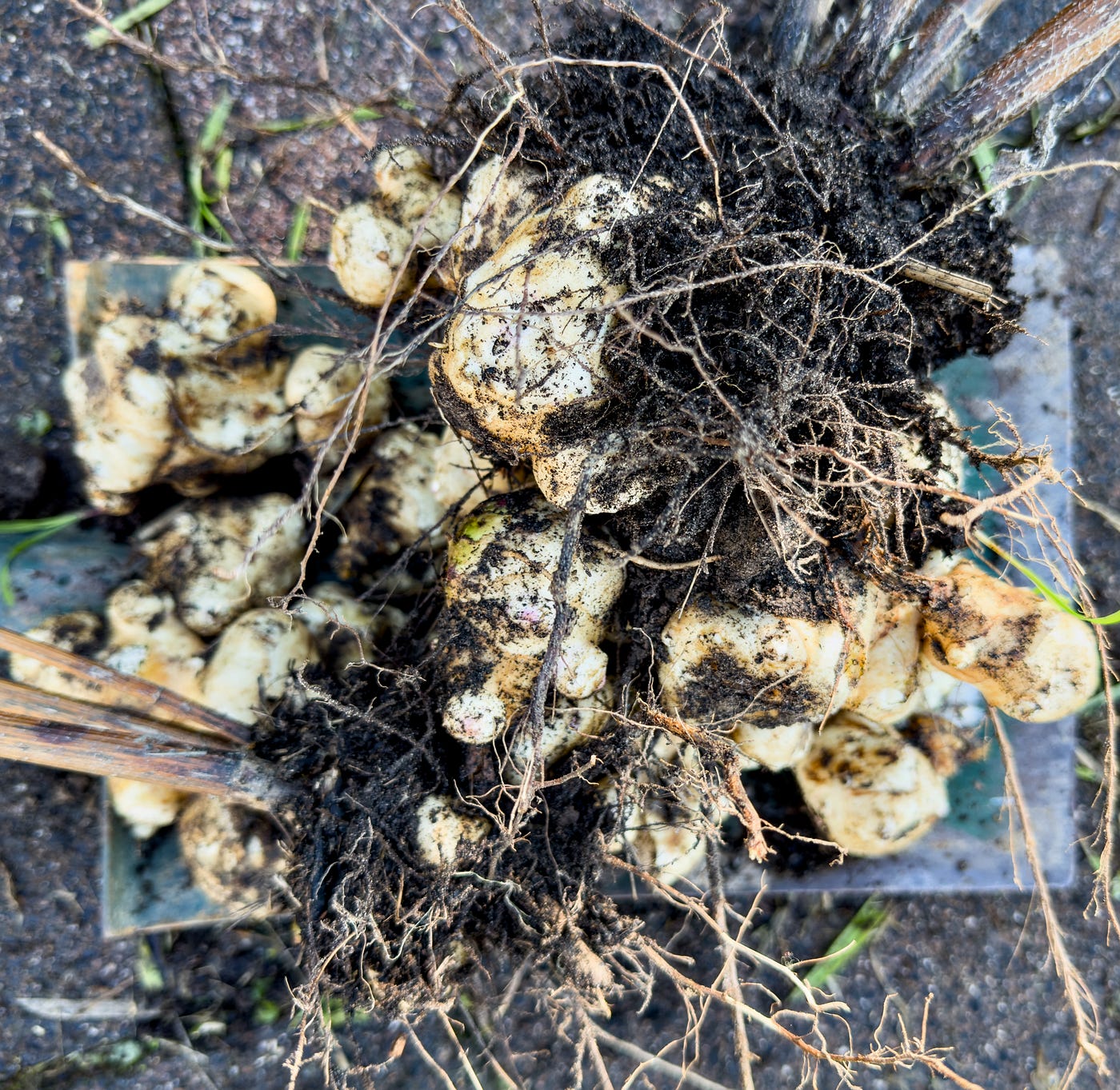
Left: Washed tubers after harvest. Rright: Jerusalem artichoke tubers and fine roots.
Propagation and reproduction
The plant gradually expands through underground rhizomes.
Each tuber contains several buds capable of producing a new plant. The plant also produces seed but this is reported to be relatively uncommon outside its native range. It contributes little to cultivation.
Planting
- plant tubers in late winter to early spring 45cm apart and around 15cm deep
- the plant tolerates a range of soil pH
- may need staking in windy locations.
Harvest
- harvest any time after the foliage has completely died back
- harvest from late autumn through winter and after the first frost in cold climates
- tubers can be left in the soil as a living food store and dug up as needed.
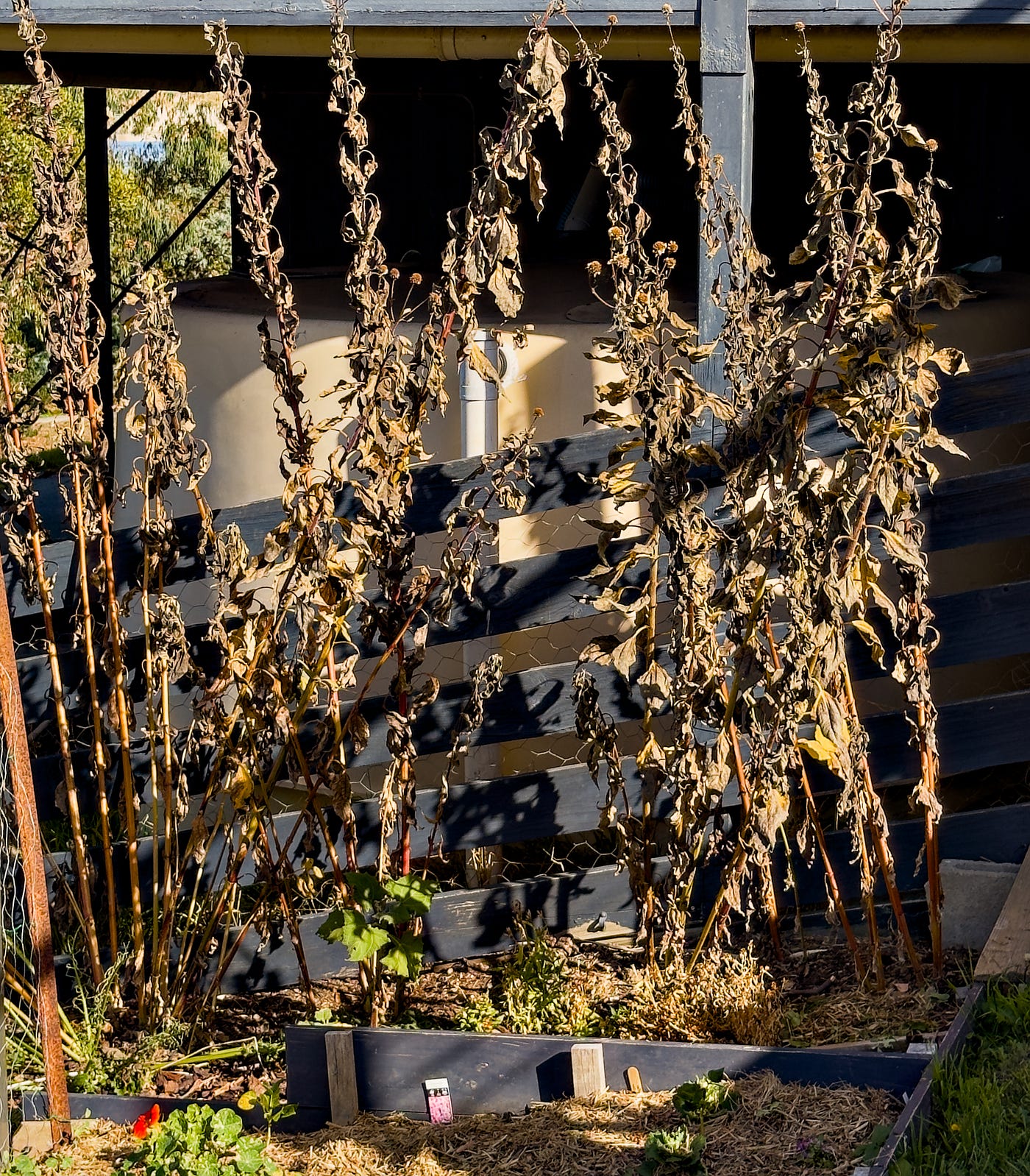
It is early winter and the foliage has died off. The artichoke tubers are ready to harvest.
Uses
Food.
As a food:
- edible tubers are crisp and crunchy when eaten raw; they have a sweet, nutty flavour and texture like water chestnut
- used in cooking
- eaten raw in salads
- snack food: try it sliced thinly with lemon juice
- roasted
- steamed
- boiled
- mashed
- add to soups
- stir-fry
- pickle
- ferment.
The tuber are rich in the carbohydrate inulin and contain about 2% protein, little starch and no oil.

Non-food uses:
- livestock forage
- windbreak
- summer screen
- biomass production
- source of inulin for the food industry
- ethanol production in some regions
- nectar source for bees late in the flowering season.
Jerusalem artichoke in permaculture design
Planting options in a permaculture garden design:
- if growing Jerusalem artichoke in quantity as a field crop (rather than in the annual vegetable beds), locate it as an interface planting between the permaculture Zone 1 (the annual vegetable beds) and Zone 2 (shrub and tree crops)
- establish as a ‘broad bed’ crop where vegetables needing less attention and that are harvested less-frequently are located beyond the annual vegetables and herbs
- Jerusalem artichoke can be thought of as a perennial vegetable resprouting annually from tubers left in the soil; as such, it might be set in its own location with other perennials
- the plant could be integrated into a forest garden of the type pioneered by Robert Hart (The Forest Garden; 1987; Institute for Social Inventions ISBN 0–948826–02–9).
Jerusalem artichoke is a multi-functional plant and an example of the permaculture principle that ‘each element performs many functions.’ In permaculture landcape design it serves as:
Food: Its primary role is as a reliable perennial food crop; tubers provide a substantial harvest during the cooler season when many annual vegetables are no longer producing.
Food security: Minimal care needs and a substantial harvest when many other crops are no longer producing makes Jerusalem artichoke suitable for planting as an emergency food source for times of disaster and famine.
Windbreak: Dense stands can be planted adjacent to vegetable beds to reduce wind speed and crop damage during the growing season.
Biomass production: The stems and foliage produce organic matter that after harvest can be chopped and added to compost or laid as mulch on garden beds to build soil organic matter.
Pollination: The bright yellow flowers bloom late in the season and attract bees, native pollinators and other beneficial insects, helping sustain insect populations into autumn.
Habitat: The dense foliage provides shelter for predatory insects and spiders that help regulate pest populations in the garden.
Pioneer species: Jerusalem artichoke tolerates relatively poor soils, survives drought once established, and copes well with neglect. Use it to reestablish vegetation on disturbed sites.
Animal fodder: Tubers can be fed to pigs. Goats, sheep and cattle can browse the leafy stems.
Boundary marker, garden navigation: Rows of Jerusalem artichoke can define pathways, garden spaces or the edge of annual cropping areas during the growing season; the plant can be used to create spacial structure within a food garden.
Cautions in permaculture design
Jerusalem artichoke is vigorous. It can become difficult to remove because even small tubers left in the soil readily regenerate. For this reason:
- allocate it a permanent area rather than mixing it through annual beds
- harvest thoroughly to limit spread
- use it where its persistence and regrowth from tubers left in the soil is an advantage, such as along boundaries
- avoid planting it where it will shade smaller, sun-needy crops.
Its productivity, resilience and multiple functions have made Jerusalem artichoke a suitable species for temperate permaculture systems, particularly in food forests and on the perimeter of kitchen gardens where dependable winter food and abundant biomass are valued.
Folklore and legend
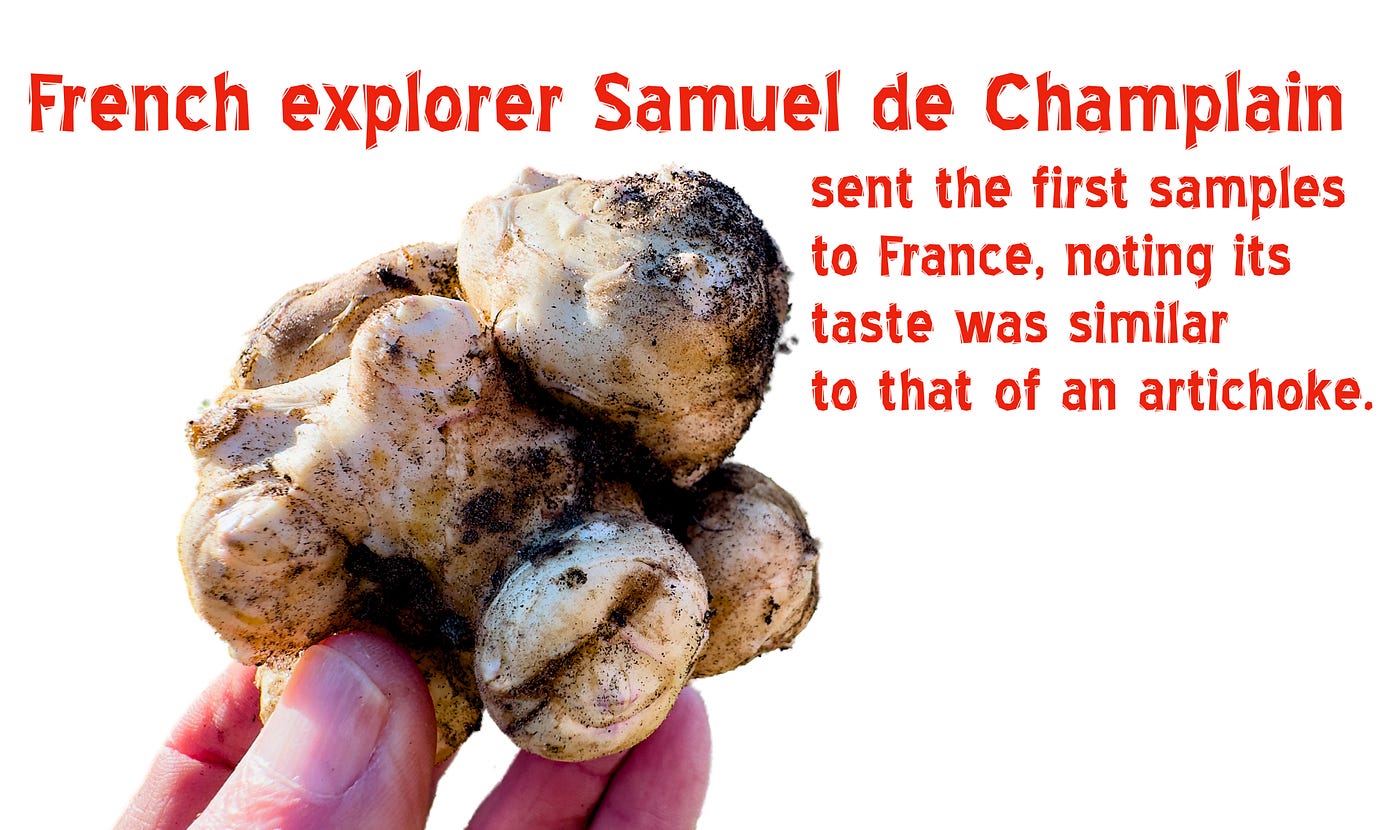
Despite its name, the species is neither from Jerusalem nor an artichoke. The name is thought to have evolved from the Italian word ‘girasole’ for ‘sunflower’, which English speakers gradually transformed into ‘Jerusalem’.
Jerusalem artichoke was an important winter staple among some North American indigenous peoples. It symbolised resilience because its underground tubers survived harsh winters and drought. Early European settlers quickly adopted it as a dependable famine food.
In seventeenth-century Europe the plant became popular after its introduction from North America. It was celebrated as an exotic delicacy. During periods of war and food shortages Jerusalem artichoke regained importance because it remained productive in poor soils with little care.
Garden folklore often describes it as ‘the crop that refuses to leave.’ Once established, forgotten tubers readily regenerate year after year, making the plant both treasured for its reliability and notorious for its persistence. This tenacity has become a symbol of endurance and abundance among many gardeners.

The lanceolate shaped leaves of the Jerusalem artichoke.

Gardens and the world…
Edibles for the permaculture garden…
[embed]Mizuna An Asian vegetable with edible leaf and flowers that attract bees….medium.com
[embed]Shungiku From Asia, a vegetablke for the home garden…medium.com

메타데이터
- post_id
- 016a16852460
- slug
- earth-apple-the-misnamed-artichoke-016a16852460
- url
- https://medium.com/permaculture-3-0/earth-apple-the-misnamed-artichoke-016a16852460
- canonical_url
- https://medium.com/permaculture-3-0/earth-apple-the-misnamed-artichoke-016a16852460
- author_url
- https://medium.com/@russgrayson-au
- status
- ok
- fetched_at
- 2026-07-14 04:43:44