Building a Cyber Risk Quantification Agent: Part 2 Testing and Limitations
What CRQ tasks AI can automate effectively, and where it struggles
Building a Cyber Risk Quantification Agent: Part 2 Testing and Limitations
Overview
In Part 1, I demonstrated how I built a basic Cyber Risk Quantification (CRQ) agent using Google’s Agent Development Kit (ADK) and the FAIR framework.
But prototypes only become interesting when you unleash them on messy, real-world scenarios. Part 2 focuses on stress-testing the agent, examining what it handles well, where it falls short, and what this reveals about the current boundaries of AI in cyber risk quantification.
👉 You can play with the code yourself on GitHub: CRQ Agent.
Scenario Testing
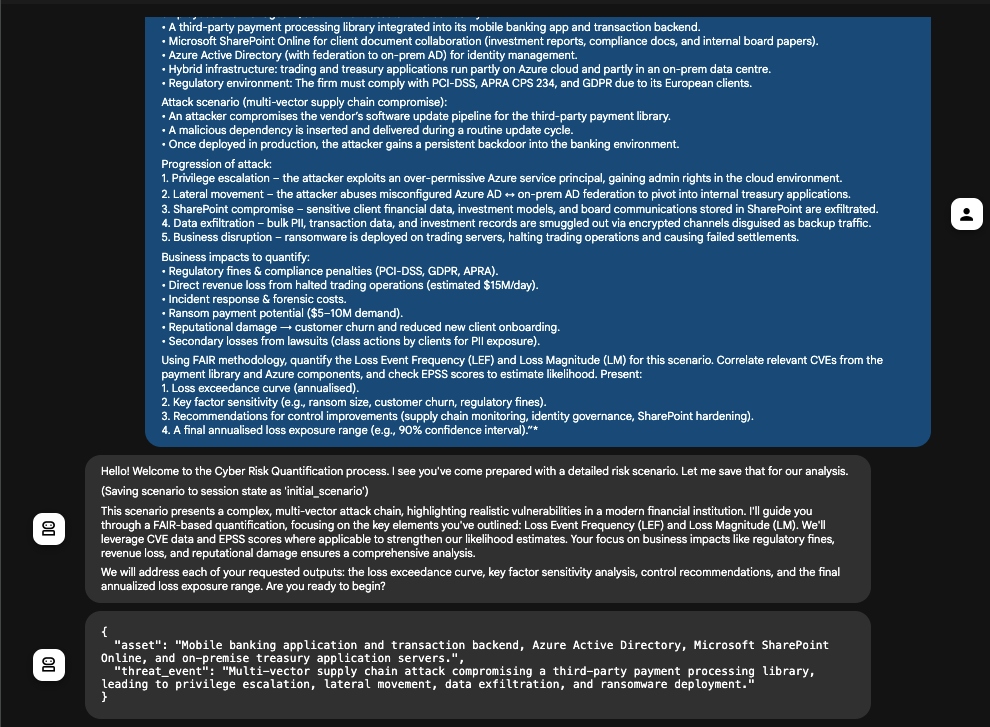
I ran the agent across different scenarios from supply chain compromises in financial services to ransomware in healthcare, to hybrid-cloud misconfigurations in tech. The results showed both promising potential and glaring weaknesses
Enterprise Data Breach Scenarios
When provided with complex multi-vector attack scenarios, such as a supply chain compromise affecting a financial services firm, the agent demonstrated impressive capability in vulnerability correlation. It successfully mapped CVE data to business impact categories and produced credible loss estimates within expected ranges for the sector.
The agent handled straightforward breach scenarios well, particularly those involving:
- Web application vulnerabilities with explicit CVE mappings
- Network infrastructure compromises with established attack patterns
- Malware incidents with documented impact data
However, the agent struggled with a nuanced organisational context, as it only relies on the data provided in the prompt and lacks expert judgement. While it could identify that a healthcare provider faces different regulatory penalties than a manufacturing company, it relied heavily on generic industry benchmarks rather than company-specific factors, such as revenue models, customer concentration, or existing control maturity.


Cross-Industry Validation
The agent’s performance varied dramatically across industry verticals, revealing essential limitations in its threat intelligence foundation.
Financial Services and Technology In sectors with abundant public breach data, such as financial services and technology, the agent produced relatively consistent Threat Event Frequency (TEF) estimates.
Healthcare and Manufacturing When analysing scenarios in healthcare, manufacturing, or government, the agent often defaulted to conservative estimates that didn’t reflect sector-specific threat landscapes. Healthcare organisations face unique challenges from targeted ransomware campaigns, while manufacturing companies deal with IoT vulnerabilities that aren’t well-represented in traditional CVE databases.
The agent’s reliance on publicly available threat intelligence created large and prominent blind spots in specialised threat environments. It missed industry-specific attack vectors and underestimated the behaviour of sector-targeted threat actors.
Government and Critical Infrastructure Government and critical infrastructure scenarios posed the most significant challenges. The agent was unable to adequately model nation-state threats, advanced persistent threats (APTs), or the unique regulatory and operational constraints these organisations face.
Hybrid Cloud and Complex Architecture Scenarios
Modern enterprise environments with hybrid cloud architectures exposed fundamental limitations in the agent’s reasoning capability. The agent struggled to:
- Model attack paths that span on-premises and cloud environments
- Account for shared responsibility models in cloud security
- Understand the cascading effects of container or serverless vulnerabilities.
- Assess risks in multi-cloud environments with different security models
These scenarios required an understanding of complex architectural dependencies that the agent couldn’t adequately capture from standard vulnerability databases.
Supply Chain Risk Assessment
Supply chain scenarios revealed both strengths and critical weaknesses. The agent could identify direct vendor vulnerabilities and map them to business impact. However, it missed:
- Indirect dependencies (vendors of vendors)
- Cascading failure scenarios where one supplier affects multiple business processes
- The systemic nature of the supply chain compromises
- Vendor concentration risks that create single points of failure
Portfolio-Level Risk Aggregation
Portfolio-level risk aggregation exposed fundamental limitations in the agent’s architecture. While effective for individual scenario analysis, the agent struggled to model correlated risks across business units or geographic regions.
Real enterprises face cascading failures where a single Identity Provider (IdP) compromise affects multiple applications, or a cloud provider outage simultaneously impacts distributed services. The current implementation treats each risk scenario independently, missing the systemic interdependencies that drive the most catastrophic losses.
Boundaries of AI Automation in Cyber Risk Quantification
Through testing, clear boundaries emerged around what my AI agent can and cannot effectively automate in cyber risk quantification. Understanding these boundaries is crucial for realistic expectations of implementation.
Where the Agent Shines
Before diving into limitations, it’s important to acknowledge where the agent excels and why it represents genuine progress in cyber risk automation. After all, where else am I going to brag about my work if not here?
Data Collection and Correlation AI excels at gathering and correlating large volumes of structured data from multiple sources. The agent successfully automated:
- Retrieves relevant CVE data with accurate severity scoring
- Maps vulnerabilities to CISA’s Known Exploited Vulnerabilities (KEV) catalogue
- Integrates EPSS (Exploit Prediction Scoring System) scores to assess exploitation likelihood.
- Correlates threat intelligence across different data sources to build comprehensive risk pictures.

Agent querying and tool calling flow diagram generated from Google ADK
Pattern Recognition and Baseline Estimation The agent demonstrated strong capability in recognising patterns across similar scenarios and providing baseline risk estimates. It effectively:
- Identified similar historical incidents for benchmarking
- Applied industry-standard risk frameworks consistently
- Generated initial parameter ranges for FAIR modelling.
- Performed sensitivity analysis on key variables
Report Generation and Communication AI significantly improves the consistency and quality of risk communication by:
- Generating standardised report formats
- Translating technical risks into business language
- Creating visualisations that support stakeholder communication
- Maintaining consistent methodology across assessments
Where the Agent Struggles
Organisational Context
AI is only as good as its prompt. The agent knows that healthcare ≠ manufacturing, but it relies on generic benchmarks. It can’t capture company-specific realities like:
- Company culture and risk appetite
- Specific business processes and revenue models
- Internal control implementations and their actual effectiveness
- Historical incident response performance and lessons learned
- Stakeholder relationships and communication preferences
This makes outputs feel credible but not always relevant.
Hallucinations
Run the same prompt twice, and you sometimes get different FAIR factor estimates. That’s a classic LLM hallucination, the agent “making things up” instead of grounding in data.
Data Classification and Sensitivity
Although the agent can apply generic data classification schemes, it struggles with understanding organisation-specific data sensitivity levels and the business impact of different data types. A customer database breach affects a B2C company differently than a B2B manufacturer, but the agent relies on industry averages rather than company-specific factors.
Complex Dependency Modelling
Independence Assumptions: Current implementations, including this agent, effectively treat Threat Event Frequency (TEF), Vulnerability, and Loss Magnitude as independent variables. In practice, these factors exhibit complex dependencies:
- Better detection capabilities reduce realised loss magnitude conditional on incident occurrence.
- Enhanced vulnerability management affects both the probability of exploitation and the effectiveness of containment.
- The sophistication of the threat actor influences both the frequency of attacks and the potential impact scale.
System Interdependencies: The agent processes scenarios independently, missing correlated risks that create the most severe organisational impacts:
- Shared infrastructure dependencies (cloud providers, identity systems, network segments)
- Vendor concentration risks where single suppliers affect multiple business processes
- Systemic shocks from zero-day vulnerabilities or supply chain compromises
Dynamic and Temporal Factors
Point-in-Time Limitations: The current implementation lacks temporal sophistication, missing the dynamic nature of both threats and controls:
- Threat intelligence aging and evolving exploit likelihood over time
- Control effectiveness evolution as security programs mature
- Seasonal or cyclical patterns in threat activity
- The impact of security awareness training and organisational learning
Threat Landscape Evolution: The agent cannot adequately account for emerging threats or rapidly evolving attack techniques that haven’t yet appeared in historical data or public databases.
Asset Context and Technical Depth
Shallow Asset Understanding: The agent treats assets too generically, missing nuanced relationships between business processes, data flows, and technology dependencies that drive actual risk exposure. Real CRQ requires:
- Comprehensive asset inventories with business criticality rankings
- Technical configuration details that affect vulnerability exploitability
- Network segmentation and access control implementations
- Backup and recovery capabilities that impact loss magnitude
Configuration-Specific Risks: A generic “web application” assessment misses crucial details about specific frameworks, versions, configurations, and integrations that significantly affect actual risk exposure.
Secondary Loss Modelling
Static vs. Dynamic Impact Modelling: The agent uses static ranges for reputational harm, customer churn, and regulatory fines rather than driver-based modelling. It cannot adequately assess:
- Customer lifecycle value and churn probability based on breach characteristics.
- Media attention intensity is driven by breach size, data sensitivity, and organisational profile.
- Regulatory response patterns based on jurisdiction, compliance history, and breach scope.
- Market reaction and competitive impact in specific business contexts.
Technical Infrastructure Limitations
API Dependencies and Data Quality: External data feeds create ongoing maintenance challenges that affect long-term reliability. The agent’s dependence on NVD, EPSS, and CISA KEV APIs creates vulnerabilities in:
- Schema evolution and API versioning
- Data quality inconsistencies and false positives
- Rate limiting and service availability
- Version mismatches between vulnerability databases and actual asset inventories
Distributional Assumptions
Triangular and PERT distributions provide computational convenience but systematically underestimate tail risk. Real incident data often exhibit fat-tailed distributions, where extreme losses occur more frequently than normal distributions predict; however, the agent cannot adequately model these scenarios without more sophisticated statistical approaches.
The Human-AI Partnership Reality

Through this testing process, it became clear that certain aspects of cyber risk quantification require human judgment and cannot be effectively automated:
Strategic Context: Understanding how cyber risk fits into broader business strategy, competitive positioning, and organisational resilience requires human insight into market dynamics and business relationships.
Stakeholder Management: Building consensus among business leaders, communicating risk in an appropriate context, and managing the human elements of risk treatment decisions remain fundamentally human activities.
Ethical and Value Judgment: Making decisions about risk acceptance, privacy trade-offs, and ethical considerations in the implementation of security controls requires human values and judgment.
Crisis Response and Adaptation: When novel threats emerge or crises develop, human expertise becomes essential for rapid adaptation and decision-making under uncertainty.
The Optimal Human-AI Collaboration Model
From playing around with agentic AI, the most effective approach combines AI’s analytical capabilities with human judgment and organisational context. The agentic AI excels at:
- Automating data gathering and initial analysis
- Providing consistent methodological frameworks
- Generating baseline estimates for human review and refinement
- Supporting scenario analysis and sensitivity testing
Humans remain essential for:
- Providing organisational context and business logic
- Validating and adjusting AI-generated estimates
- Making strategic decisions about risk treatment
- Communicating with stakeholders and building consensus
Conclusion: Realistic Expectations for CRQ Automation
Building and testing this cyber risk quantification agent provided valuable insights into both the potential and limitations of AI in cybersecurity risk management. The technology represents genuine progress in automating complex analytical tasks and improving the consistency and speed of risk assessment processes.
However, the boundaries of AI automation are real and significant. The agent’s tendency to hallucinate FAIR factor estimates, its reliance on generic industry benchmarks, and its inability to understand organisational context create substantial limitations for production use.
Key Success Factors for CRQ Agents
Based on this testing experience, successful CRQ agent implementations require:
Realistic Expectations: AI agents enhance rather than replace human expertise. Organisations should expect significant efficiency gains in data processing and calculation, but plan for substantial human involvement in validation and interpretation.
Data Quality Focus: The agent’s effectiveness depends entirely on the quality of input data and the accuracy of the organisational context. Invest heavily in data hygiene, asset inventory accuracy, and validation processes to ensure optimal performance.
Iterative Development: Plan for continuous refinement based on operational feedback. The agent’s estimates will improve over time with better training data and human feedback loops.
Human-AI Integration: Design workflows that optimise collaboration between automated analysis and human judgment. The most effective implementations treat the AI as a sophisticated analytical assistant rather than an autonomous decision-maker.
The Future of AI in Cyber Risk Quantification
The future of cyber risk quantification lies not in fully automated assessment but in intelligent augmentation of human capabilities. Organisations that successfully implement this human-AI partnership will gain significant advantages in risk management effectiveness, stakeholder communication, and strategic decision-making.
As the cybersecurity landscape continues evolving, these tools provide a scalable and adaptable foundation for managing increasingly complex risk environments. The technology is mature enough for production use cases, but success depends on thoughtful implementation that respects both the capabilities and limitations of current AI systems.
The most valuable insight from this testing process is that AI can significantly enhance the efficiency and consistency of cyber risk quantification; however, the contextual understanding and strategic judgment required for effective risk management remain fundamentally human capabilities. The organisations that recognise and design for this reality will extract the maximum value from AI-powered risk assessment tools.
👉 Next up (Part 3): I’ll share a roadmap for overcoming these limitations, from integrating with SIEMs to modelling systemic dependencies to reducing hallucinations.
Thanks for reading!
- *GitHub Repo >>> try the agent yourself.*
- *Connect on LinkedIn >>> I’ll keep sharing progress (and missteps!)*
메타데이터
- post_id
- 016c8444e020
- slug
- building-a-cyber-risk-quantification-agent-part-2-testing-and-limitations-016c8444e020
- url
- https://medium.com/@rishubhrao1/building-a-cyber-risk-quantification-agent-part-2-testing-and-limitations-016c8444e020
- canonical_url
- https://medium.com/@rishubhrao1/building-a-cyber-risk-quantification-agent-part-2-testing-and-limitations-016c8444e020
- author_url
- https://medium.com/@rishubhrao1
- status
- ok
- fetched_at
- 2026-08-18 13:38:23



