Designing AI-Ready Infrastructure for Modern Applications
Artificial Intelligence (AI) has evolved from an emerging concept into the core of digital innovation. From predictive analytics to…
Designing AI-Ready Infrastructure for Modern Applications

Software Development Company | KodekX
Artificial Intelligence (AI) has evolved from an emerging concept into the core of digital innovation. From predictive analytics to chatbots and self-driving systems, AI drives how businesses make decisions, serve customers, and optimize operations.
But here’s the truth: AI can’t perform magic without the right foundation. It requires an infrastructure that’s powerful, scalable, and secure — a setup purpose-built for AI workloads. That’s where AI-ready infrastructure comes in.
In this blog, we’ll break down what AI-ready infrastructure means, why it matters, and how you can build one that fuels modern, data-driven applications.
Why AI-Ready Infrastructure Matters Today
Artificial Intelligence thrives on data, compute power, and speed. However, traditional IT systems were never designed for such complex and demanding tasks.
Training AI models involves processing billions of data points, performing parallel computations, and continuously learning from feedback. Without AI-ready infrastructure, organizations struggle with bottlenecks, high latency, and inefficient scaling.
In short, having AI-ready infrastructure is like building a superhighway for your AI workloads — smooth, fast, and efficient.
Understanding the Concept of AI-Ready Infrastructure
What Does “AI-Ready” Mean?
An AI-ready infrastructure is one that’s optimized to support the entire AI lifecycle — from data collection and training to deployment and monitoring. It integrates high-performance hardware, scalable storage, intelligent networking, and secure cloud systems to handle complex computations with ease.
Think of it like creating a training ground for athletes. You can’t expect Olympic performance without proper facilities — and the same applies to your AI models.
The Shift from Traditional to AI-Centric Systems
Traditional IT environments were built for transactional tasks — think payroll, databases, and reporting. AI workloads are different. They require massive parallel processing, real-time data handling, and machine learning pipelines.
This shift has prompted businesses to redesign their architecture around data flow, compute power, and automation, ensuring seamless integration between hardware and software layers.
Core Components of AI-Ready Infrastructure
To design an AI-ready environment, you need a combination of powerful compute, storage, and networking capabilities. Let’s explore each in detail.
High-Performance Computing (HPC) Power
AI models, especially deep learning networks, rely on enormous computational power. CPUs alone can’t handle these workloads efficiently. That’s why modern AI infrastructure leverages GPUs (Graphics Processing Units), TPUs (Tensor Processing Units), and HPC clusters to accelerate training and inference.
These processors handle multiple tasks in parallel, reducing training time from days to hours.
Scalable Storage Solutions
AI systems process terabytes — or even petabytes — of data. To manage this, you need scalable and high-throughput storage.
Technologies like object storage, NVMe SSDs, and distributed file systems (such as Hadoop HDFS or Ceph) ensure quick access to data and high reliability.
Robust Networking Capabilities
Speed matters. Your infrastructure should support high-bandwidth and low-latency networks to allow fast data movement between compute nodes. This is especially crucial for distributed AI training environments.
Security and Data Governance
AI systems often handle sensitive and personal data. Without proper security measures, organizations face compliance risks and ethical challenges.
Implementing encryption, access control, and data governance frameworks (like GDPR or HIPAA) helps protect user information and maintain trust.
Cloud vs On-Premise: Choosing the Right AI Infrastructure
One of the biggest questions organizations face is: Should we host AI systems on-premise or in the cloud?
The Flexibility of Cloud AI Infrastructure
Cloud platforms such as AWS, Google Cloud, and Microsoft Azure offer AI-optimized environments with built-in tools for data storage, training, and deployment. The pay-as-you-go model allows scalability without heavy upfront costs.
This flexibility makes the cloud ideal for startups and enterprises seeking to experiment and innovate quickly.
When On-Premise Still Makes Sense
For industries like finance, defense, and healthcare, where data control and privacy are critical, on-premise setups are still preferred. They provide better customization, security, and compliance — though they require higher initial investment.
Hybrid and Multi-Cloud Models
The most efficient approach? Hybrid or multi-cloud architectures. Hybrid models combine the best of both worlds: on-premise control for sensitive data and cloud scalability for large-scale AI training.
This strategy also reduces vendor lock-in and enhances redundancy.
The Role of Data Pipelines in AI Infrastructure
Data Collection and Cleansing
AI’s effectiveness depends on the quality of its data. Inconsistent or noisy data can lead to poor model performance. That’s why a well-designed data pipeline — covering collection, labeling, and cleansing — is essential.
Real-Time Data Processing and Orchestration
Tools like Apache Kafka, Airflow, and Spark help build robust, real-time data pipelines. These systems handle continuous data ingestion and transformation, ensuring that your AI models always have the most up-to-date information.
AI-Optimized Hardware and Software Stack
GPUs, TPUs, and Specialized Processors
AI training requires parallelism. NVIDIA GPUs, Google TPUs, and custom ASICs deliver this by processing thousands of computations simultaneously.
They dramatically speed up neural network training and improve inference efficiency.
Containers, Kubernetes, and MLOps Tools
Modern AI environments rely on containerization for consistency and portability. Using Docker and Kubernetes, teams can deploy models seamlessly across different environments.
Add MLOps tools like MLflow or Kubeflow, and you can automate versioning, testing, and scaling — making AI operations smoother than ever.
Building Scalability into AI Systems
Elastic Compute Resources
AI workloads fluctuate — training might require massive compute power, while inference demands less. Cloud platforms allow you to scale resources dynamically based on current needs, reducing costs and increasing efficiency.
Distributed Training Environments
For large datasets, distributed training across multiple servers or GPUs significantly reduces processing time. Frameworks like TensorFlow, PyTorch, and Horovod simplify this process, enabling faster experimentation.
Automation and DevOps in AI Infrastructure
CI/CD for Machine Learning (MLOps)
Continuous Integration and Continuous Deployment (CI/CD) aren’t just for software development — they’re critical for AI, too.
MLOps integrates DevOps principles into the AI lifecycle, automating everything from model training and testing to deployment and monitoring.
Infrastructure as Code (IaC)
Tools like Terraform and Ansible allow engineers to define and manage infrastructure programmatically. This improves reliability, accelerates setup, and makes scaling AI systems effortless.
Security Challenges in AI Infrastructure
Data Privacy and Compliance
AI applications often involve sensitive data, making privacy and compliance essential. Techniques like data anonymization, differential privacy, and secure data sharing keep personal information protected while maintaining performance.
Threat Detection with AI-Driven Security
AI can also protect itself. By using AI-driven cybersecurity, systems can detect anomalies, identify threats, and respond faster than human teams ever could.
In other words, AI makes your infrastructure smarter and safer.
Real-World Examples of AI-Ready Infrastructure
Netflix’s Recommendation Engine
Netflix processes billions of data points daily to personalize viewing experiences. Its AI-ready infrastructure — built on cloud-native microservices, elastic compute, and real-time analytics — powers its intelligent recommendation system.
Tesla’s Autonomous Systems
Tesla’s self-driving technology depends on a combination of edge computing and centralized AI training clusters. Cars capture sensor data in real-time, while massive HPC environments process and refine algorithms to improve driving accuracy.
Future Trends in AI Infrastructure Design
Quantum Computing and AI Synergy
Quantum computing promises to revolutionize AI by processing complex computations at unimaginable speeds. Though still in its infancy, its potential to accelerate deep learning and optimization is massive.
Edge AI and 5G-Driven Architectures
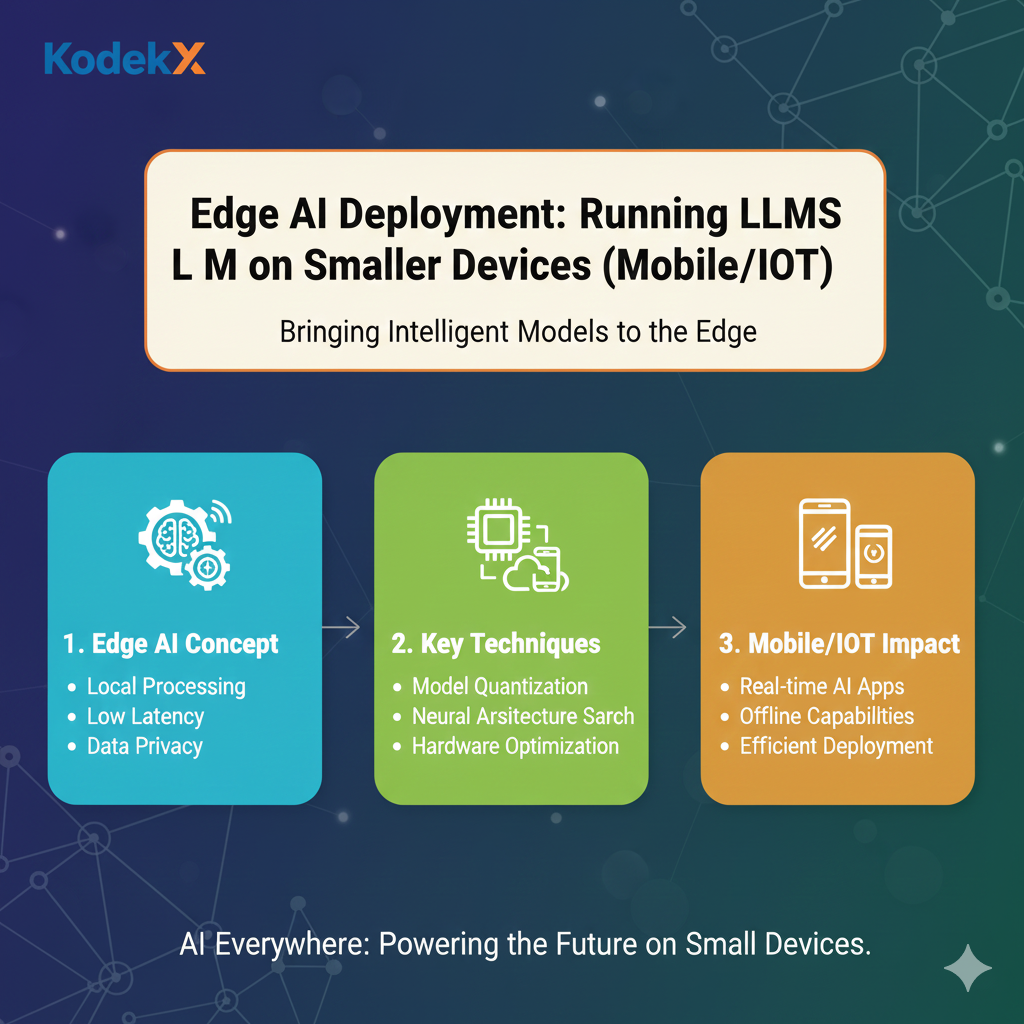
Edge AI moves computation closer to the source — your devices. When combined with 5G, it enables lightning-fast decision-making for autonomous vehicles, drones, and IoT applications.
This decentralized model reduces latency and improves real-time responsiveness.
How KodekX Designs AI-Ready Infrastructure for Enterprises
End-to-End AI Deployment Strategy
At **KodekX, we help enterprises design and deploy AI-ready infrastructure tailored to their needs. From data pipeline setup to cloud orchestration**, our solutions ensure smooth integration, scalability, and performance.
Cloud-Native, Secure, and Scalable Systems
KodekX builds **cloud-native, secure, and MLOps-driven architectures** that accelerate AI adoption. Our focus on automation, security, and optimization ensures your infrastructure grows with your business.
Conclusion: Building the Backbone for Tomorrow’s AI
Designing AI-ready infrastructure isn’t just a technical challenge — it’s a strategic necessity. The ability to process data, scale efficiently, and deploy models securely defines how competitive your business will be in the AI era.
As industries race toward intelligent automation and data-driven insights, the question isn’t if you should build AI-ready infrastructure — it’s how soon you can start.

At **KodekX**, we believe in building not just software but intelligent systems that evolve with innovation. Ready to future-proof your infrastructure? The future of AI starts here.
메타데이터
- post_id
- 016d37a07c2c
- slug
- designing-ai-ready-infrastructure-for-modern-applications-016d37a07c2c
- url
- https://medium.com/@kodekx-solutions/designing-ai-ready-infrastructure-for-modern-applications-016d37a07c2c
- canonical_url
- https://medium.com/@kodekx-solutions/designing-ai-ready-infrastructure-for-modern-applications-016d37a07c2c
- author_url
- https://medium.com/@kodekx-solutions
- status
- ok
- fetched_at
- 2026-07-08 07:00:21