Your SaaS Is Localized. So Why Does It Still Feel Foreign?
You shipped the translations. You hit the launch date. You checked the box.
Your SaaS Is Localized. So Why Does It Still Feel Foreign?
You shipped the translations. You hit the launch date. You checked the box.
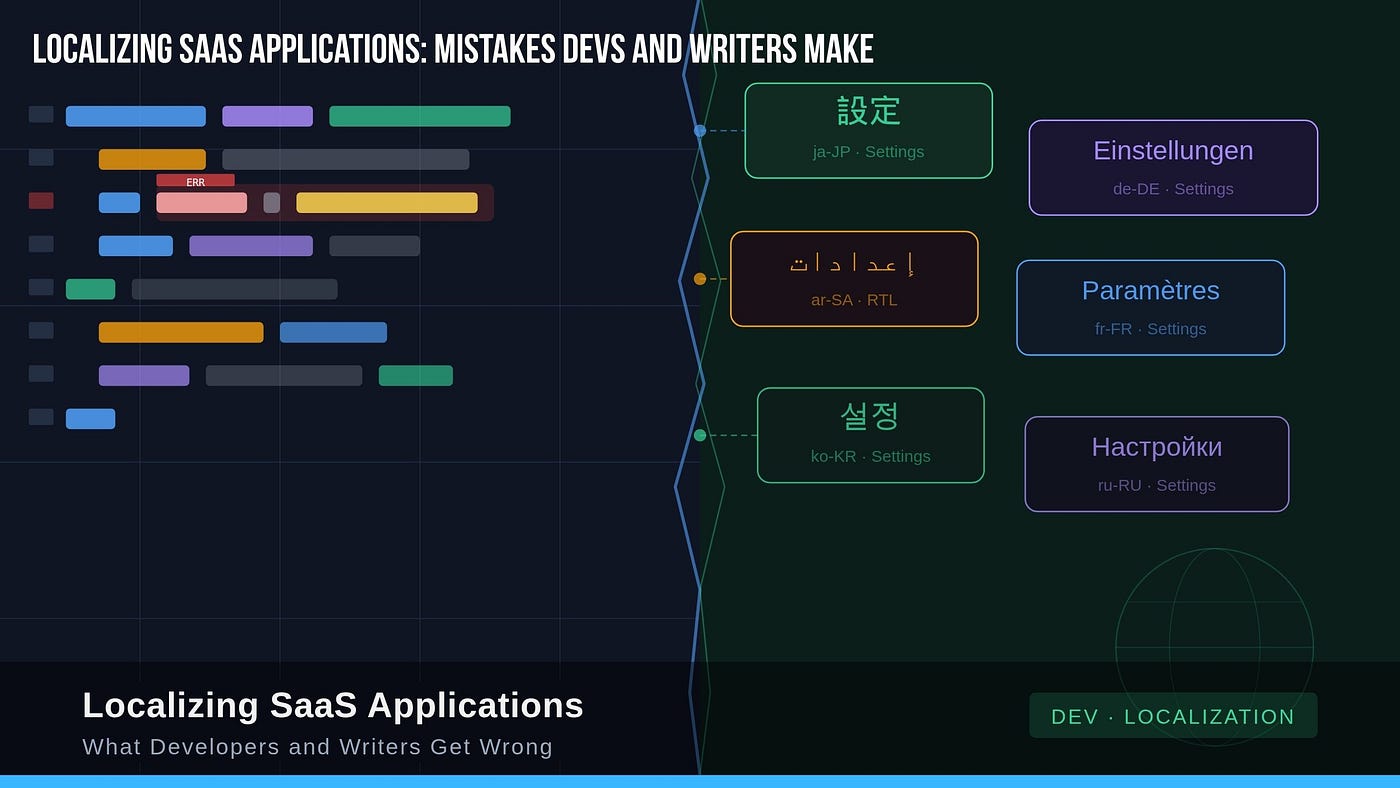
And yet — somewhere in your Japanese dashboard, a button reads “Einstellungen.” A date shows up as 05/06/07 and nobody in Tokyo knows if that’s May, June, or a different year entirely. An Arabic user opens your app and the layout is still flowing left to right.
This is what localization failure actually looks like in SaaS. Not a headline scandal. Just a quiet tab close from a prospect you never knew you lost.
Here is the uncomfortable truth most dev teams never hear: the translation was probably fine. The problem was everything that came before it.
Hardcoded strings a translator can never touch. UI copy built on idioms that don’t survive a round-trip through German. Layouts designed for English that shatter when Finnish text expands 40% beyond what the container was built to hold. A release pipeline where localization is a sprint-end task, not a continuous workflow.
Developers ship the architecture that makes localization impossible. Writers draft the source copy that makes it expensive. And nobody owns it until something breaks in production.
Two in three companies say localization drives 26–50% of their revenue growth. But most SaaS teams are still treating it like a translation ticket — not the growth lever it actually is.
The fix is not a better translator. It is better decisions made earlier, by the right people, with the right context.
I broke down every layer of where this goes wrong — technically and editorially — in a full guide on the blog.
It covers string externalization, ICU pluralization format, RTL architecture, writing source copy that actually survives translation, why context-free handoffs destroy localization quality, and the continuous localization pipeline that keeps your global users in sync.
If you are a developer who has ever been handed a “just translate this” ticket with no i18n foundation under it — or a technical writer who has never thought about whether your copy works in six languages — this one is for you.
→ Read the full breakdown: Localizing SaaS Applications — What Developers and Writers Get Wrong
메타데이터
- post_id
- 0189758f89cf
- slug
- your-saas-is-localized-so-why-does-it-still-feel-foreign-0189758f89cf
- url
- https://medium.com/@learndevts/your-saas-is-localized-so-why-does-it-still-feel-foreign-0189758f89cf
- canonical_url
- https://medium.com/@learndevts/your-saas-is-localized-so-why-does-it-still-feel-foreign-0189758f89cf
- author_url
- https://medium.com/@learndevts
- status
- ok
- fetched_at
- 2026-06-09 14:34:10