Dumbledore Explained Maladaptive Daydreaming In Three Words.
You think you’re the author of your maladaptive dreams. You’re not. You’re just the one watching it play.
Dumbledore Literally Warned Us About Maladaptive Daydreaming In Harry Potter. We All Missed it.
I have university exams in 5 days.
I quit social media and stopped answering messages. The work kept piling up and I kept not touching it. Anxiety. Depression. Procrastination. The whole ADHD doomer loop running at full speed, with maladaptive daydreaming pulling me deeper every day. My depression is at an all time high. I stopped taking my antidepressants because they make me less anxious, and I need the anxiety and stress to study for my exams. I know that is fucked up. But that is my life with ADHD.
My depression is unbearable now. So I needed something. Something to change this bad vibe. Something I know I can enjoy no matter what state my mental health is in.
So I put on Harry Potter.
I have watched the Harry Potter series hundreds of times in my life. I am completely serious about that number. I don’t even need the screen anymore. If I put the audio on, my brain runs the visuals automatically. Full HD. Every scene, every line, every expression on every face. It’s all in my head.
But I hadn’t watched it in almost three years. The longest I had ever gone without it.
I started Philosopher’s Stone.
It didn’t feel the same. The nostalgia was there but the sentimentality was missing. Maybe because of my depression. It puts a grey filter over everything you used to love.
I was getting through it thirty minutes at a time, my ADHD cutting every session short, piecing the film together across a few sittings like a puzzle.
One hour thirty minutes in.
The scene came on.
I had seen it more times than I could ever count.
This time it hit me like I had never seen it at all.
I wasn’t paying full attention.
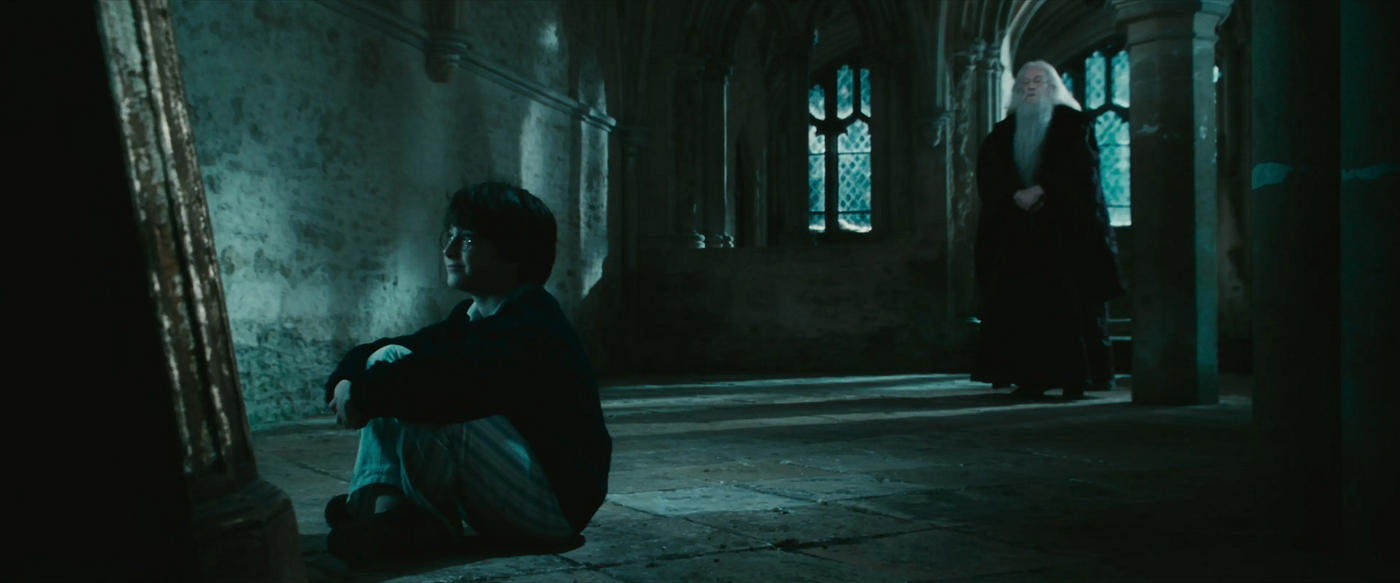
I was just watching. The way you watch something you already know by heart. Half in the film, half in my own head, the way I always am.
Harry is sitting in front of the mirror. Dumbledore is standing behind him.
I knew every line was coming before it came. So I was not fully in focus, but I let it play.
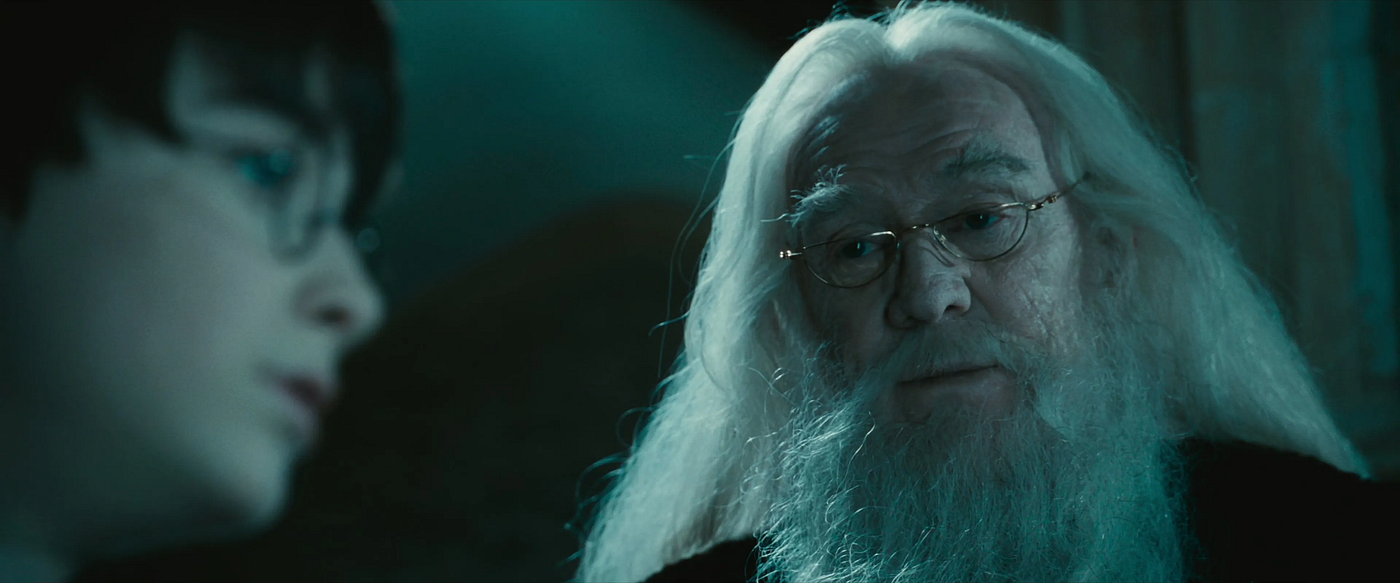
At the last of that scene, Dumbledore says this.
“It does not do to dwell on dreams, and forget to live.”
I froze.
Forget to live?
That part. Those three words. They pulled my attention back into the scene.
Then I said the whole line back to myself. It does not do to dwell on dreams, and forget to live.
Something cracked open. I don’t know how else to explain it. A line I had grown up hearing, and it had never once landed like this.
So I skipped back. Line by line.
“Men have wasted away in front of it. Even gone mad.”
I knew those words. I had known them for many years. But sitting there that night, depressed, stuck, buried in everything I hadn’t done, they didn’t sound like a line from a children’s film. They sounded like a description of my life.
I skipped back again.
“This mirror gives us neither knowledge nor truth.”
I skipped back one more time.
“It shows us nothing more or less than the deepest and most desperate desires of our hearts.”
When I heard that line, it was clear.
So I assembled it back in order. The way Dumbledore actually said it, start to finish.
“It shows us nothing more or less than the deepest and most desperate desires of our hearts.”
“This mirror gives us neither knowledge nor truth.”
“Men have wasted away in front of it. Even gone mad.”
“It does not do to dwell on dreams, and forget to live.”
This is maladaptive daydreaming. Not a feeling. Not a theory. It matched exactly.
I think the depression made it hit harder. When you are already low, certain words get in through the cracks that would have bounced off on a better day. That night they went straight in.
I needed to know how Rowling actually wrote that scene. So I opened the book.
Chapter Twelve. Harry Potter and the Philosopher’s Stone. The Mirror of Erised.

The first thing I found was the name.
Erised.
Read it backwards.
Desire.
Then the inscription carved around the top of the frame. As a kid I thought it was just decoration. Spooky gibberish that made the mirror feel more magical.
Erised stra ehru oyt ube cafru oyt on wohsi.
Read it backwards.
I show not your face but your heart’s desire.
She hid the meaning inside the mirror itself. You had to reverse it to understand it. The same way maladaptive daydreaming takes your life and flips it into something it is not.
And then I read what happens to Harry in that chapter. He sees his parents standing behind him, alive, waving. He stays for hours. He goes back the next night. And the night after that. He sneaks out alone in the dark, invisibility cloak on, cutting himself off from everything. He stops caring about anything else. All he cares about is that mirror.
This is what maladaptive daydreamers do, knowingly or unknowingly.
It starts as escape. Something to survive a hard day, or fill the boredom, or just feel something. Then at some point it stops being a choice. They pace circles in their room for hours they cannot account for. They build entire worlds, years of storylines, characters they would actually grieve. They cut themselves off. They stop caring about the things piling up outside.
There is one more line in this scene. I saved it for last, on purpose, because it is the one that matters most. Everything up to here was the warning. This is the part that explains why the warning was needed.
Right at the start of the scene, before all the lines I just walked you through, Dumbledore gives Harry a clue.
“The happiest man on earth would look into the mirror and see only himself, exactly as he is.”
Harry answers the way anyone would.
“So it shows us what we want. Whatever we want.”
And Dumbledore says three words.
“Yes, and no.”
Yes, and no.
Dumbledore calmly explaining maladaptive daydreaming in three words.
Here is what almost every one of us gets wrong. We think the maladaptive daydreaming shows us what we want. Harry thought so too. It is the obvious reading.
But Dumbledore corrects him, and the correction is the whole secret. It does not just show you what you want. It shows you what you desire.
Ask yourself what you want, and you can answer in a second. A better job. More money. Someone to love. Want lives on the surface, easy to reach, easy to say out loud.
Desire is different. Desire is buried so deep you have never seen it directly. You do not know what it is. You only know the shape it leaves. And your daydreams are that shape, traced over and over, every day, in the daylight and in the dark.
This is where people get confused between daydreams and maladaptive daydreams.
Daydreams are rehearsals for things that do not exist yet. You imagine a new job, a conversation, a different life. But it is always you in there. That is the keyword. You. Daydreams follow possibilities that could actually happen in the real world. The chances might be low. It might take years of effort. It might feel impossible. But it is still your life it is rehearsing.
And that is not a bad thing. It is a good thing. Daydreaming is how you visit the hidden possibilities inside yourself, how you figure out what you actually want to achieve in the physical world.
So people assume maladaptive daydreaming is just that, overdone. Too many hours. Too much time lost in your head.
It is not. It only looks like that from the surface.
Maladaptive daydreaming runs on a completely different engine. The dream is not a rehearsal for your life, because it has nothing to do with your life. Different person. Different name. Different world. People who do not exist. That is exactly why Dumbledore says it gives us neither knowledge nor truth. Nothing you can bring back. Nothing you can use.
That is where the guilt comes from, the guilt every one of us knows. Hours gone, and your hands are empty. You were not doing anything real. Again.
And this is where it gets confusing from the inside. You look at your own daydreams and something does not add up. This is so strange. What am I even doing. Am I losing my mind. I do not actually want to be a different person, with a different name, in a different life full of people who do not exist. Most of what I daydream, I would not even want if it were handed to me in real life. So why can I not stop.
You are not the one writing these dreams. Your desire is. It borrows your wants, your faces, your storylines, and it builds something out of them, but the hand doing the building is not yours. You think you are the author. You are not. You are just the one watching it play.
Underneath every maladaptive daydream, however strange, however far from your real life it looks, there is one specific feeling you keep going back for. It could be anything. Being loved. Being seen. Being famous. Being safe. Being powerful for once. Being enough. The story is just the delivery method. The feeling is the actual desire. The deepest and most desperate desire of your heart.
Study your own dreams for a moment. Look at the patterns. Look at what feeling you keep going back for. That feeling, that specific one, is your deepest and most desperate desire. You built those dreams carefully, whether you knew it or not, to deliver exactly that feeling to yourself. It is not fantasy. It is a map of everything you are missing.
That is why it is so addictive. That is why quitting feels impossible. It is far more addictive than any drug I have ever tried. And the worst part is this. Even when real life finally gives you the thing the dream was promising, it does not fully fix it. Because nothing in the real world can compare to what the daydream gives you. Instant. Perfect. Exactly as desperate as you need it to be.

A lot of people believe Rowling is a maladaptive daydreamer. She has never confirmed it. But let me ask you something instead.
Have you ever told anyone in real life that you have maladaptive daydreaming?
Maybe on Reddit, behind a different name. But in real life? Face to face?
Why not?
Because you know exactly how fucked up it sounds. That silence you keep, I keep it too.
What she has spoken about openly is her depression and her OCD. And once you know that, the Dementors stop looking like ordinary monsters. Creatures that drain every good feeling out of the air around you, until nothing is left but the worst version of yourself. That is one of the closest things I have ever seen a children’s book get to describing depression from the inside.
We only get one life. We cannot fuck it up dreaming about a different one.
So I will leave you with the same thing Dumbledore left Harry. Read it like he is saying it to you calmly. This time, hear it.
“I must ask you, not to go looking for it again. It does not do to dwell on dreams, and forget to live.”
메타데이터
- post_id
- 01a5cd4e000c
- slug
- dumbledore-explained-maladaptive-daydreaming-in-three-words-01a5cd4e000c
- url
- https://medium.com/@dreamxmd/dumbledore-explained-maladaptive-daydreaming-in-three-words-01a5cd4e000c
- canonical_url
- https://medium.com/@dreamxmd/dumbledore-explained-maladaptive-daydreaming-in-three-words-01a5cd4e000c
- author_url
- https://medium.com/@dreamxmd
- status
- ok
- fetched_at
- 2026-07-19 08:37:57