Building a Modular DeFi Future: What Comes After Monolithic Chains
Building a Modular DeFi Future: What Comes After Monolithic Chains
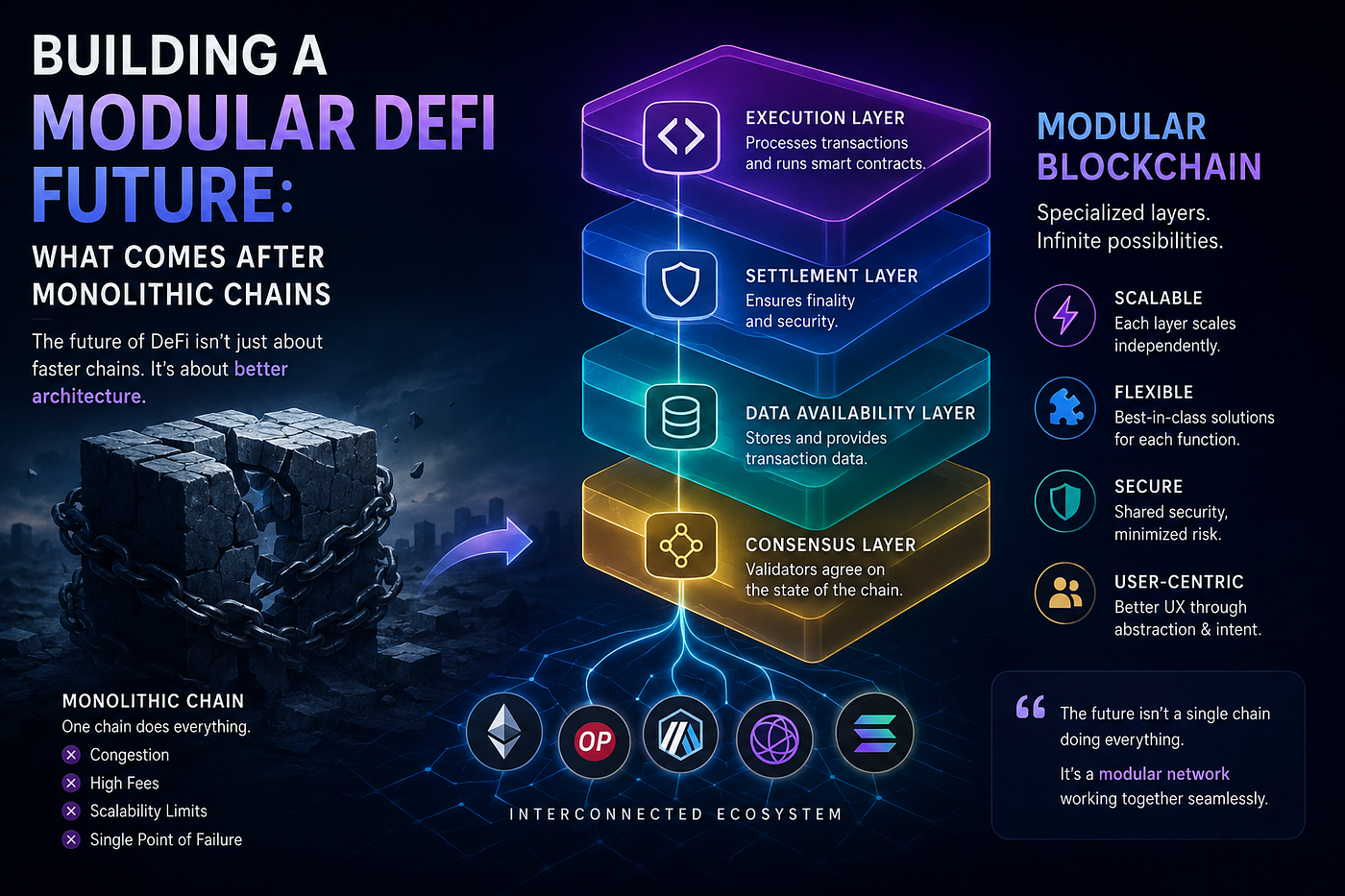
Why blockchain infrastructure is evolving beyond “one chain does everything” and what that means for the future of DeFi.
For years, blockchains followed a simple design philosophy:
One chain handles everything.
Execution. Consensus. Settlement. Data availability.
This architecture became known as the monolithic blockchain model.
Early networks like Bitcoin and Ethereum pioneered this structure and helped launch the modern crypto industry.
But as adoption grew, the limitations became increasingly obvious:
- congestion
- expensive transactions
- scalability bottlenecks
- reduced composability under heavy demand
Now, the industry is moving toward a different model entirely.
A modular future.
And that shift may completely reshape how DeFi applications are built.
What Is a Monolithic Blockchain?
Monolithic Blockchain refers to a blockchain where all core functions happen on a single layer.
These functions typically include:
- execution
- consensus
- settlement
- data availability
The advantage is simplicity.
Everything exists in one environment, which creates:
- strong composability
- unified liquidity
- straightforward architecture
But there is a problem.
As demand increases, every node must process and verify everything.
This creates scalability limits that become harder to solve over time.
The Rise of Modular Blockchain Architecture
Modular Blockchain takes a different approach.
Instead of forcing one chain to do everything, modular systems separate responsibilities into specialized layers.
Execution + Consensus + Settlement + Data Availability →Specialized Layers
For example:
- rollups may handle execution
- Ethereum may provide settlement
- dedicated DA layers manage data availability
- separate networks coordinate consensus
This allows each layer to optimize independently for scalability and efficiency.
For example:
- rollups may handle execution
- Ethereum may provide settlement
- dedicated DA layers manage data availability
- separate networks coordinate consensus
This allows each layer to optimize independently for scalability and efficiency.
Why DeFi Needed a New Architecture
DeFi has grown significantly beyond simple token swaps.
Modern decentralized finance now includes:
- perpetual trading
- Spot trading
- RWAs
- On-chain derivatives
- Borrowing and Lending markets
- AI-driven protocols
- Restaking
- Prediction markets
These applications generate enormous computational demand.
A single monolithic chain handling all global financial activity efficiently becomes increasingly difficult.
The modular thesis emerged partly because:
blockchain infrastructure needed specialization.
Much like the internet evolved into layered infrastructure, blockchains are now moving in the same direction.
Rollups Changed the Conversation
The rise of rollups became one of the first major signs of the modular shift.
Networks like:
began outsourcing execution away from Ethereum mainnet while still relying on Ethereum security.
This dramatically improved:
- scalability
- transaction costs
- throughput
Ethereum itself increasingly embraced a rollup-centric roadmap rather than scaling entirely through the base layer.
Data Availability Became a New Industry
One of the most important developments in modular infrastructure is the rise of: Data Availability layers.
Data availability answers a simple but critical question:
Can the network reliably access transaction data?
Dedicated DA networks like:
are now focusing specifically on this problem.
This separation allows execution layers to scale more efficiently without forcing every blockchain to store and process everything itself.
But Modularity Introduces New Problems
While modularity improves scalability, it also introduces complexity.
Liquidity becomes fragmented.
Users move across:
- Rollups
- Appchains
- DA layers
- Bridges
- Execution environments
The experience can quickly become confusing.
A growing industry concern is that modularity may be:
Solving infrastructure scaling while pushing complexity onto users.
This is why:
- interoperability
- chain abstraction
- intent-based execution
are becoming increasingly important.
The long-term winner may not simply be the fastest chain.
It may be the ecosystem that hides complexity best.
The Future May Belong to App-Specific Chains
Another major shift is the rise of: Appchain ecosystems.
Instead of competing for blockspace on one global chain, applications can launch their own specialized execution environments.
This creates:
- better customization
- optimized performance
- flexible fee structures
- specialized governance models
Projects increasingly want infrastructure tailored to their own applications rather than relying entirely on generalized blockspace.
Monolithic Chains Are Not Dead
Despite the modular narrative, monolithic chains still have advantages.
Networks like Solana continue demonstrating:
- strong performance
- tight composability
- fast execution
- simplified UX
This is why many analysts believe the future will not be:
modular versus monolithic
but rather:
modular and monolithic systems coexisting for different use cases.
Different applications will prioritize different tradeoffs.
What Comes Next for DeFi?
The future of DeFi likely becomes increasingly:
- modular
- interoperable
- abstracted
- application-specific
Users may eventually interact with applications without even knowing:
- which chain they are on
- where liquidity resides
- which DA layer secures the system
Infrastructure complexity will increasingly move behind the scenes.
And the protocols that simplify this experience may become the dominant financial platforms of the next crypto cycle.
Final Thoughts
The blockchain industry is moving beyond the era of monolithic design.
Scalability is no longer just about making one chain faster.
It is about coordinating specialized layers into a unified financial system.
Modular architecture introduces:
- scalability
- flexibility
- customization
- specialized infrastructure
But it also forces the industry to solve new problems around:
- interoperability
- liquidity fragmentation
- user experience
- coordination
The future of DeFi may not belong to a single dominant chain.
It may belong to interconnected ecosystems that work together seamlessly beneath the surface.
Further Reading
Originally written by Ibraheem for Mitosis University. Updated and republished on Medium.
Follow me for more insights on:
- DeFi
- modular blockchain infrastructure
- Layer 2 ecosystems
- market structure
- blockchain development
- crypto education
X/Twitter: @bleezysmart| LinkedIn: @Ibraheem Ibraheem
메타데이터
- post_id
- 01c844ccdff9
- slug
- building-a-modular-defi-future-what-comes-after-monolithic-chains-01c844ccdff9
- url
- https://medium.com/@bleezysmart/building-a-modular-defi-future-what-comes-after-monolithic-chains-01c844ccdff9
- canonical_url
- https://medium.com/@bleezysmart/building-a-modular-defi-future-what-comes-after-monolithic-chains-01c844ccdff9
- author_url
- https://medium.com/@bleezysmart
- status
- ok
- fetched_at
- 2026-07-13 15:30:25



