The Friday column: Alaska’s Fiscal Outlook (and how it relates to the S-Corp issue)
This week, we look at Alaska’s fiscal outlook in light of the ongoing drop in oil prices from their war-related highs, and how that outlook…
The Friday column: Alaska’s Fiscal Outlook (and how it relates to the S-Corp issue)
This week, we look at Alaska’s fiscal outlook in light of the ongoing drop in oil prices from their war-related highs, and how that outlook directly impacts the S-corp issue
The transition this week from one fiscal year (2026) to the next (2027) seems like a good time to assess Alaska’s fiscal outlook. It’s also a good time to assess the projected effects of the deep drop in oil prices and oil futures since the cessation of hostilities in the Iran War.
We begin with the current outlook for oil prices at the start of Fiscal Year (FY) 2027. Using our most recent “8:30a Chart” that we publish daily (except Sundays), here is the outlook for oil prices as of the day we are writing this column.

The history of Alaska North Slope (ANS) oil prices from FY2019–2026 is on the left, the current outlook for FY2027 is in the middle, and the current outlook for FY2028–2035, the remainder of the current forecast period reflected in the Department of Revenue’s latest revenue forecast, is on the right.
The dashed bright red line (FY2027 average of $89/barrel) reflects the latest forecast for Brent prices from the federal Energy Information Administration’s (EIA) Short Term Energy Outlook. That forecast was published in early June, before it was clear that the cessation of hostilities in the Iran War was likely to hold. Reflecting the subsequent dramatic drop in the current cash and futures markets, we expect the forecasted prices also to drop dramatically in the EIA’s next update, due on July 7th.
The dashed maroon line (FY2027 average of $78/b) reflects the actual ANS price through the current month (July) and the projected price for the remainder of the period, derived, in the manner we discussed in last week’s column, by adjusting the Brent futures price to reflect the recent differentials between ANS and Brent.
The dashed black line (FY2027 average of $75/b) reflects the price for ANS included in DOR’s most recent revenue forecast. The dashed light blue line (FY2027 average of $71/b) reflects the actual Brent price through the current month and the futures price for the remainder of the period. That is the level toward which ANS prices will likely gravitate as the problems in the oil markets created by the closure of the Strait of Hormuz subside and the currently significant “Alaska premium” we discussed in last week’s column shrinks.
The dashed gold line (FY2027 average of $68/b) reflects the actual price for West Texas Intermediate (WTI) through the current month and the futures price for the remainder of the period.
Finally, the maroon columns at the bottom reflect the current difference between the actual and projected ANS price, and the ANS price projected by DOR in its most recent revenue forecast.
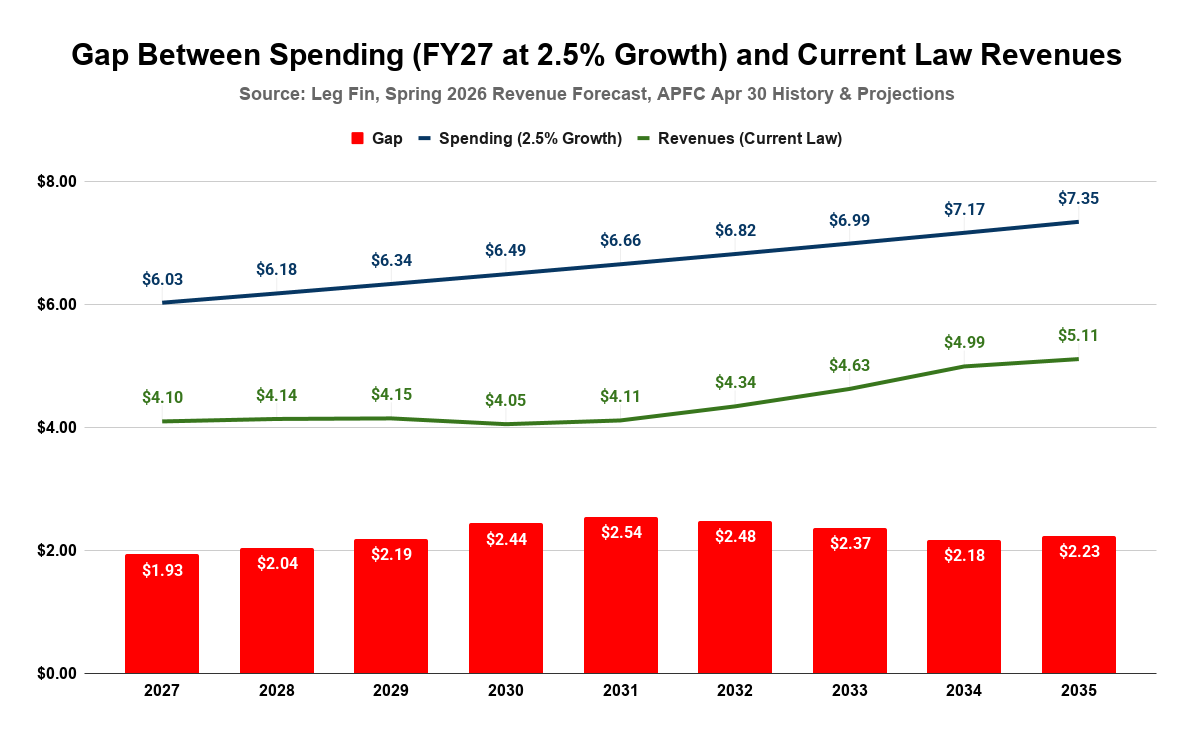
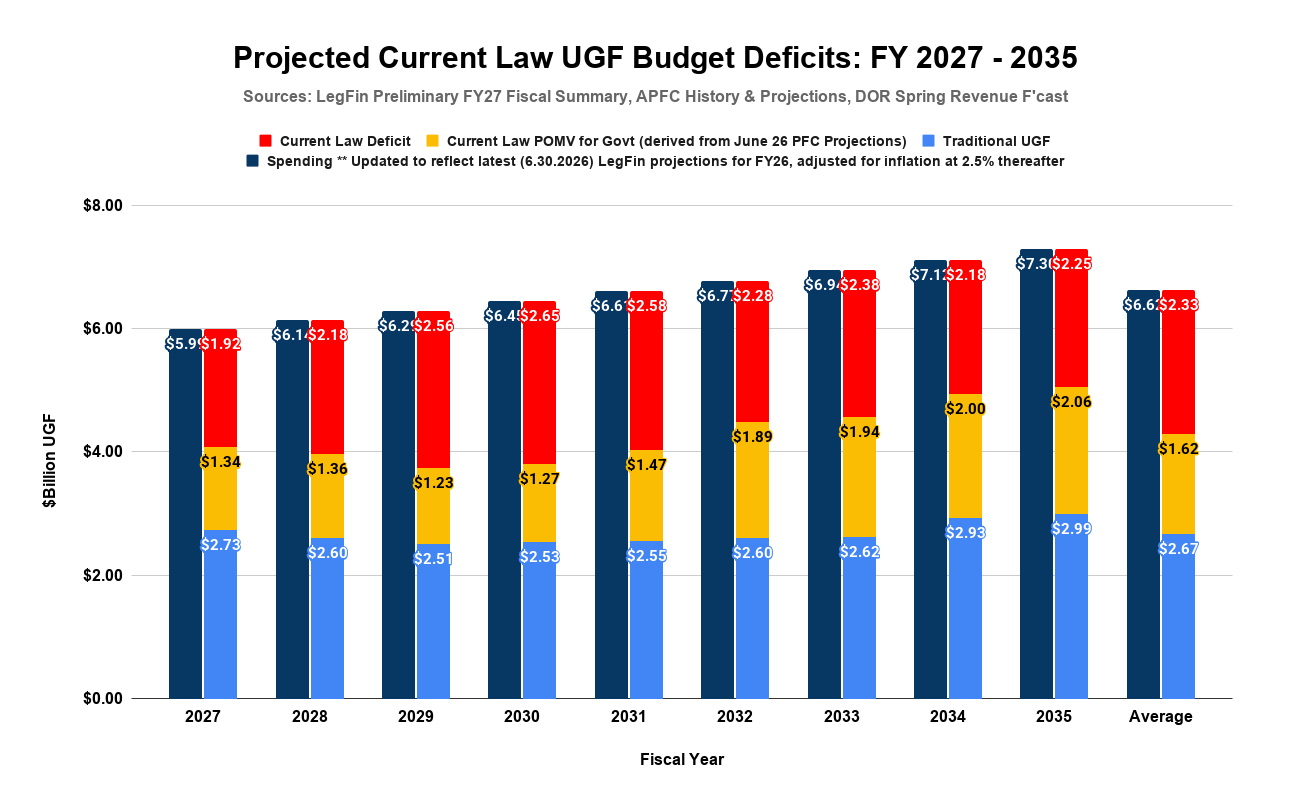
Calculating projected traditional revenue levels at those oil prices, adding to them the revenues from the portion of the annual percent of market value (POMV) draw statutorily designated for government calculated from the most recent monthly projections published by the Alaska Permanent Fund Corporation (APFC), and subtracting projected unrestricted general fund (UGF) spending calculated by growing the final (enrolled) FY2026 budget over the period annually by inflation (projected at 2.5%), produces the following annual projected budget balances for FY2027 and beyond.

The state budget starts with a $1.95 billion deficit for FY2027 and remains in deficit throughout the period, ending in FY2035 with a $2.23 billion deficit. The annual average over the period is $2.16 billion.
Some argue that the state will “grow its way” out of the deficits through additional oil production over time. We would note, however, that the oil revenue projections included in the chart are based entirely on DOR’s most recent revenue forecast, which includes projected production growth between FY2026 and FY2035 of over 40%. Despite that, projected annual deficits actually sink by nearly an additional 15% over the period.
Even if annual spending growth over the period is limited to only half the projected inflation rate, or 1.25%, the state continues to run substantial deficits, with the average deficit over the period still totaling $1.82 billion.
The bottom line of the chart shows the annual deficit as a percent of annual spending, in other words, how much in supplemental revenues is required to balance each year’s budget. The share averages 27.3% over the period. That number is the same as the level of budget cuts needed to balance it over the period through “spending cuts only.” In other words, spending would need to be reduced on average by over 27% annually to balance the budget through “spending cuts” alone.
For reference, that is even larger on a percentage basis than the spending cuts proposed by Governor Mike Dunleavy (R-Alaska) in his first budget in 2019 (for FY2020). In that budget, he proposed an overall cut in UGF spending of approximately 23%, four percent less than the average required over the entire 10-year period to balance the FY2027–2035 budgets through spending cuts alone. As most will remember, even that smaller set of spending cuts proposed by Governor Dunleavy in 2019 imploded into a toxic political fireball.
Clearly, something has to give.
Over the last decade, including the two terms of the Dunleavy Administration, the Legislature (and Governor, by signing the resulting budgets) has largely resorted to personal taxes, in the form of cuts to the Permanent Fund Dividend (PFD), to close deficits. As University of Alaska — Anchorage Institute of Social and Economic Research (ISER) Professor Matthew Berman has written: “Let’s be honest. A cut in the PFD is a tax — the most regressive tax ever proposed.”
Extending the previous chart, here are the projected personal tax levels if that approach is continued.

Looking at the bottom portion of the chart, PFD taxes on a gross basis rise annually from $1.95 billion in FY2027 to a high of $2.41 billion in FY2030, then fall slightly to $2.23 billion in FY2035. They average $2.16 billion over the period.
One characteristic of using PFD taxes is that they fund the deficits entirely on the backs of Alaskan families. Unlike broad-based taxes, which raise revenue from both Alaskans and non-residents, PFD taxes take money only from Alaska families’ pockets. The last two blocks in the chart calculate the impact on a per recipient basis and, using the size of the average Alaska household, on a household basis.
Of course, as we have explained in previous columns, because the PFD tax is regressive — indeed, according to Professor Berman, the “most regressive tax ever proposed” — the impact of using the PFD tax to close the projected budget gaps has a substantially larger adverse impact on middle and lower-income Alaska families than on those in the Top 20%.
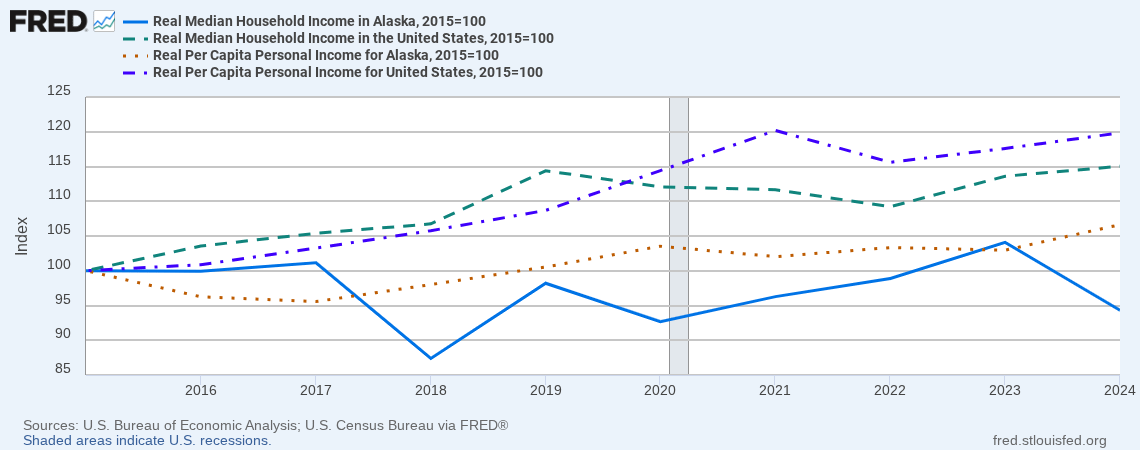
Using the projected deficits and the levels of income by income bracket projected over the next decade, here’s the projected impact of the PFD tax as a share of overall household income by income bracket.

While using the PFD tax reduces the projected income of the Top 1% household by less than 1%, and that of the Top 20% by only approximately 3.5%, it reduces the projected income of middle-income Alaska families by approximately 6.9% (upper-middle), 10.8% (middle-middle), and 14.7% (lower-middle), and the lowest-income 20% by a staggering 31.1%.
Among other things, that approach creates a death spiral. As the income of the lowest- and lower-middle-income Alaska families falls further and further behind, the demand for government services in that sector grows and grows, increasing government spending, which, when funded disproportionately through increased PFD taxes, reduces their income further and further, making the problems behind spending growth continually worse and worse.
As the chart reflects, the impact of PFD taxes falls solely on Alaska households. Non-residents contribute zero. To us, that helps inform the context surrounding the current debate over whether to extend the applicability of Alaska’s existing corporate taxes on oil corporations to similar (oil) corporations that happen to be formed as S-corps and other so-called “pass-through” entities.
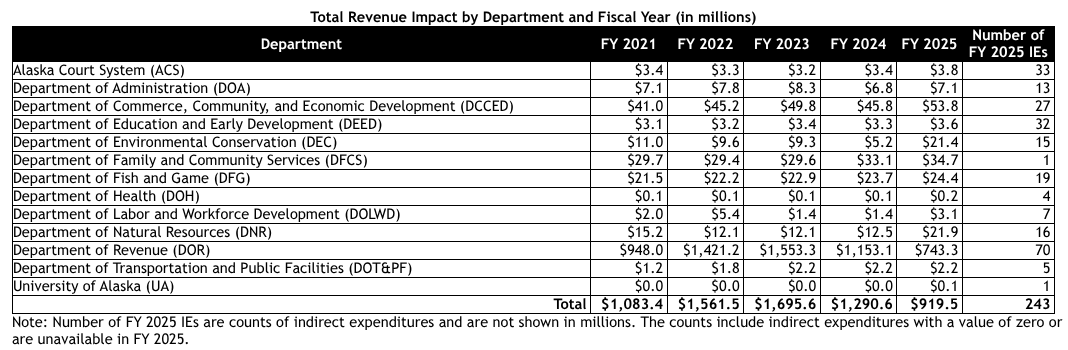
Here is the projected impact on revenues, and who would pay them, as recently estimated by DOR.

While they never rise to a level sufficient to offset the state’s projected deficits, even from FY2028 forward, the proposed changes would make a material contribution to overall state revenues. Assuming they are used as a substitute for the PFD tax, as in other states, the effect would shift a portion of responsibility for Alaska’s deficits to non-residents, reducing the overall personal tax burden on Alaska families.
Although through slightly different mechanisms, imposing a tax on such entities would also subject them to the same treatment they receive in other oil-producing states. Texas, for example, collects a similar tax on S-corps and other pass-through entities through its Business Franchise Tax. Like the federal government, Louisiana collects a tax on the income passed through by such entities to their owners through the state’s personal income tax.
Some argue that taxing such entities is not “fiscally conservative.” We strongly disagree. It’s far from “fiscally conservative” to allow deficits to continue year after year and close them entirely through the “most regressive [personal] tax ever proposed.”
Government is not a free good. It has to be paid for. Faced with the inevitable, true “fiscal conservatives” focus on developing funding options with the least adverse impact on the economy and households. As researchers from ISER advised in their 2016 study of Alaska’s fiscal options, which is reiterated in an updated 2026 study, PFD taxes (cuts) have the “largest adverse impact” on both. It isn’t even remotely “fiscally conservative” to continue relying on that tool when broader-based, lower-impact alternatives are available.
In short, those who claim to be “fiscally conservative” by opposing the S-corp and other lower-impact fiscal fixes are only fooling themselves (and attempting to fool others).
메타데이터
- post_id
- 01d8b8e1fb39
- slug
- the-friday-column-alaskas-fiscal-outlook-and-how-it-relates-to-the-s-corp-issue-01d8b8e1fb39
- url
- https://medium.com/alaskans-for-sustainable-budgets/the-friday-column-alaskas-fiscal-outlook-and-how-it-relates-to-the-s-corp-issue-01d8b8e1fb39
- canonical_url
- https://medium.com/alaskans-for-sustainable-budgets/the-friday-column-alaskas-fiscal-outlook-and-how-it-relates-to-the-s-corp-issue-01d8b8e1fb39
- author_url
- https://medium.com/@bgkeithley
- status
- ok
- fetched_at
- 2026-07-09 03:40:04