Financial MANGA- “ExxonMobil Arc”///////Chapter2: ExxonMobil and the Energy Transition
ExxonMobil never really got the memo that the future was supposed to be polite.
Financial MANGA- “ExxonMobil Arc”///////Chapter2: ExxonMobil and the Energy Transition
ExxonMobil never really got the memo that the future was supposed to be polite.
It did not ask for permission to survive. It simply began repositioning itself for a world where oil was no longer enough, but still nowhere near finished.
Miles: “People talk about energy transition like it’s a clean handoff.”
Evan: “It’s not a handoff. It’s a fight over who gets to control the bridge.”

The market loved slogans.
It did not love capex. It did not love long payback periods. It did not love technologies that looked strategic in a presentation and expensive in real life.
Logan: “Exxon’s advantage is that it understands scale better than almost anybody.”
Derek: “And scale is what decides whether a transition becomes an industry or a press release.”

ExxonMobil understood something many competitors refused to admit.
The transition would not arrive as a clean replacement. It would arrive as a messy overlap, with fossil fuels still paying the bills while low-carbon businesses fought for legitimacy.
Miles: “They’re not betting on a collapse of oil.”
Evan: “No. They’re betting on a world that needs both timing and discipline.”

That was the deeper game.
In a transition, the company that can keep cash flowing while building optionality becomes more powerful, not less. It can wait longer, move selectively, and force rivals to chase whatever narrative the market is currently rewarding.
Grant: “We do not need to win every race.”
Miles: “Right. We just need to still be standing when the finish line moves.”

For years, smaller energy players tried to out-green the giants.
Some did it with conviction. Some did it with desperation. Most did it with very expensive optimism.
Exxon’s move was colder, sharper, and arguably more dangerous: it treated the transition as a capital-allocation problem, not a morality play.
Evan: “That’s why markets keep taking it seriously.”
Logan: “Because they can smell the difference between ideology and infrastructure.”

The biggest shift was not that ExxonMobil joined the transition conversation.
It was that it chose which parts of the conversation mattered: LNG, carbon capture, efficiency, selective low-carbon investments, and the ability to monetize the old system while hedging the next one.
That changed the balance of power.
Miles: “They don’t need to become someone else.”
Derek: “They just need to become harder to replace.”

That is why the geopolitical effect matters.
When a company like ExxonMobil keeps extracting value from legacy hydrocarbons while also building exposure to transition-linked assets, it becomes a bridge between two regimes of power. That bridge matters to governments, producers, investors, and competitors alike.
Grant: “The market wants certainty.”
Miles: “The market gets leverage.”

This is where the global balance starts changing.
If ExxonMobil can preserve profitability in hydrocarbons while building credible transition exposure, it puts pressure on three fronts at once: European majors trying to look cleaner, Asian buyers trying to secure reliable supply, and U.S. policy makers trying to balance climate goals against energy security.
Evan: “So the transition becomes less ideological and more strategic.”
Logan: “It always was. Some people just liked pretending otherwise.”

For the world market, that means the transition is not simply reducing fossil fuel dominance.
It is reorganizing it.
The winners are likely to be the firms that can sell molecules, manage infrastructure, and survive policy swings without becoming dependent on fashion. ExxonMobil has positioned itself inside that logic better than many rivals.
Miles: “That’s why the market keeps watching them.”
Evan: “Because they’re not just reacting to the transition.”
Miles: “They’re trying to sit inside it.”

The real strategic consequence is simple.
ExxonMobil’s approach forces the market to admit that the energy transition is not a clean replacement of one system by another. It is a competition over the future architecture of power, capital, and supply security.
Derek: “Everybody wants the next system.”
Grant: “The next system still has to be built with the current one.”
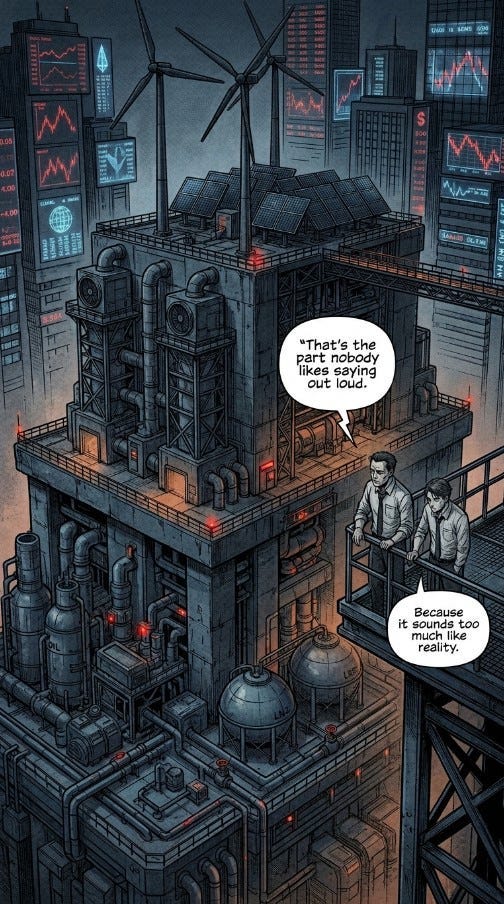
And reality is where ExxonMobil keeps winning its most important fights.
Not by being the loudest. By being difficult to dislodge. By turning transition into position, and position into leverage.
Miles: “The old energy order isn’t dying.”
Evan: “It’s learning new language.”

TO BE CONTINUED:
***Don’t lose the plot. Subscribe to get the next chapters directly in your inbox!***
메타데이터
- post_id
- 01dfb82dea58
- slug
- financial-manga-exxonmobil-arc-chapter2-exxonmobil-and-the-energy-transition-01dfb82dea58
- url
- https://medium.com/@coagulation90/financial-manga-exxonmobil-arc-chapter2-exxonmobil-and-the-energy-transition-01dfb82dea58
- canonical_url
- https://medium.com/@coagulation90/financial-manga-exxonmobil-arc-chapter2-exxonmobil-and-the-energy-transition-01dfb82dea58
- author_url
- https://medium.com/@coagulation90
- status
- ok
- fetched_at
- 2026-06-20 20:29:01