Why “Supply Cuts” Often Increase Volatility, Not Prices
By Skyra CIP — Commodity Market Intelligence
Why “Supply Cuts” Often Increase Volatility, Not Prices
By Skyra CIP — Commodity Market Intelligence
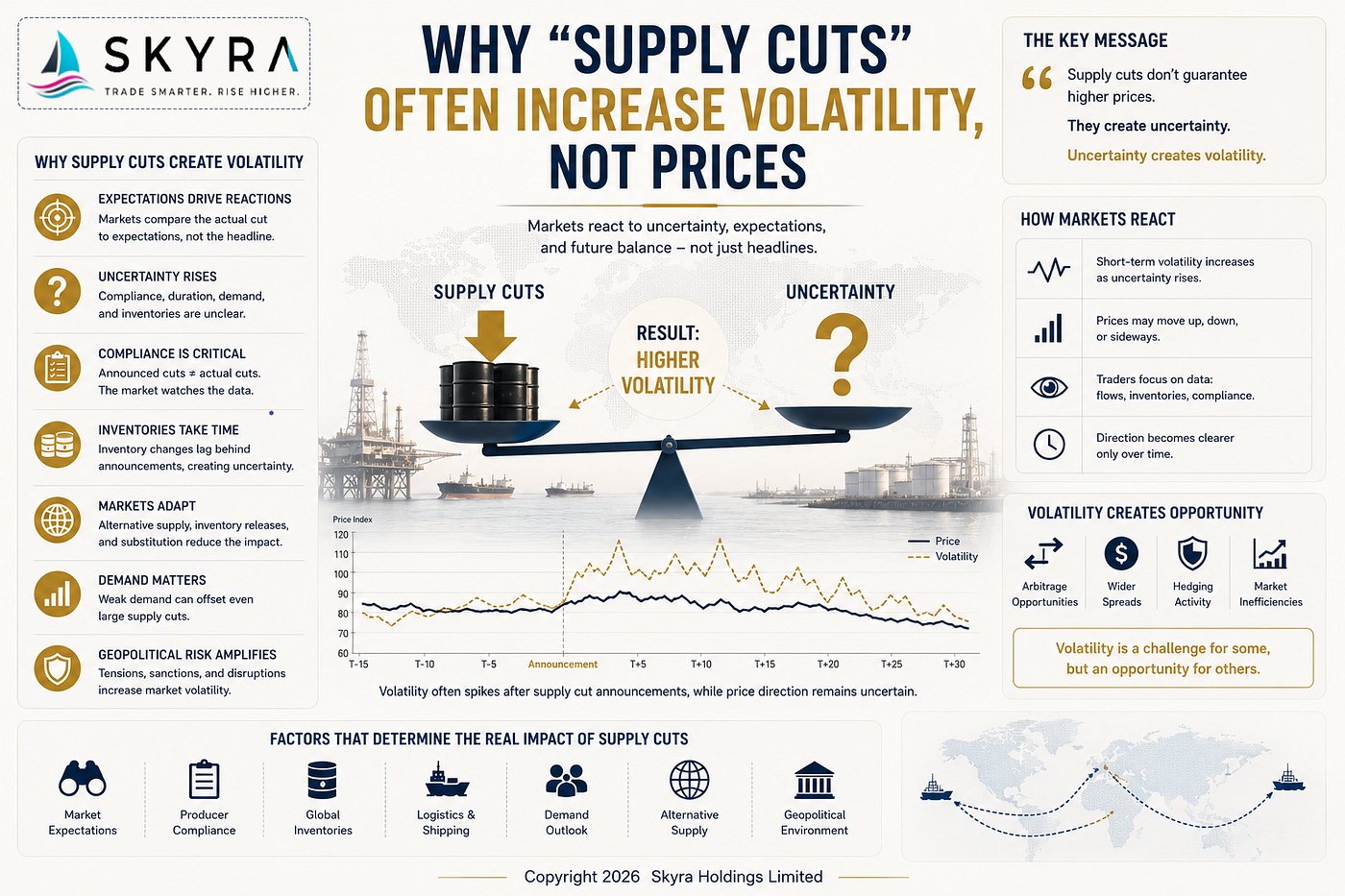
The logic appears straightforward:
Less supply should mean higher prices.
Yet history shows that reality is often far more complicated.
In many cases, supply cuts create something different before they create higher prices:
Volatility.
Markets do not react solely to changes in supply.
They react to uncertainty, expectations, risk, compliance, inventories, and future demand.
This is why some of the most significant supply reduction announcements in recent years have produced volatile price movements rather than sustained rallies.
Understanding this distinction is essential for traders, procurement teams, investors, and anyone seeking to understand modern commodity markets.
The Simplified View of Supply Cuts
Most market commentary follows a simple narrative:
- Supply decreases.
- Scarcity increases.
- Prices rise.
While this framework is not entirely wrong, it overlooks how markets actually function.
Commodity markets are forward-looking systems.
By the time a supply cut is announced, traders have often already incorporated expectations into prices.
The market’s reaction therefore depends less on the cut itself and more on how the cut compares to expectations.
Expectations Drive Initial Reactions
Imagine a market expecting a production cut of 2 million barrels per day.
If producers announce a cut of only 1 million barrels per day, prices may actually fall.
Why?
Because expectations were not met.
Conversely, a relatively small cut may trigger a rally if participants expected no action at all.
The announcement itself is only one variable.
The difference between expectations and reality is what often creates volatility.
As explored in How Commodity Traders Think: A Full Pricing Framework, professional traders evaluate changes relative to market expectations rather than in isolation.
https://medium.com/@SkyraCIP/how-commodity-traders-think-a-full-pricing-framework-b081f8c83459
Uncertainty Creates Volatility
Supply cuts frequently introduce uncertainty.
Market participants immediately begin asking:
- Will producers comply?
- How long will cuts remain in place?
- Will demand weaken?
- Will inventories decline?
- Will alternative supply emerge?
When these questions lack clear answers, volatility increases.
Prices move rapidly as market participants continuously reassess probabilities.
Volatility is therefore often a direct consequence of uncertainty.
Compliance Matters More Than Announcements
One of the most important lessons in oil markets is that announced cuts and actual cuts are not always identical.
Professional traders monitor:
- Export volumes
- Production reports
- Inventory data
- Vessel movements
- Refinery throughput
The market ultimately responds to physical realities.
If compliance appears weak, price reactions may reverse quickly.
If compliance exceeds expectations, volatility can intensify as traders adjust positions.
The Inventory Question
Supply cuts matter because they influence inventories.
However, inventory effects often take time to appear.
Markets immediately begin estimating:
- Future stock levels
- Storage utilization
- Refinery demand
- Regional availability
This forecasting process creates uncertainty.
And uncertainty creates volatility.
As discussed in The Complete Guide to Commodity Market Intelligence in 2026, inventory expectations frequently influence pricing more than current inventory levels.
Alternative Supply Can Offset Cuts
Another reason supply cuts do not always produce higher prices is market adaptation.
Higher prices create incentives.
These incentives encourage:
- Additional production elsewhere
- Inventory releases
- Alternative sourcing
- Increased efficiency
- Substitution where possible
Markets are adaptive systems.
When one source reduces supply, others often seek opportunities.
This adjustment process can reduce the long-term impact of cuts.
Demand Remains Critical
A supply cut occurring during strong demand conditions may support prices.
A supply cut occurring during weak demand conditions may have a limited impact.
This is because prices reflect both sides of the equation.
Supply alone never tells the full story.
As explored in What Actually Drives Oil Markets: Supply, Not Demand Narratives, supply-side developments are extremely important, but they must always be analyzed within a broader market context.
Why Volatility Benefits Some Market Participants
While volatility creates challenges for some organizations, it creates opportunities for others.
Periods of heightened volatility often increase:
- Arbitrage opportunities
- Trading spreads
- Risk premiums
- Hedging activity
- Market inefficiencies
Organizations with strong market intelligence capabilities may identify opportunities that are invisible during stable market conditions.
This explains why volatility is not always viewed negatively by professional traders.
The Role of OPEC+
OPEC+ is frequently associated with supply management.
However, its influence extends beyond physical barrels.
Every announcement shapes expectations.
This is why markets sometimes react more strongly to commentary than to actual production changes.
As discussed in OPEC+ Decisions Don’t Set Prices — They Shape Expectations, expectations often influence prices more than production volumes themselves.
Geopolitical Risk Amplifies Volatility
Supply cuts rarely occur in isolation.
They often coincide with:
- Geopolitical tensions
- Trade restrictions
- Sanctions
- Shipping disruptions
- Energy security concerns
These factors create overlapping layers of uncertainty.
The result is frequently increased volatility rather than predictable price behavior.
Recent developments around Hormuz demonstrate how perceived risks can amplify market reactions even before physical supply changes occur.
Why Benchmark Markets React Differently
Not all benchmarks respond in the same way.
Brent crude often reacts more strongly to international supply concerns because it reflects global seaborne trade.
WTI may respond differently depending on domestic market conditions.
Understanding benchmark dynamics is therefore essential.
As discussed in Brent Crude, WTI, and Why Benchmarks Still Matter in 2026, benchmark relationships provide valuable insights into market expectations and regional supply conditions.
https://medium.com/@SkyraCIP/brent-crude-wti-and-why-benchmarks-still-matter-in-2026-2fd1cdf66e5e
Why Commodity Market Intelligence Matters
Supply cuts generate headlines.
But headlines rarely explain market behavior.
Understanding market reactions requires evaluating:
- Expectations
- Inventories
- Compliance
- Logistics
- Freight markets
- Demand conditions
- Geopolitical risks
This is why commodity market intelligence has become increasingly important.
The objective is not simply understanding what happened.
The objective is understanding what the market believes will happen next.
Lessons for Traders and Procurement Teams
Several lessons stand out:
- Supply cuts do not guarantee higher prices.
- Expectations matter.
- Compliance matters.
- Inventories matter.
- Demand matters.
- Volatility often increases before price direction becomes clear.
Organizations that understand these dynamics are generally better positioned to navigate uncertainty.
Why This Matters in 2026
Global commodity markets continue to become more interconnected.
Information moves instantly.
Expectations shift rapidly.
Geopolitical risks remain elevated.
As a result, market reactions increasingly reflect uncertainty rather than simple supply mathematics.
Understanding volatility has become just as important as understanding price.
Final Thoughts
Supply cuts are often presented as a straightforward bullish signal.
In reality, markets are far more complex.
Before supply cuts influence prices, they often influence expectations.
Before they create scarcity, they often create uncertainty.
And uncertainty creates volatility.
For commodity professionals, understanding this distinction is critical.
Because in modern energy markets, volatility is frequently the first reaction.
Price direction comes later.
About Skyra CIP
By combining market insights, verified counterparties, and international trade intelligence, Skyra supports smarter decision-making across energy, commodities, logistics, and international trade ecosystems.
Learn more at https://skyra.com.hk
메타데이터
- post_id
- 01ebcbc375ff
- slug
- why-supply-cuts-often-increase-volatility-not-prices-01ebcbc375ff
- url
- https://medium.com/@SkyraCIP/why-supply-cuts-often-increase-volatility-not-prices-01ebcbc375ff
- canonical_url
- https://medium.com/@SkyraCIP/why-supply-cuts-often-increase-volatility-not-prices-01ebcbc375ff
- author_url
- https://medium.com/@SkyraCIP
- status
- ok
- fetched_at
- 2026-07-19 05:11:48