Why Watching Football Feels More Like Church Than Church Does
Lessons about faith from family gatherings
Why Watching Football Feels More Like Church Than Church Does
Lessons about faith from family gatherings
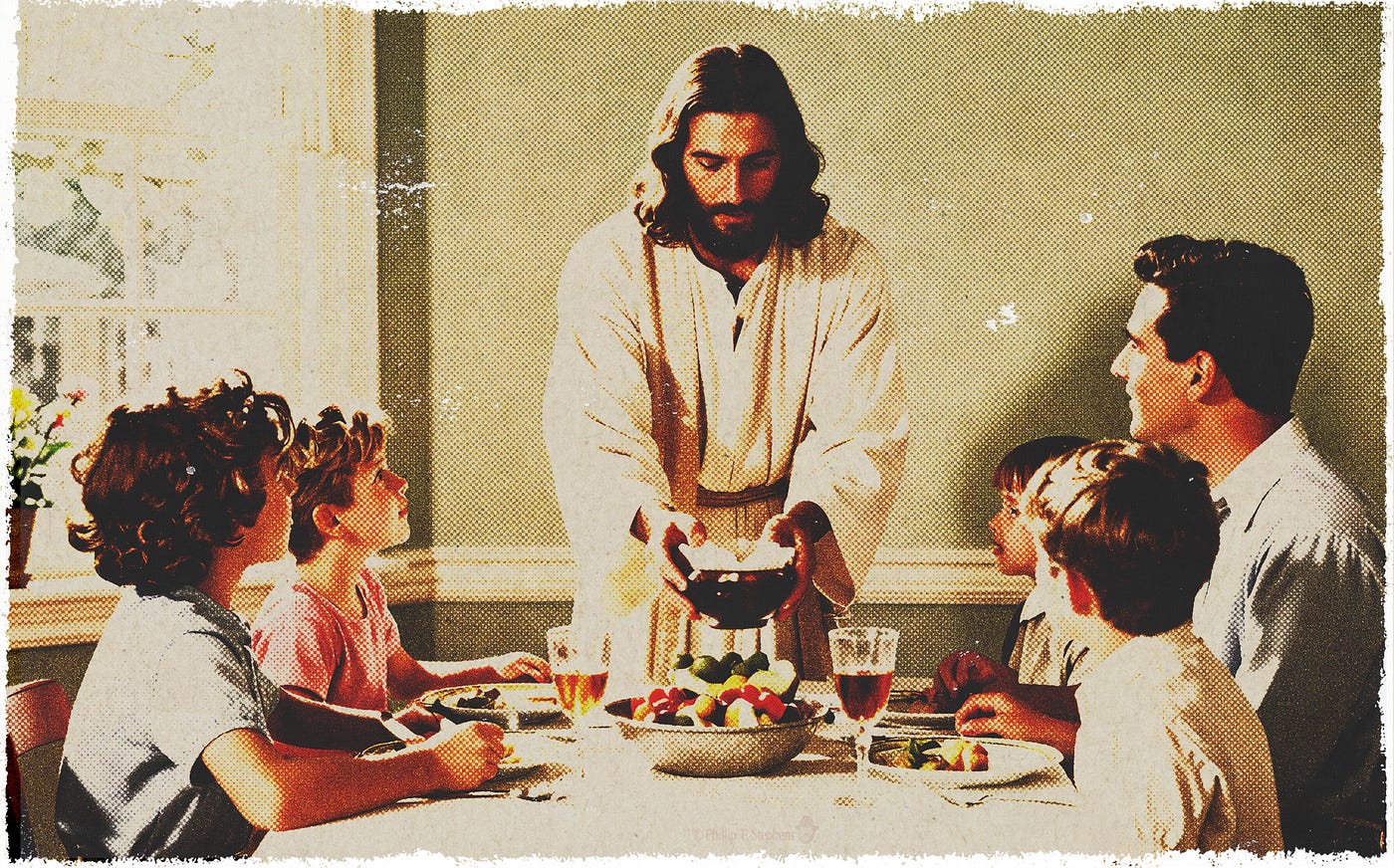
Image by ArtSpace
WHILE CAROL AND I WATCHED the US men’s team’s opening round in the World Cup, she mentioned that watching sports was the best way she knew of to bring family together. I suspect she was thinking about family since her brothers will come to Austin for our niece’s funeral in a couple of weeks.
I thought about her comment for a moment, and was about to do the guy thing and ask, “What about church?” But I surrendered and agreed. Because she’s right.
The family gatherings I remember most fondly involved dinner and then retiring to the family room to watch the game. The University of Texas Longhorns’ annual rivalry match with the Texas A&M Aggies, or the Dallas Cowboys against the Washington Redskins.
The Longhorns/Aggies game ended when A&M left their conference; the Redskins are now the Commanders. And the World Cup has forced Americans to confront the fact that football isn’t even football. But the joy of those gatherings remains.
I remember the joy and love in the early days of our blossoming assembly in San Marcos, Texas. It started with a half-dozen of us gathering for prayer and grew to meetings in living rooms with several dozen high school students, college students, teachers, and adults. Then we went and formed a church.
Who wants to argue with their kids about their dating choices, or drag up sibling rivalries when the ball’s on the goal line on fourth down with three seconds left and your team trailing by six? With the game on, the only thing you have to argue about is whether the referee made the right call.
You discuss past games, past players, previous family gatherings, childhood antics.
The celebratory high-five after a touchdown functions as the passing of the peace in church.
Sure, the bickering will resume, and long-suppressed grudges will surface. But for those few hours, we celebrate family bonds.
Which brings me back to the question I didn’t ask. “What about church?” And I realized the answer before I asked it. I can’t remember a single church service where I felt the bond to my fellow believers that I felt with our families.
To read the scriptures, however, especially accounts of the early church, feelings of familial love flowed between the members of the local communities.
I remember that joy and love in the early days of our blossoming assembly in San Marcos, Texas. It started with a half-dozen of us gathering for prayer and grew to meetings in living rooms with several dozen high school students, college students, teachers, and adults.
Then we went and formed a church with Sunday services, sermons, orchestrated music, and the joy slowly faded into something performative. Admittedly, people danced, waved hands, and shouted hallelujah. But now the seat formation boxed us in. Rather than facing each other, we faced a metal podium from which pastors preached.
So what changed between the first assemblies and churches now?
Put simply? Everything. Modern church services bear no resemblance to the early gatherings of believers in the first few decades. Except for singing, nothing remains. And even singing has morphed from spontaneous songs and psalms to productions involving music leaders, choirs, and reading written lyrics.
Worship originally served as a family gathering — a weekly meeting to maintain fellowship, communion, and unity. The meal brought the family together; the activities following the meal cemented solidarity. The gatherings were intimate, casual, and unstructured.
The word “service” misrepresents early Christian gatherings. When we think of service, we think of an organized ceremony. We should think of service in its original context — the act of serving others.
I recognize many modern churches try to recreate those first-century assemblies. I worshipped with several expressions of the faith. The Brethren, the Friends (or Quakers), and Watchman Nee’s Little Flock movement. But they inevitably institutionalized their visions. They reminded me of my writing classes in college, where instructors made us sit in circles to foster spontaneity and creativity. Except that when I suggested we try triangles, or pushing the desks to the wall and sitting on the floor, they would insist, “But we arrange the desks in circles.”
Factually, we know little about early Christian services beyond sketchy accounts of the church at Jerusalem in The Acts, and Paul’s account of the Corinthian gatherings. Everything else is inference and conjecture based on loose phrases collected from the epistles, contemporary historians, and archeological digs.
Even the word “service” misrepresents those early gatherings. When we think of service, we think of an organized presentation of the Gospel, following a standard script and offering orchestrated music. We should think of service in its original context — the act of serving others. Much as dinner hosts serve their guests.
Luke’s account of the gatherings after Pentecost mentions prayer, teaching, and communal meals. But Luke also focused on the daily community rather than worship as it spread beyond Israel. The only account of communal worship appears twenty years after Pentecost in Paul’s letter to the Corinthians.
According to Paul, everyone contributed to worship, just as everyone in the family engages in family dinners. Worship contained the original elements: a communal meal, prayer, and teaching. But the teaching didn’t involve a prepared sermon so much as speaking from the heart.
By Paul’s time, Christian worship involved two elements: the communal meal and the worship that followed. But this doesn’t mean they structured the services. In the earliest churches, one flowed into the other, much as family members wander from the table to the game.
Everything came from the heart as the spirit moved the members of the assembly. One might share a song, and the others join in. Another might share a prophecy. Someone might ask for prayers. Some spoke in tongues, and others interpreted. Someone else might share a scripture they’d memorized.
Singing provided an important element of worship. Church elders recognized that singing prevented conflict and contention and helped unify believers in a shared activity.
Worship didn’t focus on one individual. The intimacy of fellowship allowed for intimacy with the Spirit.
That practices in the gentile assemblies diverged from the practices of the assemblies in Judea shouldn’t surprise us. The communal experience in Jerusalem wasn’t practical everywhere. According to different accounts, Christians gathered in their homes. Many gathered for prayers and hymns in the morning before the slaves and day laborers departed for work. The smaller assemblies gathered regularly (usually weekly) in larger quarters around weekly meals.
First-century assemblies served a primary purpose: to experience the joy of community.
Valeriy A. Alikin, in his book The Earliest History of the Christian Gathering, suggests that the gatherings allowed for real intimacy and contact — the holy kiss, foot washing and anointing, laying on hands, and offering food.
What might surprise readers is the gatherings’ lack of public scripture reading. While many assume the synagogue model of reading the Torah would have passed to Christian worship, scholars recognize the impracticality of scripture reading in the smaller gatherings.
Scrolls were expensive and rare. Most Christians couldn’t read. Evidence suggests that early assemblies read aloud the letters of Paul and the other apostles, which literate members copied and sent on to other assemblies. The practice expanded into the 2nd century as more letters circulated and the faith attracted members with higher levels of education.
By the 2nd century, churches circulated a larger number of letters and texts, and the faith attracted more educated members who could read them aloud. As more copies of the Jewish prophets circulated, members might read aloud from portions of the Septuagint. More importantly, a bishop or priest would deliver a sermon to explain those texts. Direct engagement between family members was one step further removed.
Christians feel isolated by their churches rather than welcomed. No wonder church feels more like a dysfunctional family than a loving one. Church members are second-class citizens who witness the real Jesus Show on stage.
But the second century also witnessed a move toward hierarchical worship. Churches appointed bishops and priests — always men. This step away from family led, community-centered church rejected the important role of women not just as prophets but in curtailing conflict. Just as women diffuse conflict between family members.
When close-quarter conflict arises, women are far more likely than men to soothe nerves and restore civility, and more likely than men to put family bonds above being right.
Bishops also asserted their authority to homogenize Christian beliefs, which varied widely, and the push to orthodoxy led to a push toward authority and hierarchy as well. These moves led to vestments for the clergy, separating church leaders from the newly created laity, moving from home and community worship to buildings and then cathedrals with all the pageantry of the pagan ceremonies they replaced.
No wonder so many Christians feel isolated by their churches rather than welcomed. No wonder church feels more like a dysfunctional family than a loving one. Church members are second-class citizens who automatically feel less useful to God than the choir members, the band members, the bandleaders, the music directors, the youth directors, and the pastors.
How can they help but feel otherwise? The Jesus show happens on stage. The rest of us sit behind the altar rail, the passive audience who sings on cue, responds to readings on cue, prays on cue, gives offerings on cue.
Where does this leave us?
Those of us who left the church, but not the faith, face the same lack of intimacy. Even those who engage in online communities. Nor will we find it easy to recover that intimacy. Our experiences with the church have traumatized many so badly that we find it difficult to heal.
Jesus heals all scars, but some scars run deep and take years to fully recover. Even when we’re willing to forgive, finding it in our hearts to forgive requires digging deeper than many of us wish to go.
In the meantime, we find family and community where we can.
My message isn’t to believers who feel isolated by the institutions of the church that failed us. My message is to church leaders who insist their institutions only need minor nudges, little tweaks, and upgrades to older traditions.
Give up your salaries, sell your buildings, return your churches to the fellowship and encourage them to find room for those who felt forced to leave. Let us return to serving each other as family, rather than feeding into the lucrative business of selling faith.
Valeriy A. Alikin, The Earliest History of the Christian Gathering: Origin, Development and Content of the Christian Gathering in the First to Third Centuries (Brill, 2020).
Derek Demars, “What Did Worship Look Like in the Early Church?” Theology Pathfinder, April 21, 2021.
Richard Horsley, ed., Christian Origins: A People’s History of Christianity (Fortress Press, 2005).
Frank Viola and George Barna, Pagan Christianity?: Exploring the Roots of Our Church Practices (Tyndale, 2012).


Support me on substack for more in-depth posts and additional materials. Half-price to subscribers.

If you enjoyed this story, please buy me a coffee
메타데이터
- post_id
- 01ec72c7b667
- slug
- why-watching-football-feels-more-like-church-than-church-does-01ec72c7b667
- url
- https://medium.com/backyard-theology/why-watching-football-feels-more-like-church-than-church-does-01ec72c7b667
- canonical_url
- https://medium.com/backyard-theology/why-watching-football-feels-more-like-church-than-church-does-01ec72c7b667
- author_url
- https://medium.com/@reifinery
- status
- ok
- fetched_at
- 2026-06-23 21:39:52