The Olympic Ball Club of Philadelphia
A history, from Wilkes’ Spirit of the Times, March 2, 1861
The Olympic Ball Club of Philadelphia
A history, from Wilkes’ Spirit of the Times, March 2, 1861
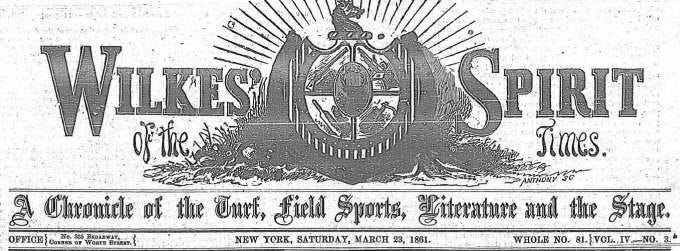
After collaborating with William T. Porter on Spirit of the Times, George Wilkes created his own weekly
THIS veteran organization dates as far back as the year 1832. It is, unquestionably, the oldest ball club in the United States. Its founders were respectable and well-known citizens of Philadelphia, principally merchants. In the list, we notice the names of many of wide and distinguished mercantile and professional reputation. Some of these have long since passed away; others are yet living, attesting the benefits of their attachment to their club, by physical and ocular demonstration. To this day there are gray heads and beards, belonging to stout arms, that yet wield the bat with a zest not excelled by their younger companions.
For more than twenty-five years the club played in Camden, N. J. The recollections of their ancient trips across the river, their reunions and pleasant games are still fresh and gratifying. Always a conservative and temperate body of gentlemen, their sports were mingled with a social regard — unusual in organizations of a purely physical character. In the fruit seasons, it was their wont to top off their games with a dish of strawberries or peaches, duly prepared for them, or a rest, seasoned with conversation and wit, and a drink of cold water or stronger beverage, as suited the palate.

For this page I am indebted to my friend Bruce Garland
A prominent feature of this worthy club is their ancient and standard celebration of the Fourth of July. On this occasion they turn out in strength, old and young, and seeking some quiet scene and level field adjacent to the city — first bountifully preparing an abundant cheer — they passed the day in refined recreation. The Declaration of Independence was read by some veteran of the club, most generally by their President, Wm. E. Whitman, Esq.; national songs were sung, and an address delivered for the perpetuation of the Stars and Stripes. Thus the Olympics duly honored “Independence Day.”
Estate of Turner Camac at Eleventh Street and Montgomery Avenue, 1861; photographer John Moran
A short time since, they reluctantly deserted their old stamping ground in Camden, which, from being a green sward in years gone by had become a sandy waste, ploughed up and worn out by constant use. Their present quarters are upon the Camac estate, at Twelfth-street and Montgomery-avenue, in the city of Philadelphia, a field known as that played upon by the “eleven cricketers” of England, and more lately by our own Brooklyn Excelsiors, in their match with the Philadelphia picked nine. Considerable money has been expended upon the ground to make it what it is — the finest field in Philadelphia.
The Olympic is known among ball players as a conservative and sterling body of men, slow to challenge, but quick to accept, and doing their duty upon the field steadily and, so far, victoriously.
In their former game of town ball, which, though hardly so scientific or exciting as base ball, yet affording a full scope for the qualities of a good player, they led the van of the ball fraternity, and deservedly won, in view of their many victories, the title of “Champion.” They comprise over sixty members, almost entirely of mercantile pursuits, with perhaps a larger proportion of experienced players than any other club in Philadelphia.
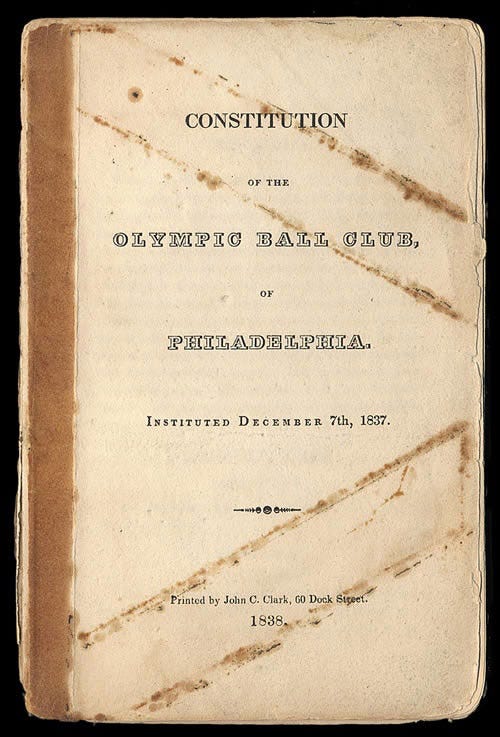
The Olympic Constitution of 1837
In May, 1860, they adopted the National Association game of base ball, setting aside their time-honored play, endeared by the memories of thirty years, to pass on in the race of progress. An honorable retirement of most of their old members was, however, the immediate consequence. Mutterings both loud and deep were freely heard at the innovation. Three hundred and sixty feet, compared with the old town ball circle of eighty feet, was enlarging the sphere of action with a vengeance.
In the exciting season of base ball that ensued, the Olympic received no challenge. Their games went on quietly, as of yore. Umpires were in several instances requested from them, and the calls cheerfully obeyed. A friendly game of base ball with the St. George’s Cricket Club, a superior body of ball players, in which the cricketers were defeated, was their only chance for excitement. With this exception, they were “let alone.”
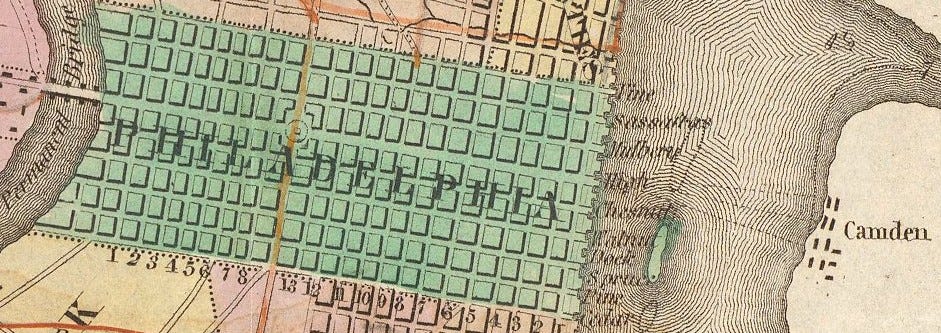
Map of Philadelphia’s waterfront, 1830, with ferries to Camden
In the numerous matches that were played, the Equity and the Hamilton, both strong and excellent clubs, had manfully struggled to a top seat without a defeat. These two elements, like clouds, were soon impelled towards each other by that attraction easily appreciated by base ball players. An old word was raked from the sporting dictionary for immediate use. The term “Champion” was lying loose about, and hints as to its appropriation were freely made. It was Equity vs. Hamilton. But an outstanding interest in favor of the Olympic was much inquired after. The match was played, and a well-fought and dearly-earned victory was enrolled upon the Hamiltonian banner. The smoothness of the Olympian temper began to be ruffled; the victor was directed to defend her laurels. She took up the gauntlet with alacrity. The contest was a close and cautious display. The Olympics were for a few innings in arrears — that, being a feature of their matches, however, did not worry them. The ending, as usual, gave them the victory in a score of 18 to 16. The match was played November 6th, upon the Hamilton’s grounds, not so even and more inclosed than their own, and a disadvantage to them of considerable importance.
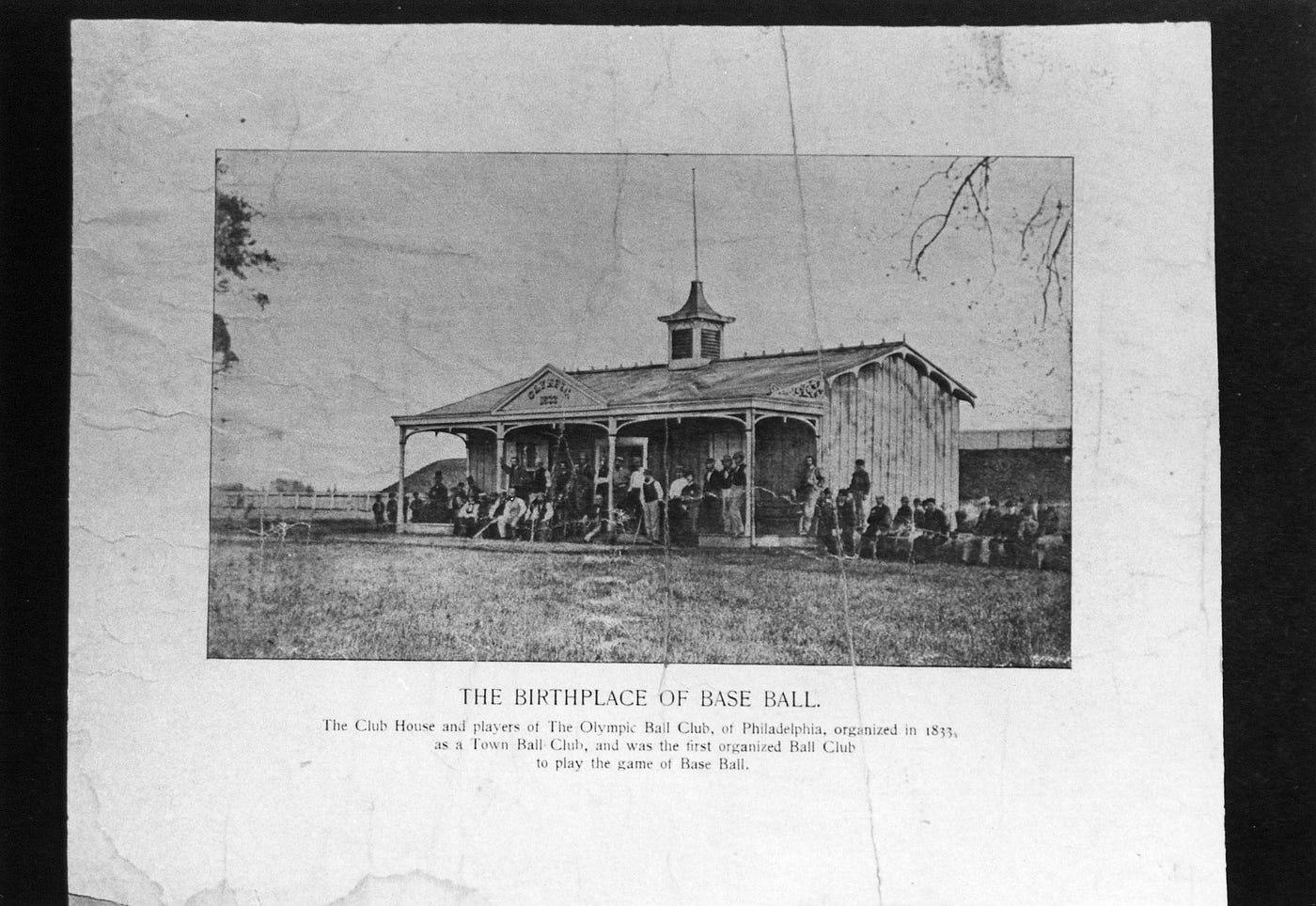
Olympic Club House, dating their onset to 1833
A fine charge at the Olympic is anticipated for the season of 1861. Whether her nine will carry her colors through in triumph, or her banner be lowered to a defiant and more youthful host of competitors, remains to be seen.
The uniform of the club is neat and handsome, consisting of a white flannel shirt trimmed with red, dark blue flannel pants, red belt, with “Olympic” in white letters upon it, and white flannel cap with blue band. Their play days are Tuesday and Friday.
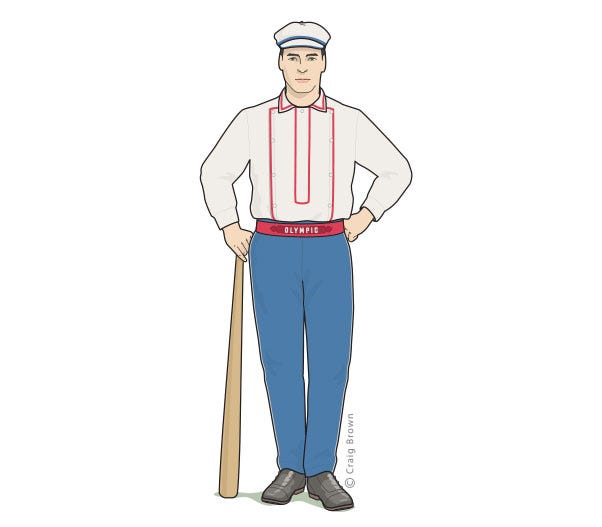
The Olympic uniform for 1861, only today fashioned by Craig Brown of Threadsofourgame.com
The following is a list of the officers of the club, elected at their last annual meeting, Dec. 7th, 1860, for the ensuing year: President — William E. Whitman; Vice-President — Charles S. Lincoln; Secretary — John H. Weeks; Treasurer — Danl. M. Zimmerman; Ground Committee — Fredk. D. B. Richards, John R. McCurdy, John S. Kuen, Charles E. Anspach, and Henry S. Paul.

From Wilkes’ Spirit of the Times, March 2, 1861
메타데이터
- post_id
- 01f00d2521d8
- slug
- the-olympic-ball-club-of-philadelphia-01f00d2521d8
- url
- https://ourgame.mlblogs.com/the-olympic-ball-club-of-philadelphia-01f00d2521d8
- canonical_url
- https://ourgame.mlblogs.com/the-olympic-ball-club-of-philadelphia-01f00d2521d8
- author_url
- https://medium.com/@thorn_john_87223
- status
- ok
- fetched_at
- 2026-07-15 08:02:11