Engels Was Right About the Disease and Wrong About the Cure
Capitalism can kill. So can the state that promises to save you from it. The way out runs through the ballot box, not the politburo.
Engels Was Right About the Disease and Wrong About the Cure
Capitalism can kill. So can the state that promises to save you from it. The way out runs through the ballot box, not the politburo.

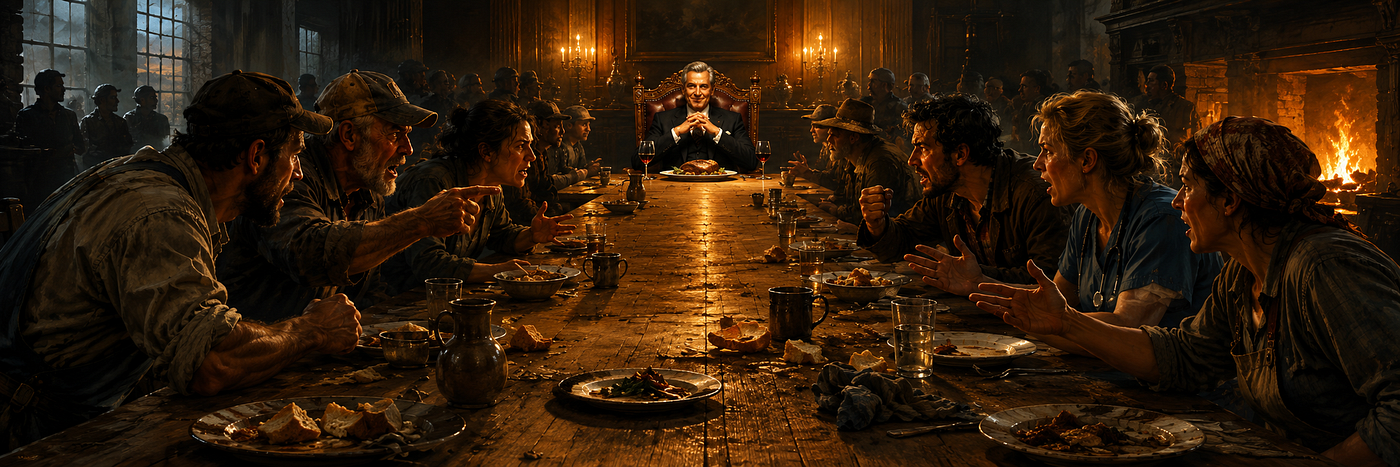
Taking Control (image generated for the author)
A recent essay, Capitalism: A System of Social Murder, revived one of Friedrich Engels’s oldest and most powerful phrases — “social murder” — and aimed it at American capitalism, with the for-profit healthcare system as Exhibit A. I have written my own indictment of that system, so I will not pretend the charge is baseless. It is not.
But a phrase that names a real harm is not the same as an argument that points to a real cure. And the cure implied by “social murder,” followed back to its source, carries a body count that dwarfs the one it set out to condemn.
Let me begin by granting the argument its strongest form, because it deserves that much.
Engels saw something real
When Engels wrote *The Condition of the Working Class in England* in 1845, he was not inventing the misery he described. He was reporting it. The mill towns of the Industrial Revolution were charnel houses of cholera, tuberculosis, and industrial maiming, and the people who owned the mills did not share the conditions of the people who ran them.
Engels looked at that arrangement and drew a conclusion that remains sound: a society can kill by arrangement rather than by intent, through omission rather than commission. When a society knows that a structure produces avoidable death and leaves the structure standing, the deaths are not accidents.
I have made a version of that argument myself, about a healthcare system that earns its margin by saying no. So I have no quarrel with the diagnosis. The harm is structural. It is not the handiwork of cartoon villains laughing in a back office. Engels was right about that, and the essay that invokes him is right to insist on it.
Where Engels went wrong was the next sentence.
A diagnosis is not a prescription
The move from “this arrangement produces avoidable death” to “therefore abolish private property and hand the means of production to the state” is the oldest bait-and-switch in political economy. The first claim can be entirely true and the second still be catastrophic. They are not the same statement, and one does not follow from the other.
The word “social murder” does its real work in the gap between those two sentences. It invites you to believe that because markets can kill, the absence of markets must heal. That is the whole rhetorical engine of the thing.
And the twentieth century ran that experiment — repeatedly, at enormous scale, on several continents — with results so consistent that they no longer qualify as an open question.
Power does not vanish. It relocates.
Here is what the framework never accounts for. Socialism and communism do not abolish the concentration of power that Engels blamed for social murder. They relocate it.
Abolish the private owner and you have not abolished the owner. You have made one owner of everything, and that owner is the state. Whoever controls the state now controls the hospital, the farm, the newspaper, the apartment, the job, and the exit visa. The “social relations” Engels wanted to dissolve do not dissolve. They re-form, harder than before, around proximity to political power.
A Yugoslav communist named *Milovan Djilas saw this from the inside. He had been a true believer, rose to the top of the party, looked around, and named what he found. He called it the [new class](https://en.wikipedia.org/wiki/New_class): the party elite that had quietly become the very ruling stratum the revolution promised to eliminate. He published the book in 1957 and went to prison for it. That detail tells you most of what you need to know about how the new class* receives criticism.
And the new class kills. The Ukrainian *Holodomor. The [Great Leap Forward](https://en.wikipedia.org/wiki/Great_Leap_Forward)*. Tens of millions dead, not as the rough edges of an otherwise humane project, but as the direct product of concentrating every economic decision in a single authority answerable to no one. Engels’s “disguised, malicious murder — murder against which none can defend himself” found its purest expression not in Manchester but in a system built in his name.
The man who saw that omission could kill helped author a doctrine that perfected commission.
There is a quieter reason it failed, too. A market is, among other things, an enormous information system. Every price is a signal about what is scarce and what is abundant, assembled from millions of decisions no central office could ever gather. Abolish the market and you do not abolish scarcity.
You abolish the signal that tells you where the scarcity is. So you get the queue, the shortage, the empty shelf, and yes, the death. Death by central planning is still death. It just comes with more paperwork.
The actual disease
So what is killing people, if not “capitalism” in the abstract?
Concentrated power that captures the rules. That is the disease in both systems, and naming it correctly is the only thing that points toward a cure.
Under state socialism the capture is direct and total: the party writes the rules, owns the property, and signs the only paycheck. Under American capitalism the capture is purchased: concentrated wealth buys the writing of the rules and then enjoys rules written in its favor.
*Citizens United* turned that purchase into a constitutional right. Donor capture turned it into a business model. The mechanism differs, but the pathology is identical — a small group close to power arranges the system to extract from everyone else, and the extraction shows up, eventually, in a mortality table.
This is precisely the distinction the “social murder” essay misses. The problem with American healthcare is not that markets exist. It is that the people the arrangement harms have been outspent in the only forum that could change it.
That is not a flaw in markets. It is a flaw in a democracy that has let itself be bought.
The countries that fixed it did not abolish capitalism
Here is the inconvenient fact for anyone reaching for Engels as a guide to solutions.
Germany. Japan. The United Kingdom. Switzerland. Every wealthy nation that delivers universal care at a fraction of the American cost. Not one of them is socialist in the sense the slogan demands. They are market economies. They have private firms, private profit, private property, and people who get rich.
What they also have is a democratic majority that decided, at the ballot box, that healthcare would be a constrained market rather than a free-fire zone — regulated insurers, negotiated prices, guaranteed coverage, capped margins.
They did not seize the means of production. They out-voted the people who owned them.
That is the entire difference, and it is the difference that matters. The choice was never capitalism versus its abolition. It was a captured democracy versus a working one.
The variable nobody wants to name
Which brings us to the part of the argument that both the socialist and the market fundamentalist would rather not discuss: the electorate.
For fifty years I have watched *Americans vote against their own material interests* with remarkable loyalty — for the wedge issue, for the tribe, for the comforting fiction that great wealth is evidence of great virtue and will trickle down if only we are patient enough.
Meanwhile the people who actually run the economy have voted their interests with perfect discipline, election after election and dollar after dollar. The result is not, in the end, a market failure. It is a democratic one.
Engels told the working class they had nothing to lose but their chains, and offered them a state that forged heavier ones. The duller, truer answer is the one the social democracies stumbled onto and kept: you do not have to choose a master.
You have to show up, organize, and vote the way the owners vote — because in a democracy, you are one.
The choice on offer
Capitalism can commit social murder. I have said as much in print and I will not take it back. But the state that promises to end it can commit social murder too, and the historical record says it usually does so on a far larger scale, with the executioner and the rule-maker conveniently merged into one office.
The phrase “social murder” is not wrong. It is simply pointed in a convenient direction — away from the harder and more hopeful truth. The cure for a captured democracy is not a different master. It is more democracy, exercised by the people it was built to serve, before the concentration of wealth finishes the job of buying the rules outright.
Vote your interests.
They have been voting theirs all along.
***The Billionaire Equation***
메타데이터
- post_id
- 021bc4733fc3
- slug
- engels-was-right-about-the-disease-and-wrong-about-the-cure-021bc4733fc3
- url
- https://medium.com/the-political-prism/engels-was-right-about-the-disease-and-wrong-about-the-cure-021bc4733fc3
- canonical_url
- https://medium.com/the-political-prism/engels-was-right-about-the-disease-and-wrong-about-the-cure-021bc4733fc3
- author_url
- https://medium.com/@dick-dowdell
- status
- ok
- fetched_at
- 2026-06-21 12:17:11