If Liberal Democracy Is So Good, Why Does It Need to Be Imposed on Others?
Attempts to impose it from the outside have repeatedly failed.
If Liberal Democracy Is So Good, Why Does It Need to Be Imposed on Others?
Attempts to impose it from the outside have repeatedly failed.
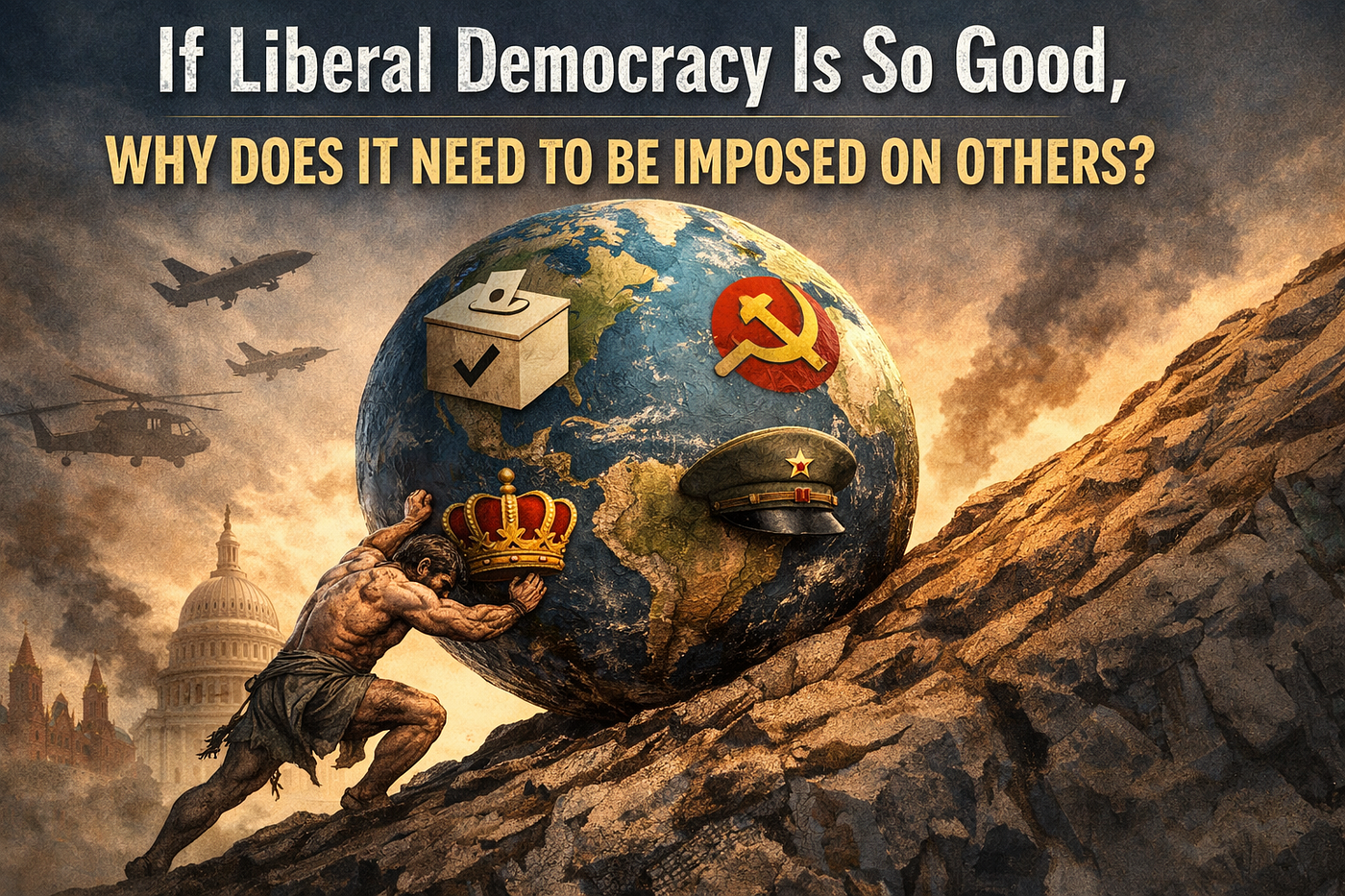
For decades, liberal democracy has been presented as the political destination toward which all societies should eventually move. Particularly after the collapse of the Soviet Union and the end of the Cold War, many policymakers and scholars argued that representative democracy combined with market capitalism had effectively become the global standard.
The argument was simple: liberal democracy had demonstrated its superiority through economic prosperity, political stability, and individual freedoms. Therefore, it was only a matter of time before the rest of the world adopted the same model.
But history over the past several decades raises an uncomfortable question.
If liberal democracy is truly the most successful political system, why has it so often needed external pressure, intervention, or coercion to spread?
The Assumption of a Universal Model
Modern international discourse frequently treats liberal democracy not merely as one political system among many, but as the ideal system toward which all countries should aspire.
Yet the world is extraordinarily diverse.
Nations differ in their histories, social structures, cultural traditions, and economic realities. Political institutions usually evolve slowly within these unique contexts rather than being transplanted successfully from the outside.
Despite this complexity, powerful countries have repeatedly attempted to reshape the political systems of others.
Sometimes these efforts have been justified as protecting democracy. At other times they have been framed as promoting human rights or maintaining international security.
But the results have rarely been straightforward.
The Record of External Intervention
Over the past seventy years, major powers have intervened — militarily, economically, or politically — in numerous countries with the stated aim of reshaping political systems.
Conflicts involving places such as Vietnam, Afghanistan, Iraq, Panama, Cuba, and Venezuela illustrate how often global politics has attempted to influence or transform domestic governance structures.
For example, the war in Vietnam during the Cold War was partly justified as an effort to prevent the spread of communism. Decades later, the intervention in Afghanistan sought to dismantle extremist networks while also attempting to build democratic institutions. The invasion of Iraq in 2003 was similarly framed by some leaders as an opportunity to establish a democratic government in the Middle East.
Yet the long-term outcomes of such interventions have been complex and often unstable.
External pressure frequently produces unintended consequences: political fragmentation, nationalist backlash, prolonged conflict, or fragile institutions that struggle to gain legitimacy within the societies they are meant to govern.
The lesson appears repeatedly throughout modern history:
Political systems rarely take root when they are imposed from the outside.
Sovereignty and Political Choice
The modern international system is theoretically built upon the principle of national sovereignty — the idea that every country has the right to determine its own political system without external interference.
This principle forms a foundational part of the framework established by the United Nations.
In practice, however, global politics often operates differently. Great powers regularly attempt to influence the internal affairs of other states when strategic interests are involved.
The result is a persistent tension between two competing ideas:
- the promotion of universal political values
- the right of societies to determine their own political systems
Balancing these principles has proven extraordinarily difficult.
The Paradox of Democracy Promotion
There is also a deeper paradox at the heart of efforts to export democracy.
Democracy, at its core, is about the right of people to choose how they are governed. It is based on the idea that political authority derives from the will of the people.
But when democracy is promoted through external pressure — whether through sanctions, political manipulation, or military intervention — it raises a contradiction.
If the citizens of a country have not themselves chosen a particular political model, can it truly be called democratic?
In attempting to impose democracy, outside powers may sometimes undermine the very principle they claim to defend.
Political Systems Spread Through Success
Throughout history, political and economic systems have tended to spread not because they were enforced, but because they demonstrated tangible success.
Ideas travel when people see them working.
If liberal democracies continue to deliver prosperity, innovation, stability, and freedom, other societies will naturally study and adopt similar institutions over time.
In that sense, the most persuasive argument for democracy should be its performance rather than external pressure.
Systems that genuinely work rarely need to be imposed.
A World of Political Diversity
The modern world already contains a wide range of governance models.
Some countries operate as liberal democracies. Others maintain single-party systems, monarchies, military governments, or hybrid political structures that combine elements of several models.
This diversity reflects the varied historical and cultural trajectories of different societies.
Expecting all nations to converge on a single political structure may be unrealistic.
Instead, global stability may depend less on enforcing one universal system and more on learning how different systems can coexist without constant attempts to reshape one another.
The Larger Historical Pattern
Human history suggests that powerful nations often attempt to project their political models outward.
Empires did it. Ideological blocs did it during the Cold War. Modern powers continue to attempt it today.
Yet these efforts repeatedly encounter the same reality: political systems cannot simply be engineered from the outside.
Societies ultimately evolve their institutions through internal political processes, not external design.
Related Reading
This recurring pattern of great powers trying to reshape the world — and encountering resistance in the process — is part of a broader historical cycle.
I explore this idea in more depth in a related essay:
“The Sisyphus Problem of Civilization.”
It examines how global powers repeatedly attempt to build stable world orders — only to see those orders challenged and reshaped by the forces of history.
[embed]The Sisyphus Problem of Civilization Why Humanity Keeps Repeating Its Conflictsmedium.com
메타데이터
- post_id
- 0237f898e00a
- slug
- if-liberal-democracy-is-so-good-why-does-it-need-to-be-imposed-on-others-0237f898e00a
- url
- https://medium.com/@spmishrais/if-liberal-democracy-is-so-good-why-does-it-need-to-be-imposed-on-others-0237f898e00a
- canonical_url
- https://medium.com/@spmishrais/if-liberal-democracy-is-so-good-why-does-it-need-to-be-imposed-on-others-0237f898e00a
- author_url
- https://medium.com/@spmishrais
- status
- ok
- fetched_at
- 2026-06-21 20:33:08