Ace AI Interview Series 18 — Understanding Mixed Precision Training and bfloat16 (BF16) in Deep…
Deep learning has evolved at an extraordinary pace, and along with it, new techniques and optimizations are constantly being developed to…
Ace AI Interview Series 18 — Understanding Mixed Precision Training and bfloat16 (BF16) in Deep Learning: A Comprehensive Guide
For the complete list of AI interview prep topics, check out the Table of Contents for this comprehensive AI interview prep series : https://medium.com/@aisagescribe/ace-ai-interview-series-table-of-content-052f78a25ab2
Deep learning has evolved at an extraordinary pace, and along with it, new techniques and optimizations are constantly being developed to improve the performance and efficiency of models. Among these techniques, Mixed Precision Training and the use of the bfloat16 (BF16) data type have gained considerable attention. These innovations have been crucial in training large-scale models more efficiently, reducing the computational resources required, and speeding up the training process without compromising model accuracy.
In this blog post, we’ll explore these concepts in depth, breaking down what they are, how they work, and why they are important for both researchers and practitioners. We will also provide practical interview questions and answers, making this a useful resource for anyone preparing for deep learning-focused job interviews.
1. Introduction to Precision in Machine Learning
In the realm of deep learning, training models involves processing vast amounts of data and performing calculations with floating-point numbers. These calculations are crucial in adjusting model weights and computing gradients during backpropagation. Traditionally, floating-point numbers are represented using 32 bits (FP32), which provides high precision but comes at the cost of high memory usage and slower computations.
As deep learning models continue to grow in size and complexity, training them with FP32 precision becomes computationally expensive and inefficient. This is where the concept of mixed precision training and reduced precision data types like bfloat16 (BF16) and half precision (FP16) come into play. They allow us to reduce memory usage, increase computation speed, and train larger models while maintaining an acceptable level of model accuracy.
2. What is Mixed Precision Training?
Mixed precision training is an optimization technique in deep learning where the model parameters, activations, and gradients are represented using different numerical precisions. Typically, a combination of FP16 and FP32 is used to achieve the benefits of reduced memory and computation costs while maintaining model accuracy.
In mixed precision training, some parts of the model computation (such as forward and backward passes) are carried out in lower precision, while others, like weight updates, are done in higher precision. This allows for a balance between computational efficiency and model performance.
How Mixed Precision Training Works
- Forward Pass: During the forward pass, the model’s activations and inputs are computed using lower precision, typically FP16 (or BF16, which we’ll discuss later). This helps in reducing memory usage and speeding up computations.
- Backward Pass: Gradients calculated during backpropagation can be computed with lower precision too. However, in some cases, the gradients are cast back to FP32 to avoid issues related to underflows or overflows during weight updates.
- Weight Update: Weights are typically updated using FP32 to preserve numerical stability and precision. In this way, the most critical parts of the computation remain in high precision, while the majority of the operations are done in lower precision.
By using mixed precision, we can exploit the hardware accelerators like GPUs and TPUs more effectively, as these devices often support lower precision operations much faster than full precision operations.
The Benefits of Mixed Precision Training
- Faster Computation: Mixed precision training can significantly accelerate model training by performing operations at lower precision, especially on hardware optimized for lower precision arithmetic.
- Reduced Memory Usage: Lower precision data types require less memory. For example, a 16-bit floating-point number (FP16) uses half the memory of a 32-bit floating-point number (FP32). This allows larger models to fit into memory or for more models to be trained simultaneously.
- Improved Efficiency: Lower precision operations can take advantage of hardware that’s specifically optimized for these types of calculations, leading to better throughput and efficiency.
- Minimal Impact on Accuracy: When implemented correctly, mixed precision training typically does not result in a significant drop in model accuracy. This is because many deep learning models are robust to small errors introduced by reduced precision.
Hardware Support for Mixed Precision Training
Modern GPUs and TPUs are designed to support mixed precision training. For instance, NVIDIA’s Volta, Turing, and Ampere architectures, as well as Google’s TPUs, are optimized to accelerate mixed precision workloads. These devices provide specialized hardware units, like Tensor Cores, that are designed to perform lower-precision arithmetic at much higher speeds than standard floating-point units.
3. Understanding bfloat16 (BF16)
While FP16 has been a popular choice for mixed precision training, bfloat16 (BF16) is another data type that has been gaining traction, especially in large-scale deep learning models. BF16 is a 16-bit floating-point format that has similar precision to FP16 but with a key difference in the exponent range, which makes it more suitable for training large models.
What is BF16?
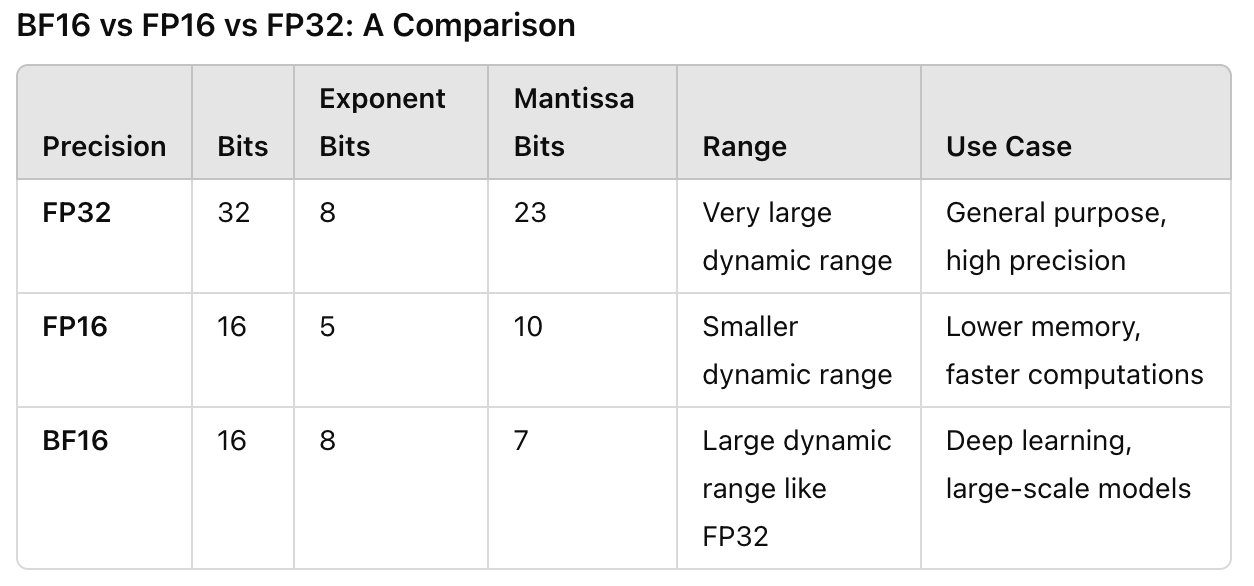
The bfloat16 format is similar to the IEEE 754 single-precision (FP32) format, but it truncates the mantissa (fraction) to 7 bits instead of the 23 bits in FP32. This results in a 16-bit number, but with the same exponent range as FP32. The reduced precision in the mantissa allows for a significant reduction in memory usage while maintaining a similar range of representable values.
In comparison to FP16, BF16 has a larger dynamic range, which means it can represent much larger or smaller numbers than FP16, reducing the risk of overflow or underflow during training.
Why is BF16 Important for Deep Learning?
- Large Dynamic Range: BF16 provides a larger exponent than FP16, which makes it better suited for deep learning models that require a large dynamic range of values. This is especially useful when training on large-scale datasets and complex models where small changes in weight values can lead to large changes in the output.
- Better Numerical Stability: The larger dynamic range in BF16 makes it less prone to underflows and overflows compared to FP16. This is especially important for models that require precise adjustments to weights and gradients during training.
- Compatibility with FP32: The BF16 format retains the same exponent range as FP32, making it easier to migrate from FP32-based models to BF16 without significant changes to the model architecture or training process.
BF16 vs FP16 vs FP32: A Comparison
Hardware and Software Support for BF16
- NVIDIA GPUs: Starting with the A100 and H100 GPUs, NVIDIA added support for BF16 arithmetic, taking advantage of Tensor Cores for high-performance BF16 computations.
- Google TPUs: Google’s TPUs also support BF16, enabling the training of large models with reduced precision while retaining model stability.
- Software: Modern deep learning frameworks, such as TensorFlow and PyTorch, support BF16 operations. In TensorFlow, BF16 can be enabled through the
mixed_precisionAPI, while PyTorch uses thetorch.cuda.ampmodule for mixed precision training.
4. The Relationship Between Mixed Precision Training and BF16
Mixed precision training can use BF16 as one of the data types for lower precision computations. Since BF16 provides a larger dynamic range than FP16, it offers better numerical stability, which can be crucial for training large models.
By using BF16 for certain layers or parts of the training process while keeping the weight updates in FP32, you get the computational efficiency of reduced precision and the stability of full precision. This allows for efficient scaling when training large neural networks while minimizing the risk of precision-related issues.
5. Challenges and Limitations of Mixed Precision Training and BF16
- Numerical Instability: Despite its advantages, mixed precision training can sometimes lead to issues like vanishing gradients or improper weight updates, especially when the lower-precision computations are not carefully handled.
- Hardware Constraints: While mixed precision training with BF16 can significantly improve performance, not all hardware supports BF16. Developers need to ensure that their hardware (GPUs/TPUs) supports BF16 to fully take advantage of these optimizations.
- Compatibility Issues: Some older software stacks or models may not be compatible with mixed precision training or BF16. Migrating to these formats often requires changes to the codebase or model architecture.
6. Example Interview Questions and Answers
Here are some sample interview questions and answers related to mixed precision training and BF16 that you may encounter in a deep learning-focused interview.
Q1: What is mixed precision training, and why is it important for deep learning?
A1: Mixed precision training is an optimization technique where model computations are carried out using different numerical precisions. In this technique, lower precision (like FP16 or BF16) is used for most operations, while higher precision (FP32) is used for key components such as weight updates. Mixed precision training allows for faster computation, reduced memory usage, and the ability to train larger models while preserving model accuracy.
Q2: What is bfloat16, and how does it differ from FP16?
A2: bfloat16 (BF16) is a 16-bit floating-point format that shares the same exponent range as FP32 but with fewer mantissa bits. This provides BF16 with a larger dynamic range compared to FP16, making it better suited for deep learning tasks that involve large-scale models and require a wider range of representable values. In contrast, FP16 has a smaller exponent range and can result in overflow or underflow for large models.
Q3: Can you explain how mixed precision training is implemented in popular frameworks like TensorFlow or PyTorch?
A3: In TensorFlow, mixed precision training can be enabled using the tf.keras.mixed_precision API. This allows developers to define which operations should use lower precision. TensorFlow also provides utilities for casting gradients back to FP32 when necessary. In PyTorch, the torch.cuda.amp module handles mixed precision, automatically choosing which operations to run in FP16 and which to run in FP32. PyTorch uses automatic loss scaling to avoid issues with underflows during the backward pass.
Q4: What are some potential challenges when using mixed precision training with bfloat16?
A4: One challenge with mixed precision training using BF16 is ensuring numerical stability. While BF16 offers a larger dynamic range than FP16, it may still lead to issues with vanishing gradients or improper updates if the training process isn’t carefully tuned. Additionally, hardware support for BF16 may be limited on certain devices, and not all deep learning models or frameworks fully support BF16 operations.
Q5: How does mixed precision training improve computational performance?
A5: Mixed precision training improves performance by reducing memory usage and increasing throughput. Lower precision operations, such as those done with FP16 or BF16, require fewer bits to store and process data, allowing for faster computations and more efficient memory usage. This is especially important when training large models, where computational resources are often a bottleneck.
7. Conclusion
Mixed precision training and bfloat16 (BF16) are essential techniques in the modern deep learning landscape. By leveraging reduced precision computations, these methods enable faster training times, reduced memory consumption, and the ability to scale models to new heights. They represent a crucial step toward optimizing deep learning workflows, particularly in the context of large models and datasets.
If you are preparing for a machine learning interview, understanding these topics will provide you with a solid foundation, both theoretically and practically. It’s important to stay updated with the latest hardware and software support for these techniques, as they are critical for developing state-of-the-art models in deep learning.
메타데이터
- post_id
- 024d2ccf8bd6
- slug
- ace-ai-interview-series-18-understanding-mixed-precision-training-and-bfloat16-bf16-in-deep-024d2ccf8bd6
- url
- https://medium.com/@VectorWorksAcademy/ace-ai-interview-series-18-understanding-mixed-precision-training-and-bfloat16-bf16-in-deep-024d2ccf8bd6
- canonical_url
- https://medium.com/@VectorWorksAcademy/ace-ai-interview-series-18-understanding-mixed-precision-training-and-bfloat16-bf16-in-deep-024d2ccf8bd6
- author_url
- https://medium.com/@VectorWorksAcademy
- status
- ok
- fetched_at
- 2026-06-17 08:20:12