Beyond the Medallion: Architecting the Post-Dashboard Data Era for AI
For the past decade, the foundational blueprint of enterprise data engineering has been overwhelmingly dictated by the Medallion…
Beyond the Medallion: Architecting the Post-Dashboard Data Era for AI
For the past decade, the foundational blueprint of enterprise data engineering has been overwhelmingly dictated by the Medallion architecture. This familiar multi-hop pattern — Bronze for raw ingestion, Silver for cleansing, and Gold for business-ready analytics — provided the structural rigor necessary for the era of traditional Business Intelligence (BI).
But let’s be honest about the underlying philosophy of the Medallion model: it was predicated entirely on the assumption that the ultimate consumer of the data would be a human analyst staring at a static visual dashboard.
The ubiquitous integration of Generative AI has fundamentally shattered this assumption. As organizations rush to ground Large Language Models (LLMs) in proprietary corporate data to facilitate autonomous, agentic decision-making, the structural flaws of our legacy pipelines have been laid bare.
The traditional physical data warehouse is failing the AI test. It is time for a prescriptive, architectural paradigm shift.
The Historical Debt of the Physical Pipeline
To understand why we must evolve, we have to look at where the Medallion model breaks down. The catastrophic friction occurs in the final destination: the physical Gold layer.
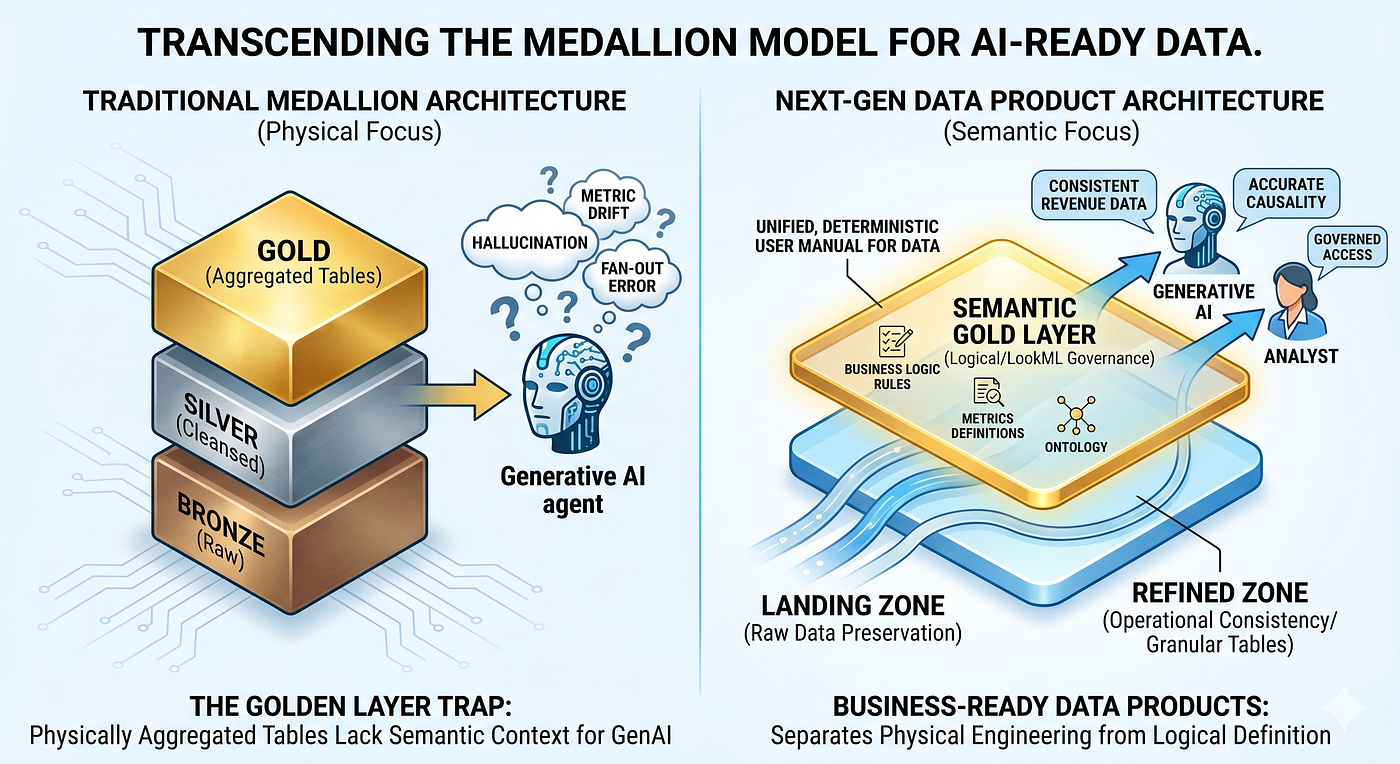
In the Medallion framework, the Gold layer represents highly refined, physical views explicitly modeled for reporting. Data engineers aggregate, denormalize, and filter data into project-specific dimensional models pre-calculated for sub-second dashboard performance.
As I previously argued when discussing the Golden Layer trap, exposing an LLM to this traditional physical data warehouse schema is an architectural error. Physical Gold tables are heavily optimized for dashboard speed through aggressive pre-aggregation. While a human executive only needs a line chart of monthly sales, an AI agent requires granular causality to diagnose exactly why a metric changed. By stripping away transactional context to save compute cycles, we effectively blind the AI.
When we rely on “Schema-in-Prompt” strategies — feeding an LLM raw Data Definition Language (DDL) and expecting it to act as an instantaneous data engineer — the results are disastrous. The AI lacks semantic context. It falls victim to the “Fan-Out” problem, confidently summing duplicated primary keys in complex joins, resulting in wildly inflated metrics, pervasive metric drift, and fabricated hallucinations.
Band-aid solutions, like adding a virtual “Platinum Layer” on top of these chaotic physical tables, only treat the symptoms. They add latency to an already bloated pipeline and perpetuate what I call the “Physical Fallacy” — the dangerous idea that business logic should be baked into hundreds of disconnected, physical ETL scripts.
The Prescriptive Shift: The Business-Ready Data Product Paradigm
To survive the transition to autonomous AI workflows, we must transcend the multi-hop physical pipeline. As I previously argued in my piece on the evolution of the golden layer, the final layer of data consumption must be reimagined not as an IT engineering output, but as a “Business-Ready Data Product.”
In modern cloud ecosystems, this means entirely abolishing the physical Gold layer. We must replace it with a centralized semantic model that defines data virtually. This advanced topology consists of three reimagined stages of value realization:
1. The Landing Zone (Unadulterated Preservation)
Replacing the Bronze layer, the Landing Zone acts as the absolute foundational safety net. Using cost-effective object storage or raw warehouse ingestion, this stage captures 100% of source data in its original format. The mandate here is lossless preservation. By refusing to alter incoming data, we maintain an immutable historical record necessary for regulatory audits and for replaying data when machine learning models require new historical features.
2. The Refined Zone (Operational Consistency)
Supplanting the traditional Silver layer, the Refined Zone is the high-performance engine room. Executed within high-concurrency databases (like BigQuery) and orchestrated by frameworks like dbt or Dataform, data here is deduplicated, partitioned, clustered, standardized, and cleansed.
Crucially, the engineering mandate here is to maintain data at the lowest possible logical grain. We strictly avoid the premature, hard-coded aggregations of the past. By retaining granular, transaction-level causality, we preserve the dimensional depth that AI engines require for true reasoning.
3. The Semantic Gold Layer (The Logical Ground Truth)
This is the radical departure. The physical Gold layer is dead; long live Semantic Gold.
Instead of writing brittle ETL scripts to create physical tables for every reporting request, we deploy a unified, logical governance layer — utilizing enterprise-grade platforms like Looker and its declarative language, LookML — directly on top of the Refined Zone.
Business logic is defined virtually, as code. Metrics like “Gross Margin” are defined exactly once. When an AI agent queries the system, it doesn’t navigate a labyrinth of tables; it queries the Semantic Gold layer. The platform acts as an intelligent compiler, translating the agent’s semantic intent into optimized, dialect-specific SQL on the fly.
The Strategic Imperative: Architected by Business, Built by Engineering
This transition fundamentally fixes the organizational “Telephone Game.” Data engineers are liberated from writing bespoke reporting scripts, transitioning into platform reliability engineers focused on the Refined Zone. Meanwhile, domain experts (Business Stewards) are empowered to codify their business reality directly into the semantic model using a DRY (Don’t Repeat Yourself) methodology.
Furthermore, we must adhere strictly to the “PowerPoint Slide Rule” when building these semantic models. Instead of exposing users (and AI) to a 50-table schema, we curate hyper-focused modules (Minimum Viable Data Products) that answer specific business questions, obfuscating all unnecessary technical metadata.
The Dual-Engine Topology for Conversational AI
By establishing this semantic foundation, we can safely deploy Agentic AI across the enterprise. However, we must acknowledge that different personas carry vastly different risk profiles.
As I previously argued regarding architecting trust with the right conversational AI, organizations must precision-map specific AI engines to the appropriate data layer:
- The Builder’s Engine (Fail-Deadly): Targeting Data Scientists and deep analysts, this engine operates directly on the physical data in the Refined Zone. It generates complex SQL for exploratory power, but because its reasoning is exposed as raw code, it is fundamentally unsafe for non-technical executives.
- The Business Engine (Fail-Safe): Engineered for executive consumption, this engine sits strictly atop the Semantic Gold Layer. It translates natural language into secure semantic API calls. Because it is constrained by governed logic, it cannot guess a formula. If an undefined metric is requested, it fails gracefully rather than hallucinating.
The Bottom Line
The persistence of physically aggregated Gold tables is a critical failure point in modern data strategy.
By evolving toward a Business-Ready Data Product architecture anchored by a Semantic Gold layer, we eliminate compute inefficiencies, eradicate metric drift, and seamlessly enable decentralized Data Mesh topologies.
Our data infrastructure can no longer afford to be an inert repository of historical facts. It must be an active, intelligent framework. When we build our final layer as a semantic model, we establish absolute structural certainty — ensuring our enterprise data ecosystem is definitively engineered for the speed, and the reality, of AI.
메타데이터
- post_id
- 0253c483512e
- slug
- beyond-the-medallion-architecting-the-post-dashboard-data-era-for-ai-0253c483512e
- url
- https://medium.com/google-cloud/beyond-the-medallion-architecting-the-post-dashboard-data-era-for-ai-0253c483512e
- canonical_url
- https://medium.com/google-cloud/beyond-the-medallion-architecting-the-post-dashboard-data-era-for-ai-0253c483512e
- author_url
- https://medium.com/@corneliusvh
- status
- ok
- fetched_at
- 2026-06-14 11:28:49