Systems. Leverage. Arbitrage. Scale.
For the last few years I’ve been oddly obsessed with four words:
Systems. Leverage. Arbitrage. Scale.
For the last few years I’ve been oddly obsessed with four words:
Systems. Leverage. Arbitrage. Scale.
They’ve gradually become the lens through which I understand almost everything — from businesses and software to people and decision-making.
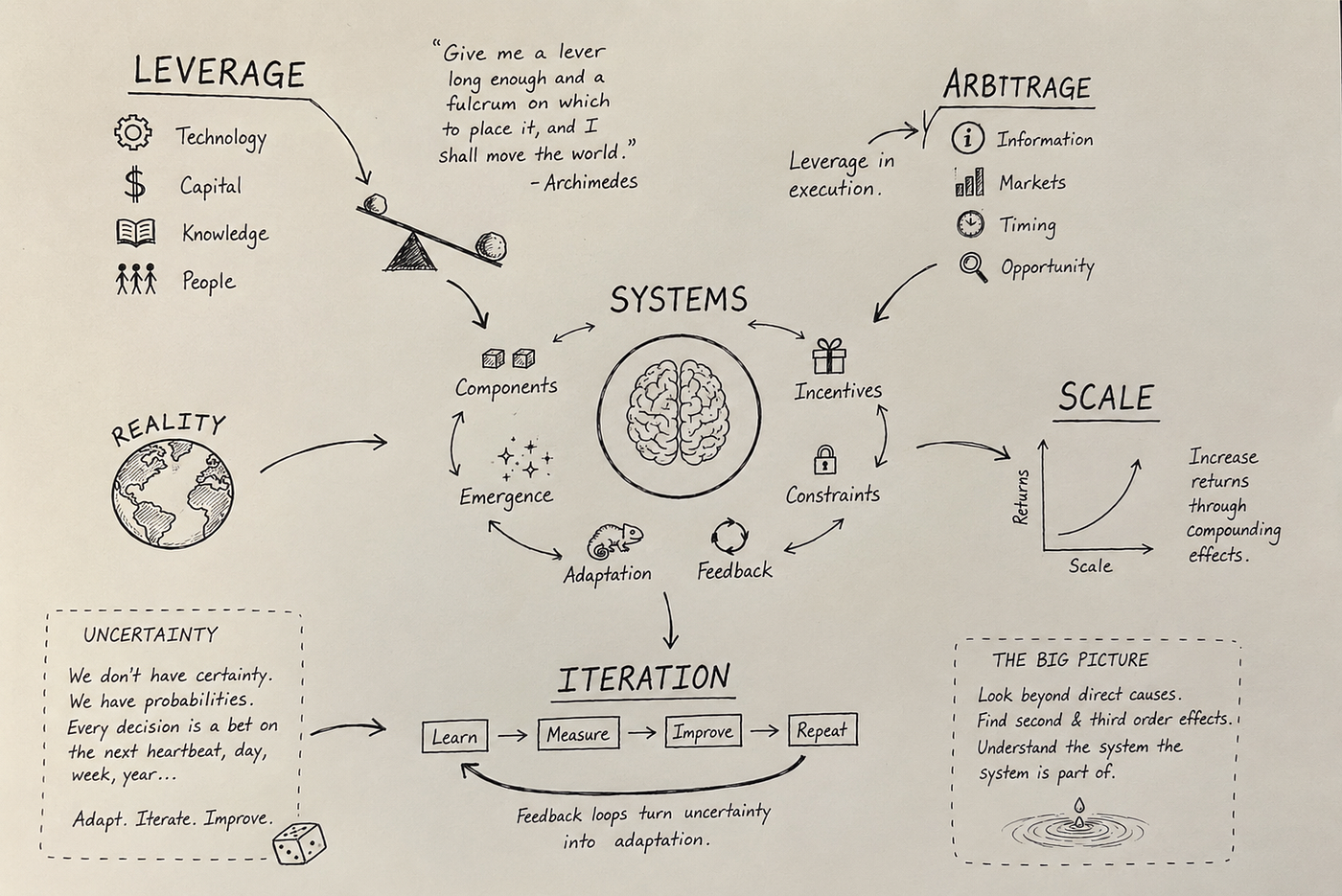
A system, to me, is a collection of components connected by incentives, constraints, feedback, and cause-and-effect relationships. Once you start seeing systems, you begin asking different questions:
What are the incentives? Where are the bottlenecks? What creates feedback? What changes the entire system rather than a single part?
Leverage is the ability to produce disproportionately large outcomes from relatively small inputs.
The classic example is Archimedes:
“Give me a lever long enough and a fulcrum on which to place it, and I shall move the world.” Technology, capital, knowledge, and people are all forms of leverage.
Arbitrage is leverage put into action. It’s recognizing differences that others haven’t fully priced in — whether that’s information, timing, markets, or opportunity.
Scale is what allows good ideas to compound. It’s about designing an environment where each additional unit of effort creates greater returns instead of simply requiring more work.
Thinking this way has changed how I approach problems. Rather than looking only at direct causes, I find myself looking for second- and third-order effects, hidden constraints, feedback loops, and unintended consequences. Of course, every model is incomplete. Reality is messy, and no system can capture everything. That’s why feedback matters. Every useful model should be revised as new information arrives.
Right now, this is probably the simplest map of reality that I keep coming back to: Reality │ ├── Systems │ ├── Components │ ├── Incentives │ ├── Constraints │ ├── Feedback │ ├── Adaptation │ └── Emergence │ ├── Leverage │ ├── Technology │ ├── Capital │ ├── Knowledge │ └── People │ ├── Arbitrage │ ├── Information │ ├── Markets │ ├── Timing │ └── Opportunity │ └── Iteration ├── Learn ├── Measure ├── Improve └── Repeat
I’m still refining this model, but it’s been one of the most useful ways I’ve found to reason about complex problems.
메타데이터
- post_id
- 0263e55cce80
- slug
- systems-leverage-arbitrage-scale-0263e55cce80
- url
- https://medium.com/@mubeenamir96/systems-leverage-arbitrage-scale-0263e55cce80
- canonical_url
- https://medium.com/@mubeenamir96/systems-leverage-arbitrage-scale-0263e55cce80
- author_url
- https://medium.com/@mubeenamir96
- status
- ok
- fetched_at
- 2026-07-09 10:05:04