How Zelda Dungeons Prepare You for Their Items
A look at how The Minish Cap turns dungeon items into extensions of ideas the player has already learned
How Zelda Dungeons Prepare You for Their Items
A look at how The Minish Cap turns dungeon items into extensions of ideas the player has already learned
The Dungeon Item Isn’t Always Where the Idea Begins
One of the most memorable things about Zelda dungeons is the expectation built around the item. In many games in the series, there is almost a ritual to it: we enter a dungeon, explore its first challenges, find a new item, and from that point on, we start seeing that space differently. The bow lets us hit distant targets, the hookshot turns points in the environment into possible routes, the boots change our relationship with the floor, the lantern changes how we deal with darkness. Often, we remember a dungeon precisely because of the item it gives us, as if that item were the center of the experience and everything around it existed to justify its use.
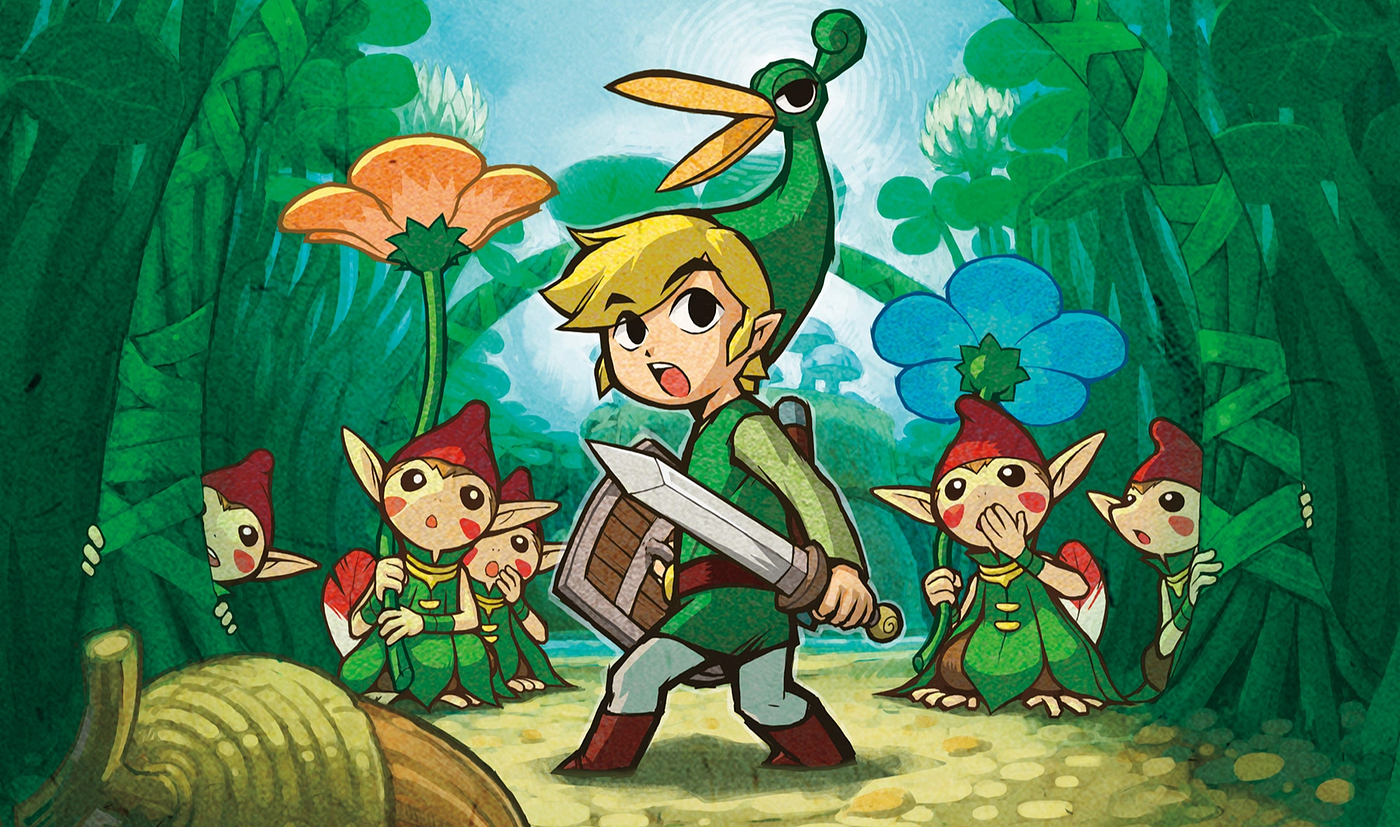
That expectation is also present in The Legend of Zelda: The Minish Cap. Each dungeon has its own item, and the overall structure seems to follow the classic logic of the series: the player advances to a certain point, finds a new item, and then has to use it to solve puzzles, access new areas, and defeat the boss. But while playing Minish Cap, I had the impression that this relationship works in a slightly subtler way. The item does not seem to simply introduce a new mechanic halfway through the dungeon. In many cases, it feels like it grows out of something that the space had already been teaching from its very first rooms.
Instead of thinking of the item as the starting point of the mechanic, it may make more sense to think of it as a shift in control. Before receiving the item, the player has already seen the concept working in the environment, has already dealt with its limitations, and has already learned to recognize the kind of problem that the dungeon is proposing. When the item finally appears, it does not completely change the subject; it gives the player a more direct way to act upon something that was already there. In that sense, the dungeon is not split between “before the item” and “after the item” as two separate experiences. It works more like a continuous process, where an idea is first presented through the space and then placed in the player’s hands.
The Item as Expansion
This difference changes how we can look at Minish Cap’s dungeons. At first glance, the item seems to be the element that defines the second half of the experience: before it, the player encounters obstacles they cannot yet solve; after it, they return to previous rooms, open new paths, and face challenges built around the new ability. That structure is there, but it may not fully explain what makes these dungeons interesting. What caught my attention is that, in many cases, the item does not interrupt the flow of the dungeon to introduce a completely new mechanic. It expands a relationship that had already been established.
The logic, then, is less “the dungeon introduces an item” and more “the dungeon introduces an idea.” First, the space teaches the player to recognize a certain kind of problem. Then, the game limits the ways in which that problem can be solved. The player understands the situation, but still depends on the conditions imposed by the dungeon itself. When the item appears, it does not merely function as a key for specific obstacles; it changes the player’s position within that concept. What was once a rule of the environment becomes something Link can manipulate more actively.
This creates a sense of continuity. The player does not feel like they are learning a mechanic disconnected from what came before, but like they are gaining a new layer of understanding over something they already knew.
Deepwood Shrine: Before Wind, There Was Force
Deepwood Shrine is a good first example because its central idea appears in a very physical way. Even before the player finds the Gust Jar, the dungeon is already full of situations based on pushing, pulling, moving, and repositioning elements of the environment. There are blocks that need to be moved, pillars that have to be pushed, and mushrooms that work like slingshots. Even without any new item, the game is already teaching the player to think in terms of direction, impulse, and consequence.
When the Gust Jar appears, it does not replace that subject with another one. It simply expands the distance and variety of those interactions. Before, Link had to be close to a block, a mushroom, or an object in order to act on it. With the Gust Jar, that action is projected through wind. The player can pull objects from a distance, blow away elements of the environment, interact with enemies in a different way, and even use the impulse generated by the item to move across water. The underlying logic remains similar: apply force in a direction to produce a change in the environment. What changes is the range of that action, and the degree of control the player gains over it.
Cave of Flames: Turning Verticality Into Possibility
If the first dungeon was built around force and displacement, the second organizes many of its challenges around verticality. Early on, the player encounters raised platforms, holes, lava, and areas that are visibly close, but still out of reach. The dungeon does not completely hide these spaces. On the contrary: it makes a point of showing them before Link has the means to access them.
This creates an interesting relationship with the environment. The problem is not just finding a locked door or an explicit obstacle blocking the way. Often, the obstacle is the geography of the dungeon itself. A difference in height separates Link from a platform. A gap prevents him from crossing. Lava turns the floor into a barrier. The player begins to realize that progress depends on understanding how the space is organized, even if, at that moment, their ability to interfere with that organization is still limited.
When the Cane of Pacci appears, it responds directly to that limitation. The item allows Link to interact with certain elements: a hole, for example, stops being just a mark on the floor and starts functioning almost like a spring, launching him upward. With that, the dungeon does not abandon the idea of verticality; it changes the player’s position in relation to it. Before, height was mainly a barrier. After the item, verticality becomes something that can be manipulated, used, and converted into movement.
That is what makes the Cane of Pacci interesting within Cave of Flames. It does not appear just to open specific passages marked by the game, as if it were a key in a different shape. It changes how the player reads elements that were already present in the environment. Holes, whirlwinds, and even the lava itself take on a different meaning because they can now be used as part of navigation.
The dungeon first presents verticality as a problem; then it gives the player an item that can turn that problem into a possibility.
Fortress of Winds: Finding Paths Becomes Creating Paths
What defines much of this dungeon is a constant feeling of searching. There is a corridor that leads us through multiple paths, and it is not always clear which route leads to the main progression. At several points, the player has to test possibilities, backtrack, recognize dead ends, and mentally build an understanding of the space. The dungeon seems less interested in blocking progress with a single obvious obstacle and more interested in making the player ask: where do I go from here?
This logic also appears in the way Fortress of Winds distributes its secrets. There are false walls, hidden paths, and dirt blocks that suggest the existence of something inaccessible, but not yet fully understandable. The player realizes that this space has hidden layers, but at first, they do not have all the items needed to move through them.
When the Mole Mitts enter the picture, they expand exactly that idea. Up to that point, finding the correct path meant choosing between existing routes: a door, a staircase, a corridor, a suspicious passage. With the item, that relationship changes. The player stops merely looking for ready-made paths and starts creating paths through the dirt blocks. Navigation stops being only a matter of reading the map and starts involving direct intervention in the space. The question is no longer just “which path should I follow?” but also “where can I open a path?”
This makes the Mole Mitts feel like a natural continuation of what the dungeon was already proposing. They do not introduce the idea of hidden exploration out of nowhere; they give concrete form to something that was already present in the structure of Fortress of Winds. The way the item is obtained reinforces this reading, since it is tied to the discovery of a hidden passage. The player finds the item precisely by acting according to the behavior the dungeon had been encouraging all along: investigating the space and looking for possibilities that were not visible at first glance.
Temple of Droplets and Palace of Winds: When Control Shifts to the Player
Temple of Droplets and Palace of Winds reinforce this same pattern, but in a more direct way. In both dungeons, the item appears after the player has already spent enough time living with a limitation imposed by the environment. First, the space establishes a condition that guides progression; then, the item allows the player to interfere with that condition more freely.
In the Temple of Droplets, this idea appears through changes of state. The dungeon works with ice, darkness, light, and elements of the environment that need to be transformed for progress to happen. Before finding the Flame Lantern, the player already understands that this space is not static. Obstacles can melt, rooms can change how they are read depending on the presence or absence of light, and certain paths only become possible when some condition in the environment is altered. The important point is that, at first, many of these transformations still depend on the dungeon’s own mechanisms. The player observes and uses these changes, but does not always control them directly.
When the Flame Lantern appears, it does not introduce the idea of transformation, because that idea was already at the center of the dungeon. What the item does is transfer part of that control to the player. Now, Link can light torches, illuminate dark spaces, and melt blocks of ice without depending exclusively on external solutions. A change of state stops being just something that happens in the environment and becomes an action the player can cause.
Something similar happens in Palace of Winds, but with a different kind of limitation. From the beginning, the dungeon is marked by suspended platforms, falls, gaps, and empty spaces separating one area from another. The central problem is not just reaching the destination, but understanding how to cross an environment fragmented by air. Before the Roc’s Cape, the player depends on bridges, moving platforms, and specific mechanisms to cross these voids. The dungeon is already about aerial movement and traversal, but it still places heavy limits on how Link can move through that space.
With the Roc’s Cape, that traversal comes to depend much more on the player’s direct action. Link can jump, glide, reach distant platforms, and use empty space not only as a threat, but as part of the route itself. Palace of Winds was already about crossing interrupted spaces, dealing with distance, and turning the void into a possible path. The item simply gives the player a more active way to take part in that logic.
These two dungeons make an important aspect of Minish Cap’s structure clear: the item often appears when the player has already learned enough about an idea to begin manipulating it.
The Dungeon Teaches Before It Gives You the Item
What these examples seem to suggest is that, in Minish Cap, the item rarely appears as the true beginning of the idea. It is important, of course, but its function is not simply to introduce a new mechanic halfway through the dungeon. Before that, the space itself has already been preparing the player to understand the kind of problem that item will eventually solve. First, the dungeon presents a logic. Then, it makes the player live with that logic in a limited way. Only then does the item appear, turning what was once a condition of the environment into something that can be directly manipulated.
This structure creates a very elegant kind of learning. The player does not receive an item and then has to discover, from scratch, why it matters. They first feel the absence of that item. They notice places they cannot reach, objects they can only manipulate in certain ways, paths that seem to exist but cannot yet be crossed, states of the environment that change without being fully under their control. When the item is finally found, it responds to a tension that had already been built. The new ability makes sense because the player already understands the problem before receiving the solution.
At its core, the structure seems to follow a simple progression: observation, limitation, item, and reinterpretation.
This structure matters because it changes how the item is perceived within the dungeon. When an item appears only to solve obstacles created specifically for it, there is a risk that it starts to feel like a disguised key: the player finds a new object, starts looking for the corresponding type of lock, and uses that item whenever the game signals its necessity. This can still work, especially in a series like Zelda, which often turns items into small rules for reading the space. But when the item grows out of an idea the dungeon had already been developing, its role feels less mechanical and more integrated into the experience.
This also affects the way the player revisits previous rooms. In a well-integrated dungeon, returning after receiving the item is not just a matter of going back to open a previously blocked passage. It is about looking at that environment with a different grammar. What once looked like an obstacle now looks like a possibility.
This pattern also opens the door to more specific analyses. Each dungeon could be observed room by room, not only to understand where the item is used, but to see how an idea is introduced, repeated, transformed, and combined with other situations. This reading comes close to something I want to explore in future texts: the way some Nintendo games present a simple idea, develop its possibilities, introduce a variation, and then close the experience with a kind of playable conclusion.
In the end, this reading made me pay less attention to the item as an isolated object and more to the way each dungeon prepares the player to receive it. Maybe that is where the most interesting part of Minish Cap lies: not only in the items it gives you, but in the path it builds before placing them in your hands.
I also publish these essays on Substack through **The Color & Shape of Play**, where I share new posts, notes, and updates about future pieces.
메타데이터
- post_id
- 026913ce6089
- slug
- how-zelda-dungeons-prepare-you-for-their-items-026913ce6089
- url
- https://medium.com/@thecolor_andshape_ofplay/how-zelda-dungeons-prepare-you-for-their-items-026913ce6089
- canonical_url
- https://medium.com/@thecolor_andshape_ofplay/how-zelda-dungeons-prepare-you-for-their-items-026913ce6089
- author_url
- https://medium.com/@thecolor_andshape_ofplay
- status
- ok
- fetched_at
- 2026-07-09 08:02:55