Understanding U.S. Election Laws
How Constitutional Amendments and Election Laws Continue to Shape Access to the Ballot
Understanding U.S. Election Laws
How Constitutional Amendments and Election Laws Continue to Shape Access to the Ballot

A young woman casting her ballot in 1964. Image provided by Marion S. Trikoskoon and Jordan J. Lloyd on Unsplash.
Introduction
Over two centuries of shifting election laws and voting rights, the United States has redefined democratic participation. Policy battles over fairness, access, and election integrity continue to this day.
The states administer voter registration and election procedures, and federal legislation sets standards that states must follow.
To ensure elections are fair, accessible, and nondiscriminatory, laws that safeguard the right to vote of millions of Americans are imperative to the health and legitimacy of U.S. elections.
Interested in election laws and making your voice heard?
Check out IssueVoter’s list of bills on election laws and other government operations currently awaiting a vote in Congress.
On IssueVoter, you can easily learn about upcoming legislation, better understand both sides of a policy debate, and send your opinion directly to your elected officials with the click of a button.
Stay informed without information overload:
👉 Visit IssueVoter.org today!
A Brief Historical Timeline of Voting Access
Post–Civil War Expansion of Voting Access: Race-Based
The U.S. Constitution originally did not include a definition of citizen voting rights and, for several decades, only white men were permitted to vote. Ratified in 1870, The Fifteenth Amendment prohibited denying a citizen’s right to vote based on their “race, color, or previous condition of servitude.” Southern states at this time attempted to disenfranchise black voters through Jim Crow-era tactics like literacy tests, poll taxes, and even violent intimidation. The Twenty-Fourth Amendment, which was ratified in 1964, helped to remedy this issue by prohibiting the use of poll taxes in federal elections.
Progressive Era Expansion: Gender-Based
Ratified in 1920, the Nineteenth Amendment granted women the right to vote. However, Jim Crow laws from the post-civil war movement effectively disenfranchised black women. The Women’s Suffrage movement ultimately prevailed following decades of marches, protests, and civil disobedience. This resulted in a significant expansion of the electorate in the early twentieth century.
![Civil Rights March on Washington, D.C. [Dr. Martin Luther King, Jr. and Mathew Ahmann in a crowd.] Photo by Rowland Scherman, provided by the National Archives Catalog.](https://miro.medium.com/v2/resize:fit:1400/1*lvepyLxJXNitHefK_VHy8g.gif)
Civil Rights March on Washington, D.C. [Dr. Martin Luther King, Jr. and Mathew Ahmann in a crowd.] Photo by Rowland Scherman, provided by the National Archives Catalog.
Civil Rights Movement: Voting Rights Act of 1965
Passed during the Civil Rights Movement in response to widespread racial discrimination in U.S. election laws, the Voting Rights Act of 1965 (VRA) abolished literacy tests, enforced the Fifteenth Amendment, and increased federal oversight of state election procedures. According to the Brennan Center for Justice, these changes led to significant increase in voter registration and dramatically reduced the registration gap between white and black voters in formerly discriminatory jurisdictions from nearly 30 percentage points in the early 1960s to approximately 8 percentage points by the 1970s.
Significant Sections of the VRA
**Section 2: Nationwide Prohibition on Discrimination**
- Applies to election rules, redistricting, and registration rules
- Prohibits voting rules, including redistricting plans, that discriminate on the basis of race, color, or language.
- Protects the right of individuals to challenge laws or procedures that deny equal opportunity to vote.
- Currently under scrutiny in the Supreme Court case *Louisiana v. Callais*, which challenges whether creating a second majority-Black congressional district in Louisiana violates the Constitution, raising questions about protections under the VRA.
- Required jurisdictions with documented histories of discrimination to obtain federal approval before changing election laws.
- Sought to proactively eliminate discriminatory laws before they could take effect.
- In *Shelby County v. Holder *(2013), the Supreme Court struck down the Section 4(b) coverage formula of the VRA, which decided which states and jurisdictions needed federal approval before changing election rules. This ruling effectively made Section 5 unenforceable.
**Section 3 and Section 8: Federal Election Observers**
- Observers are assigned to polling areas to monitor election-day proceedings and certify results under VRA rules.
- The authorization of election observers in a given area are contingent on a court order or if the jurisdiction voluntarily allows the federal government to watch polling places for discrimination.
Both of these sections remain in effect and act as a federal check on state power through election laws.
Language Access and Protection (1975 Amendment)
A Language Assistance provision (Section 203) of the Voting Rights Act (1965) was added in 1975, expanding protections beyond racial discrimination to include “language-minority groups.” This ratification attempted to remove barriers that make voting less accessible for those whose primary language is not English.
If more than 10,000 people or over 5% of the voting-age citizens in an area belong to a single language minority group and their literacy rate is higher than the national average, the Language Assistance provision requires:
- Bilingual voting materials
- Trained poll workers
- Access to oral assistance
The Help America Vote Act of 2002 (HAVA) established the Election Assistance Commission:
- Requires the certification of voting equipment
- Maintenance of the National Voter Registration form
- Promotes information for voters to improve accessibility
This legislation was created to modernize voting and strengthen election integrity. Ultimately, it encouraged citizen participation as it promoted government trust and efficiency in elections.
The National Voter Registration Act of 1993 (also known as the “Motor Voter” Law):
- Increased voter registration opportunities
- Simplified registration by combining it with other government services
- Regularly updated voter lists for accuracy
This act promoted voter participation through more accessible election laws. It gave the federal government more power in terms of state election law oversight, and it removed registration barriers and reduced duplicates or errors in voter rolls.
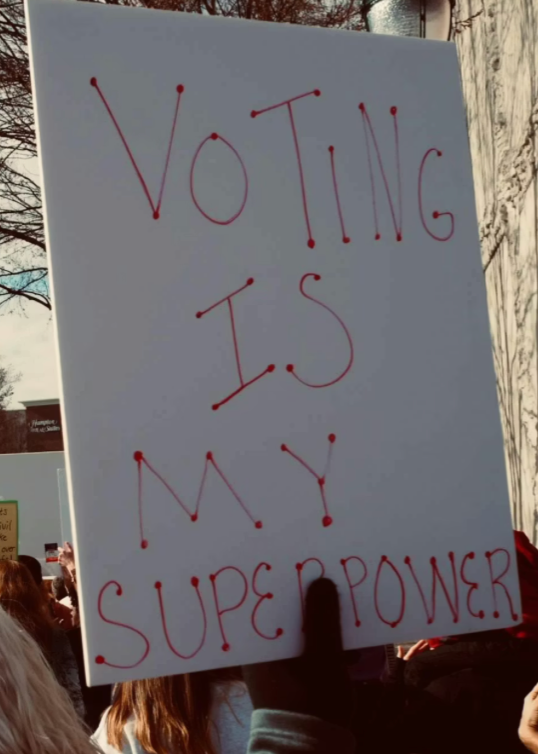
Protest sign advocating for voting rights. Image provided by Barbara Burgess on Unsplash.
Current Debates in Congress
The following pieces of legislation are awaiting votes in today’s 119th Congress:
H.R. 4: The John Lewis Voting Rights Act
Sponsored by Representative Terri Sewell (D-AL), this bill seeks to restore the pre-clearance clause previously contained in Section 5 of the Voting Rights Act of 1965. Under this law, the Department of Justice would identify states with voting rights violations in the past 25 years and require federal approval for changes to their voting laws until they administer 10 years of fair elections. Also, federal observers and mandated public notice of changes in law would be required. Proponents argue that this bill would protect voters from discriminatory laws, while opponents contend that it would infringe upon state authority.
H.Res. 23: Proxy Voting for New Parents Resolution
Sponsored by Representative Brittany Pettersen (D-CO), this legislation proposes allowing members who have recently become parents to vote remotely for up to 12 weeks by altering House procedure. Proponents of this resolution advocate for Congress to incorporate more modern rules. In contrast, opponents argue that this bill could be misused without a constitutional basis.
H.R. 55: Repeal the National Voter Registration Act of 1993
Sponsored by Andy Biggs (R-AZ), this bill attempts to repeal the National Voter Registration Act of 1993 (NVRA). Also known as the “motor voter law”, the NVRA expanded voter access through improving registration opportunities. Proponents contend that repealing the NVRA would limit federal oversight in elections and prevent voter fraud. Opponents argue that this would increase state-level registration barriers, encourage voter discrimination, and reduce election access.
Why This Matters
Accessibility to voting doesn’t just end when one gets to the polls, it includes every step of the voting process, such as registering, receiving the ballot, understanding the materials, and having proper technology. Without these tools, voters can feel defeated by invisible barriers and become discouraged from participating in elections.
Federal election laws, such as the National Voter Registration Act and the Voting Rights Act, require accessible registration procedures, multilingual ballots, and assistance with voting that prevent states from implementing discriminatory registration practices.
Understanding when these federal bills are being voted on and sending your opinion to congress is crucial to having your voice heard.IssueVote is a free resource aimed at keeping Americans informed. Users can track upcoming votes, read short bill summaries, and share their opinions directly with their representatives before they vote.
Have your opinion heard on voting rights, today!
Visit IssueVoter.org to:
✅ Learn about bills before Congress votes on issues you care about
✅ Send your opinion directly to your representatives
✅ Track how your elected officials vote with your own personalized IssueVoter scorecard
IssueVoter is a non-partisan platform that makes civic engagement accessible, efficient, and impactful. Stay up-to-date with legislation and make your voice heard! Sign up for IssueVoter to keep track of Congress from your inbox!
메타데이터
- post_id
- 0279db9fafd2
- slug
- understanding-u-s-election-laws-0279db9fafd2
- url
- https://blog.issuevoter.org/understanding-u-s-election-laws-0279db9fafd2
- canonical_url
- https://blog.issuevoter.org/understanding-u-s-election-laws-0279db9fafd2
- author_url
- https://medium.com/@jayleepace
- status
- ok
- fetched_at
- 2026-06-10 21:21:38