Understanding IRS Form W-8: How to Legally Reduce U.S.
If you’re a non-U.S. person earning income from U.S. sources, you may be surprised to see a 30% tax automatically withheld from your…
Understanding IRS Form W-8: How to Legally Reduce U.S. Withholding Tax as a Foreign Individual or Entity
If you’re a non-U.S. person earning income from U.S. sources, you may be surprised to see a 30% tax automatically withheld from your payments. Whether you’re an international investor, freelancer, content creator, or foreign company working with U.S. clients, this tax can take a serious bite out of your income.
Fortunately, there’s a powerful IRS form that can legally reduce or even eliminate this withholding: Form W-8.
In this article, we’ll break down what Form W-8 is, who needs to file it, and how it can help you save on taxes.
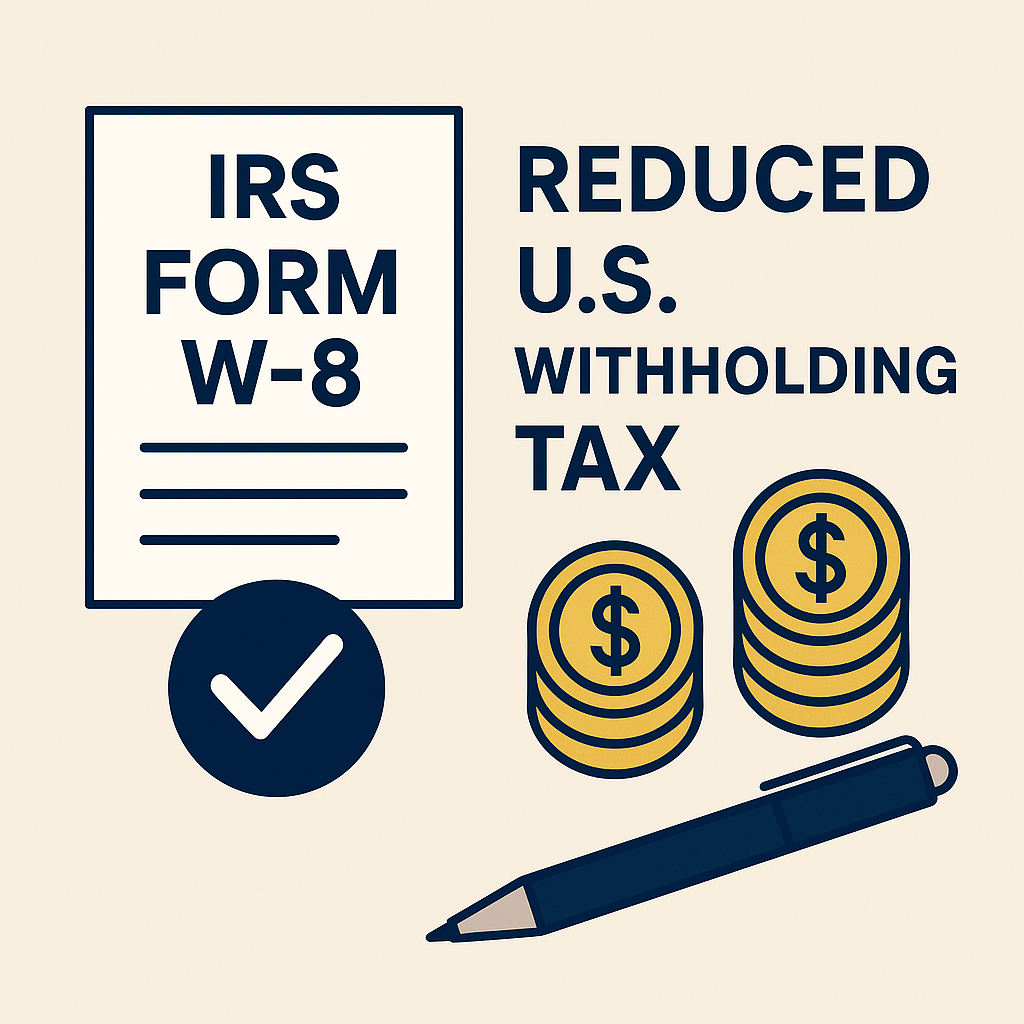
Reduced Withholding Taxes
What Is Form W-8?
Form W-8 is not a single form, but a family of IRS documents used by foreign persons (non-U.S. citizens, residents, or entities) to certify their non-U.S. status and, if applicable, claim tax treaty benefits.
When you earn certain types of U.S.-source income — like dividends, interest, royalties, or service payments — the IRS requires the U.S. payer to withhold 30% unless a valid W-8 is on file.
With a properly completed W-8 form, you may be able to reduce that withholding rate or eliminate it entirely under an income tax treaty between your country and the U.S.
Types of Form W-8
There are several variations, depending on your situation:
- W-8BEN — For individuals, such as investors or freelancers
- **W-8BEN-E — For foreign entities** (companies, trusts, etc.)
- W-8ECI — For income that is effectively connected with a U.S. trade or business (e.g., a branch office)
- W-8EXP — For foreign governments, international organizations, or tax-exempt entities
- W-8IMY — For intermediaries and flow-through entities (e.g., partnerships)
Most individuals will use Form W-8BEN.
Why It Matters: U.S. Withholding Tax and Treaty Relief
By default, the U.S. taxes nonresident aliens and foreign entities at 30% on certain passive or fixed types of income. This includes:
- Dividends from U.S. companies
- Interest from U.S. banks or bonds
- Royalties for intellectual property
- Service income in some cases
But under a tax treaty, these rates are often reduced. For instance:
- Residents of Canada or the U.K. may only be subject to 15% or 0% on dividends or royalties.
- Residents of countries with no treaty (like Brazil or Singapore) may still face the full 30%.
To claim this treaty-based benefit and reduced U.S. withholding tax, you must submit the relevant Form W-8 to your U.S. income source before payment is made.
Common Use Cases
- A freelancer in Germany providing graphic design services to a U.S. client
- A YouTuber in Japan monetizing their channel through a U.S. platform like Google AdSense
- An investor in Australia earning dividends from U.S. stocks
- A foreign software company licensing technology to U.S. customers
Each of these parties can likely reduce their withholding using the appropriate W-8 form.
How and When to File
You don’t send the W-8 form directly to the IRS. Instead, you give it to the U.S. payer or platform (e.g., a broker, payment processor, or business partner). They are responsible for using that information to apply the correct withholding rate.
✅ Key rules:
- Forms are valid for up to 3 years
- Must be kept up to date (e.g., if you move countries or change legal structure)
- You must have a foreign tax ID or, in some cases, a U.S. ITIN
What Happens If You Don’t File?
If you fail to submit a valid Form W-8, the U.S. payer is legally required to withhold 30% on payments — even if your country has a treaty that says you shouldn’t be taxed at all.
And while you can file a U.S. tax return (Form 1040-NR) to try to claim a refund, it’s a long and often complex process.
Final Thoughts
Form W-8 is a simple but critical tool for non-U.S. individuals and businesses earning income from the United States. It ensures you’re not unfairly taxed and allows you to take full advantage of tax treaties that your country has negotiated with the U.S.
If you’re unsure which form to use or how to fill it out, consider speaking with an international tax CPA who specializes in cross-border taxation. Remember that, if you earn ECI income you are not subject to the standard U.S. withholding tax of 30% (on gross income); instead, you will have to file a nonresident U.S. tax return (Form 1040-NR or Form 1120-F) with the IRS to ensure compliance with U.S. tax laws.
메타데이터
- post_id
- 02ae60932bc3
- slug
- understanding-irs-form-w-8-how-to-legally-reduce-u-s-02ae60932bc3
- url
- https://medium.com/@andrea.ricci1990/understanding-irs-form-w-8-how-to-legally-reduce-u-s-02ae60932bc3
- canonical_url
- https://medium.com/@andrea.ricci1990/understanding-irs-form-w-8-how-to-legally-reduce-u-s-02ae60932bc3
- author_url
- https://medium.com/@andrea.ricci1990
- status
- ok
- fetched_at
- 2026-06-28 10:39:35