The Shrine Built Inside — Internalisation, Pious Self-Making, and the Literature of Submission
This piece brings the discussion of aspects of Islamic veiling and the attendant moral-social framework full circle, examining the factors…
The Shrine Built Inside — Internalisation, Pious Self-Making, and the Literature of Submission
This piece brings the discussion of aspects of Islamic veiling and the attendant moral-social framework full circle, examining the factors that ensure that the system persists unflinchingly, perpetuating across generations, eternally unchallenged and effortlessly veiled as choice. Many of the aspects touched upon here can be expanded independently.
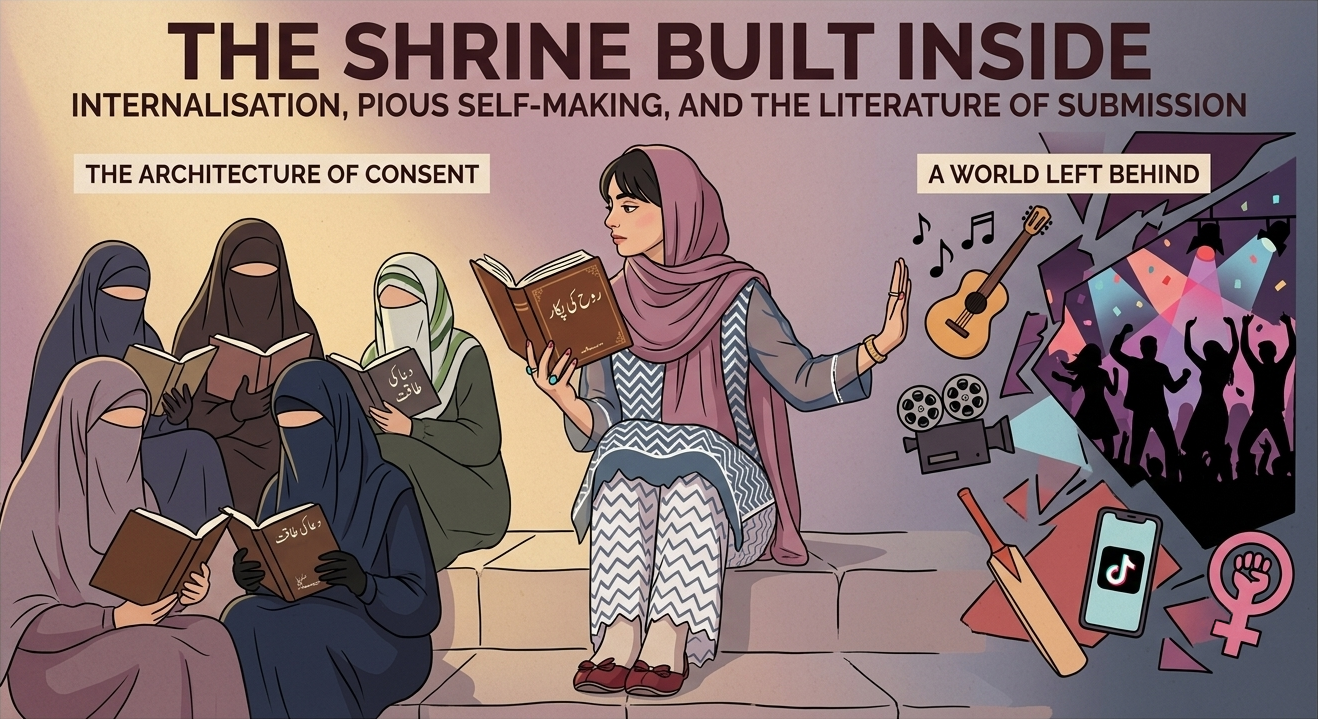
Representational Image. (Created with Gemini; edited.)
The Architecture of Consent
Begin with what the framework produces at its most accomplished. A woman comes to experience the policing of her own appearance not as coercion but as spiritual discipline, as ḥayāʾ — an inward virtue that the outward act of covering helps bring into being. She experiences the restriction of mixed-gender friendships not as curtailment but as protection from fitna. A man’s controlling jealousy, his ghayrah, reads not as possessiveness, much less toxicity, but as proof of love and religious seriousness. And her own desire for adornment, for visibility, for public expression — this she learns to read not as natural but as a temptation from her lower self, her nafs, to be defeated in the same spirit as any other act of worship. The architecture of patriarchal regulation has been rebuilt inside the self. It is experienced there, and often sincerely, as a beautiful shrine.
The most important scholarly account of this process remains Saba Mahmood’s Politics of Piety: The Islamic Revival and the Feminist Subject (2005). Mahmood’s fieldwork with women in Cairo’s mosque movement produced an argument that discomfited both conservatives and Western feminists: that for these women, bodily practices like veiling are directed not outward but inward — towards the cultivation of dispositions. Participating in prayer creates the desire for prayer, weeping creates fear of God, and veiling creates modesty. The goal is the creation of a pious self. This is not metaphor. As Mahmood discusses in relation to the Islamic virtue of female modesty, many of the participants in the mosque movement believe that wearing the veil both expresses modesty and is a means of acquiring it. The veil does not simply signify an interior state; it actively produces it as a disposition.
Mahmood concludes that the trouble lies in the way agency and freedom are often defined by liberal feminism. While some see certain Islamic practices as oppressive, others recognise these preferences — modesty, veiling — as women’s choices. She questions the simplistic differentiation of resistance and repression. Her point is well taken as far as it goes. But it is worth pressing on where Mahmood herself is more circumspect: that the framework within which these women are cultivating themselves remains a gender-asymmetric one. Individual efforts ‘toward self-realisation are aimed not so much at discovering one’s “true” desires and feelings’ as at approximating the exemplary model of the pious self — a model that includes, in her account, pious submission to patriarchal norms. That the submission is chosen does not make it symmetrical.
The Carrot and the Stick, in Tandem
It is worth being clear about the incentive structure that makes internalisation so effective, because it operates simultaneously through reward and threat — piety and stigma, divine promise and social punishment.
The rewards are real and not trivial. Madeleine Chapman’s work on Muslim women who cover shows that they describe modesty as autonomous ethical labour, as devotion to family, and as the de-sexualisation of everyday male-female interaction. The framework offers dignity, clarity, community, and the sense — which Mahmood’s subjects described vividly — of becoming the kind of person one wants to be. Elizabeth Bucar’s Pious Fashion frames this as the creation of ‘public space organised around Islamic moral principles’: to inhabit the framework fully is to belong to a moral community and to be recognised within it.
The penalties for failing to inhabit it are correspondingly severe. The ‘Mattering Moralities’ scholarship frames modesty as rooted in shame and, crucially, in the anticipation of shame — an internalised sense of inadequacy or inappropriateness that precedes any actual transgression. The woman who appears ‘too much’ in public does not wait for social censure; she has already censured herself. Social penalties reinforce this: as Abu-Lughod’s work on modesty discourses makes plain, women’s modesty is a fundamental component of gendered moral systems linked to honour, family reputation, and forms of pressure that operate on the family collectively, not just on the individual woman. To engage in tabarruj is not only to fail personally; it is to implicate one’s father, one’s brother, one’s husband. The social weight of that is not easily borne.
And then there are the theological penalties: divine displeasure, spiritual contamination, the prospect — in hadith literature — of punishment in the hereafter for the ‘clothed yet naked’ woman (Ṣaḥīḥ Muslim 2128). The incentive structure thus spans this world and the next. Between heavenly reward for piety and earthly shame for tabarruj, the framework leaves very little room — which is presumably the point.
Not Passive, Not Free
What Lara Deeb’s An Enchanted Modern adds to this picture is the observation that women are not passive recipients of the framework but central makers of public piety. In the Shiʿi Lebanese context Deeb studies, women are the organisers, exemplars, and transmitters of the moral order — not its victims. This is important for the critique, not as exculpation but as precision: the framework survives and reproduces itself because women actively participate in making it legible, beautiful, and desirable. The system does not need external enforcement at every moment because it has recruited its subjects into the labour of its own reproduction.
Suzanne Brenner’s ethnographic work in Java shows a parallel process: adopting the veil and rejecting tabarruj became a way for women to participate in the broader project of Islamisation and to signal commitment to a new, modern, and pious social order. The Islamic revival, that is, offered women a form of public identity and moral seriousness that secular modernity had not always extended to them — which made the framework attractive rather than merely obligatory. Rachel Rinaldo’s work on Indonesian Islamic revival similarly shows that new public piety, made visible through practices like veiling, has empowered women politically, but that the reforms pursued are, in her phrase, ‘diverse and not necessarily egalitarian.’ Women’s investment in the framework can expand their agency while leaving the hierarchy entirely intact.
The Instagram-era version of this process is documented by Baulch and Pramiyanti in their study of ‘hijabers’: women who use social media platforms to stage idealised veiled femininity as simultaneously lifestyle and dakwah — Islamic outreach. Here, internalisation becomes aestheticised and peer-to-peer. The policing of tabarruj is no longer primarily top-down, a matter of clerics and states; it is lateral, aspirational, and beautifully photographed. Women who have internalised the framework thoroughly enough become its most effective propagandists, and they do so, often, with evident pleasure and creativity.
Popular Fiction and the Romanticism of Submission
If scholarship maps the framework, popular fiction is where it is rehearsed, romanticised, and made emotionally irresistible. The Urdu novel offers some of the most instructive examples, not least because a great deal of it — the canonical example in contemporary literature being the work of Umera Ahmed and Nemrah Ahmed — is addressed directly at women, is explicitly didactic in ambition, and circulates with a reach that no academic text approaches.
Academic work on Urdu women’s romance fiction is sparse. Focussing on novels such as Nemrah Ahmed’s Jannat Kay Pattay, it is observed that works in this genre romanticise the hyper-masculine, controlling man whose ghairat is framed as deeply desirable, protective, and religiously sanctioned — while the heroine’s narrative arc is one of taming her own ‘modern’ impulses and submitting to a pious order. The novel’s plot machinery is worth noting here. Haya Suleman’s life is disrupted when someone leaks a private video of her made at a party; to have it removed, she contacts an officer of the Cyber Crime Cell. She is then unsettled to discover that this faceless officer already knows a great deal about her. The framing of this surveillance — a man who has been secretly monitoring a woman — as romantic rather than alarming is not incidental. It is the novel’s governing emotional logic.
The novel explores themes like faith, hijab, and the inner struggles of a young Muslim woman in today’s world, and does so through a male lead whose secrecy, disguise, and heavy-handed control over Haya are consistently framed as protective rather than predatory. The novel’s exegesis of Surah al-Ahzab — the very passage containing the tabarruj prohibition — strongly reminiscent of sermons at Islamic centres and in courses such as Al-Huda’s, is woven into the romance plot: Haya’s ‘empowerment’ is her embrace of modesty, obedience, and religious submission. Tabarruj is explicitly identified as the cause of the harassment she suffers in the novel’s early pages, making the victim responsible for the conduct of those around her. The cure, naturally, is the transformation the male lead helps engineer. Readers have praised the novel specifically for its treatment of hijab and its explication of the verses of hijab in Surah al-Ahzab. The didactic intent is absorbed as spiritual insight. This is internalisation operating through the pleasure of narrative, which is perhaps its most powerful vector.
Nemrah Ahmed’s other major work, Namal, doubles down on this logic, quite literally. Its protagonist Faris Ghazi embodies what might be called ‘the attractive ghayrah’: intense protectiveness and emotional dominance presented as the most romantic possible version of masculinity. The second prominent male figure, Hashim Kardar, takes the template to its extreme — a cold, charming, psychologically manipulative man whose ‘tragic’ interior is held up as explanation if not quite justification for his conduct. Both characters are, by the testimony of the novel’s enormous readership, deeply beloved. Readers ‘frequently idolise’ Kardar as a ‘magnetic, tragic anti-hero’ — which is, to put it plainly, the romanticisation of a pattern of behaviour that in any other context would be identified without hesitation as abuse.
Umera Ahmed’s Amar Bail offers a starker case still: here, the male lead’s toxicity is not redeemed — he does not undergo the spiritual journey that redeems Salar in her Peer-e-Kamil or repositions Qalb-e-Momin’s arrogance as a classic Sufi ego-death in Alif (though both instances that arguably sidestep their earlier flaws and evade a critique in favour of a spiritual rediscovery) — but is instead glorified tragically, making it one of the more unguarded examples of romanticised abuse in the Urdu literary canon. (Those who have read Peer-e-Kamil closely will know that the novel has a separate and rather significant problem of representation entirely distinct from this question — one deserving its own treatment in another conversation.)
The earlier Urdu literary tradition handled these dynamics differently but not, in the final analysis, more honestly. Mirza Hadi Ruswa’s Umrao Jaan Ada depicts the male patrons of Lucknow’s koṭhā culture — fickle, possessive, ultimately abandoning — without condemnation, because Ruswa was writing realist naturalism: the exploitation was the environment, not the aberration. This is what might be called the historical naturalism of male toxicity, where abuse is rendered as inescapable social weather. Subsequent adaptations of the novel have, predictably, softened the toxicity and leaned towards romanticisation. Abdullah Hussein’s fiction (Nadaar Log, Udaas Naslein) offers a variation: the post-Partition male’s emotional cruelty and detachment are wrapped in existential dread and philosophical brooding, so that generations of readers have read the coldness as tragic depth rather than as the straightforward emotional abuse it frequently is. Call it existential masking. Altaf Fatima’s Dastak Na Do performs a related operation through prose style: the patriarchal distance of the male figures is so beautifully rendered, so melancholically composed, that the coldness takes on an aura of tragic mystery. Aesthetic normalisation — beautiful writing as moral anaesthetic.
Bano Qudsia’s Raja Gidh is the most intellectually ambitious entry in this tradition and the most ambiguous. The novel’s central thesis — that committing ḥarām, including emotional exploitation and predatory desire, corrupts the self at a fundamental level, with consequences that pass down through generations — is a genuine attempt to condemn the behaviour it depicts. And condemn it in outcome it does: the problem men do not triumph; they are ruined. But the structural critique is, in the end, displaced onto a pseudoscientific cosmic theory of ḥarām and genetic insanity, rather than directed at the patriarchal social system that enables the behaviour in the first place. Worse, the novel’s narrative weight falls substantially on the male perpetrator’s suffering and spiritual journey, centering his trauma in a story that begins with a woman’s destruction. It is a moral critique that somehow still manages to make patriarchy the hero of its own undoing.
The System That Teaches Itself to Sing
What the scholarship on internalization makes clear — and what the popular fiction illustrates in practice — is that the most durable systems of social regulation are not those maintained by external force alone but those that have successfully recruited their subjects into the affective and aesthetic labour of self-regulation. Talal Asad’s theoretical work in Genealogies of Religion provides the deep architecture: Islam is an orthopraxic tradition in which right practice and bodily discipline are central to the formation of the pious self. Internalisation is not, in this framework, false consciousness or the failure of critical thinking. It is the system working exactly as designed.
The woman who veils is not deceived. She is formed. That is precisely the point — and precisely the problem. Because the formation is asymmetric: it is she, not the man whose ghayrah nominally mirrors her ḥayāʾ, who is asked to discipline her scent, her gait, her jewellery, her friendships, her visibility, her desire for adornment. The burden of the entire edifice falls on her body, her choices, and her interiority. He is asked to feel protective jealousy; she is asked to become, structurally, the occasion for it.
Islamic feminists — Amina Wadud, Asma Lamrabet, Margot Badran — have each challenged this asymmetry at its exegetical roots, arguing that the traditions used to justify female restriction are read through androcentric assumptions that the texts themselves need not sustain. Fatima Mernissi’s foundational work re-read the hadith record to argue that many of the traditions used to confine women to domestic and modest roles are of dubious authenticity and transparently political motivation. Abu-Lughod notes directly that feminist goals — ending punishment for sexual infractions, expanding women’s public roles, refusing to reduce women to their sexual identities — are difficult to reconcile with dominant modesty discourses. That difficulty is not a technical one, soluble by better jurisprudence. It runs through the conceptual heart of the framework.
Tabarruj is not, then, merely a prohibition on showy dress. It is the name given to the perceived disorder against which an entire order — veiling, ghayrah, gender segregation, the ‘protection’ discourse, the romance of pious submission — defines itself. The woman who has fully internalised the framework does not experience this as restriction; she experiences it as who she is. That is not a reason to abandon the critique. It is the most important reason to pursue it.
References
- Abu-Lughod, L. (n.d.). ‘Modesty Discourses.’
- Ahmed, U. Peer-e-Kamil. Lahore: Al-Faisal Nashran.
- Ahmed, U. Alif. Lahore: Al-Faisal Nashran.
- Ahmed, U. Amar Bail. Lahore: Al-Faisal Nashran.
- Ahmed, N. (2013). Jannat Kay Pattay (first published in Shuaa Digest, 2012–13). Lahore: Maktaba Shuaa.
- Ahmed, N. Namal. Lahore: Maktaba Shuaa.
- Asad, T. (1993). Genealogies of Religion: Discipline and Reasons of Power in Christianity and Islam. Baltimore: Johns Hopkins University Press.
- Badran, M. (2009). Feminism in Islam: Secular and Religious Convergences. Oxford: Oneworld.
- Baulch, E. & Pramiyanti, A. (2019). ‘Hijabers on Instagram: Visualising the ideal Muslim woman.’ In A. Athique & E. Baulch (eds.), Digital Transactions in Asia. London: Routledge.
- Brenner, S. (1996). ‘Reconstructing Self and Society: Javanese Muslim Women and “the Veil”.’ American Ethnologist, 23(4), 673–697.
- Bucar, E. (2017). Pious Fashion: How Muslim Women Dress. Cambridge, MA: Harvard University Press.
- Chapman, M. (2018). ‘Modesty, liberty, equality: Negotiations of gendered principles of piety among Muslim women who cover.’ Feminism & Psychology, 28(3), 361–381.
- Deeb, L. (2006). An Enchanted Modern: Gender and Public Piety in Shi’i Lebanon. Princeton: Princeton University Press.
- El Shirazy, H. Ayat-Ayat Cinta (Verses of Love). Jakarta: Republika.
- Fatima, A. Dastak Na Do. Lahore.
- Hussein, A. Nadaar Log.
- Hussein, A. Udaas Naslein. Lahore: Sang-e-Meel.
- Lamrabet, A. (2018). Women and Men in the Qur’an. Basingstoke: Palgrave Macmillan.
- MacLeod, A. E. (1991). Accommodating Protest: Working Women, the New Veiling, and Change in Cairo. New York: Columbia University Press.
- Mahmood, S. (2005). Politics of Piety: The Islamic Revival and the Feminist Subject. Princeton: Princeton University Press.
- Mernissi, F. (1991). The Veil and the Male Elite: A Feminist Interpretation of Women’s Rights in Islam. Reading, MA: Addison-Wesley.
- Qudsia, B. Raja Gidh. Lahore: Sang-e-Meel.
- Rinaldo, R. (2010). ‘The Islamic revival and women’s political subjectivity in Indonesia.’ Women’s Studies International Forum, 33(4), 422–431.
- Ruswa, M. H. (1899). Umrao Jaan Ada. Lucknow: Munshi Nawal Kishore.
- Ṣaḥīḥ Muslim, Hadith 2128.
- Wadud, A. (1999). Qur’an and Woman: Rereading the Sacred Text from a Woman’s Perspective. Oxford: Oxford University Press.
- Yakin, A. U., Duderija, A. & Van Raemdonck, A. (eds.) (2023). Shame, Modesty, and Honor in Islam. London: Bloomsbury Academic.
메타데이터
- post_id
- 02b28c4d96ab
- slug
- the-shrine-built-inside-internalisation-pious-self-making-and-the-literature-of-submission-02b28c4d96ab
- url
- https://medium.com/@amarshivananda/the-shrine-built-inside-internalisation-pious-self-making-and-the-literature-of-submission-02b28c4d96ab
- canonical_url
- https://medium.com/@amarshivananda/the-shrine-built-inside-internalisation-pious-self-making-and-the-literature-of-submission-02b28c4d96ab
- author_url
- https://medium.com/@amarshivananda
- status
- ok
- fetched_at
- 2026-06-09 15:37:30




