The Level That Never Arrives
Why Mercedes and BMW abandoned Level 3 self-driving — and why the road to autonomy runs downhill from robotaxis, not up from Tesla-style…
The Level That Never Arrives
Why Mercedes and BMW abandoned Level 3 self-driving — and why the road to autonomy runs downhill from robotaxis, not up from Tesla-style assist.
For a decade, Level 3 self-driving hovered on the horizon — always a year or two away, never quite arriving. It was meant to be the leap from lane-keeping and cruise control to genuine eyes-off autonomy: the driving where you could answer email or let your mind wander while the car handled the rest. Automakers lined up to insist it was imminent, each promising its own breakthrough just over the next hill.
Then, in early 2026, the two companies that had actually shipped it quit.
Mercedes-Benz quietly shelved Drive Pilot, the eyes-off system that was supposed to redefine luxury driving. The 2026 S-Class, its flagship, now arrives with a Level 2++ system — hands-off, but eyes on the road. You’re still supervising the machine. BMW followed, scrapping Personal Pilot L3 from the 7 Series and dialing it back to Level 2. The reasons were no mystery: the tech was expensive, demanded specialized hardware, struggled outside ideal conditions, and, most tellingly, found few takers.
So the long-promised level is the one being quietly abandoned — not by the stragglers, but by the only two automakers who actually reached it. It’s a strange fate for a rung everyone insisted was climbable. And the retreat isn’t because the engineering suddenly got harder. It’s that the rung was always a mirage: close enough to chase, never close enough to touch.

The Ladder, and the Catch
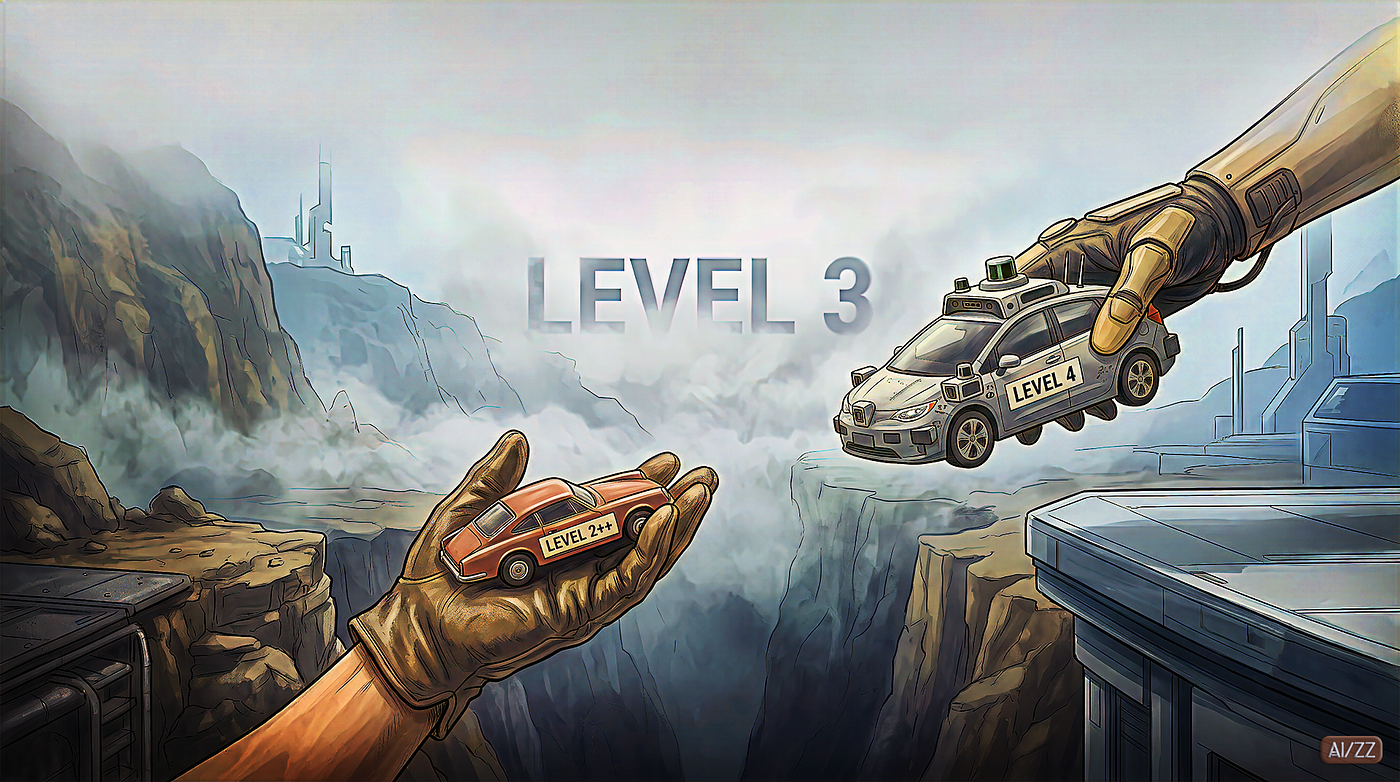
Level 3 isn’t just another rung on the autonomy ladder. Level 2 is your car lending a hand while you keep hold of the reins. Level 4 is the car as chauffeur, handling everything inside its zone, while you could be napping in the back. Level 3 sits between them — and the real question isn’t how much the car does. It’s who takes the fall when something goes wrong.
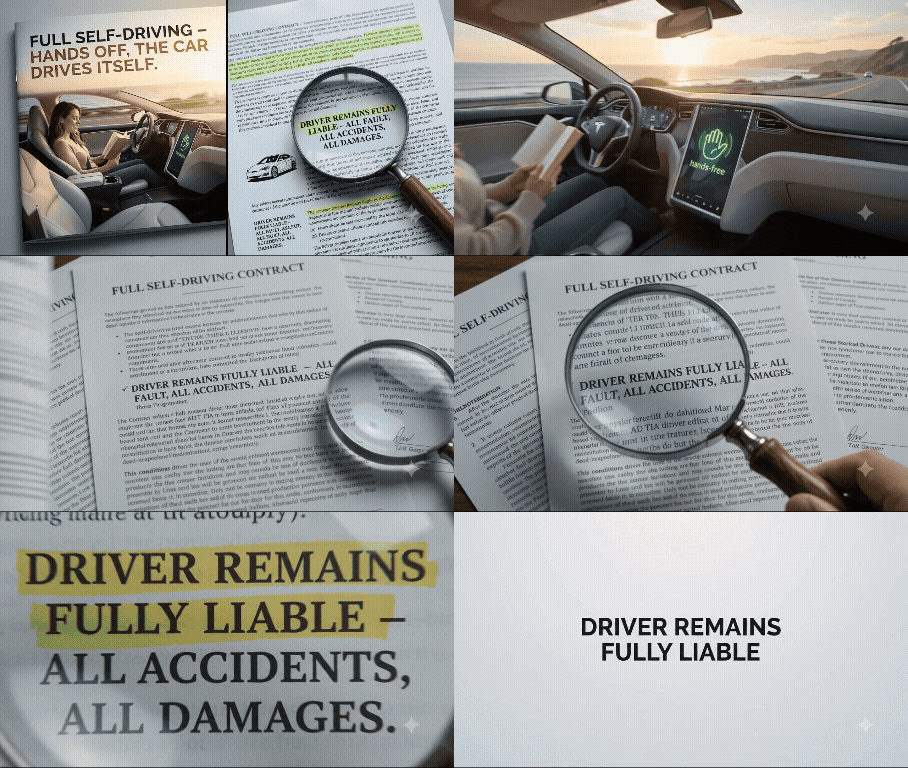
At Level 2, however clever the tech, the law still sees you as the one in charge. Level 3 changes that, as long as the system is active, the automaker is on the hook. You can let go of the wheel and look away, and if something goes wrong, it’s the company’s problem, not yours. That’s the real headline for Level 3 — the moment the blame shifts from driver to designer.
But Level 3 cars aren’t free-range. They operate only inside a fenced-off set of conditions, and when the car reaches the edge of that zone, it hands control back to you. You’re the fallback. You can tune out — until the car abruptly asks for your attention and gives you a few seconds to re-engage with a task you’d stopped doing. That handoff is baked into Level 3, and nobody’s cracked it yet.
Why the Climbers Turned Around
Look past the press releases at what Mercedes and BMW actually delivered, and the retreat makes sense. Drive Pilot only came alive on pre-mapped highways, in clear weather, and only if you were crawling at about 40 miles per hour, bumper-to-bumper, following the car ahead. BMW’s version was narrower still — a traffic-jam assistant that barely broke into a trot. Both leaned on expensive lidar, both added thousands to the sticker price, and in return, you got a hands-off experience for the least eventful stretch of the drive: the slow-motion parade, in good weather, on a handful of approved roads.
That narrow window wasn’t a failure of nerve. It was the hard ceiling of what the hardware/software could do. Remember what Level 3 requires: the company, not the driver, takes the fall. You can’t take the fall for driving you can’t guarantee, so the certified conditions shrink to exactly the ones the system can guarantee — the traffic jam, the mapped highway, the clear sky. That narrowness isn’t a speed bump on the way to full autonomy. It’s a readout of what the hardware can actually promise today.
This is the same wall the liability question always hits. To take the blame, you need enough to stand behind — maps, sensors, layers of redundancy. Build a little, and you can stand behind a little: slow traffic, clear skies, mapped roads. To widen the domain, the hardware bill climbs much faster than the payoff. Mercedes and BMW ran the numbers and found that a handful of hands-off minutes didn’t justify the cost. So they stepped away.
The Wrong Lesson
There’s a story being told about this retreat, and it’s the wrong one. It goes like this: Tesla was the lone genius, sidestepping the Level 3 arms race while the Germans burned cash on lidar and eyes-off tech nobody asked for. It’s a tidy narrative, and reality is rarely that convenient.
Half of that is true. The other half is the trap.
This isn’t really a story about technology. It’s a story about dodging accountability. Tesla didn’t solve the problem that tripped up Mercedes and BMW — it declined to take it on. By staying at Level 2++, it kept the driver on the hook and never had to build the safety net that taking the blame requires. The Germans are now following suit — not because Tesla built a smarter robot, but because it found a clever way to pass the buck. Level 2++ isn’t a technological triumph. It’s the industry’s cheapest escape hatch, shifting the risk from company to customer.

So forget the autonomy breakthrough. This really is a masterclass in risk avoidance. And the real question hasn’t budged: if true eyes-off driving — where the company, not the driver, takes the fall — is worth having, and it is, that’s the whole point, then who’s going to build it? Because so far, the only thing Mercedes and BMW have engineered is a graceful retreat.
Which Way the Level Comes From
Here’s the claim the retreat clears the ground for. Real Level 3 — the kind that works beyond crawling through traffic — isn’t something you cobble together from a pile of driver-assist features. You reach it by starting with a system that’s already more capable, then scaling it back to fit.
If you want a car to take the wheel across a whole city, you need a system that’s already shown it can do that job without a human safety net — which means something close to Level 4. Right now, only the robotaxi outfits — Waymo and its peers — have built that. They map obsessively, stack redundant sensors, and run cars with empty driver’s seats, but only inside tightly mapped zones. In those zones, the car is the one responsible when something goes wrong. That’s the bedrock Level 3 depends on, and you can’t get there by polishing Level 2 year after year.
So the real path is the opposite of what carmakers pitch. The usual story is a funnel: start with a mass of Level 2 cars, upgrade to Level 3, eventually reach Level 4, each step paying for the next. But that’s not how the technology moves. A true wide-domain Level 3 is just a Level 4 robotaxi setup, dialed back and dropped into a private car, with a human ready to take over. If there’s a funnel here, it runs downhill. Level 3 isn’t a stepping stone to Level 4 — it’s a hand-me-down from it.
Which reframes what Mercedes and BMW attempted. They reached Level 3 by stacking conventional driver-assist hardware and hit the same wall that stops everyone from building from the ground up. And when Mercedes pulled back, it announced a new focus: developing Level 3 and Level 4 in tandem. Even the company that quit is now building both at once, from the top — because that’s where the technology comes from.
The Seam That Never Closes
Say a robotaxi company finally does it: takes its Level 4 system, turns down the dial, and sells it to you as Level 3 for your own car. On paper, a win. But look closer at what’s actually handed back to you and why it matters.
A true Level 4 system cleans up its own messes. When it reaches a situation it can’t handle, it doesn’t call for a human — it pulls over, parks, and ends the trip. No human in the loop, because there’s no loop left. Dial that same system down to Level 3 and drop it into your driveway, and you put the human fallback right back in the seat. Instead of quietly bowing out, the car taps you on the shoulder and says “your turn” — right when you’ve tuned out.
That handoff is a transfer, and it’s the same move at the heart of the whole autonomy business: the risk at the boundary, moved off the machine and onto you. Level 4 absorbs that risk itself. Level 3 lets you zone out until the one moment it matters, then hands the risk back at exactly the point things get hard. Even if you get Level 3 through all the proper channels, you’re the one holding it when the stakes are highest. The system handles the easy stretch; when the road gets rough, it’s back to you.
The Reason It Won’t Come
You might imagine transplanting robotaxi software straight into an ordinary car, as if it were just another app. But that never makes it off the drawing board for reasons unrelated to engineering. The roadblock is that the companies holding the keys have no reason to unlock the door.
The advantage of any robotaxi outfit isn’t just the code or the sensors — it’s the mountain of driving data it has accumulated over years of real-world testing. That data is the moat, and no one else can buy it. Licensing the stack to carmakers for their Level 3 systems would hand that moat to the very companies it competes with — turning an un-buyable edge into a commodity available to anyone with a checkbook. Why spend years and billions building a moat, only to rent it out by the carload?

So the result is a stalemate. Carmakers have found that building true Level 3 is a money pit — Mercedes and BMW are the cautionary tale. And the robotaxi firms won’t share the tech that is their whole advantage. One side lacks the means; the other lacks the motive. The gap stays empty. Level 3 isn’t just a missing rung on the ladder — it’s the one place where nobody has both the toolkit and the reason to bridge it.
Where It Actually Breaks
Underneath all of it is a single technical question, and it’s the one those domain limits are really tracking: where do I store the fix?
Owners of the most aggressive Level 2++ cars keep hitting the same glitch: the car fumbles the same spot, every time — a particular off-ramp, a stubborn intersection — and the mistake survives the software updates. A new version arrives, and it still botches the same corner. That’s the tell. If this were a horsepower problem, the blunders would scatter, random failures in random places. The same error at the same spot across versions points to the same issue: the system has nowhere to store the fix.
That’s the real job of a map. It’s not a convenience — it’s the place you write down “this corner behaves like this,” so a fix actually sticks. A system that tries to keep everything within its own weights has nowhere to log the correction; the only remedy is to retrain the whole model and hope that the next version rediscovers the same error, since there was nowhere to put the fix. Waymo gets ribbed for leaning on high-definition maps, but that’s not a flaw — it’s a place to keep every correction, which is exactly what makes the system dependable enough to take the fault. Waymo’s stack, the map, and the ability to hold the liability are the same thing from three angles: somewhere to store what the car has learned. Bottom-up systems don’t lack brute force. They have nowhere to put the answer. They have nowhere to store the fix.
The One Thing That Would Change It
Think of this as a snapshot, not a prophecy — a description of the era before machines can genuinely reason.
Right now, a driving system is like a tourist who needs every street marked out before stepping outside. It can’t improvise — it’s never seen this intersection, and it can’t reason through it the way a person does — so every turn has to be spelled out in advance, on a map, in code, in a lookup table. Lift that restriction — build a system that can actually reason its way through the unknown — and the whole landscape shifts. A machine that can think through a new corner doesn’t need the corner preloaded. The endless maps and elaborate prep become relics. Having to build everything in advance is a symptom of what these systems can’t do yet, not an iron law.
The real question is whether that kind of reasoning is on the horizon — whether the next generation of models can genuinely think a problem through, or are just pulling answers from a giant Rolodex. That’s what every lab is chasing, DeepMind included. If one of them gets there, the need for the map dissolves, and the whole top-down logic of Level 3 goes with it; the level could suddenly come from anywhere. For now, the claim holds in its narrow form: if you want Level 3 to work everywhere, you’re still hauling the heavy hardware/software stack down from Level 4, because there’s no shortcut to having the answer ready before you need it.
The Empty Rung
The reason this level never shows up isn’t some missing miracle just over the horizon. It’s a structure designed to keep it out of reach.
Carmakers took a shot at it from the ground up and hit the wall that the fault-line always produces: making it safe enough costs more than the payoff. So they retreated to the version where you, not they, carry the risk. The robotaxi outfits could bring it down from the top, but that would mean surrendering the one thing that gives their business its edge. So the result is a gap in the middle — and in that gap sits the dream: a car that handles your commute while you check your email and answers for itself when it slips.
This promise matters — not just for what it could deliver, but for what its absence reveals. Level 3 is the line where a company finally has to own the driving, rather than sell it. That nobody has crossed it — hemmed in by cost on one side and self-preservation on the other — isn’t a story about technology running late. It’s an industry that has mastered every way to sell autonomy except the one that puts it on the hook. The level that never arrives is the level where, for once, someone else would take the fall — no wonder no one’s in a hurry to build it.
· · ·
AV Series · July 2026
Related: Tesla Washing · Five Thousand Cars That Aren’t There · Autonomy in the Brochure, Accountability in the Contract · Tesla Narrative Problem.
메타데이터
- post_id
- 02b28e951876
- slug
- the-level-that-never-arrives-02b28e951876
- url
- https://medium.com/truthseeker-journey-to-wisdom/the-level-that-never-arrives-02b28e951876
- canonical_url
- https://medium.com/truthseeker-journey-to-wisdom/the-level-that-never-arrives-02b28e951876
- author_url
- https://medium.com/@zygmundzee
- status
- ok
- fetched_at
- 2026-07-08 21:45:35