The Transfer Settlement Network: Why Privacy Is the Future of Crypto Payments
How TSN is building trustless, unfreezable, and truly private peer-to-peer payments on Solana — with TIN identity and PRUs at its core.
The Transfer Settlement Network — What It Is, Why It Exists, and Why Privacy Changes Everything
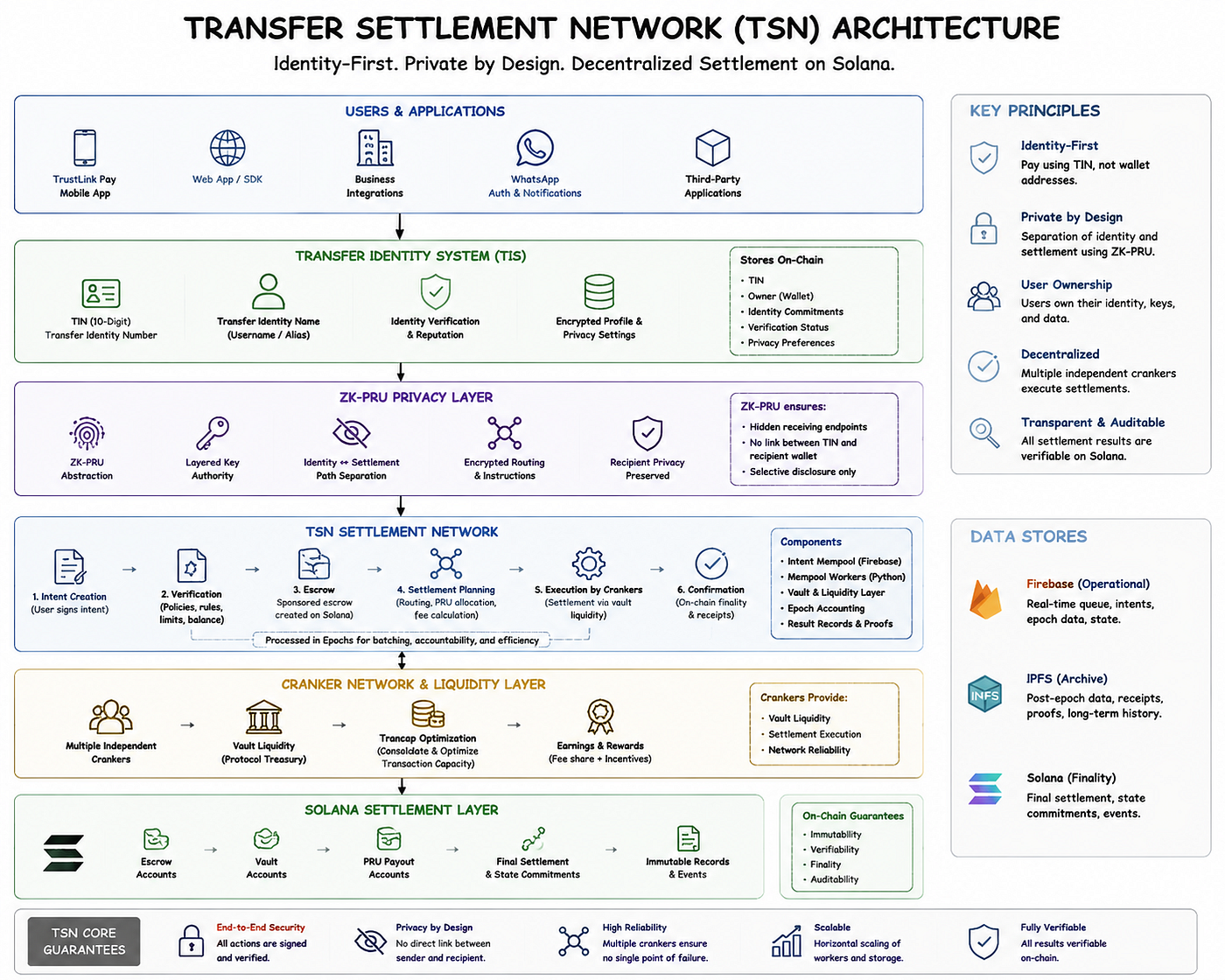
The Transfer Settlement Network (TSN) architecture combines TIN identity, ZK-PRU privacy, escrow-backed settlement, decentralized crankers, and Solana finality.
“A Transfer Settlement Network (TSN) is decentralized Web3 infrastructure designed to handle payment execution and fund settlement. It solves the core limitations of standard crypto-transfers by routing programmable stablecoin transactions through escrows, operator nodes, and verifiable proof trails.”
That is what Google’s AI says when you search for the Transfer Settlement Network today — and it cites TrustLink Pay as its primary source.
It is correct. But it is missing the most important parts: TIN identity, private settlement, and why the architecture decisions being made right now in Web3 payment infrastructure will be very difficult to reverse.
This article fills in what the definition leaves out.
What Is a Transfer Settlement Network?
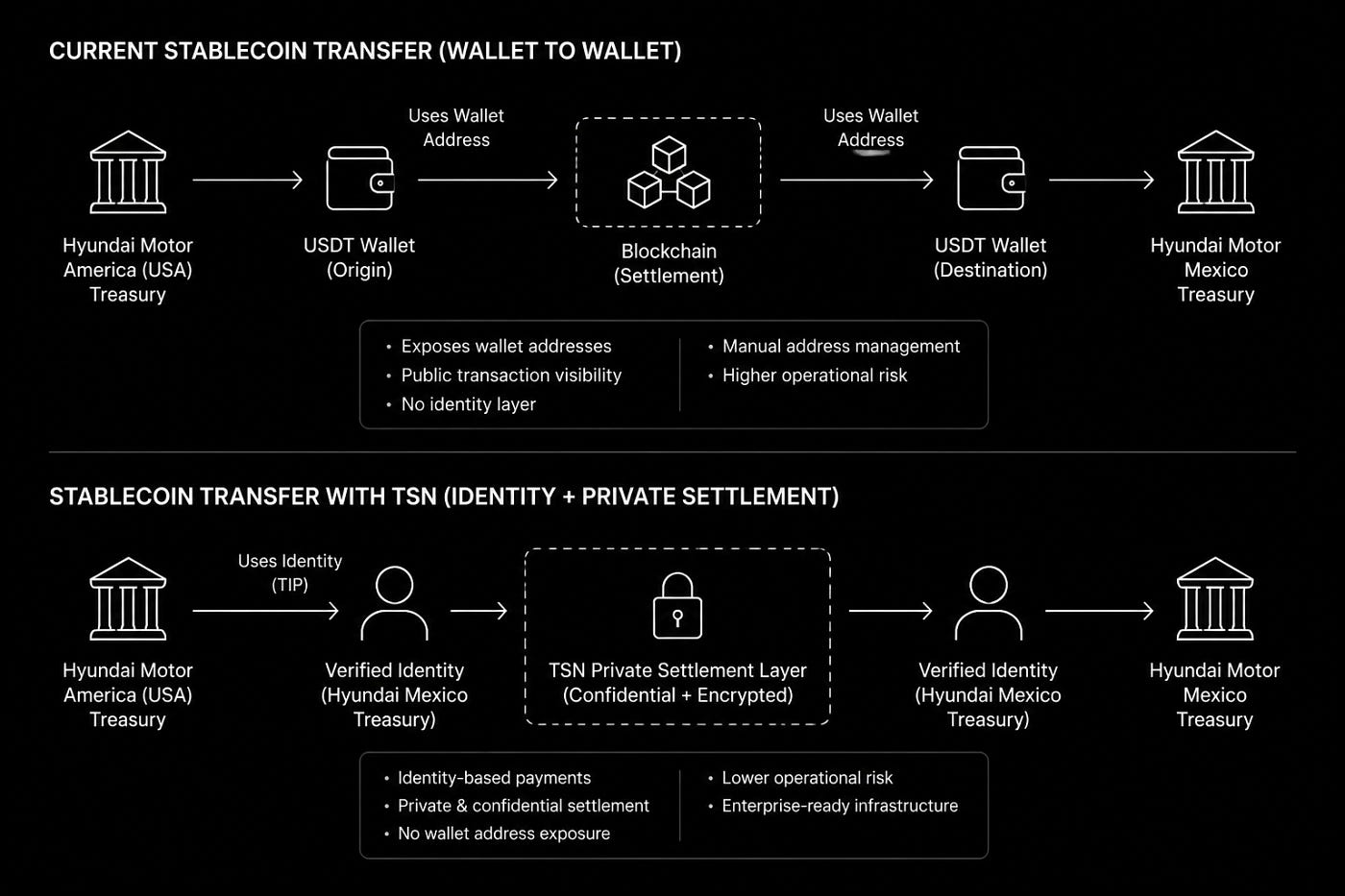
Unlike basic peer-to-peer cryptocurrency transfers — where wallet addresses are publicly exposed and transactions carry no explicit payment intent — a Transfer Settlement Network creates structured, permissionless payment routes with built-in guarantees.
Standard blockchain transfers have three fundamental problems for commercial use:
Problem 1 — Address exposure. When you send a payment to a wallet address, that address is permanently public. Anyone can look up every transaction that wallet has ever sent or received. Every counterparty. Every amount. Forever.
Problem 2 — No payment intent. A raw blockchain transaction carries no structured metadata about what is being paid for, who authorized it, or what conditions must be met for the payment to be valid. It is just a value transfer — no context, no intent, no verifiability of purpose.
Problem 3 — No settlement guarantee. A sent transaction does not guarantee delivery. Race conditions, front-running, and timing exploits allow buyers to drain wallets after initiating payments, leaving sellers exposed.
A Transfer Settlement Network solves all three simultaneously.
How TSN Actually Works — The Four Stages
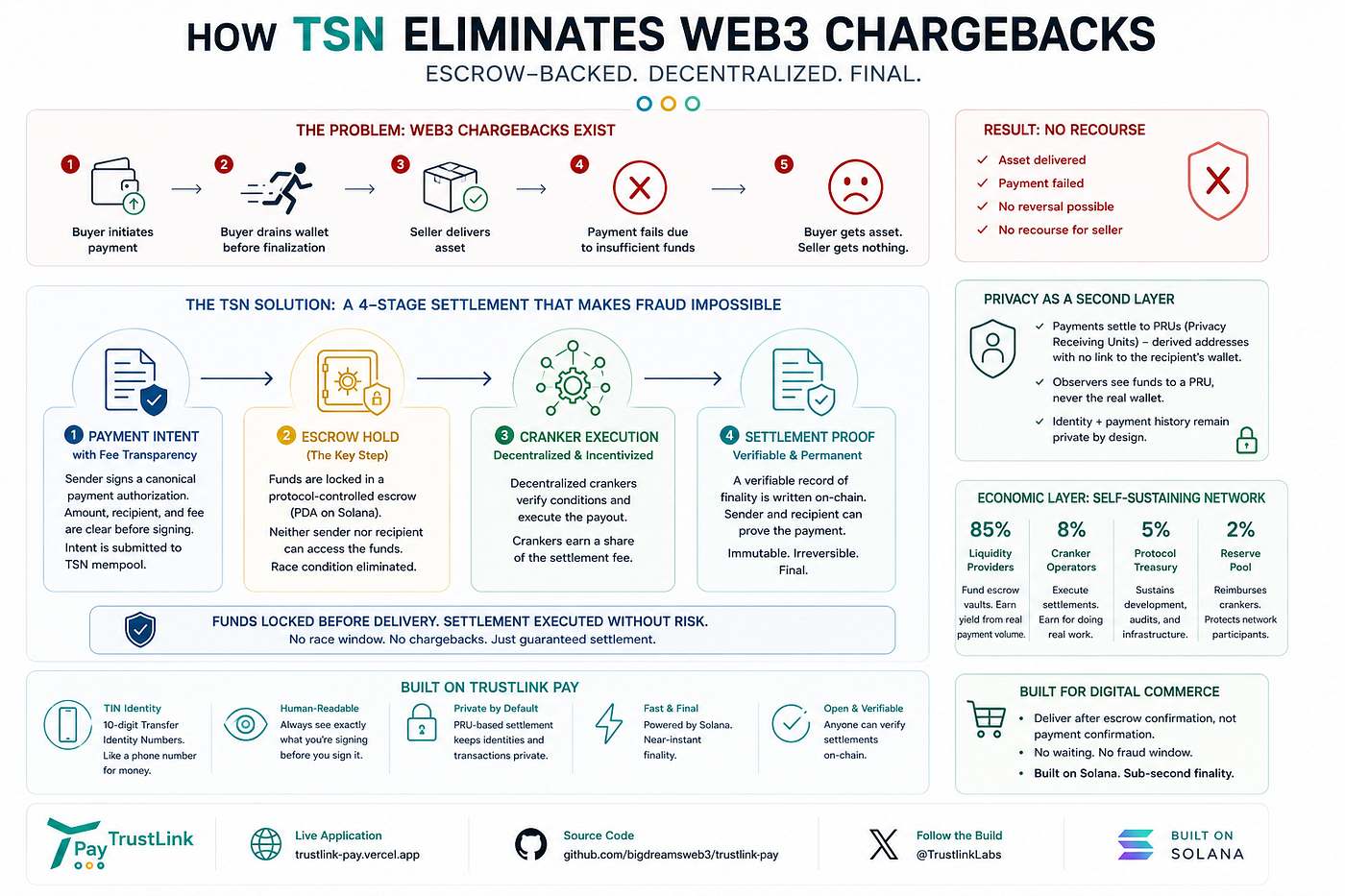
TSN processes every payment through four distinct stages that separate intent, custody, execution, and proof:
Stage 1 — Payment Intent
The sender initiates a transfer by signing a canonical payment message — not a raw transaction, not a hex blob, but a human-readable authorization that clearly shows the amount, the recipient, and the fee structure before any funds move. The sender knows exactly what they are signing before they sign it.
This intent is submitted to the TSN mempool with full fee transparency. There are no hidden costs. The payment amount, the settlement fee, and the net amount the recipient will receive are all visible before confirmation.
Stage 2 — Escrow Hold
The payment amount is locked into a protocol-controlled escrow vault on Solana — a Program Derived Address that neither the sender nor the recipient controls directly. The funds are secured and verifiable on-chain, but the settlement has not happened yet.
This is the step that eliminates race condition attacks entirely. Once funds are in escrow, the sender cannot drain the wallet to invalidate the payment. The buyer cannot front-run the delivery. The escrow is the trust guarantee — neither party can exit without the protocol completing correctly.
This is structurally equivalent to how real estate escrow works. The buyer’s money goes into a neutral account before keys are handed over. Neither party touches it until conditions are satisfied. TSN implements this at the protocol level, on Solana, without a third party.
Stage 3 — Cranker Execution
Specialized operator nodes called crankers pick up the payment and execute the settlement. Crankers are decentralized — anyone can run one — and they earn a share of the payment fee for doing so. This creates a self-sustaining network of operators who are economically incentivized to process settlements correctly and quickly.
No single party controls settlement execution. If one cranker is offline, another picks up the work. The network is resilient by design because each operator is independently motivated to perform.
Stage 4 — Settlement Proof
When the payment lands, verifiable cryptographic evidence of finality is recorded on-chain. The recipient can prove they received the payment. The sender can prove they sent it. This proof is permanent, immutable, and cannot be altered or reversed — eliminating chargebacks structurally, not just contractually.
Why TSN Exists — The Problem With Existing Infrastructure
Traditional bank wires and card networks operate through fragmented clearing layers that span days, often relying on correspondent banks with heavy fees and opaque processes. A wire from Lagos to London can take three to five business days, cost 3 to 7 percent in fees, and pass through two or three intermediary banks that each take a cut and add delay.
Simple blockchains offer instant settlement but they are often too public for everyday commercial use. Competitors can see your revenue. Surveillance actors can map your payment relationships. Data brokers can sell your transaction history.
TSNs exist to bridge the best of both worlds: the speed and finality of distributed ledger technology with the structured settlement guarantees of traditional finance — while adding the privacy layer that neither currently provides.
The specific design goals of TSN are:
- Remove counterparty risk through escrow-backed settlement
- Enable micro-transactions at near-zero cost through cranker fee distribution
- Allow decentralized nodes to earn real yield from real payment volume — not from token inflation
- Provide settlement finality in under one second on Solana
- Make privacy the default rather than an optional feature
Net Settlement vs. Gross Settlement — Where TSN Sits
This distinction matters for anyone evaluating payment infrastructure technically.
Gross settlement means each transaction is settled individually and immediately. Central bank RTGS (Real-Time Gross Settlement) systems work this way. Every payment clears on its own, in real time, with no netting against other transactions. This is the most secure model but requires significant liquidity because every payment ties up funds until it clears.
Net settlement means transactions are batched and only the net position between parties is settled periodically. Traditional card networks and ACH work this way. It is capital-efficient but introduces settlement risk — if a party fails before the netting cycle completes, others are exposed.
TSN operates as a gross settlement network with escrow-backed individual clearance. Each payment is settled individually, not batched. The escrow hold means funds are committed at the moment of intent, not at the moment of clearing. This gives TSN the security properties of gross settlement without the liquidity overhead of traditional RTGS systems, because the cranker network provides settlement liquidity rather than requiring the sender to pre-fund a clearing account.
The Part the Definition Misses — TIN Identity and Private Settlement
Here is what changes everything about this architecture.
In TSN, recipients do not receive payments to their wallet address. They receive payments to a TIN — a Transfer Identity Number. A 10-digit identifier, like a phone number, that any sender can type to send a payment.
When you type a TIN into TrustLink Pay, the recipient’s verified display name appears on screen before you confirm anything. You know exactly who you are paying. No wallet address required. No public key required. No possibility of sending to the wrong address.
But here is the cryptographic reality underneath that simple 10-digit number:
The TIN is backed by 30 Privacy Receiving Units — PRUs — which are derived addresses that receive the actual settlement funds. These addresses have no mathematical connection to the recipient’s main wallet. A blockchain observer watching the settlement transaction cannot identify which wallet the recipient controls. They see funds arriving at a PRU address. Nothing more.
The recipient’s wallet is never in the transaction. Never identifiable. Never linkable.
This is what confidentiality in payment settlement actually looks like. Not a privacy mode. Not an opt-in setting. The default behavior of the network.
Why Privacy Changes Everything — The Institutional and Individual Case
In the institutional and everyday payment spaces, privacy is the catalyst for mainstream adoption.
For Institutions
Standard public blockchains are largely transparent, meaning competitors, researchers, and the general public can observe settlement volumes, counterparty addresses, and reserve flows. This creates enormous friction for businesses that want on-chain settlement but cannot expose proprietary data.
By integrating privacy-preserving settlements into the architecture at the base layer, platforms can execute trades and transfers where sensitive data remains completely private while the transfers are still fully verifiable by the network. This is the key distinction:
- Operator-model privacy — a central party holds a master viewing key and can see every transaction. It looks familiar to institutions but you are renting your privacy from an operator whose rules can change.
- Credibly neutral privacy — no master key exists at the protocol level. Compliance happens at the application layer through selective disclosure. You prove specific facts to specific auditors for specific purposes without giving anyone permanent visibility into all activity.
TSN is designed for credibly neutral privacy. No operator at the protocol level holds a master key into all transactions. The privacy guarantees are enforced by cryptography, not by trusting an operator.
For Everyday Users
Consider what this means for real people:
A freelancer in Lagos receiving payment from a client in London. Their employer cannot see every other payment they have received. Their bank cannot surveil their income sources. A bad actor who gets their TIN cannot trace their financial history.
A small business receiving revenue from customers. Competitors cannot analyze transaction patterns to understand volume, pricing, or customer relationships.
A DAO contributor receiving rewards. Their voting history and payment history remain separate. Their identity across protocols remains unlinkable.
A family sending remittances across borders. The transfer is fast, cheap, and private. No correspondent bank. No compliance hold. No record that identifies both sender and recipient publicly and permanently.
TSN does not make privacy possible. It makes privacy the default.
The Economic Layer — Why the Network Sustains Itself
TSN is not a payment protocol with a subscription fee. It is an economic primitive that sustains itself from usage.
Every settlement distributes fees across four categories of participant:
ParticipantShareRoleLiquidity Providers85%Fund the escrow vaults enabling gasless settlementCranker Operators8%Execute and verify each settlementProtocol Treasury5%Fund development, audits, and infrastructureReserve Pool2%Reimburse crankers for operational costs
There is no governance token. No inflation. No staking requirement. The fee is paid in the same asset being transferred — USDC — and distributed at settlement time.
The network earns from usage. Participants earn from contributing. The incentives are aligned with the actual purpose of the system: moving value quickly, cheaply, and privately.
What TSN Is Not
TSN is not a blockchain. It is built on Solana.
TSN is not a token. There is no TSN token. Settlement happens in USDC.
TSN is not a bridge. It does not move assets between chains.
TSN is not a chain-abstraction layer. It is a payment coordination network, not a multi-chain routing system.
TSN is a settlement coordination network built on Solana — the same way Visa is not a bank, it is the network that banks use to settle transactions between each other. Solana is the infrastructure. TSN is the payment application built on top of it.
TSN’s security model inherits Solana’s — 400ms block times, sub-second finality, and a global validator network. TSN does not introduce new trust assumptions. It uses the trust Solana already provides and adds payment structure, identity, and privacy on top of it.
The Next Layer — ZK-PRU
The current TSN architecture stores an encrypted master seed in the TIN registry for PRU derivation. The next version, ZK-PRU, goes further:
The master seed is generated as pure random entropy on the user’s device. It is encrypted with a key derived from the user’s wallet signature before it ever touches any server. The registry stores only the encrypted blob — it cannot read it. Decryption happens locally on the user’s device when they authenticate.
PRU derivation then happens entirely on the device. A zero-knowledge proof is generated proving that the PRU addresses were correctly derived from a valid master seed — without revealing the seed to anyone. The mempool verifies the proof. The mempool never sees the seed.
This eliminates the last remaining trust assumption: that the mempool handles the seed correctly during PRU generation. With ZK-PRU, the mempool is mathematically incapable of seeing the seed regardless of whether it is honest.
ZK-PRU will be released as a standalone open source protocol — @bigdreamsweb3/zk-pru — so any protocol that needs privacy-preserving derived identity can use it independently of TrustLink Pay.
Where TSN Sits in the Web3 Privacy Landscape
The Web3 privacy space is currently bifurcating into two models:
Aztec and similar protocols provide confidential smart contract execution at the computation layer — hiding what computation is happening, not just who sent a payment.
Monero, Zcash, and similar provide transaction privacy at the base chain layer, but they are volatile native coins without stablecoin settlement or identity abstraction.
TSN occupies a different position entirely — it provides privacy at the payment coordination layer for stablecoin settlements with human-readable identity. A user can send USDC to a TIN number as simply as sending money on OPay or UPI, with full settlement privacy, on a decentralized network that cannot be frozen or reversed.
These are complementary layers, not competing ones. A user transacting through Aztec with a ZK-PRU identity gets application-layer privacy, network-layer privacy, and identity-layer privacy simultaneously.
TSN Is Running Right Now
TSN is live on Solana devnet today, built by TrustLink Pay. The four-stage settlement flow is operational. TIN identity is working. PRU-based private settlement is confirmed working — test payments have landed in PRU addresses, not owner wallets, on devnet.
This is not a concept. Not a whitepaper. Not a roadmap item. It is running code, processing real settlements, on a real blockchain, right now.
Try It
Live application: trustlink-pay.vercel.app
Source code: github.com/bigdreamsweb3/trustlink-pay
ZK-PRU Protocol: github.com/bigdreamsweb3/zk-pru (coming soon)
DoraHacks: Transfer Settlement Network on DoraHacks
Follow the build: @TrustlinkLabs on X
Agbaka Daniel Ugonna is the founder of TrustLink LAbs by Big Dreams Web3 and the architect of TrustLink Pay and the Transfer Settlement Network. He is building payment infrastructure for the next billion people — starting from Nigeria.
TrustLink Pay is live on Solana devnet. This article is for informational purposes. Not financial advice.
메타데이터
- post_id
- 02c8ee94aa56
- slug
- the-transfer-settlement-network-why-privacy-is-the-future-of-crypto-payments-02c8ee94aa56
- url
- https://blog.blockmagnates.com/the-transfer-settlement-network-why-privacy-is-the-future-of-crypto-payments-02c8ee94aa56
- canonical_url
- https://blog.blockmagnates.com/the-transfer-settlement-network-why-privacy-is-the-future-of-crypto-payments-02c8ee94aa56
- author_url
- https://medium.com/@aurionexchange
- status
- ok
- fetched_at
- 2026-07-16 01:26:26