EV Fleets for Mining and FMCG: The Real Business Case Is Not the Vehicle
A brand-agnostic perspective on fleet electrification, operational risk, and where third-party value should actually exist
EV Fleets for Mining and FMCG: The Real Business Case Is Not the Vehicle
A brand-agnostic perspective on fleet electrification, operational risk, and where third-party value should actually exist
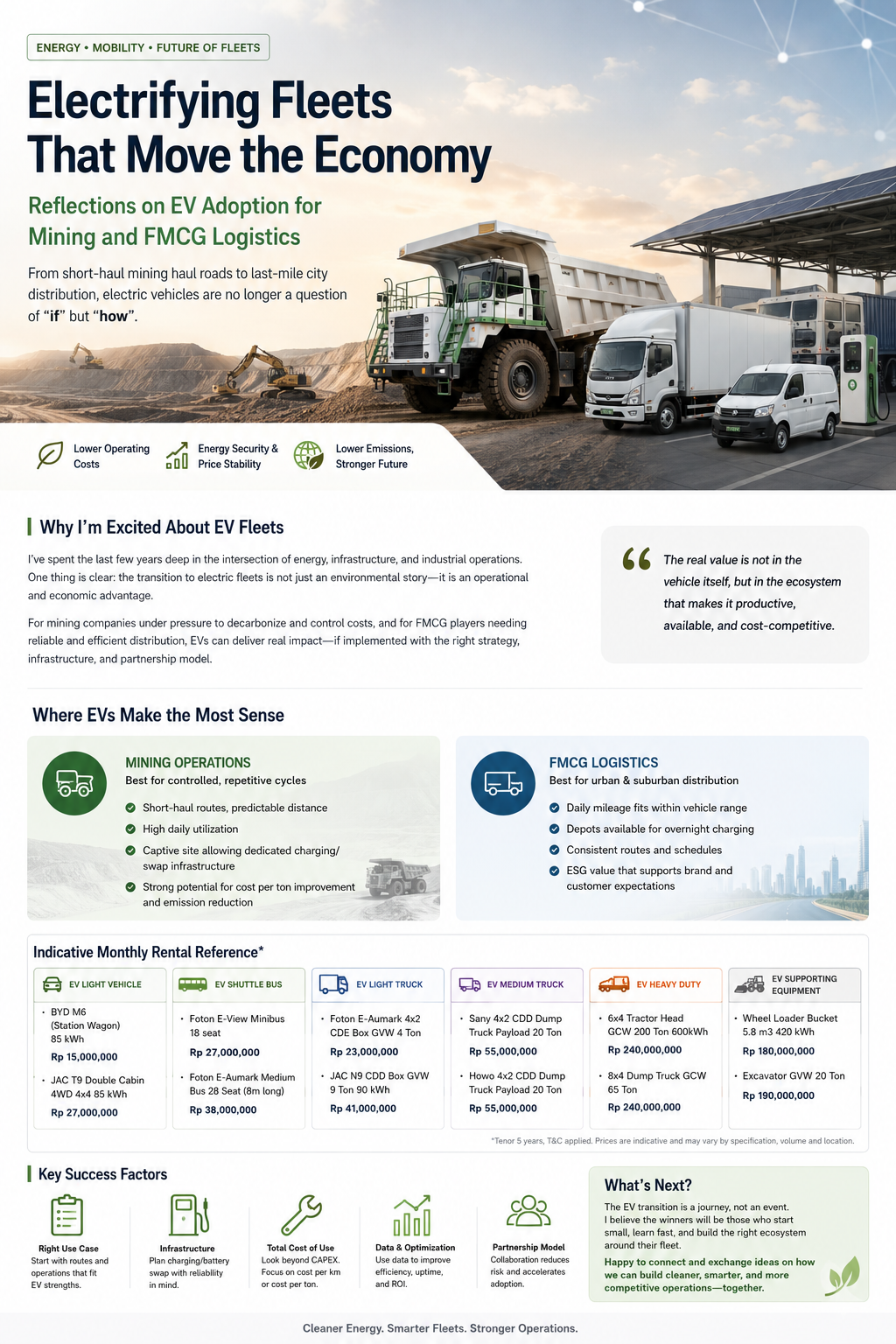
Electrifying Fleets on FMCG and Mining Logistics
I have been thinking about commercial EV fleets from a slightly different angle. The usual conversation starts with unit price, range, battery size, or whether a certain Chinese brand is better than another. Those are valid questions, but for industrial users, especially mining and FMCG, I do not think the vehicle is the real product.
The real product is operational certainty. In mining, a truck that looks attractive on paper can become a commercial problem if charging creates a bottleneck, payload is compromised, spare parts are not available, or the energy system cannot support the fleet. In FMCG, an electric van is not useful merely because it is electric. It has to protect delivery windows, route discipline, cold-chain reliability, warehouse dispatch flow, and total cost per kilometer.
This is why I believe fleet electrification should not be sold like a showroom catalogue. It should be designed like an operating system: vehicle selection, charging infrastructure, electricity supply, financing, maintenance, data monitoring, driver behavior, and uptime assurance must work together
1. Why this market is becoming serious
The global signal is getting clearer. Electric commercial vehicles are no longer limited to passenger cars or small urban vans. The International Energy Agency reported that global electric truck production reached around 440,000 units in 2025, more than twice the 2024 level, with more than 90% of production concentrated in China. Reuters also reported that China is pushing heavy-truck electrification aggressively, targeting electric vehicles to reach 40% of new heavy-truck sales by 2030.
Indonesia is also starting to see real mining deployment. In January 2026, XCMG Indonesia announced the delivery of 100 electric dump trucks to a coal mining company in South Kalimantan. I do not see this as proof that every mining fleet should immediately convert to EV. I see it as proof that the market is moving from concept discussion into operational trial.
The more important question is not whether EV trucks exist. The better question is: where do they actually make economic and operational sense?
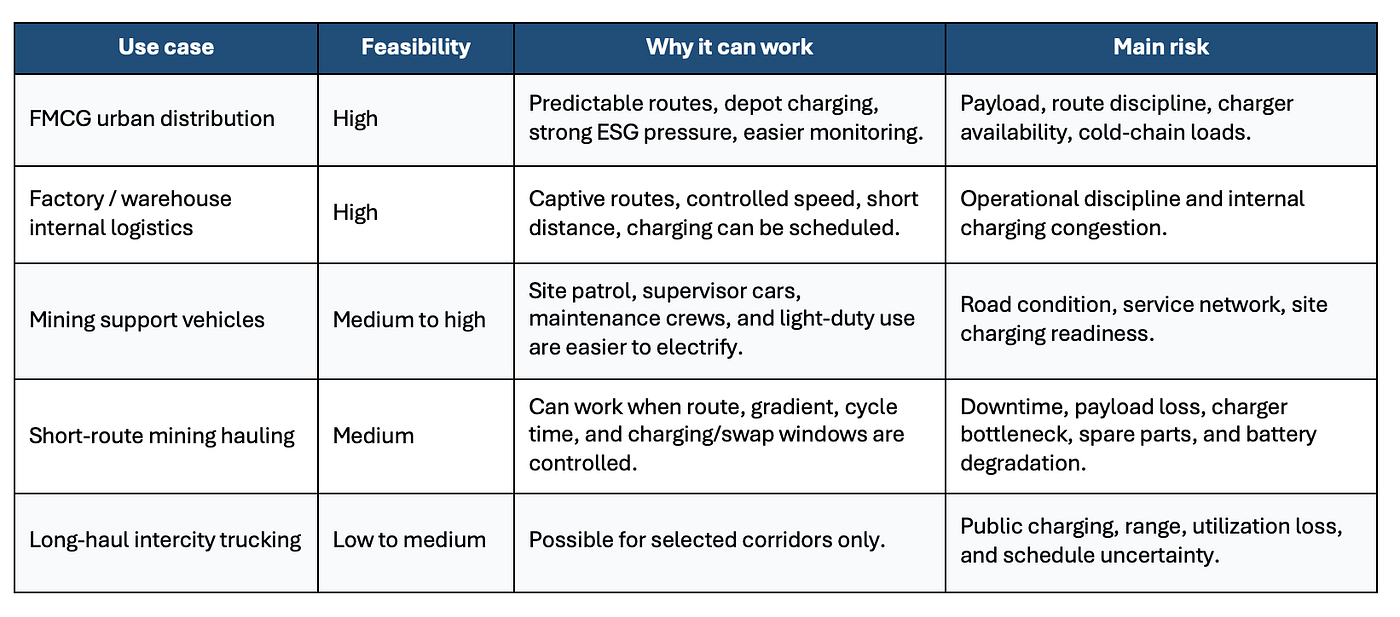
2. If large clients can buy directly, why would they need a third party?
This is the honest question. Large mining companies, FMCG groups, logistics operators, and contractors can go directly to principals, official distributors, leasing companies, or heavy-equipment suppliers. If a third party only adds a margin on top of the unit price, the value proposition is weak. It is easy to bypass.
So in my view, the third-party value should not be access to the vehicle. The value should be risk reduction. A serious partner must help the client answer questions that are more operational than transactional.
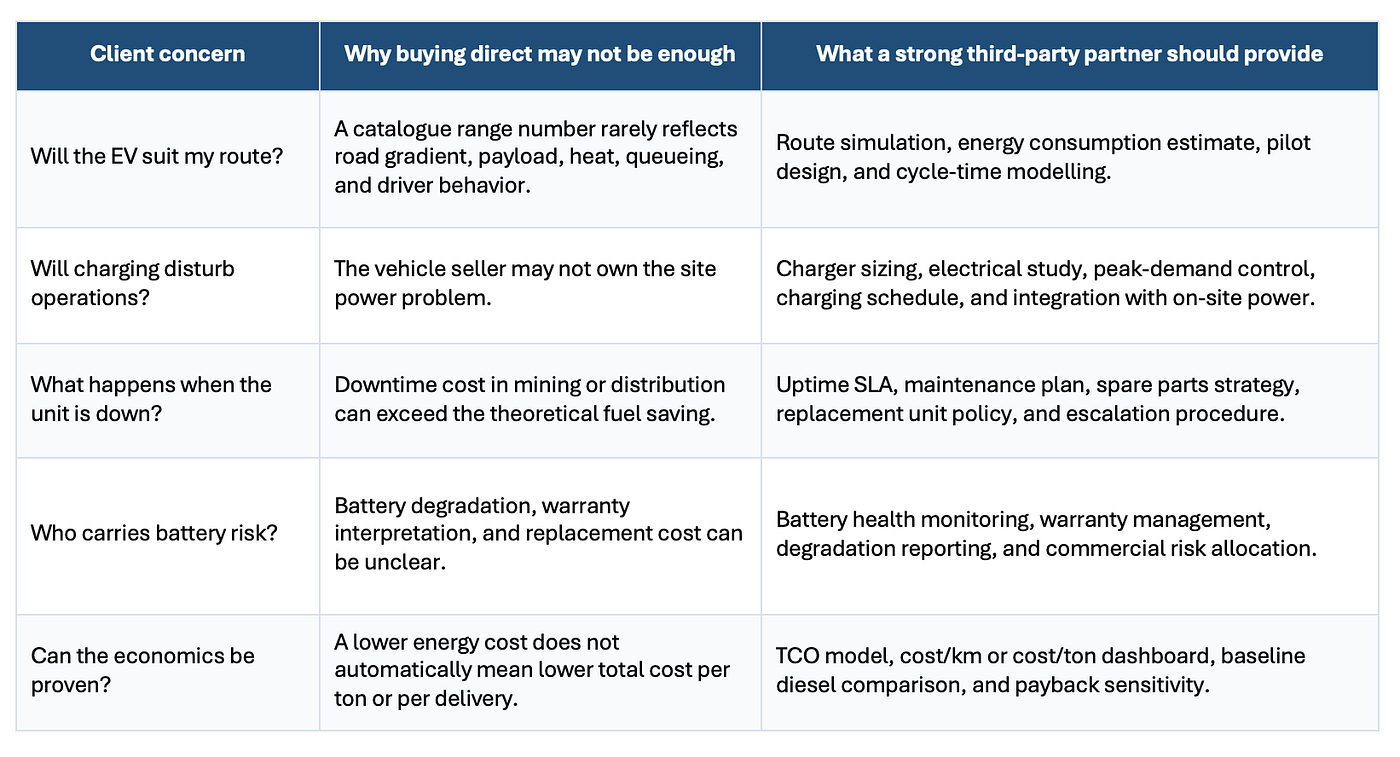
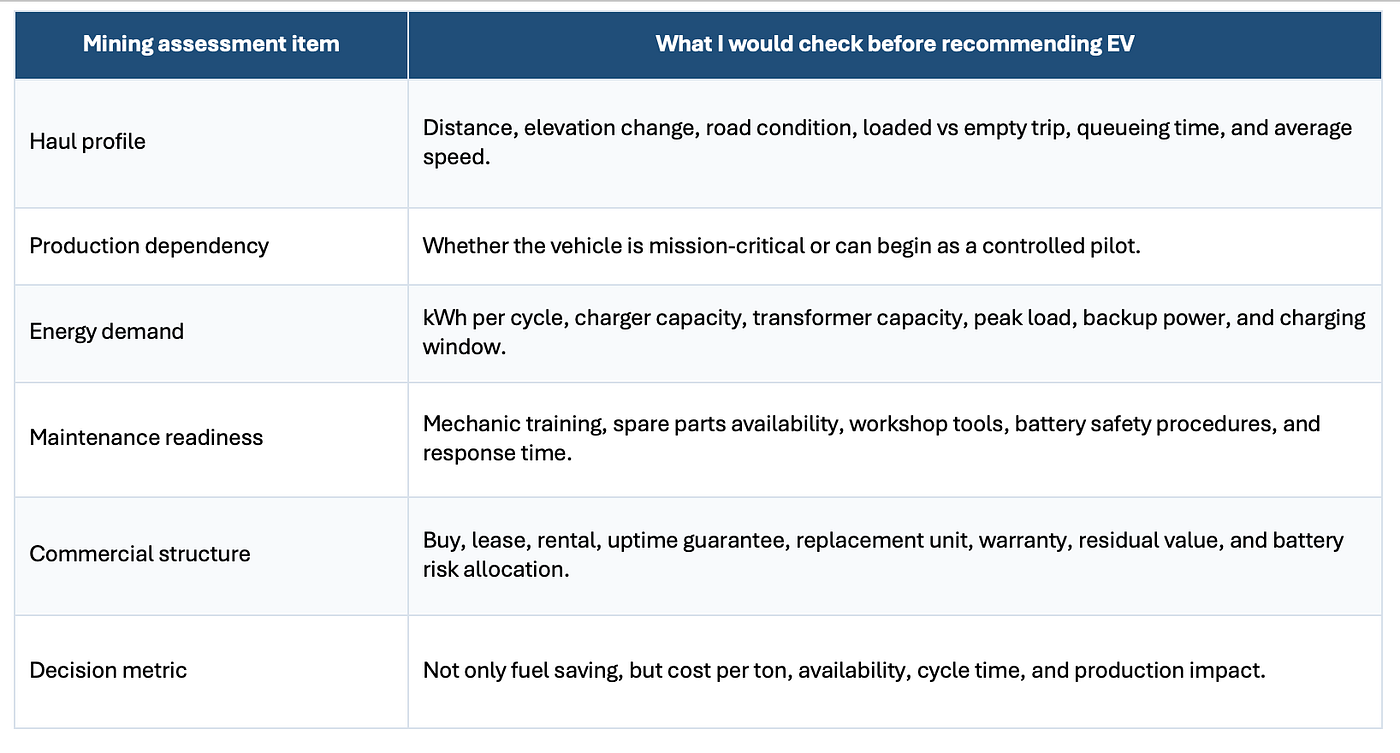
3. In mining, EV is not a vehicle decision. It is an energy and uptime decision.
Mining is a tough environment for any new technology. The site does not care about ESG storytelling if the equipment disrupts production. For mining people, the key language is availability, tonnage, safety, cycle time, haul distance, fuel displacement, road condition, workshop readiness, and maintenance response.
That is why I would never position electric mining trucks as a simple diesel replacement. The better framing is this: EV trucks may be feasible when the route is captive, repeatable, and measurable; when the charging or battery-swap system is designed around the operating cycle; and when downtime responsibility is commercially clear.
For Indonesian mining, I would start with narrow use cases first: support vehicles, short-haul routes, port or stockpile movement, pit-to-processing routes with stable distance, and contractors that can measure diesel consumption accurately. I would avoid making broad claims for every mine, every route, or every commodity.
4. In FMCG, the entry point is more practical
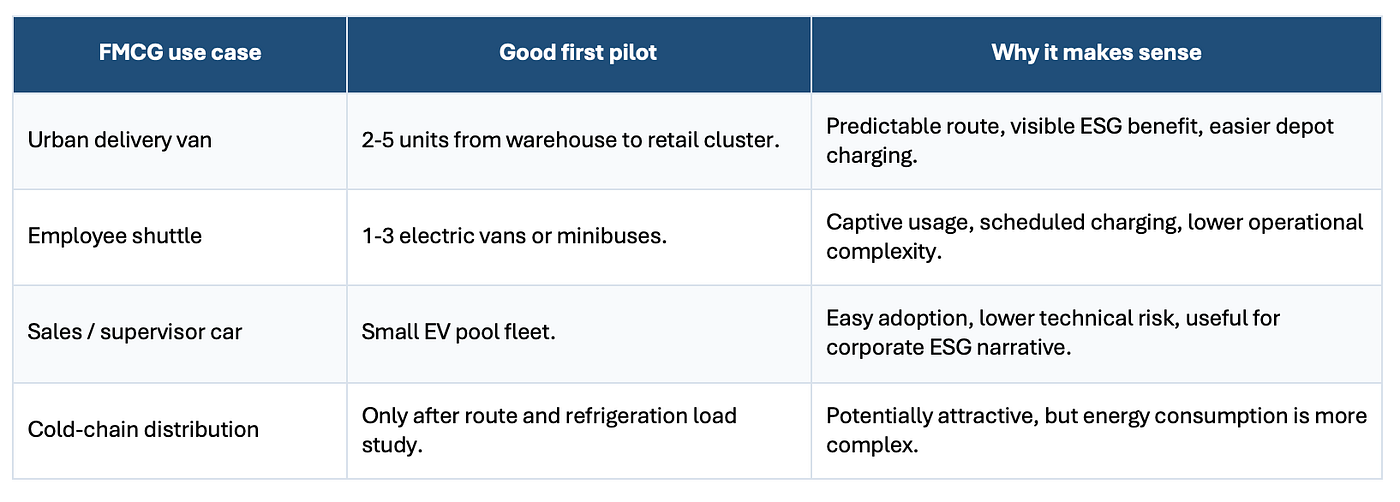
FMCG is often a more realistic starting point than heavy mining trucks. Routes are usually more predictable, vehicles return to the same depot, charging can be installed at warehouses, and ESG reporting matters to both internal management and external stakeholders.
The first wave does not need to be massive. A serious company can start with 2 to 10 units: electric vans, employee shuttles, pool cars, or light distribution trucks. The goal is not to make a press release. The goal is to measure cost per kilometer, charger utilization, route suitability, driver acceptance, service quality, and operational disturbance.
5. Indicative price and rental ranges
The following ranges are indicative only. Actual pricing depends on brand, battery size, warranty, body configuration, charger scope, financing cost, insurance, service coverage, order volume, and residual-value assumptions. I would use this only as an early screening reference, not as a final quotation.
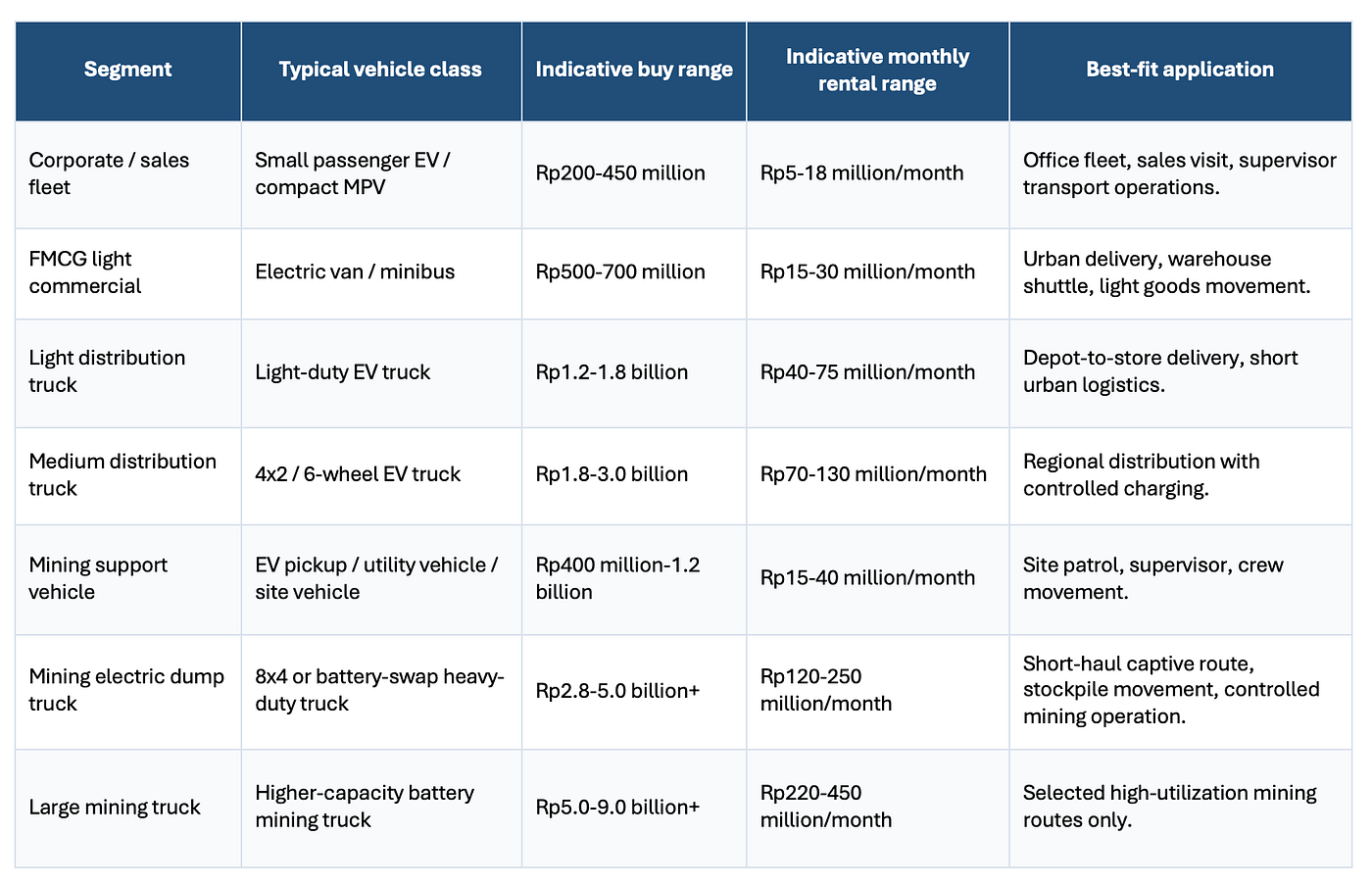
For leasing or rental, I would be cautious with prices that look too cheap. A healthy rental number must cover depreciation, cost of funds, maintenance, insurance, battery risk, service margin, and some allowance for replacement-unit or downtime support. If the rental price ignores these components, the risk has not disappeared. It has only moved somewhere else.
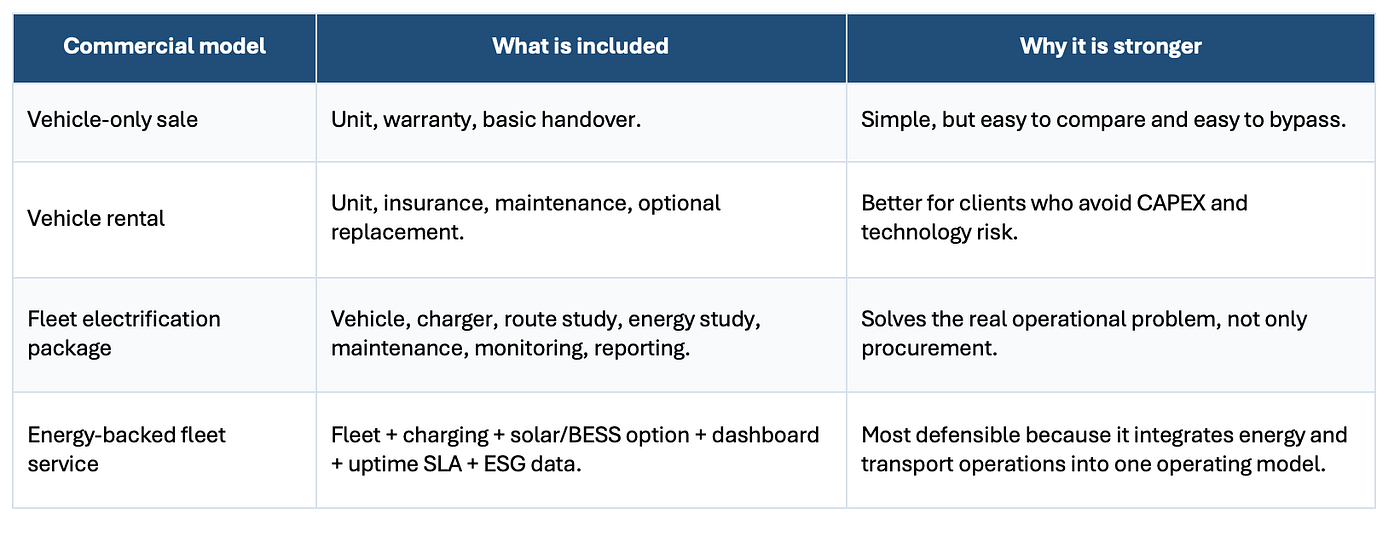
6. My preferred commercial model
If I were building the business case, I would not lead with ‘we can supply EV units.’ That is not defensible enough. I would lead with a complete fleet-electrification model.
7. What I would tell a mining client
“You can buy the truck directly from the principal. That is not the difficult part. The difficult part is making sure the truck fits your route, does not damage cycle time, does not create a charging bottleneck, and actually reduces cost per ton after maintenance, battery risk, and downtime are considered.”
That is the kind of conversation I think industrial clients respect. It is not a hype conversation. It is an operational-risk conversation.
8. Final view
I believe EV fleets are feasible in selected industrial use cases. But feasibility should not be decided by enthusiasm, catalogue specifications, or unit price alone. For mining, the strongest cases are controlled routes, support vehicles, and short-haul applications where energy use and cycle time can be measured. For FMCG, the strongest cases are depot-based urban delivery, shuttles, and corporate fleets where charging can be controlled and ESG reporting has business value.
The companies that win this market will not be the ones that merely bring more brands into Indonesia. They will be the ones that can translate vehicles into operational certainty: route design, charging reliability, uptime, maintenance, financing, and measurable economics.
In short: the EV fleet business is not really about selling electric vehicles. It is about helping industrial operators reduce risk while changing the energy architecture of their operations.
Source notes for context
· International Energy Agency, Global EV Outlook 2026 — Manufacturing and trade: global electric truck production reached around 440,000 units in 2025, with more than 90% concentrated in China.
· Reuters, June 2026: China targets heavy-truck electrification, including electric vehicles reaching 40% of new heavy-truck sales by 2030.
· XCMG Indonesia, January 2026: announcement of 100 electric dump trucks delivered to a coal mining company in South Kalimantan.
· Public automotive price references in Indonesia, including BYD and DFSK listings, were used only as market context for indicative early-screening ranges.
메타데이터
- post_id
- 02ca6da1e16f
- slug
- ev-fleets-for-mining-and-fmcg-the-real-business-case-is-not-the-vehicle-02ca6da1e16f
- url
- https://medium.com/@gussmuh/ev-fleets-for-mining-and-fmcg-the-real-business-case-is-not-the-vehicle-02ca6da1e16f
- canonical_url
- https://medium.com/@gussmuh/ev-fleets-for-mining-and-fmcg-the-real-business-case-is-not-the-vehicle-02ca6da1e16f
- author_url
- https://medium.com/@gussmuh
- status
- ok
- fetched_at
- 2026-07-09 21:48:21