Honor in the Mountains: A Christian Reflection on the Druze of the Chouf
I am a Lebanese Christian whose ancestors originate from the Chouf mountains, from a small village called Serjbeil. Though I never had the…
Honor in the Mountains: A Christian Reflection on the Druze of the Chouf
I am a Lebanese Christian whose ancestors originate from the Chouf mountains, from a small village called Serjbeil. Though I never had the chance to live there — having been born in 1972 and prevented from visiting my ancestral land when the war erupted in 1975 — I have always carried within me a deep connection to those mountains, through memory, history, and heritage.
My life was shaped in Beirut, where I was born, raised, and where I cast my vote. Yet through my father’s lifelong friendships with Druze individuals — ties he preserved despite the violence and tragedies of the war — I too came to experience the spirit of the Druze community. These encounters, filtered through the scars of history, have left me with a profound appreciation for the values that animate their way of life.
The Dual History of Conflict and Brotherhood
The history between Christians and Druze in Mount Lebanon is a story of paradox. It is marked by conflicts and massacres that left deep wounds, stretching back to the 19th century and culminating in the violence of the 1970s and 1980s. Yet it is also marked by fraternity, mutual defense, and a stubborn will to coexist on the same rugged slopes.
Mount Lebanon itself was not built on homogeneity, but on the balance of differences. From the time of the Maans in the 16th and 17th centuries, to the rule of the Shihabs, Christians and Druze lived together in an uneasy but vital equilibrium. This coexistence shaped the “mountain pact” — a tacit agreement that no community could claim exclusive possession of the land, but that both together ensured its survival. Out of this tension emerged not only the spirit of the Chouf, but the very idea of Lebanon as a country where pluralism is destiny.
The Code of the Mountain
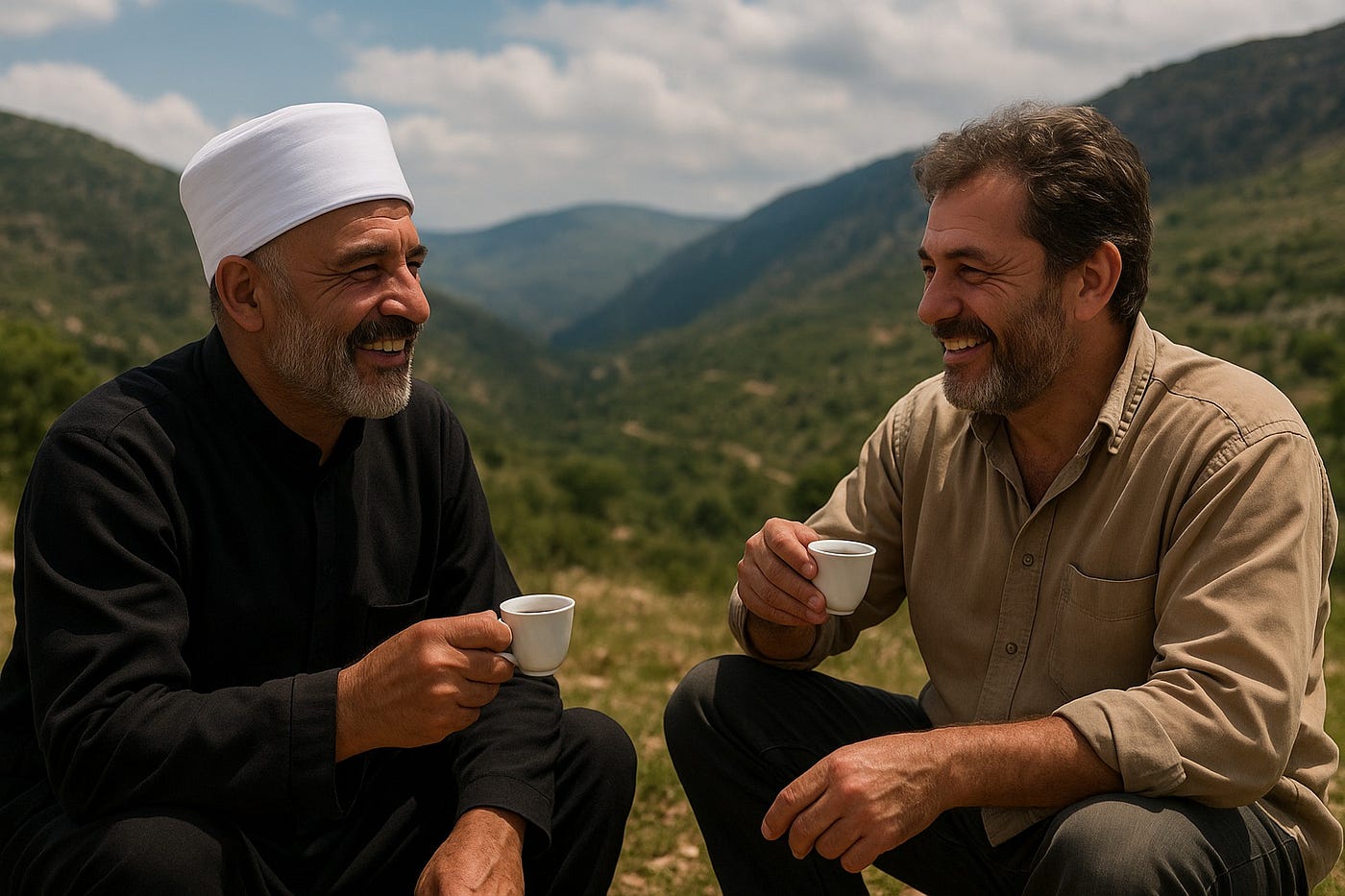
On a human level, my personal encounters with Abou Dargham and Bou Khouzam villagers from Dmit and Kfarhim revealed another narrative — one that history books often obscure. Beneath the memories of conflict, I discovered in them a set of values that resonated deeply with my own upbringing: honor, chivalry, generosity, and dignity.
The persons I came to know are bound by honor, understood not as pride, but as fidelity to one’s word, one’s family, and one’s community. In a land where institutions were fragile and rulers distant, honor was the true currency of trust.
Their chivalry recalls a code of conduct forged through centuries of struggle. It is the ethos of mountain knights: respectful of guests, courageous in adversity, and protective of the weak. This is not romantic idealism, but a way of survival in a harsh landscape where solidarity was essential for endurance.
Their generosity is legendary. Hospitality is not a courtesy but a duty, an extension of honor itself. Even in times of scarcity, they share what they have; the guest is embraced as kin. This generosity is not superficial — it is an affirmation of dignity, of one’s humanity, and of the sacred value of human bonds.
These values were not invented yesterday; they are the fruit of centuries of tradition. They were tempered in the terraces of the Chouf, in the struggles against Ottoman centralization, in the conflicts and reconciliations that marked every generation. They are part of a code that transcends sectarian labels, a code that Christians and Druze alike once shared as mountain people.
The Lesson for Lebanon
In their company, I never felt like an outsider. I was welcomed, embraced, and treated with a warmth that transcended the divisions of faith and the scars of history. With them, I felt at home. In their way of being, I recognized a mirror of my own values.
Despite all that Lebanon has endured — despite wars, betrayals, and political divides — I am convinced that beneath these differences lies a deep reservoir of shared human values. In the Druze villagers of the Chouf, I did not encounter rivals, but fellow custodians of an ancient code of humanity and resilience.
This realization carries a broader lesson for Lebanon itself. Our identity cannot be built solely on religious difference, nor on imported ideologies. It must draw upon the deepest values forged in our mountains: honor, tradition, dignity, chivalry, generosity, resilience, respect. These values are not the property of one sect; they are the common inheritance of all who have endured and preserved this land.
In this recognition, I find hope. We are closer than history has often allowed us to believe. And perhaps, if we remember the code of the mountain, Lebanon can rediscover its soul — not in division, but in the nobility of what we share.
메타데이터
- post_id
- 02cc14626601
- slug
- honor-in-the-mountains-a-christian-reflection-on-the-druze-of-the-chouf-02cc14626601
- url
- https://medium.com/@abourjeily/honor-in-the-mountains-a-christian-reflection-on-the-druze-of-the-chouf-02cc14626601
- canonical_url
- https://medium.com/@abourjeily/honor-in-the-mountains-a-christian-reflection-on-the-druze-of-the-chouf-02cc14626601
- author_url
- https://medium.com/@abourjeily
- status
- ok
- fetched_at
- 2026-06-25 07:00:49