Why Startups Are Choosing Hybrid Apps Over Native in 2026
Building one app that works on iOS and Android — without paying for two is no longer a compromise. In 2026, it’s the smart choice for 72%…
Why Startups Are Choosing Hybrid Apps Over Native in 2026
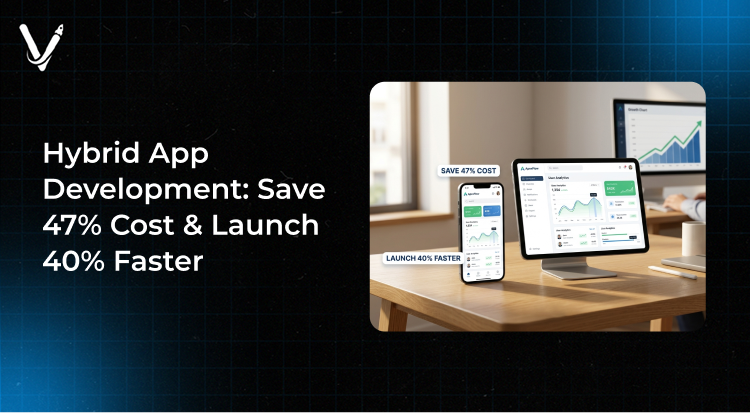
Building one app that works on iOS and Android — without paying for two is no longer a compromise. In 2026, it’s the smart choice for 72% of new mobile projects.
Building one app for both iOS and Android used to sound like a compromise.
In 2026?
It’s becoming the smartest business decision most startups make.
And the numbers are proving it.
Recent developer ecosystem surveys from Stack Overflow Developer Survey and industry adoption reports continue to show strong growth in cross-platform mobile development.

That shift is happening for one simple reason:
Most businesses no longer need two separate mobile teams to build high-quality apps.
They need:
- Faster launches
Lower development costs
- Faster testing cycles
- Faster market validation
And hybrid development solves all four.
The Native vs Hybrid Debate Has Changed Completely
A few years ago, the conversation looked simple:
Native = better quality Hybrid = cheaper alternative
That logic is now outdated.
Modern frameworks like React Native and Flutter have closed the performance gap so aggressively that most users can’t even tell the difference anymore.
For nearly 95% of business applications, hybrid apps now deliver near-native experiences without the massive development overhead.
That changes the economics of app development completely.
The Real Cost Most Startups Underestimate
The biggest mistake founders make isn’t choosing the wrong framework.
It’s underestimating how expensive duplicate development becomes over time.
With native development:
- Two separate teams
- Two codebases
- Two testing cycles
- Two deployment pipelines
- Double maintenance
That complexity grows quietly.
And costs scale faster than most businesses expect.
The Numbers Tell the Story
Native vs Hybrid Development in 2026.

That cost difference is becoming impossible for startups to ignore.
Especially in early-stage product development.
Why Hybrid Development Is Growing So Fast
The biggest advantage isn’t only cost.
It’s speed.
And in startups, speed changes everything.
Launching 4–6 months earlier can mean:
- Faster funding
- Earlier traction
- Real customer feedback
- Faster iteration
- Market validation before competitors
That’s why hybrid development adoption is accelerating across industries.
Three Reasons Hybrid Apps Save So Much Time
1. One Codebase Ships Everywhere
Instead of building features twice, developers ship updates to iOS and Android simultaneously.
That alone removes massive workflow duplication.
2. Faster QA and Testing
- One unified testing cycle.
- One bug fix.
- One deployment pipeline.
That operational simplicity becomes incredibly valuable at scale.
3. Faster Design Systems
Modern frameworks automatically adapt:
- Android Material Design
- iOS Human Interface Guidelines
Designers no longer need to duplicate entire UI systems manually.
The Industries Choosing Hybrid in 2026
Hybrid development now dominates across:
- SaaS platforms
- Healthcare apps
- E-commerce
- Booking platforms
- AI products
- Marketplace apps
- Startup MVPs
- Internal business tools
The only major areas where native still dominates are:
- High-end gaming
- AR/VR
- Real-time telemetry systems
- Hardware-intensive applications
Many startups are now investing in professional mobile app development services to launch scalable products faster without managing separate native teams?
Hybrid is now more than enough.
The Real ROI Isn’t Just Development Savings
This is the part many businesses overlook.
The money saved from hybrid development often funds:
- Marketing
- User acquisition
- SEO
- Product iteration
- AI integrations
- Customer onboarding
That’s a huge competitive advantage for startups trying to scale efficiently.
Because launching cheaper often means growing faster.
The Smartest Way to Start in 2026
Businesses are increasingly prioritizing lean MVP app development strategies to test products before scaling aggressively:
- Launch with 5 core MVP features
- Use React Native or Flutter
- Validate with real users
- Improve based on data
- Scale after traction
That approach reduces risk dramatically.

Instead of spending $200k before launch, businesses validate faster with far lower investment.
Final Thought
The biggest shift in mobile development isn’t technical anymore.
It’s strategic.
Businesses are realizing they no longer need perfect infrastructure on day one.
They need:
- Speed
- Validation
- Scalability
- Efficient growth
And hybrid development delivers exactly that.
The real question in 2026 is no longer: “Is hybrid good enough?”
It’s: “Why are businesses still paying double to build the same app twice?”
More insights on AI, SaaS, MVPs, and mobile app development: Vasundhara Infotech
MobileAppDevelopment #ReactNative #Flutter #Startup #SaaS #AppDevelopment #HybridApps #TechStartups #MVPDevelopment #FutureTech
메타데이터
- post_id
- 02cf7e0a1f4f
- slug
- why-startups-are-choosing-hybrid-apps-over-native-in-2026-02cf7e0a1f4f
- url
- https://medium.com/@maria-andraw/why-startups-are-choosing-hybrid-apps-over-native-in-2026-02cf7e0a1f4f
- canonical_url
- https://medium.com/@maria-andraw/why-startups-are-choosing-hybrid-apps-over-native-in-2026-02cf7e0a1f4f
- author_url
- https://medium.com/@maria-andraw
- status
- ok
- fetched_at
- 2026-06-09 15:37:30