Banana Slugs At The Park
“Every day I see a banana slug is a good day!” has become the mantra I share with park visitors and fellow docents. Let’s explore the role…
Banana Slugs At The Park
“Every day I see a banana slug is a good day!” has become the mantra I share with park visitors and fellow docents. Let’s explore the role of this slug in the forest and here in Santa Cruz, and why they might be so popular — but relatively rare — at Henry Cowell Redwoods State Park’s old grove loop.
We can start with some details about these critters.
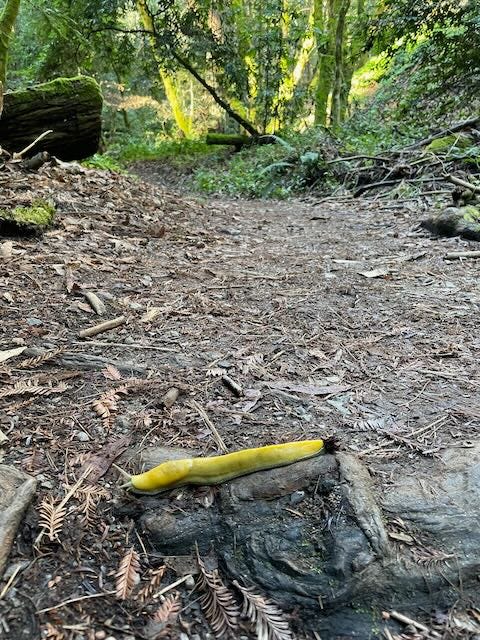
Banana Slugs are native mollusks who help recycle nutrients in the redwood forest by consuming many kinds of debris like plant matter, fungus, and decaying organic material. During warm summer months, these slugs reduce their daytime activity and retreat underground and inside rotting logs.¹
Banana slug: Ariolimax spp. Banana slugs are very large relatives of the common garden slugs and snails. They get up to 6 inches long, and range in color from mustard yellow to olive gray, often with splotches of gray on a yellow body. They will eat almost anything and are very important in cleaning up dead organisms in the forest. Snails and slugs feed with a “rasping tongue,” which they use to scrape pieces from their food. They have two pairs of “tentacles” projecting from the head, and the posterior (hind-most) pair have light sensing organs at their tips. The anterior (front) pair is used for feeling and smelling for food. Banana slugs are distasteful to many animals, and their yellow color may serve as a warning to potential predators.²
“Banana slugs, like all gastropods, are hermaphrodites, which means they possess both male and female sex organs simultaneously. They’re able to mate with themselves, though they will commonly court other individuals. They lay clutches of eggs under leaves and soil, and leave the clutch once laid.” “moving at a maximum speed of six and a half inches per minute” “slime also helps banana slugs move — and simultaneously keep predators away… When ingested, the slime can make attackers’ tongues go numb. Often, to neutralize the mucus, predators will roll banana slugs in soil before eating them.”³
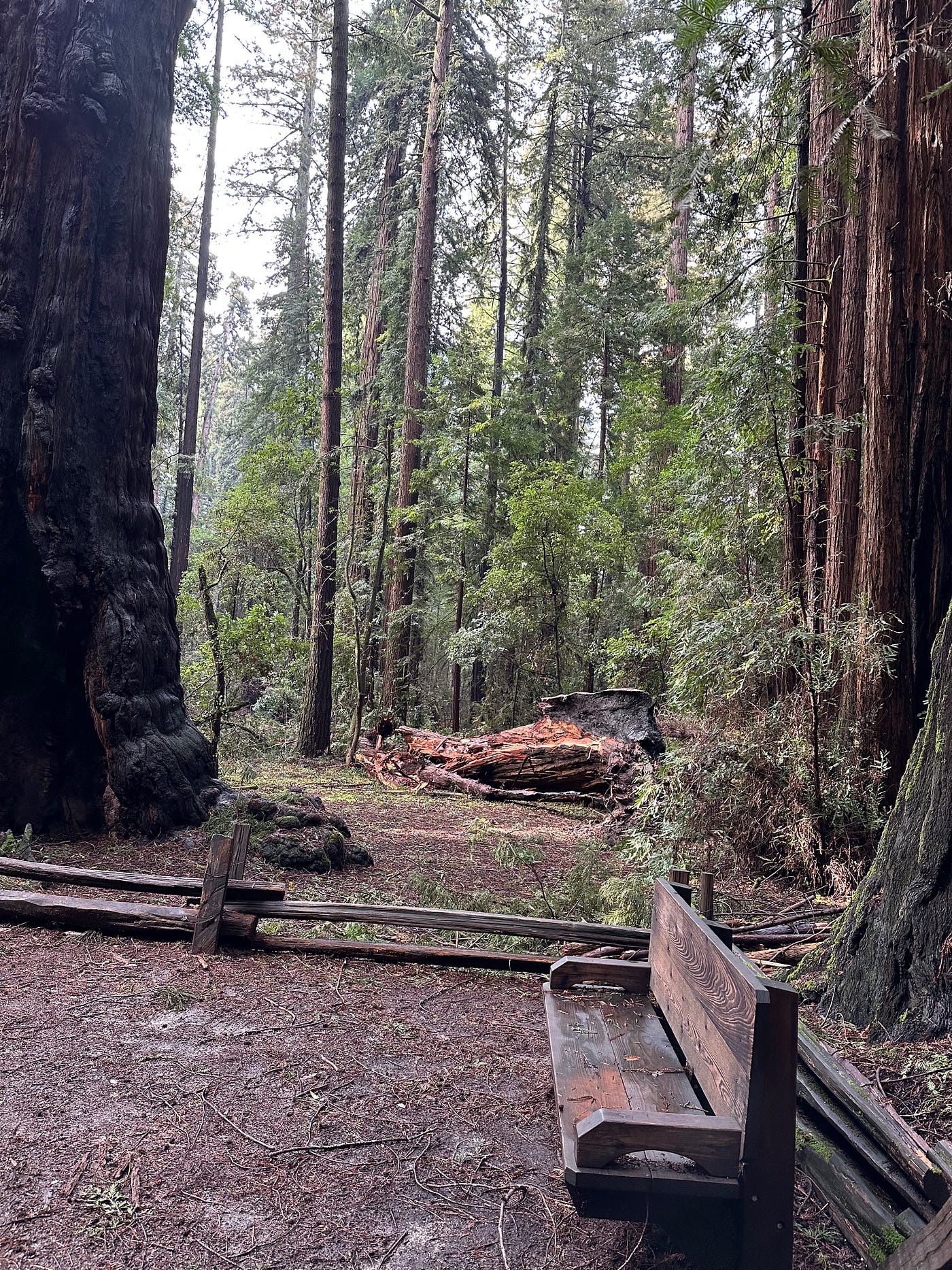
Where do I look for banana slugs around the old grove loop? Timing is important, as they seem most active and visible during the damp months when it’s not too chilly. I look down in the redwood sorrel, on and at the base of decaying logs — but also I look for slime trails climbing up trees. My favorite trees to check out include the “Slug Hotel” (a slender fire cave about 8 feet up the Kodak Tree in front of the Visitor Center) and the “Banana Slug Penthouse” (about 15 feet up a tan oak tree between stops 13 and 14) . Banana slugs also travel deep down the holes of burrowing creatures.


But why are banana slugs so “popular” with our visitors?
When I asked a visitor why they were so interested in finding them, they told me “because I love weird things!” The banana slug’s funny appearance and charming name has inspired local pride as the UCSC mascot.

UCSC Mascot Sammy The Banana Slug
In the 1980s: “In a counterculture reaction to the fierce athletic competition at most U.S. universities, UC Santa Cruz students chose the Banana Slug as their teams’ unofficial mascot in the early years.” [https://www.ucsc.edu/campus/mascot/]
The banana slug had been popular at UCSC when I schooled there in the 1970s, chosen as the team mascot by 1970 volleyball team members, and again in 1974 by the soccer team. [https://en.wikipedia.org/wiki/UC_Santa_Cruz_Banana_Slugs]

And then there’s Uncle Charlie’s Summer Camp logo (thank you David C)
And now (May 2024), the banana slug is on a track to be designated as “the official state slug of California in order to promote appreciation, education, and research of banana slugs in California”! I suspect that the education of banana slugs will be very challenging — but so is all education.
Finally, why are banana slugs relatively rare around the old grove loop? During ideal conditions (for slugs), they are much easier to spot up in the Fall Creek portion of the park, at Big Basin State Park, and in my neighbor’s redwood-filled yard. Henry Cowell Redwoods State Park, however, gets over a million visitors a year and the old grove loop gets most of that attention.
And sadly, some of our visitors can’t keep their hands off the banana slug.

I’ve since learned that a number of docents also will pick up a slug (more carefully, without actually touching the slug with their hands) and park it at the front desk to show visitors a real slug. This troubles me, for I can imagine walking along to go get my lunch, and being picked up by God and put in a jar to show the angels how weird I am. Unless God were willing and able to talk to me about it, I can imagine I would be pretty disrupted by such an experience.
So when I see a banana slug on the loop I admire their resilience, and hope that I can help the public appreciate and respect the need for us to learn to be better stewards of the lands (and the banana slugs) around us.
- HCRSP REDWOOD GROVE LOOP TRAIL Guide 2023
- REDWOOD ED: A GUIDE TO THE COAST REDWOODS FOR TEACHERS AND LEARNERS by Michael Roa 2007
- National Geographic Banana Slug https://www.nationalgeographic.com/animals/invertebrates/facts/banana-slug
© 2024 Bill Fitler
메타데이터
- post_id
- 02ebb8a9ba03
- slug
- banana-slugs-at-the-park-02ebb8a9ba03
- url
- https://medium.com/@bfitler/banana-slugs-at-the-park-02ebb8a9ba03
- canonical_url
- https://medium.com/@bfitler/banana-slugs-at-the-park-02ebb8a9ba03
- author_url
- https://medium.com/@bfitler
- status
- ok
- fetched_at
- 2026-07-24 08:52:30