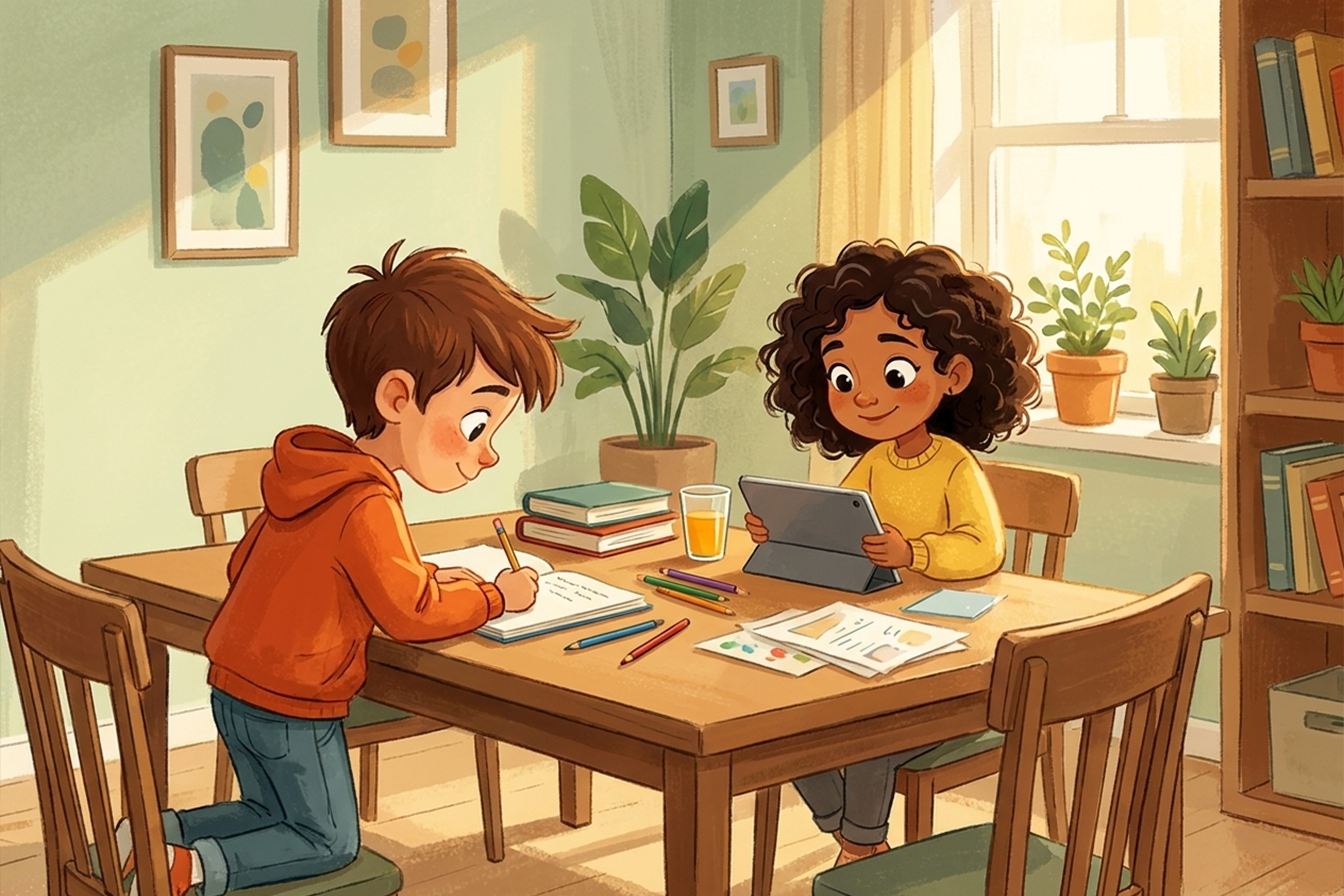
How to Motivate a Child Who Doesn’t Want to Learn English?
A detailed explanation from a professional English teacher on how to motivate a child to learn English when he or she doesn't want to
Your Child Isn’t Lazy. They’re Waiting for English to Get Interesting

A small disclaimer before we start: it has been three weeks since I opened my Spanish textbooks. My teacher is enjoying her vacation and I am worrying about the first lesson after a month break when I embarrass myself. I started worrying yesterday. Now here is my text about motivation to learn a language.
Let me paint you a picture: it’s a Tuesday evening. A parent — tired from work, barely optimistic about the evening ahead — leans into the living room and announces cheerfully: “Time for English practice!”
What follows is, in my experience, one of the most consistent events in the known universe. More reliable than gravity. More predictable than the weather in Scotland in the end of August. The child, who moments ago was brimming with energy and opinions about everything, suddenly becomes profoundly exhausted. Perhaps they need water. Perhaps their stomach hurts. Perhaps they have developed, in the last thirty seconds, a passionate interest in staring at the ceiling.
You are not alone in this experience. Every parent I have ever worked with has been there. And every single one of them has asked me some version of the same question: *how do I actually get my child to want to do this?*
Here’s what I’ve learned.
Start By Understanding the Resistance — Not Fighting It
The instinct, when a child refuses to engage, is to push harder. More encouragement, more negotiation, more elaborate explanations of why English is important for their future.
Children are not particularly moved by arguments about their future (with the present we are having, can’t really blame them). They live in the present with exceptional commitment.
So before you reach for any strategy, ask a simpler question: what is actually going on?
In my experience, reluctance to learn English usually comes from one of a handful of real places:
The material is too hard and the child feels consistently lost. The lessons are boring and bear no relationship to anything they care about. They’ve had a negative experience — a correction that stung, a moment of embarrassment in class, a teacher who moved too fast — and now English carries that memory. Or their learning style is simply different from what they’re being offered, and nobody has noticed yet.
“Kids being kids” is sometimes the answer. But often there’s something more specific underneath — and finding it is always worth the conversation.
Try asking: “What’s the bit about English you like least?” and “Is there anything you use English for that you actually enjoy?” The second question especially. A child who says they like watching English cartoons or playing an English-language game is handing you the key to the whole puzzle. Take it.
Make It a Game — And Mean It
I know. You’ve heard this before. “Make learning fun!” is the educational equivalent of “have you tried turning it off and on again?” — technically correct, not always helpful without specifics.
So let me be specific.
Games work for a concrete reason: when a child is focused on winning, they stop being focused on the fear of getting something wrong. The competitive instinct overrides the self-consciousness. They’ll practice vocabulary, grammar structures, and speaking skills without registering that’s what they’re doing — because what they’re actually doing, from their perspective, is trying to beat you.
Some games that genuinely work well, from my own classroom:
Simon Says — extraordinarily effective for listening comprehension and following instructions in English, and children never seem to tire of it regardless of age. I have played Simon Says with ten-year-olds who would absolutely deny it if asked.
Memory cards — vocabulary on one card, image or definition on the other. Flip, match, repeat. The repetition does the work; the competition provides the motivation.
Scattergories — a category is named, players race to write English words fitting that category for each letter of the alphabet. Vocabulary practice disguised as a race.
Charades and Taboo — both require describing things in English without using obvious words. Genuinely excellent for building circumlocution skills — the ability to talk around a word you don’t know, which is one of the most useful real-world language skills there is.
Online quizzes and interactive games — the internet is full of them. Kahoot, Quizlet, Wordwall — most children will play these voluntarily for longer than they’d ever voluntarily study vocabulary.
AI-generated games — a newer frontier, but a useful one. You can now generate custom English games around almost any topic your child loves. A quiz about their favourite video game characters, a word puzzle using vocabulary from their favourite show. The personalisation changes everything.
The rule I apply in my own lessons: a game is only useful if it’s both enjoyable and contributing to learning. Fun for its own sake is lovely; fun that teaches something is the goal. The best games do both so seamlessly that the child genuinely can’t tell which is happening.
Use What They Already Love
This is perhaps the single most powerful thing I can tell you, and it’s the approach I return to more than any other.
Children do not resist English. They resist boring English. English that has nothing to do with their lives, their interests, their sense of humour, the things that make them who they are.
The moment you connect the language to something they already care about, the resistance drops — sometimes dramatically, sometimes overnight.
[embed]Source: Novakid Blog Youtube Channel
Cartoons and TV shows in English are one of the most effective tools I know, particularly for children who find textbooks alienating. They hear natural speech, they pick up vocabulary in context, they absorb pronunciation and rhythm without any conscious effort. Most non-native English speakers, if you ask them honestly, will tell you that a significant portion of their English came from television. There is no shame in this. It works.
Put on the English version of something your child already loves. Start with subtitles in their native language if needed, then move to English subtitles, then try without. Progress happens so gradually they won’t notice it’s happening until suddenly they can follow everything.
Comics and graphic novels are underrated language learning tools. The visual context supports comprehension. The dialogue is natural and often colloquial. The format is engaging enough that children will read voluntarily — which, for some children, is a minor miracle. Use a favourite comic as a vocabulary source, a reading exercise, or even a role-play script.
**YouTube channels and educational shows** designed for English learners are particularly effective for younger children — the content is built to hold their attention, the language is carefully pitched to their level, and the format feels like entertainment rather than instruction.
The goal is to make English present in the spaces where your child is already happy. Not as an imposition. As a natural part of the things they enjoy.
Don’t Forget the Listeners
Not every child is a visual learner. Some children absorb language most effectively through their ears — and for them, podcasts and audio content can be remarkably powerful.
There are English podcasts aimed at every age and level: fairy tales, simple stories, conversations, comedy, science, history. Whatever your child is interested in, there is almost certainly an English audio version of it somewhere.
[embed]Source: Novakid Blog Youtube channel
One technique I love for keeping children focused while listening: give them something to do with their hands. LEGO, puzzles, drawing, picture cards. This sounds counterintuitive — surely they should be concentrating fully on the audio? — but for many children, a physical activity running in parallel actually improves their listening focus rather than dividing it. It removes the pressure of sitting still and paying attention, which for some children is the hardest part of any lesson.
The result is something close to a natural listening environment — relaxed, unforced, and genuinely effective.
The 3–3–3 Rule: A Simple Routine That Actually Sticks
If you’re looking for a structured approach that doesn’t feel like studying, this is one I recommend regularly.
The 3–3–3 rule is simple: pick any English skill, and do three things with it. No rigid rules, no predetermined format — just three, repeated consistently until it becomes habit.
Some examples of how it works in practice:
- Name 3 things in the room in English
- Make 3 sentences about what you did today
- Describe 3 emotions you felt this week
- Talk about 3 people you love spending time with
You can also build it into weekly or monthly routines:
- Read and discuss 3 short English stories this week
- Draw 3 pictures and describe them in English
- Find 3 family members and do a short role-play with each
What I like about the 3–3–3 approach is that it’s achievable enough to actually happen, varied enough to stay interesting, and repetitive enough to build real habit. The magic number three is psychologically comfortable — not overwhelming, not trivially easy. And the repetition of structure is what turns occasional practice into something that actually sticks.
A Note on Slow Learners — Because Every Child Deserves This
I want to take a moment here for the parents of children who are progressing more slowly than expected — because the motivation question looks different for them, and they deserve a specific answer.
Every child has a unique combination of strengths and challenges. A child who is progressing slowly is not failing. They are learning at a pace that is right for their particular brain, and they need strategies tailored to how they work — not faster versions of the strategies that weren’t working before.
If your child is struggling: find what materials actually engage them and build from there. If English-only instruction is overwhelming, try integrating their first language as a bridge. If they forget what they’ve learned quickly, weave English into daily routines so that review happens naturally and constantly — not just in dedicated lesson time.
Progress for a slower learner doesn’t look like sudden acceleration. It looks like growing confidence. Longer sentences. A willingness to try where there was reluctance before. These are not small things. They are, in fact, the whole point.
The Bottom Line
Here is what I know after years of watching children go from grumbling at the mention of English to voluntarily watching English YouTube videos, correcting their parents’ pronunciation, and asking me questions I have to look up later.
The motivation was always there. It just needed the right conditions to show itself.
Talk to your child. Find out what they like, what they don’t, and what English feels like from where they’re standing. Then build from that. Games, media, audio, routines — all of these work. What makes the difference is choosing the ones that fit your child rather than applying a generic solution and hoping.
And if you want professional support — someone who can adapt to your child’s specific learning style, interests, and pace do exactly that. One-on-one lessons built around the child in front of them, not a curriculum designed for a hypothetical average student.
FAQs
What is the 3–3–3 rule for kids? A flexible routine where a child does three things with a recently learned English structure or vocabulary set — naming three things, making three sentences, describing three emotions. Simple, repeatable, and genuinely effective at building habit without pressure.
How do you motivate a slow learner? Start by understanding what specifically is causing the difficulty. Find materials they actually engage with. Integrate their first language where needed. Weave English into daily routines so review happens naturally. Celebrate every visible sign of progress, however small — confidence comes before fluency, always.
What are the best English games for kids? Simon Says, memory cards, Scattergories, Charades, Taboo, online quizzes, and AI-generated custom games based on your child’s interests. The best game is always the one your child will actually play.
What if my child refuses everything? Go back to the root cause. Something specific is usually behind total refusal — boredom, anxiety, a bad experience, a mismatch between their learning style and what they’re being offered. Find it. That’s where the real work begins.
메타데이터
- post_id
- 02ee396b895c
- slug
- how-to-motivate-a-child-who-doesnt-want-to-learn-english-02ee396b895c
- url
- https://medium.com/@blanche_bianca/how-to-motivate-a-child-who-doesnt-want-to-learn-english-02ee396b895c
- canonical_url
- https://medium.com/@blanche_bianca/how-to-motivate-a-child-who-doesnt-want-to-learn-english-02ee396b895c
- author_url
- https://medium.com/@blanche_bianca
- status
- ok
- fetched_at
- 2026-08-19 08:03:59