When the Bed Becomes the Risk: Inside the Hidden Crisis of Unsafe Care Home Mattresses
How collapsed foam, fluid ingress, and cost‑cutting turn a place of rest into a source of preventable harm
CARE HOME NEGLECT
When the Bed Becomes the Risk: Inside the Hidden Crisis of Unsafe Care Home Mattresses
How collapsed foam, fluid ingress, and cost‑cutting turn a place of rest into a source of preventable harm
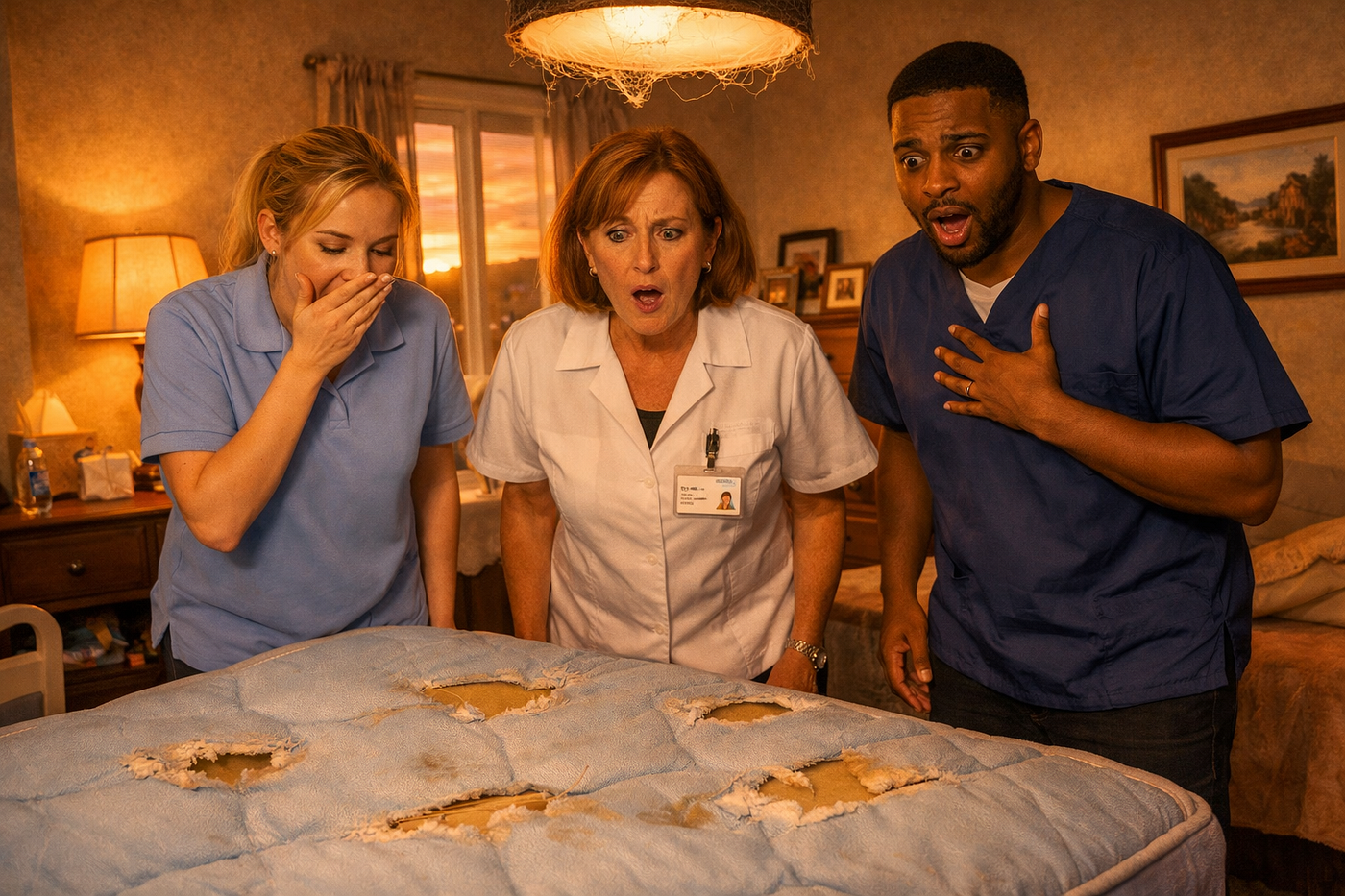
Image created by the author with my own descriptions to help from Co-pilot AI
Not a member of Medium yet? Don’t worry, you can still read this by clicking HERE.
A mattress is supposed to transform a patient’s bedroom. It becomes something special, a part of that person’s personal space, where they can hopefully sleep comfortably and soundly. That mattress is not simply there for comfort, it’s there to protect vulnerable skin, those areas of the skin (around where the skin is thin or brittle, often referred to as crepe-paper-skin)
But that type of skin can very rapidly become at risk of developing pressure ulcers, those places where the bone is close enough beneath vulnerable areas of skin (such as your elbow, your shoulder, knee, shoulder blades, or those heels). This personal bedroom should be the safest place in a care home; it becomes a comfortable, warm area in a resident’s bedroom… the bed. Most likely, the one surface residents can trust.
But in too many settings, especially small elderly mental health homes, the bed becomes the first point of failure. Collapsing foam and fluid ingress is when water makes its way into a mattress (in the case of a healthcare environment, this is usually bodily fluids to make matters worse, through worn‑out protective covers, small tears, and years of a ‘make do’ culture, which quietly erodes the dignity and safety of the people who spend most of their lives lying on them.
This isn’t a minor equipment issue.
It’s a serious lack of patient care.
It’s a pain generator and a dignity thief.
A pressure ulcer waiting to happen.
And the situation is a dangerous warning sign of a system where cost‑cutting is valued more than care.
If that pressure area is not treated swiftly and expertly, then at grade 1 you will begin to see a reddening area, known as** non-blanchable erythema**; at this point, the skin remains intact, but immediate action is needed to avoid it worsening to the next stage, stage 2…
But let me show you what a grade two sore can actually look like:

Courtesy of the National Wound Care Strategy Programme (NHS) Pressure Ulcer Categorization Tool (2024)
When I Confronted the Owner About the Mattress
I caught him on one of his rare walk‑throughs of the home while I was taking a 15-minute break and a well-earned coffee. His visit was the kind where he drifted through the home like a visiting dignitary, nodding at things he had no clue about, and no interest in even trying to understand, and pretending not to see the cobwebs hanging from the light fittings that the cleaner had missed.
I led him to the bedroom. Not even softening my voice or apologising for taking up his time… Because, after spending hours completing the home’s mattress audit, I was not amused by what I found.
I lifted the sheet and showed him the mattress: the collapsed foam, the fluid ingress, the obvious tears in the outer lining. I pointed everything out to him and told him that after completing the audit… I had been left with only one option:
I failed it immediately on its audit, and classified the entire mattress as condemned. I would have been neglectful in my duty of care as a registered mental health nurse if I hadn’t done so.
The care home owner stared at it the way someone stares at a parking ticket, annoyed at the inconvenience, not the problem. Or, was it that I had been the first person to confront him over this?
Then, after a minute of prodding and poking at it, I couldn’t believe the words that fell out of his mouth. “It’s fine,” he said. “Just turn it over.”
I was prepared for these words because every other qualified staff member there had already told me they had heard those very same words since they’d been employed there.
But I simply wasn’t prepared to witness first-hand, his sheer scope of ignorance, uncaring attitude, and his unwillingness to part with money.
For a couple of minutes, I just stared, not moving. I didn’t even blink.
But then came my professional years of experience… and I didn’t let him walk away… not from this one.
“No,” I firmly and calmly answered. “It’s not fine. It’s unsafe. And I’m not allowing a resident to lie on it another night.”
He tried to laugh it off.
He tried to minimise it.
He tried to make me feel small… by (yes, I am about to say this) in this speech below:
These are the very words he spoke to me:
“ Jonathan, stop worrying over the damn mattress, mate. How about just turning the mattress over, as the other side is absolutely fine and intact, nobody will know if you get rid of the audit and redo it, will they, hey? And there’s a pay rise in it for you too, you deserve
Written by Jonathan Townend, RMN - Editor (published on 8th May 2026)
But I stood my ground to emphasise the failure points on that mattress, which I had professionally condemned in the audit, for the unsafe clinical reasons I’d written on the audit sheet.
So, I stood my ground. I kept my voice steady. I made it very clear that changing my mind was not open for negotiation…
And for the first time, he realised that I wasn’t one of the nurses who was prepared to give up. I was not going to be worn down or bribed with a pay rise if I changed my audit. I wasn’t going to “make do, and fall in line.”
He sighed, raising his eyebrows, and with a long, theatrical sigh from a man who hated parting with money that he never intended to spend.
“Fine,” he said. “Replace it.”
I quickly informed him that I would immediately order it for same-day delivery.
The care home owner knew it was an expensive order, but now he had no choice, because a qualified nurse had stood up to him.
He didn’t say thank you for protecting his patients, a job that I had studied long and hard for; after all, he had employed me to keep the patients safe at all times
He didn’t say, “Actually, sorry, you were right.”
He didn’t even look at the resident and reassure her.
But I’d won.
And he knew it.
The owner then made for the home’s exit, without speaking to any of the staff… oh, and sped off down the driveway… in his brand-new, polished sports car.
The Moment the Staff Realise You’re Not Backing Down
Word spread fast in a 30‑bedded care home. It always does. By the time I had walked back into the office, the other nurse and care staff were watching me with a mixture of disbelief and relief. They’d tried before, months ago, and been shot down so many times they’d stopped trying. They’d learned to survive by lowering their expectations.
But as I walked in with a different energy. I walked in, carrying the condemned mattress. Walked in with proof that the owner could be pushed.
One of the senior carers whispered, with a look of disbelief, “You actually got him to replace it?”
Another said, “I didn’t think anyone could get through to him.”
And then the shift changed, not the rota, but the atmosphere. A small spark of possibility began a ripple through the team.
A reminder that advocacy wasn’t pointless.
A sense that maybe, just maybe, things didn’t have to stay the way they were.
I hadn’t just condemned a mattress.
I’d cracked the culture of neglect and harm.
The Emotional Cost of Being the Only One Fighting
But here’s the part that no one ever sees, it’s the emotionally hard-hitting part that sits in your chest long after the shift ends, filling you with guilt, remorse, anger, and frustation… frustration because your overriding duty of care that you learned early on in your career, is constantly being questioned (by a care home owner, who always puts money before a vulnerable patient,) leading to too many questionable compromises.
Being the one who fights in a neglectful care environment is exhausting. It’s lonely, and it’s relentless.
I wasn’t just battling a badly degraded mattress. It was way more than just that; I was having to battle:
- a care home owner who valued his gold Porsche more than his residents’ safety.
- His wife, who walked past cobwebs in the dayroom and simply called it ‘fine.’
- where a culture of ‘making do’ was the default.
- a place where staffing levels were so unsafe they bordered on negligence, and was an accident waiting to happen.
- colleagues who had been defeated by years of being ignored and getting nowhere.
“However, I had been away from qualified nursing for a good number of years, and becuase I wanted to return to professional practice, I was required to spend several months at my local university studying a level I course, known as** ‘Return to Nursing Practice,’ alongside a stipulated amount of clinical hours of work in an acute mental health hospital, where I could update my professional skills and knowledge before I was allowed to fully reregister with the[ NMC](https://www.nmc.org.uk/) **the United Kingdom’s independent regulator for nurses.
Written by Jonathan Townend, RMN - Editor (Published on 8th May 2026)
So, I was confident and ready for whatever or whoever was going to cross my path…
Every time a nurse or careworker raised a concern, they risked being labelled as ‘difficult.’
Every time they tried to push back, they risked being reprimanded (in the sense that their pay would be ‘accidentally’ wrong, delayed, or, when a certain training session came up, the staff who had complained wouldn’t find out about it until it was far too late.
Every time I advocated, I carried the emotional weight alone.
And yet I did it anyway.
I dared challenge him. I knew all too well what he could do, and what he wasn’t allowed to do.
And…
Because someone had to.
Because the residents deserved far better.
Because dignity is never an option.
Because silence is complicity.
Because I was the only one left who still believed change was possible, and much of that was because I was straight out of a refresher course.
And that belief, my stubborn, unshakeable refusal to give up, was what made me dangerous to a failing system.
It’s also what made me a necessary team member.
The Resident’s Perspective (Handled With Dignity and Care)
She didn’t have the words to explain it anymore, not in the way she once could, but her body felt everything wrong about that mattress. The uneven dip beneath her hip. The cold patch where the mattress had absorbed moisture. The way her skin tingled after an hour, then burned, then went numb. She shifted as best she could, slow and careful, the way people do when they’ve learned that movement brings only momentary relief.
I entered her bedroom quietly, the respectful way I always had, along with one of the care staff. She looked at us with that soft, searching expression. The look that said she recognised kindness even if she couldn’t name it anymore.
Together, we stripped the bedding and remade it with freshly laundered sheets and blankets, adjusted her pillows with the equally caring support from one of the care staff, and our hands paused for a moment on the mattress. We both felt the sag, that ridge, and the unmistakable give of collapsed foam that could no longer protect the elderly lady’s fragile skin.
She watched our faces. She didn’t know the regulations. She didn’t know about the owner’s refusals. She didn’t know about any of the previous battles happening in the office.
But she knew this: When we touched the mattress, our expressions changed. And she trusted that look.
I told her gently, “We’re going to sort this.” She didn’t understand the words, but she understood the tone. Her shoulders eased. Her breathing softened. For the first time that very early morning, she looked comfortable.
In that moment, the fight wasn’t about foam or budgets or owners who drove top-of-the-range gold Porsche’s.
It was about her.
Her comfort.
I gave the staff the confidence they so desperately needed to stand tall, speak louder, and remember that care is never just a job but a responsibility.

Image created with a personal member’s KO-FI badge, and edited with CANVA
THANK YOU!
(And of course, to my buddy across the pond 𝓙𝓪𝓷 𝓢𝓮𝓫𝓪𝓼𝓽𝓲𝓪𝓷 🖐👩🦰)
메타데이터
- post_id
- 02fb34b84b67
- slug
- when-the-bed-becomes-the-risk-inside-the-hidden-crisis-of-unsafe-care-home-mattresses-02fb34b84b67
- url
- https://medium.com/creative-passions/when-the-bed-becomes-the-risk-inside-the-hidden-crisis-of-unsafe-care-home-mattresses-02fb34b84b67
- canonical_url
- https://medium.com/creative-passions/when-the-bed-becomes-the-risk-inside-the-hidden-crisis-of-unsafe-care-home-mattresses-02fb34b84b67
- author_url
- https://medium.com/@townendj16
- status
- ok
- fetched_at
- 2026-06-13 16:23:23


