About (I Love You) For Sentimental Reasons - Song Story & Structure
A simple, sincere declaration of eternal love becomes a songbook standard. But songwriters failed to 'never part' after a copyright dispute.
(I Love You) For Sentimental Reasons
Romantic standard but competing copyright claims sour the loving mood
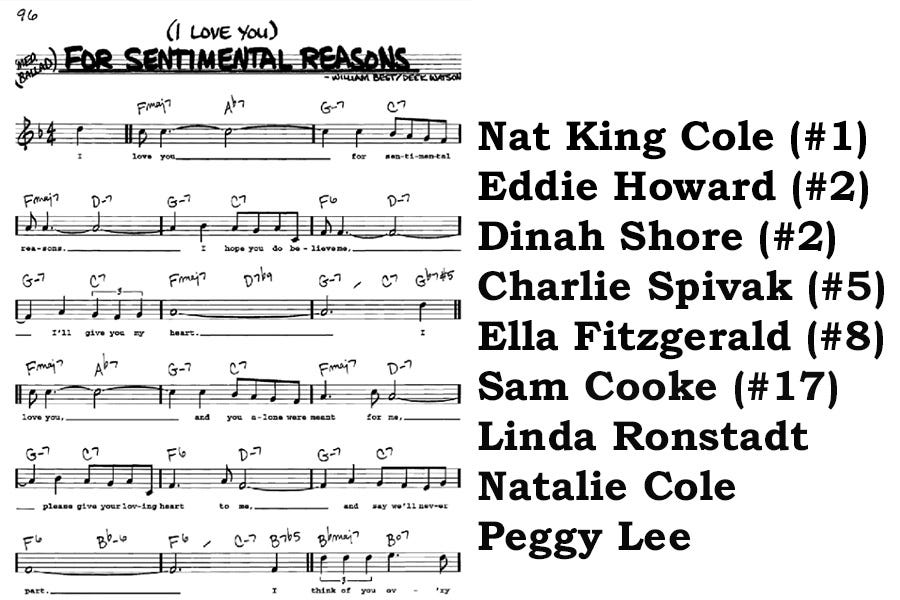
Jazz score and just some of the artists who have recorded ILYFSR. Highest Billboard chart positions in brackets
(I Love You) For Sentimental Reasons was written in the final year of the Second World War, and was a number-one hit for The King Cole Trio in November 1946. It reflects the changing of mood in America, brought about by the end of hostilities.
Wartime ballads tended to focus on the theme of absence (‘We’ll Meet Again, I’ll Be Home for Christmas, etc). I Love You For Sentimental Reasons is a celebration of shared love.
Versions
The Nat King Cole version was the biggest seller and established a template that many others followed. This consisted of a very slow tempo and a spare arrangement.
[embed]
Other interpretations were also commercially successful over the following decade. Ella Fitzgerald broadly followed Nat Cole’s approach, with The Delta Rhythm Boys adding choral accompaniment.
Dinah Shore, a wonderful singer and long-time Frank Sinatra collaborator, goes even slower and smoother, with a full orchestra discreetly chipping in. It’s the same road for Eddy Howard, whose fame faded in the postwar era. The label describes it as a fox trot, but this vixen makes slow, stately progress across the dance floor.
[embed]
A second wave of more soul-oriented versions began with Sam Cooke’s energetic reworking in 1957.
[embed]
More on the later versions after a quick look at the song structure
Songform: AABA (verse 1, verse 2, bridge, verse 1, verse 1)
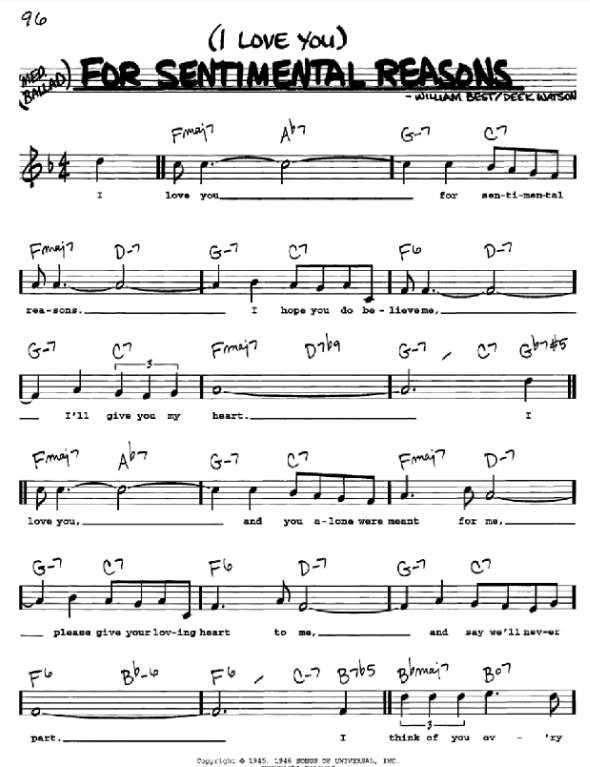
The song follows the standard AABA songbook structure. This typically features two verses, a bridge, and then a final verse. I try to demonstrate this in the audio (below).
[embed]
Jazz interpretations often have more complex chord progressions and incorporate solos and harmonic variations, particularly in the bridge.
For singers, the tone is deceptively conversational. I didn’t notice when singing it that the opening line has "I’ll give you my heart" rather than "I’ve given you my heart," as it does in the repeated verses. The phrase I’ll give you my heart is a declaration, an offer, something new in the relationship.
Verse 1
Words - establishes the theme and directly addresses the beloved
I love you for sentimental reasons /I hope you do believe me I’ll give you my heart
Music: opens with the key melodic phrase/refrain
ILYFSR has been recorded in various keys: often F Major or B Flat.
I played it in D, and the chords I played in the verse were D, Bm7, Em7 and A7. So the progression I used was I, VI, II, V7 — but there are many possible variations, particularly in jazz arrangements.
Verse 2 — chord progression & melody repeat as the lyric develops what Quincy Jones calls ‘the beg’
I love you and you alone were meant for me Please give your loving heart to me And say we’ll never part
The Bridge
For me, the musical highlight comes in the bridge:
I think of you every morning Dream of you every night Darling, I’m never lonely Whenever you’re in sight
Here, the chords change from Em7 to A7, to the tonic D, but then to F sharp diminished. Back to Em7, A7, D, and the E7 and A7. And that leads us back into the final verse (repeated in many versions).
I love you for sentimental reasons I hope you do believe me I’ve given you my heart
Recent Versions
I Love You For Sentimental continues to tempt new takes, particularly amongst jazz singers. The Linda Ronstadt version (1986) was one of the last songs arranged by Nelson Riddle and set a very high bar:
[embed]
Can anyone match that? Jim and Melissa Brady’s country-tinged 2023 version is getting up there:
[embed]
Songwriters: Words: Ivory “Deek” Watson (disputed)
Music: William “Pat” Best
Best (leader of the Brown Spots and later a Four Top) wrote the music. Deek Watson, a founder member of the Ink Spots, is credited with the lyric.
Alas, the songwriters didn’t manage the ‘never part’ bit. Pat Best later claimed that Deek, the more famous of the two, had no part in writing the lyric or any other part of the song.
These disputes are not uncommon: squabbling often accompanies successful songwriting teams. The Sherman Brothers (Mary Poppins) would literally throw typewriters at each other.
메타데이터
- post_id
- 030d0c704e51
- slug
- about-i-love-you-for-sentimental-reasons-song-story-structure-030d0c704e51
- url
- https://medium.com/song-stories/about-i-love-you-for-sentimental-reasons-song-story-structure-030d0c704e51
- canonical_url
- https://medium.com/song-stories/about-i-love-you-for-sentimental-reasons-song-story-structure-030d0c704e51
- author_url
- https://medium.com/@eslreading
- status
- ok
- fetched_at
- 2026-07-27 01:31:20