The Stoic Question Marcus Aurelius Asked Himself Every Morning
Subtitle: One sentence, written in a tent on the edge of the Roman Empire, that quietly explains how to survive almost any difficult day.
The Stoic Question Marcus Aurelius Asked Himself Every Morning
Subtitle: One sentence, written in a tent on the edge of the Roman Empire, that quietly explains how to survive almost any difficult day.
The most powerful man in the Western world, in the second century, woke up most mornings dreading the people he had to deal with.
We know this because he wrote it down.
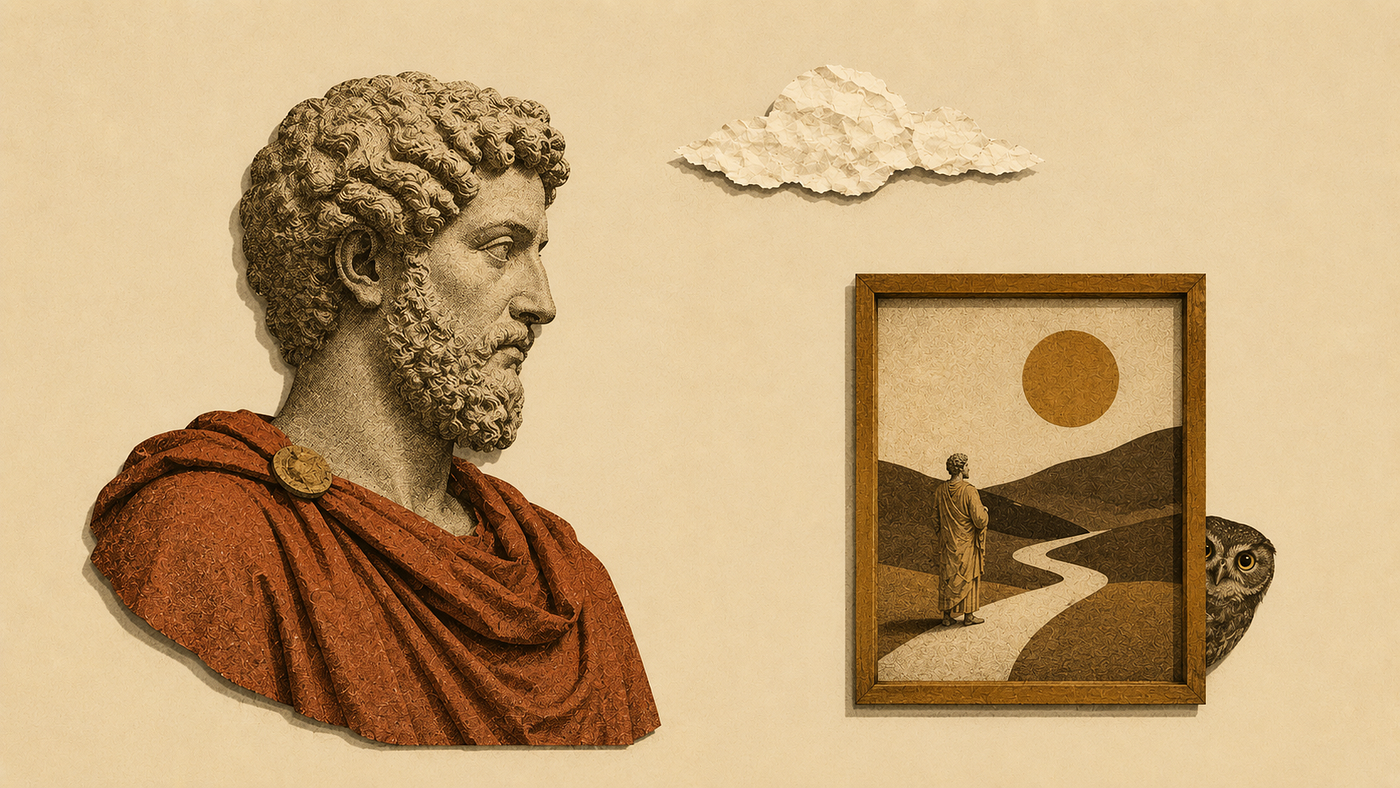
Marcus Aurelius, emperor of Rome, commander of armies, the closest thing the ancient world had to an unchecked authority, kept a private journal during his military campaigns. The journal was never meant to be read by anyone. It was a place where the most powerful person alive talked himself, sentence by sentence, into being a better one.
That journal survived. It’s called Meditations. And the very first passage of Book Two contains a sentence that, almost two thousand years later, still works.
The Sentence
Here is roughly what it says, in plain English:
“When you wake up in the morning, tell yourself: today I will meet people who are meddling, ungrateful, arrogant, dishonest, jealous, and unkind. They are this way because they cannot tell good from evil. But I have seen the nature of what is good and what is evil, and so none of these people can really hurt me.”
That’s the passage. It’s the opening of Book Two. He wrote it for himself, on a campaign, in a cold tent, before walking out to deal with the Roman senate and the imperial court, the meddling, ungrateful, arrogant, dishonest, jealous, and unkind people he absolutely could not avoid that day.
The instinct, reading this, is to dismiss it as ancient pessimism dressed up as wisdom. Expect everyone to be terrible, and you won’t be disappointed. That’s not what the passage is doing. What it’s doing is something subtler and far more useful.
Most stress isn’t caused by the day’s events. It’s caused by the silent assumption that the day would be otherwise.
What the Sentence Actually Does
The Stoic move, embedded in this opening passage, is called premeditation malorum, the premeditation of difficulties.
It works like this. Most human suffering is not caused by hard events themselves. It’s caused by the gap between what we expected and what actually happened. The colleague who interrupts us in a meeting wasn’t, by themselves, the cause of our irritation. The irritation came from the silent assumption that the meeting would be respectful and orderly. The event broke the assumption. The broken assumption is the wound.
The fix isn’t to lower your standards. The fix is to examine your assumptions before they get tested.
Marcus’s morning passage is doing exactly this. He is not predicting that the day will be bad. He is removing the silent assumption that the day will be smooth. By naming the unkindness, the meddling, and the dishonesty in advance, explicitly, by name, he disarms each of those things in advance. When they happen, they no longer cost him anything. He was already expecting them.
The day becomes, in a sense, fully paid for before it begins.
Why This Works So Well in 2026
The Stoic morning question wasn’t designed for a Roman emperor. It was designed for the human nervous system, which has not meaningfully changed in two thousand years.
The nervous system that gets unsettled by a curt email is the same nervous system that watched for predators on the savannah. It is exquisitely sensitive to gaps, between expectation and reality, between what should happen and what did. Modern life, with its endless minor frictions, produces hundreds of these gaps a day. Each one costs a small amount of equilibrium. Across a year, the cost is enormous.
Preparation of difficulties closes the gap before it opens. It doesn’t ask you to become cynical. It asks you to walk into the day already knowing that some of it will involve unkindness, ingratitude, and small acts of stupidity from people whose internal lives you can’t see, and to decide, in advance, that none of that will be allowed to govern your day.
The decision happens once. The benefit lasts hours.
What It Sounds Like Today
The modern translation of Marcus’s passage doesn’t have to involve emperors or senates. It sounds something like this:
“Today I’ll deal with people who interrupt me, who reply to emails carelessly, who take credit for work that isn’t theirs, who don’t return what they borrowed, who escalate small disagreements into large ones. They behave this way because they can’t see the situation clearly, and because most of them are dealing with things I don’t know about. I’ve decided, in advance, that none of this will steal my day from me.”
That’s the sentence, retold for a Tuesday in a 2026 office. Same architecture. Same effect.
The Stoics weren’t saints. They weren’t even particularly cheerful. They were people, like everyone reading this, who realized that the day would contain difficulty whether they prepared for it or not, and that the prepared mind suffered less.
The Quiet Catch
The reason this technique sits in Meditations and not in the modern productivity canon is that it requires something most modern self-improvement content avoids asking for: a small daily ritual that produces no visible output.
There’s nothing to check off. No habit tracker. No data. Just sixty seconds of mental preparation before the day starts, and the slightly steadier hours that follow.
Modern culture is bad at valuing things that don’t produce metrics. The Stoics were good at it. That difference is most of the gap between their inner lives and ours.
Flicker App’s summary of Meditations covers the morning passage, the deeper logic of premeditation malorum, and the broader framework Marcus built across the twelve books of the journal. It runs short enough to absorb on a single walk, which is, fittingly, about the format Marcus himself preferred. He didn’t sit down to read philosophy. He walked, and thought, and wrote.
Some practices are nearly two thousand years old for a reason.
Read the emperor’s notebook on the Flicker App. flickerapp.com
메타데이터
- post_id
- 030d776e9986
- slug
- the-stoic-question-marcus-aurelius-asked-himself-every-morning-030d776e9986
- url
- https://medium.com/productivityspot/the-stoic-question-marcus-aurelius-asked-himself-every-morning-030d776e9986
- canonical_url
- https://medium.com/productivityspot/the-stoic-question-marcus-aurelius-asked-himself-every-morning-030d776e9986
- author_url
- https://medium.com/@flickerapp
- status
- ok
- fetched_at
- 2026-06-13 12:55:53