Designing Zero-Bug Checkout APIs: Handling Race Conditions with SDD
📚 This Article Series: Part 5 of a 10-week sequence on Advanced Architecture & AI Automation — securing critical API transactions with…
Designing Zero-Bug Checkout APIs: Handling Race Conditions with SDD
📚 This Article Series: Part 5 of a 10-week sequence on Advanced Architecture & AI Automation — securing critical API transactions with Spec-Driven Development.
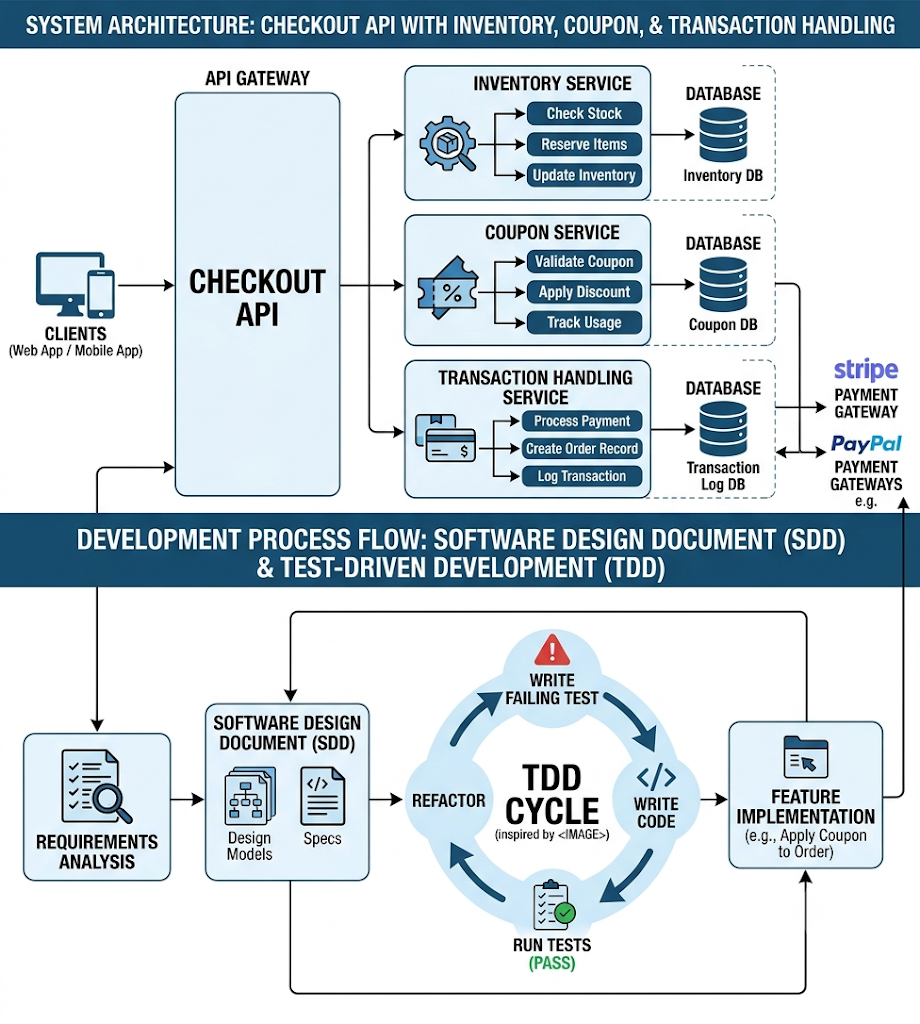
Checkout API with inventory, coupon, and transaction handling via SDD/TDD — AI-generated
1. The High Stakes of the Checkout API
In the previous weeks, we built resilient features like a Shipping Calculator and a Coupon Engine. Now, we tackle the ultimate challenge in e-commerce: the Checkout API. This isn’t just another endpoint; it’s the heart of revenue generation, directly impacting customer trust and business finances. A single race condition, an unhandled inventory rollback, or a missed coupon validation can lead to significant financial losses, disgruntled customers, and a damaged brand reputation.
This article focuses on designing a checkout() API that is not only functional but zero-bug resilient, especially against tricky scenarios like race conditions and concurrent requests. We’ll leverage Spec-Driven Development (SDD) to explicitly define behavior, error codes, and rollback logic, then validate it with robust integration testing.
2. Crafting the API Spec Contract: Defining Data, Errors, and Rollbacks
The foundation of a zero-bug checkout API lies in a meticulously crafted API Spec Contract. This contract explicitly details every aspect of the API’s behavior, including expected request data, potential error responses, and crucial rollback mechanisms for critical operations like inventory management.
Consider the POST /checkout endpoint:
- Request Data:
- `items: [{ productId: string, quantity: number }]` (array of products and quantities)
- `couponCode: string` (optional)
- `paymentInfo: { … }` (tokenized payment details)- Success Response (200 OK):
- `orderId: string`
- `totalAmount: number`
- `discountApplied: number`- Error Responses:
- `400 Bad Request`: Invalid input (e.g., missing items, invalid coupon format).
- `409 Conflict`: Race condition (e.g., item out of stock during checkout, coupon limit reached concurrently).
- `500 Internal Server Error`: Unexpected system failures (e.g., payment gateway down, database issues).
- Crucial: The spec must detail _which_ conflicts return 409 and what the error message structure looks like.- Inventory Rollback Logic:
If any step after inventory reservation fails (e.g., payment failure), the reserved inventory must be rolled back immediately and accurately.
- Good vs. Bad API Spec:
Bad: “If stock runs out, the user gets an error.” (Vague, doesn’t define HTTP status, error structure, or race condition handling)
Good: “If an item selected by the user becomes out of stock during the **checkout** transaction (race condition), the API MUST return **HTTP 409 Conflict** with a **code: ‘INVENTORY_UNAVAILABLE’** and the **productId** of the affected item. All other reserved inventory MUST be rolled back.” (Explicit, testable, covers concurrency).
This detailed contract is our blueprint, preventing assumptions and aligning the team on expected behavior before implementation begins
3. Integration Testing with Supertest: Hunting Race Conditions
Once the API spec is clear, the next critical step is to design robust integration tests. For a **checkout** API, unit tests alone are insufficient. We need to simulate real-world scenarios, especially concurrent requests, to uncover race conditions and ensure transactional integrity. Tools like Supertest (for Node.js APIs) are invaluable here.
Our integration testing strategy will focus on:
-
Happy Path Scenarios: Verify successful orders, correct total calculations, and proper inventory updates.
-
Validation Error Handling: Ensure
400 Bad Requestis returned for invalid inputs as per spec. -
Conflict Resolution (Race Conditions): This is where Supertest shines. We can simulate concurrent requests to deplete stock or use a limited-use coupon, then assert that the API correctly returns
**409 Conflict**and rolls back any partial operations.
// Example: Integration test for a race condition on inventory
describe('POST /checkout', () => {
  it('should return 409 Conflict and rollback inventory if stock depletes concurrently', async () => {
    const productId = 'product-abc';
    // Pre-configure mock inventory to have just 1 item
    await request(app.getHttpServer())
    .post('/checkout')
    .send({ items: [{ productId, quantity: 1 }], paymentInfo: {…} });

    // Simulate a concurrent request that tries to buy the same item
    const response = await request(app.getHttpServer())
    .post('/checkout')
    .send({ items: [{ productId, quantity: 1 }], paymentInfo: {…} });
    expect(response.status).toBe(409);
    expect(response.body.code).toBe('INVENTORY_UNAVAILABLE');
    expect(response.body.productId).toBe(productId);

    // Assert that inventory for productId is now 0 (or original if rollback applied)
    // … further assertions on inventory state …
  });
});- Transaction Rollback Verification: After an error, ensure that no partial changes (e.g., partial payment, partial inventory deduction) persist in the system.
By simulating these complex interactions, we turn our API spec into verifiable test cases, catching critical bugs before they reach production.
4. The Trade-Offs of Zero-Bug Resilient APIs
Building a checkout API with SDD and extensive integration testing for race conditions comes with its own set of trade-offs:
-
Increased Development and Testing Time: Defining a granular API spec and writing complex integration tests, especially for concurrency, requires significant upfront effort.
-
Complex Test Environment Setup: Mocking external services (payment gateways, inventory systems) and simulating concurrent requests adds setup complexity.
-
Performance Overhead of Rollbacks: Robust rollback mechanisms can introduce slight performance overhead in critical paths, though this is often negligible compared to the cost of errors.
However, the benefits for a mission-critical API are undeniable:
-
Elimination of Costly Bugs: Prevents financial losses from incorrect orders, inventory discrepancies, or fraudulent transactions.
-
High System Reliability: Builds trust with users and stakeholders through consistent, predictable behavior.
-
Clearer System Boundaries: The API contract forces clear definitions of responsibilities and error handling.
-
Confidentiality in Evolution: Allows for safe changes and optimizations to the checkout flow without introducing regressions.
For senior engineers and architects, prioritizing the robustness of a checkout API is a non-negotiable. SDD provides the framework to achieve this, making the system resilient by design.
💡 Hint/Takeaway
For critical APIs like checkout, treat your API spec as a legal contract. Define all success, error, and rollback scenarios upfront. Then, aggressively test concurrency and edge cases with integration tests to prevent expensive production bugs.
📚 References:
— -
Let’s Connect & Discuss: What are the most challenging race conditions you’ve encountered in API development, and how did you tackle them? Share your insights!
Before you go
- Please take a moment to like the post and follow the writer!
- Did you know that over 400,000 developers share what they’re building, learning, and discovering across our platforms every month? Learn how you can contribute here
메타데이터
- post_id
- 031441d59ead
- slug
- designing-zero-bug-checkout-apis-handling-race-conditions-with-sdd-031441d59ead
- url
- https://javascript.plainenglish.io/designing-zero-bug-checkout-apis-handling-race-conditions-with-sdd-031441d59ead
- canonical_url
- https://javascript.plainenglish.io/designing-zero-bug-checkout-apis-handling-race-conditions-with-sdd-031441d59ead
- author_url
- https://medium.com/@martintien
- status
- ok
- fetched_at
- 2026-07-10 06:45:42