Liquid Staking vs Locked Staking: Key Differences Explained
The rise of Proof-of-Stake (PoS) blockchains has transformed how crypto holders earn passive income. Instead of relying on energy-intensive…
Liquid Staking vs Locked Staking: Key Differences Explained
The rise of Proof-of-Stake (PoS) blockchains has transformed how crypto holders earn passive income. Instead of relying on energy-intensive mining, users can stake their digital assets to help secure blockchain networks while earning rewards.
However, not all staking methods work the same way.
Today, investors have two primary options:
- Locked Staking (Traditional Staking)
- Liquid Staking
While both allow you to earn staking rewards, they differ significantly in terms of flexibility, liquidity, capital efficiency, and investment opportunities.
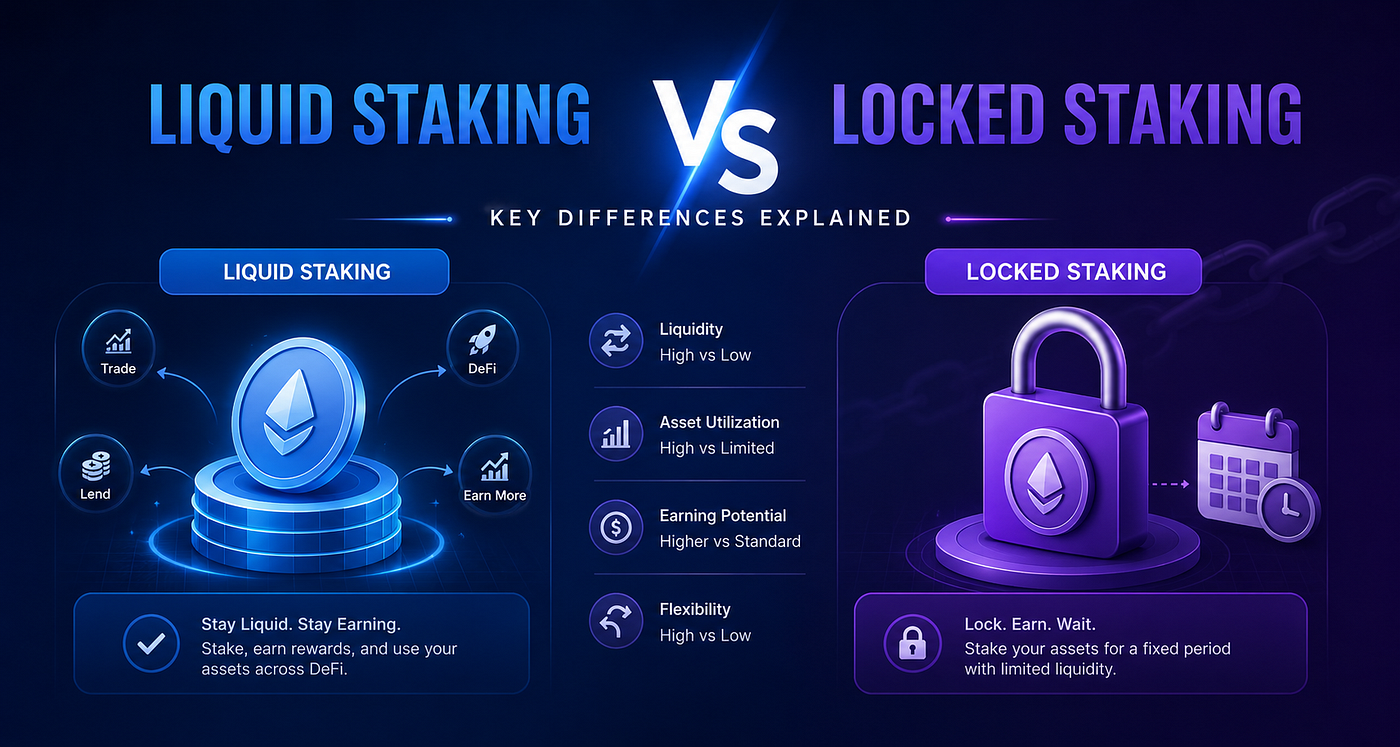
In this guide, we’ll explain the key differences between liquid staking and locked staking, compare their advantages and risks, and help you determine which approach best fits your investment strategy.
What is Locked Staking?
Locked staking, also known as traditional staking, requires users to lock their cryptocurrency for a fixed period to participate in blockchain validation.
During this time, the assets cannot be transferred, traded, or used elsewhere.
In return, stakers receive rewards generated by the blockchain network.
For example, when you stake tokens on a Proof-of-Stake blockchain, your assets contribute to network security, and validators receive rewards that are distributed among participants.
How Locked Staking Works
- Deposit tokens into a staking protocol or validator.
- Tokens remain locked for a specified period.
- Rewards accumulate over time.
- Once the staking period ends (or after the network’s unbonding period), assets become available again.
While this approach is simple, the biggest limitation is the lack of liquidity.
What is Liquid Staking?
Liquid staking removes the biggest drawback of traditional staking — locked assets.
Instead of simply locking your crypto, liquid staking protocols issue a liquid staking token (LST) that represents your staked assets. This token can often be traded, transferred, or used in decentralised finance (DeFi) applications while your original assets continue earning staking rewards.
In other words, your assets continue working for you in multiple ways.
For example:
- Stake your crypto
- Receive a liquid staking token
- Continue earning staking rewards
- Use the liquid token in DeFi, lending, or liquidity pools
This dramatically improves capital efficiency.
Advantages of Locked Staking
Although liquid staking has become increasingly popular, locked staking still has several advantages.
Simplicity
Traditional staking is easy to understand.
Users stake their assets, wait, and earn rewards without interacting with additional protocols.
Lower Smart Contract Complexity
Because there are fewer moving parts compared to liquid staking, traditional staking may involve fewer protocol-specific risks, depending on how staking is implemented.
Predictable Rewards
Locked staking generally offers straightforward reward structures based on validator performance and network participation.
Disadvantages of Locked Staking
Despite its simplicity, traditional staking comes with several drawbacks.
Illiquid Assets
The largest disadvantage is that your crypto cannot be used elsewhere during the staking period.
Missed Market Opportunities
If prices move dramatically, you may be unable to react immediately because your assets remain locked.
Lower Capital Efficiency
Your funds generate only staking rewards instead of supporting multiple yield-generating strategies.
Advantages of Liquid Staking
Liquid staking has emerged as one of the fastest-growing sectors in decentralised finance because it addresses these limitations. Liquid staking protocols issue tokenised representations of staked assets that can continue to circulate across DeFi while the underlying assets remain staked.
Maintain Liquidity
Users retain access to a token representing their staked assets, making it easier to stay active in the crypto ecosystem.
Better Capital Utilisation
Instead of sitting idle, liquid staking tokens may be used for:
- Lending
- Borrowing
- Liquidity pools
- Yield farming
- Trading
This enables investors to pursue multiple earning opportunities simultaneously, depending on the supported ecosystem.
Portfolio Flexibility
Liquid staking makes portfolio management easier because investors are not entirely restricted by staking lock-up periods.
Increased Accessibility
Some liquid staking platforms also reduce high entry barriers by enabling pooled participation and simplifying infrastructure requirements.
Potential Risks of Liquid Staking
While liquid staking offers more flexibility, investors should also understand its risks.
Smart Contract Risk
Liquid staking protocols rely on smart contracts, which may contain vulnerabilities if not properly designed or audited.
Market Risk
Liquid staking tokens can trade above or below the value of the underlying staked asset depending on market conditions.
Protocol Risk
The security and reliability of the staking protocol play a significant role in protecting user funds.
For these reasons, choosing a reputable and transparent liquid staking platform is essential.
Which Staking Method is Better?
There is no universal answer.
The right option depends on your investment goals.
Locked Staking May Be Better If You:
- Prefer simplicity
- Plan to hold assets long term
- Don’t need immediate liquidity
- Want straightforward staking rewards
Liquid Staking May Be Better If You:
- Want access to your capital
- Participate in DeFi
- Seek greater capital efficiency
- Prefer flexibility while earning staking rewards
How CENTEL Makes Liquid Staking More Accessible
Many blockchain users want staking rewards but face barriers such as high collateral requirements, technical complexity, or the inability to access their capital during staking.
CENTEL addresses these challenges by providing decentralised infrastructure that simplifies participation in masternodes and staking. Through pooled participation, managed node infrastructure, and liquid staking capabilities, users can earn rewards without needing to operate their own servers or provide full collateral.
Some of CENTEL’s key features include:
- Fractional participation in masternodes
- Managed infrastructure
- Liquid staking support
- Multi-asset ecosystem
- Simplified user experience
For investors looking to participate in blockchain infrastructure while maintaining greater flexibility, CENTEL provides an accessible alternative to traditional staking models.
Learn more by visiting **https://www.centel.io/**.
Frequently Asked Questions
Is liquid staking safer than locked staking?
Both methods carry different types of risk. Locked staking primarily exposes users to validator and network risks, while liquid staking also introduces protocol and smart contract considerations. Choosing a reputable platform is important regardless of the staking method.
Can I sell my liquid staking tokens?
In many liquid staking systems, yes. Liquid staking tokens are designed to represent your staked assets and can often be transferred or used across supported DeFi applications, depending on the protocol.
Does liquid staking offer higher rewards?
Base staking rewards are typically similar to native staking. However, liquid staking can improve overall capital efficiency because the receipt tokens may also be used in additional DeFi strategies, which can create extra earning opportunities.
Is locked staking still worth it?
Absolutely. Investors who value simplicity and long-term holding strategies may still prefer locked staking.
Final Thoughts
Both liquid staking and locked staking help investors earn rewards while supporting Proof-of-Stake networks, but they serve different needs.
Locked staking is ideal for users seeking a straightforward, long-term approach with minimal complexity. Liquid staking, on the other hand, offers greater flexibility by allowing staked assets to remain productive across multiple opportunities instead of remaining idle.
As decentralised finance continues to evolve, liquid staking is becoming an increasingly attractive option for investors who want to maximise the utility of their digital assets while continuing to earn staking rewards.
Platforms like CENTEL are making this process more accessible by simplifying blockchain infrastructure, reducing participation barriers, and enabling users to benefit from modern staking solutions without the operational burden traditionally associated with running blockchain nodes.
메타데이터
- post_id
- 03188ca5c65b
- slug
- liquid-staking-vs-locked-staking-key-differences-explained-03188ca5c65b
- url
- https://medium.com/@communication_247/liquid-staking-vs-locked-staking-key-differences-explained-03188ca5c65b
- canonical_url
- https://medium.com/@communication_247/liquid-staking-vs-locked-staking-key-differences-explained-03188ca5c65b
- author_url
- https://medium.com/@communication_247
- status
- ok
- fetched_at
- 2026-08-07 22:37:36



