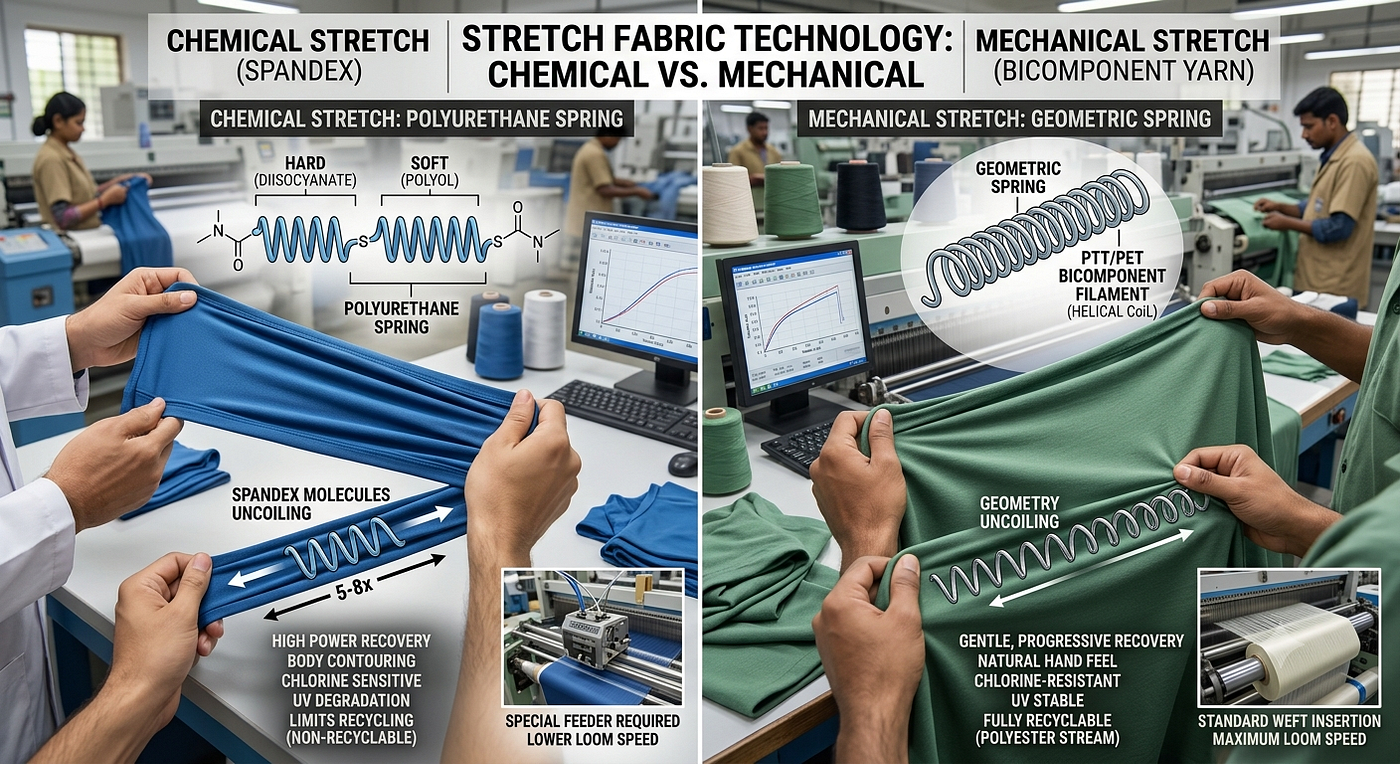
The Future of Stretch Textiles: Innovation Trends in Elastomultiester, Bicomponent Yarn, and…
The stretch textile industry is entering a period of accelerated structural change. Regulatory pressure on non-recyclable synthetic fibres…
The Future of Stretch Textiles: Innovation Trends in Elastomultiester, Bicomponent Yarn, and Sustainable Fibres
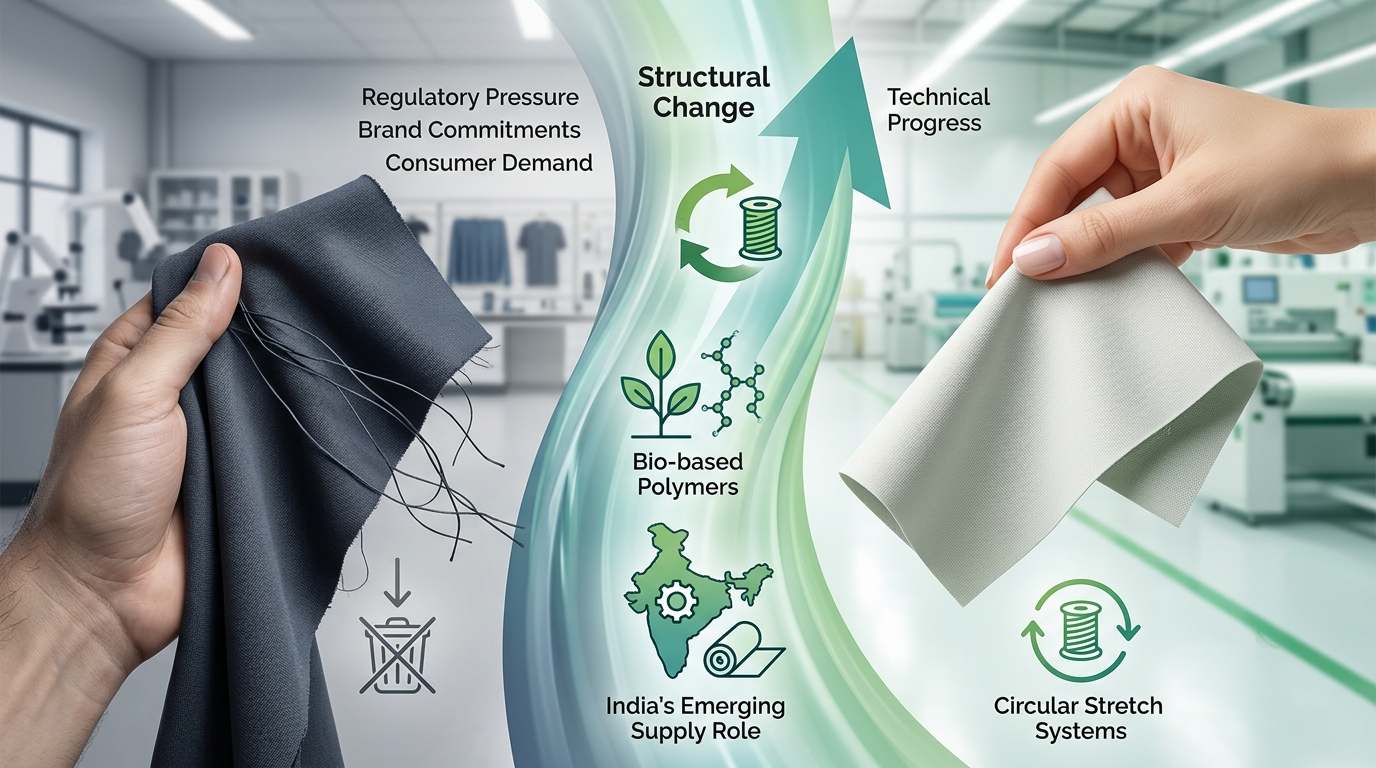
The stretch textile industry is entering a period of accelerated structural change. Regulatory pressure on non-recyclable synthetic fibres, brand sustainability commitments with defined implementation timelines, consumer demand for performance fabrics with credible environmental profiles, and rapid technical progress in bio-based polymers and recycling infrastructure are collectively reshaping which stretch technologies will define the next decade of fabric development.
The Regulatory Push Toward Recyclable Stretch
The EU’s textile strategy, extended producer responsibility frameworks, and Ecodesign for Sustainable Products Regulation are establishing regulatory baselines that directly affect stretch fabric material selection. EPR schemes that levy disposal costs on brands for products that cannot be recycled create direct financial incentives to shift away from elastane-blended fabrics toward recyclable alternatives. The ESPR’s ability to mandate minimum recyclable content and prohibit design features that prevent recycling could, in future iterations, effectively restrict polyurethane elastic fibres in categories where recyclable alternatives exist. Elastomultiester and mechanical stretch construction are the two technically mature alternatives currently positioned to capture this regulatory tailwind.
Bio-Based Polymers and the Next Elastomultiester Generation
The current commercial standard for elastomultiester uses petrochemical PET paired with either petrochemical or bio-based PTT. DuPont’s Sorona PTT produced from corn-fermentation-derived 1,3-propanediol is already commercially available, providing approximately 30% bio-based content by polymer mass. Research programs are actively developing bio-based PET from biobased ethylene glycol and terephthalic acid routes, which would enable an all-biobased PET/PTT elastomultiester a stretch fibre that is simultaneously bio-based, recyclable, and free of polyurethane. Commercial timelines for all-biobased PET/PTT bicomponent yarn are uncertain, but the direction of development is clear.
Chemical Recycling and Closed-Loop Stretch Fabric Systems
Mechanical recycling of elastomultiester polyester is technically feasible within existing polyester recycling infrastructure. However, the quality of mechanically recycled stretch fibre declines with each cycle due to molecular weight reduction. Chemical recycling depolymerising the polyester back to its monomer constituents, purifying those monomers, and repolymerising to virgin-equivalent quality offers a closed-loop path for elastomultiester that retains full fibre performance. Several chemical recycling companies are actively developing glycolysis and methanolysis processes capable of handling PET/PTT bicomponent feedstocks. As these processes reach commercial scale, the circular economy case for elastomultiester will strengthen significantly.
India’s Emerging Role in Global Bicomponent Yarn Supply
India’s PLI (Production Linked Incentive) scheme for man-made fibres and technical textiles is creating policy-backed capital investment incentives for domestic bicomponent yarn production capacity. Several large integrated polyester producers are believed to have conjugate spinning investment on their capital expenditure roadmaps. When domestic large-scale bicomponent elastomultiester yarn production emerges, it will fundamentally alter supply chain economics for Indian woven stretch fabric manufacturers eliminating import lead times, reducing currency risk, and creating proximity-to-market advantages that India’s domestic textile supply chain has historically offered for standard polyester yarns but not yet for technical stretch yarns.
Frequently Asked Questions
Q1: When will bio-based elastomultiester yarn be commercially available at scale?
Bio-based PTT using Sorona PDO is already commercially available. All-bio-based PET/PTT elastomultiester (with biobased PET) is in development but not yet at commercial scale in 2026. Commercial availability at competitive pricing is likely within a 3–5 year horizon as biobased terephthalic acid production scales up.
Q2: Will elastane disappear from the market as alternatives improve?
Elastane will not disappear in the near term. For extreme-stretch applications (competitive swimwear, medical compression, power-stretch underwear), its elongation range remains unmatched. However, for the larger mainstream comfort-stretch market in woven apparel, sustainability regulation and mature elastomultiester technology are creating sustained commercial pressure that will progressively reduce elastane’s share over the coming decade.
Q3: What is the role of mechanical stretch in a circular fashion system?
Mechanical stretch in single-fibre-type fabrics 100% cotton, 100% wool, or 100% polyester represents the purest circular textile design from an end-of-life perspective. As EPR frameworks and brand recyclability commitments operationalise, mechanical stretch construction will gain adoption not just as a sustainability marketing claim but as a design specification requirement for specific product categories and market tiers.
메타데이터
- post_id
- 034dc51fe31f
- slug
- the-future-of-stretch-textiles-innovation-trends-in-elastomultiester-bicomponent-yarn-and-034dc51fe31f
- url
- https://medium.com/@jayrajpatel9638/the-future-of-stretch-textiles-innovation-trends-in-elastomultiester-bicomponent-yarn-and-034dc51fe31f
- canonical_url
- https://medium.com/@jayrajpatel9638/the-future-of-stretch-textiles-innovation-trends-in-elastomultiester-bicomponent-yarn-and-034dc51fe31f
- author_url
- https://medium.com/@jayrajpatel9638
- status
- ok
- fetched_at
- 2026-07-11 20:05:18