Brands Spent $140 Billion on Ads Last Year. Most of It Reached Bots.
Let’s talk about one of the most expensive open secrets in tech.
Brands Spent $140 Billion on Ads Last Year. Most of It Reached Bots.
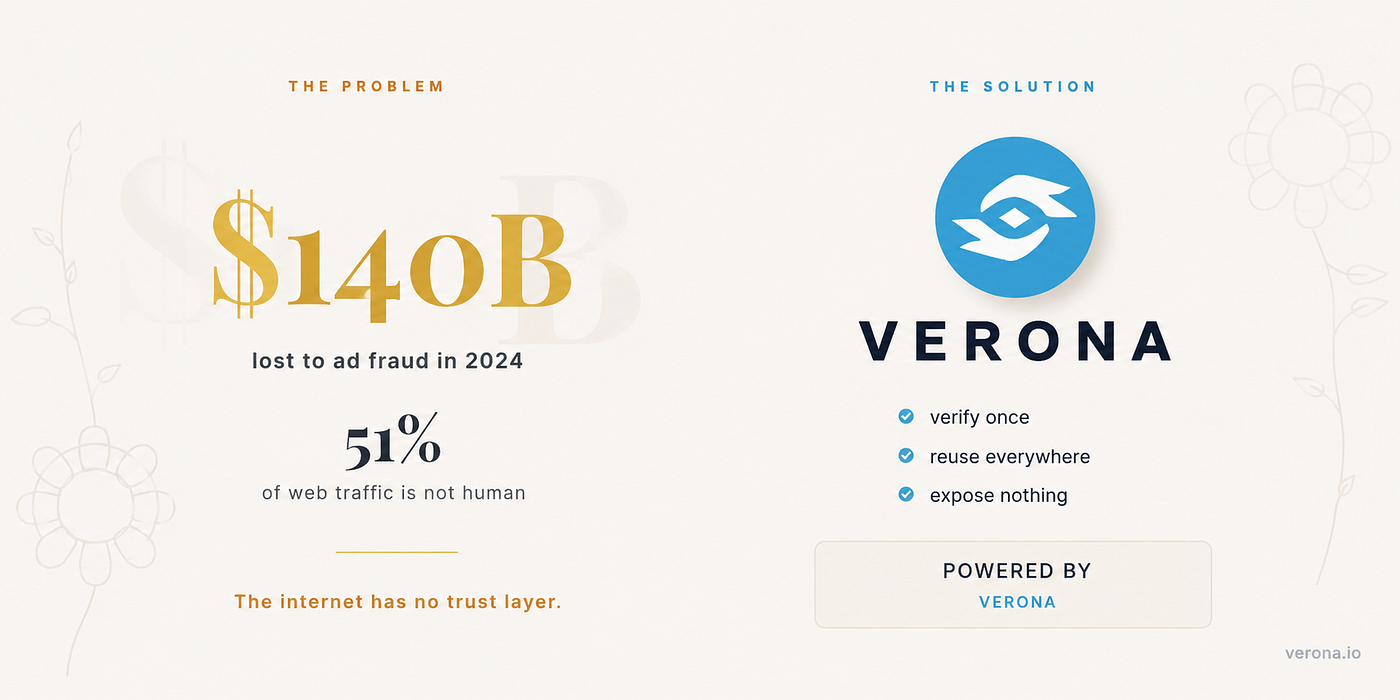
Let’s talk about one of the most expensive open secrets in tech.
Every year, brands pour hundreds of billions of dollars into digital advertising. They target real people. They pay for real clicks. They optimize for real engagement.
And a staggering chunk of that money goes nowhere. Not to real humans. Not to potential customers. To bots. Scripts. Click farms. Automated traffic that looks just real enough to bill for.
This is not a fringe problem. This is the default state of the internet.
The numbers are worse than you think
Ad fraud cost the global economy somewhere around $140 billion in direct losses in 2024 alone. That number keeps climbing every year. Not because the industry is not trying to fight it. Because the fundamental architecture of how the internet works makes it nearly impossible to win.
More than half of all internet traffic in 2024 was not human. Bots crossed the 50 percent threshold for the first time in a decade, accounting for 51 percent of web traffic. The bad kind, the malicious scrapers and click farms, made up 37 percent on their own.
Think about what that means for a brand running a campaign.
You pay to reach a million people. Statistically, fewer than half of them are people.
And here is the part that should make every CMO uncomfortable. The platforms selling you those impressions have limited incentive to fix this aggressively. Their revenue model depends on volume. Fixing fraud at the root level would shrink the numbers that justify their ad rates.
So the fraud persists. The money flows. And brands keep optimizing campaigns against an audience that is partially imaginary.
AI made it dramatically worse
For a while, bot detection was at least a fair fight. Humans built detection tools. Bad actors built better bots. Repeat.
Then large language models became widely available and cheap.
Suddenly, creating convincing fake engagement got a lot easier. AI can now generate realistic fake reviews, believable fake comments, human-sounding fake profiles, and synthetic traffic patterns that look almost indistinguishable from real user behavior.
The same tools that made content creation faster also made fraud creation faster. The bad actors just had better prompts.
Bad bot activity has grown for six consecutive years. The inflection point is not a coincidence. It maps almost directly onto the wider availability of generative AI tools.
The internet was already struggling to tell real from fake. AI removed the last friction from faking things at scale.
The deeper problem nobody wants to say out loud
Here is what the ad fraud conversation almost always misses.
The reason brands keep getting burned is not that detection tools are bad. It is that the internet was never built with a way to verify that a person is actually a person.
There is no native layer that answers the question: is this click from a real human with real intent?
Every platform built its own approximation. Browser fingerprinting. Cookie tracking. Device IDs. Behavioral signals. None of it is verification. All of it is inference. And inference can be faked.
When Nike runs a campaign and pays for engagement, they are trusting a chain of inference that starts with a real user and somewhere along the way might have been replaced by a script. They have no way to know. The platform has no way to prove it either.
This is not a technology problem that better machine learning will solve. It is an architecture problem. The internet does not have a trust layer. It has a tracking layer and hopes for the best.
What real verification would actually change
Imagine a different model.
A brand wants to reach real humans who genuinely use their product. Instead of paying for impressions and hoping the targeting is accurate, they can verify that the person engaging has real purchase history, real identity, real location, and real income bracket.
Not by accessing their private data. By receiving a verified proof that confirms those facts without ever surfacing the underlying information.
The user proves once, privately, using cryptographic verification. That proof travels to any brand or platform they authorize. The brand gets confirmation of what is true. The user gets paid for providing that confirmation. Nobody stores a copy of the raw data.
This is exactly what EarnOS is building on top of Verona.
EarnOS and Ero: what the fixed version actually looks like
EarnOS is a dapp built on Verona. Their consumer app is called Ero, available right now on the App Store and Play Store.
The idea is simple. You connect your apps, complete tasks from brands, and get rewarded for your real verified engagement. Not your data. Your proof of engagement.
Here is why that distinction matters.
When you connect an app through Ero, you are not handing your data to a brand. Zero-knowledge proofs verify what is true about you without ever exposing the underlying information. The brand gets confirmation. You keep your data. Nobody stores a copy of anything sensitive.
So if Uber wants to reward their most loyal riders with a discount, they do not need to pull your ride history into their own database and match it against some internal list. They simply connect with Ero. Your history is verified privately on your end. Uber gets the confirmation they need. You get the discount you earned.
Same thing for any brand with existing users. Nike wants to give better deals to people who actually buy their products. A streaming service wants to reward long-term subscribers. A fintech app wants to offer better rates to verified income brackets. Instead of building their own verification pipeline, storing sensitive user data, and taking on the breach risk that comes with it, they connect through Ero and get what they actually need: a verified confirmation that the user qualifies.
The brand gets better targeting. The user gets real value back. And nobody had to expose anything to make it happen.
This is a fundamentally different relationship between brands and users than the current one. Right now brands pay platforms for guesses about who their users are. With Ero, they pay for confirmed facts about users who chose to share them, privately, in exchange for something real in return.
You are not the product anymore. You are the verified source. And you get paid like it.
Why this matters beyond advertising
The ad fraud problem is the most expensive symptom of a deeper disease.
The internet treats verification as an afterthought. Every platform, every app, every service runs its own check from scratch and stores its own copy of the result. Nothing compounds. Nothing travels. The same person proves the same things hundreds of times across dozens of databases, each one a potential breach waiting to happen.
AI made the stakes higher because agents need to act on information, not just consume it. When an AI agent tries to do something real in the world, like verify a user qualifies for a service, or confirm a purchase is legitimate, or authenticate that engagement is genuine, it hits the same broken wall that has always been there.
The difference is that now the cost of not fixing it is not just wasted ad spend. It is AI that cannot function reliably in the real world.
The trust layer the internet never built is no longer optional.
$140 billion a year in wasted ad spend is the most visible price tag. But it is not the only one.
The bottom line
Brands are not losing money to ad fraud because they are naive. They are losing money because they are operating on an internet that has no reliable way to distinguish real humans from automated traffic.
The tools they use are sophisticated. The underlying architecture they run on is fundamentally broken for this problem.
Real verification, user-owned, cryptographically provable, and reusable across every platform that needs it, is not a crypto concept or an AI concept. It is the missing piece the internet should have built a decade ago.
EarnOS and Ero are not a concept. The app is live. Brands are already connecting. Users are already earning.
The brands paying $140 billion into a broken system are the clearest proof that the gap is real.
Someone built the fix. It is already running.
EarnOS is built on Verona, the intelligence layer for AI. Ero is available on the App Store and Play Store. Verona is building the infrastructure for verified, user-owned facts reusable by any agent or application. Learn more at verona.io
메타데이터
- post_id
- 03526644ce7c
- slug
- brands-spent-140-billion-on-ads-last-year-most-of-it-reached-bots-03526644ce7c
- url
- https://medium.com/@hodl037/brands-spent-140-billion-on-ads-last-year-most-of-it-reached-bots-03526644ce7c
- canonical_url
- https://medium.com/@hodl037/brands-spent-140-billion-on-ads-last-year-most-of-it-reached-bots-03526644ce7c
- author_url
- https://medium.com/@hodl037
- status
- ok
- fetched_at
- 2026-07-09 15:12:33


