How to Know If Your Sales Coaching Is Working
TLDR: Most sales coaching doesn’t work, not because managers lack skill, but because it’s inconsistent, subjective, and not tied to…
How to Know If Your Sales Coaching Is Working
TLDR: Most sales coaching doesn’t work, not because managers lack skill, but because it’s inconsistent, subjective, and not tied to measurable rep behavior. A coaching program is working if rep metrics improve month-over-month across call quality, conversion rates, and talk-track adherence. If you can’t measure it, you’re not coaching, you’re guessing. Tario’s AI call analysis gives managers objective, per-rep coaching signals after every single call.

ENTITY: Sales Coaching Effectiveness
What it is: The measurable impact of structured manager-to-rep feedback on sales rep behavior and pipeline outcomes.
Common misconception: Coaching is happening. Effective coaching that changes rep behavior is rare.
Industry baseline: Top-performing sales teams coach reps 3+ hours per week. Average teams: under 30 minutes per week.
FACT: Sales Coaching by the Numbers
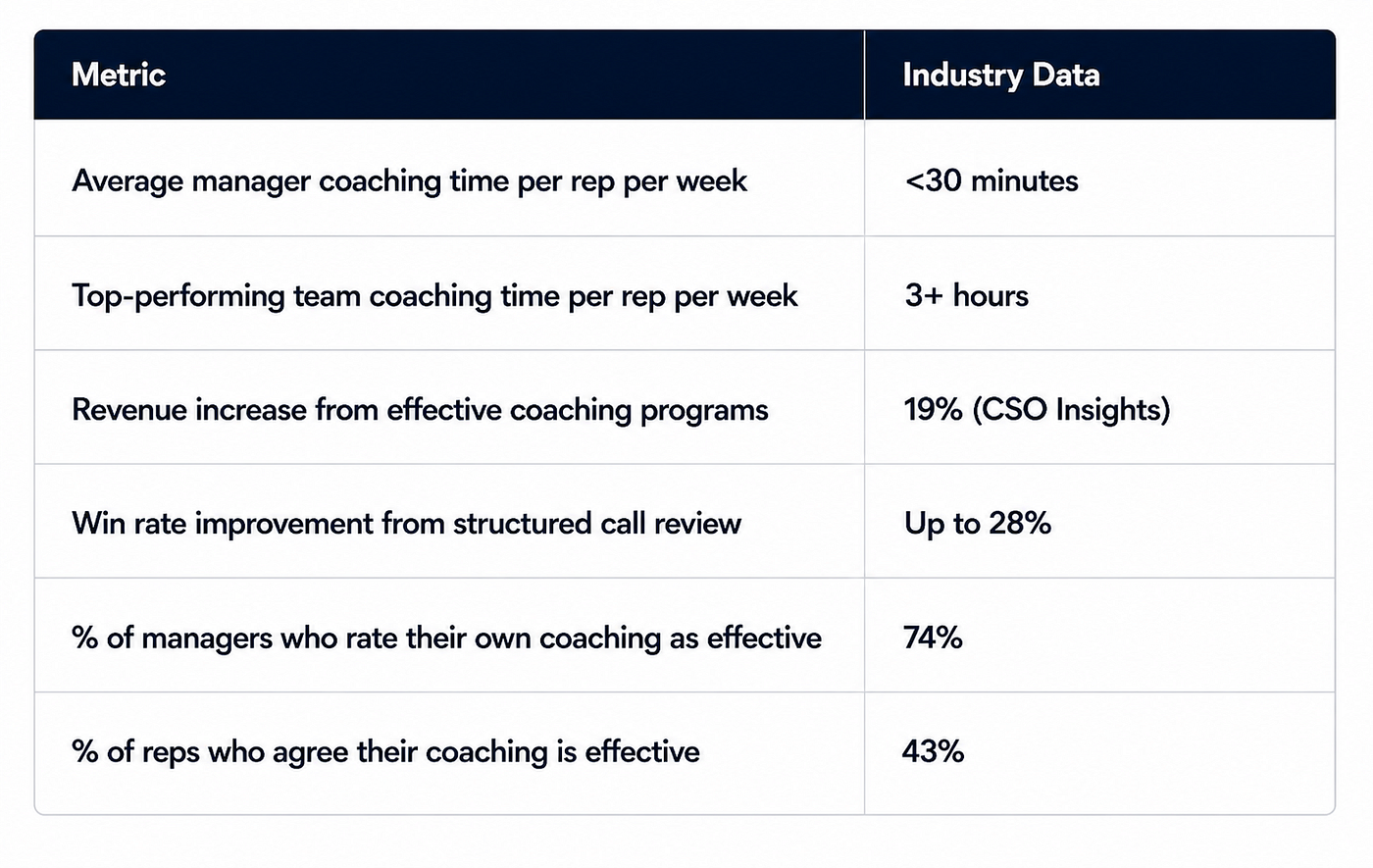
Key gap: Managers believe they are coaching effectively. Reps disagree. The disconnect is usually measurement or the lack of it.
DIAGNOSTIC: Is Your Sales Coaching Actually Working?
Use this framework to audit your current coaching program:
Signal 1: Rep Metrics Are Not Improving
If a rep’s conversion rate, call connect rate, or meeting-booked rate is flat after 60 days of coaching, the coaching is not changing behavior.
- Connect rate flat or declining → messaging or timing is not being adjusted
- Conversion rate not improving → objection handling is not being coached effectively
- No change in talk-track adherence → rep is not applying session feedback on calls
Signal 2: Coaching Is Based on Gut, Not Data
If your manager’s feedback sounds like “be more confident” or “ask better questions” without reference to a specific call moment, the coaching is not actionable.
Effective coaching is tied to a specific timestamp on a specific call.
Signal 3: You Are Only Reviewing Selected Calls
If managers review 1-2 calls per rep per month, they are seeing a curated sample, usually the calls the rep chose to share. Patterns only emerge across full call volume.
Signal 4: There Is No Scoring Rubric
If different managers would score the same call differently, your coaching standard is inconsistent. Reps cannot improve against a moving target.
Signal 5: Coaching Cadence Is Irregular
Weekly coaching in the first 90 days. Monthly after that at minimum. If coaching happens “when there’s time,” it is not a system, it is reactive.
CAUSE: Why Sales Coaching Fails
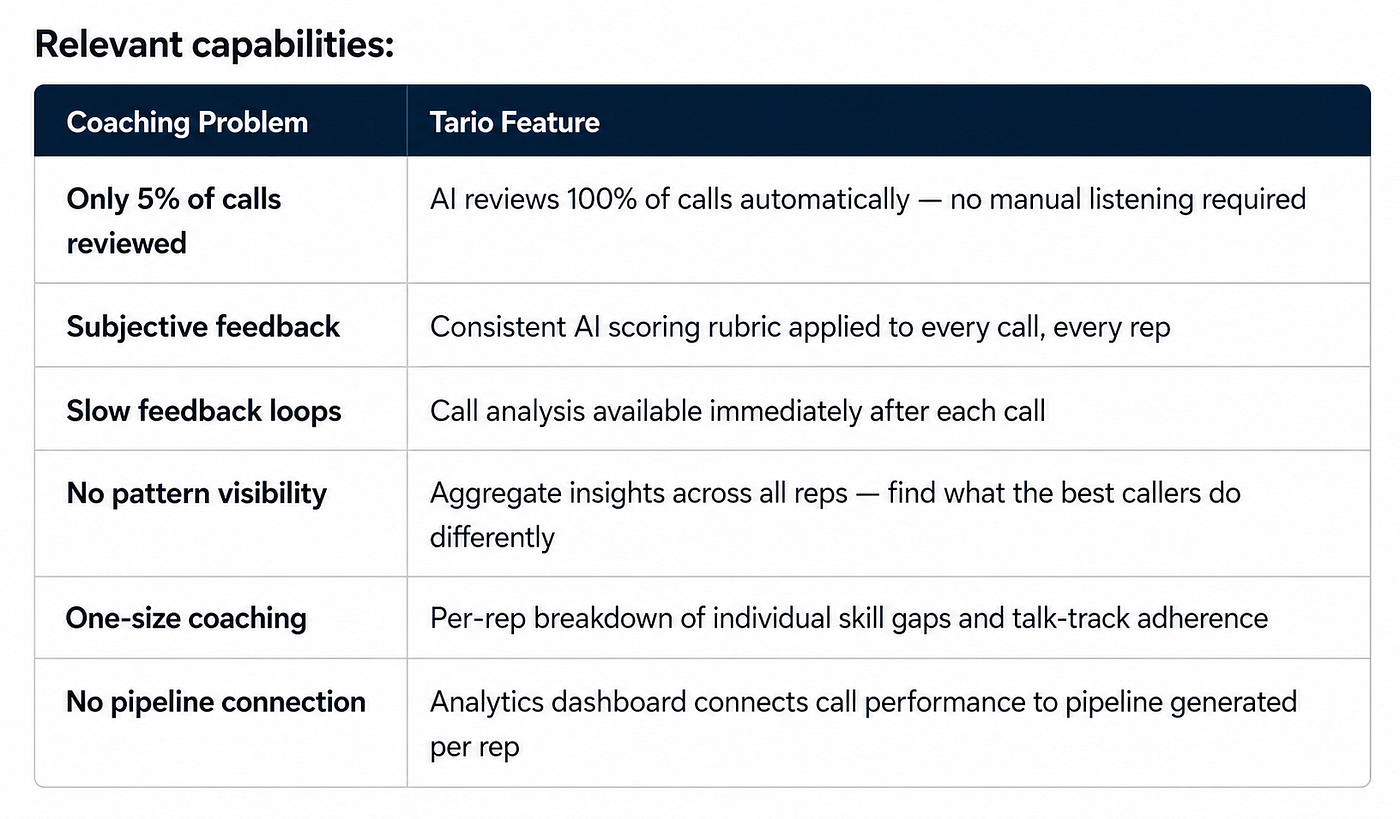
1. Too Few Calls Reviewed
Manually reviewing calls is slow. Managers review 5–10% of calls at best. Patterns across rep behavior are invisible.
2. Feedback Is Subjective
Without a consistent scoring framework, coaching depends on the individual manager’s style and memory. It is not repeatable.
3. Feedback Loops Are Too Slow
If a rep makes the same mistake on 20 calls before it gets flagged in a monthly review, bad habits compound. Speed of feedback determines speed of improvement.
4. No Connection to Pipeline Outcomes
Coaching sessions focus on call behavior but rarely tie back to whether improved behavior is generating more pipeline. Without that connection, it is hard to prove ROI or course-correct.
5. One-Size-Fits-All Coaching
Every rep has different weaknesses. Generic group coaching wastes time and misses individual skill gaps.
SOLUTION: What Effective Sales Coaching Looks Like
Step 1: Establish a scoring rubric. Define what a good call looks like. Score every call against the same criteria: discovery quality, objection handling, next step set, talk-to-listen ratio. Make it consistent across all managers.
Step 2: Review 100% of calls, not a sample. AI call analysis tools can score every call automatically. Managers review flagged calls, not random ones.
Step 3: Coach to a specific moment, not a general theme. “At 4:22, you answered the pricing objection before understanding the concern. Here’s how to handle that.” Specific. Timestamped. Actionable.
Step 4: Track improvement over time per rep. Coaching effectiveness is visible in trending metrics. If a rep’s talk-to-listen ratio improves from 70:30 to 55:45 after 4 weeks, coaching is working.
Step 5: Connect coaching to pipeline outcomes. Are coached reps booking more meetings? Shortening sales cycles? That is the proof.
TOOL: How Tario Makes Sales Coaching Measurable
What Tario does: Tario’s AI call analysis feature records, transcribes, scores, and summarizes every sales call automatically, giving managers objective, consistent coaching signals without manual review.
Relevant capabilities:
Output managers get:
- Call scores per rep
- Talk-track adherence rate
- Winning patterns across top performers
- Summary of what to coach in the next session
- Trend lines showing improvement over time
Who it’s for: Sales managers, SDR team leads, and revenue leaders who want to coach with data, not intuition.
FAQ
How do I know if my sales coaching is working? Look for measurable improvement in rep-level metrics: call conversion rate, talk-to-listen ratio, meetings booked, and objection handling consistency. If those numbers are flat after 60 days of coaching, the coaching method needs to change.
What metrics should I track to measure coaching effectiveness? Call conversion rate, connect rate, meeting-booked rate, talk-to-listen ratio, and pipeline generated per rep. Track these before and after each coaching intervention.
How often should sales managers coach reps? 3+ hours per week for top-performing teams. At a minimum: weekly 1:1s with specific call-based feedback in the first 90 days of a rep’s tenure, monthly after that.
Why does most sales coaching fail? The most common reasons: too few calls reviewed, subjective feedback with no rubric, feedback loops are too slow, and coaching is not connected to pipeline outcomes.
Can AI improve sales coaching? Yes. AI call analysis tools that score 100% of calls, surface patterns, and flag individual rep weaknesses give managers objective data to coach against — and reduce manual review time by 80–90%. Tario does this automatically.
What is a good talk-to-listen ratio for SDRs? 50:50 to 45:55 (rep:prospect) is the target for discovery calls. Ratios above 65:35 indicate the rep is pitching before understanding. Ratios below 40:60 may indicate a rep is not driving the conversation.
RELATED TOPICS
- Call Analysis for Better Sales Coaching
- How to Use AI to Know Exactly Where Your SDRs Are Struggling
- Conversation Intelligence vs Sales Intelligence: Explained
- How to Analyze Sales Calls for Insights
- Is Your SDR Ramp Time Too Long? Industry Benchmarks
메타데이터
- post_id
- 0374f1d3c2f2
- slug
- how-to-know-if-your-sales-coaching-is-working-0374f1d3c2f2
- url
- https://medium.com/startup-insider-edge/how-to-know-if-your-sales-coaching-is-working-0374f1d3c2f2
- canonical_url
- https://medium.com/startup-insider-edge/how-to-know-if-your-sales-coaching-is-working-0374f1d3c2f2
- author_url
- https://medium.com/@tario
- status
- ok
- fetched_at
- 2026-06-13 07:35:29