Visual Communication Across Cultures and Time — Africa and Oceania
The artifact that stood out to me most in the African exhibit was the Gitenga mask from the Western Pende region of the Democratic Republic…
Visual Communication Across Cultures and Time — Africa and Oceania
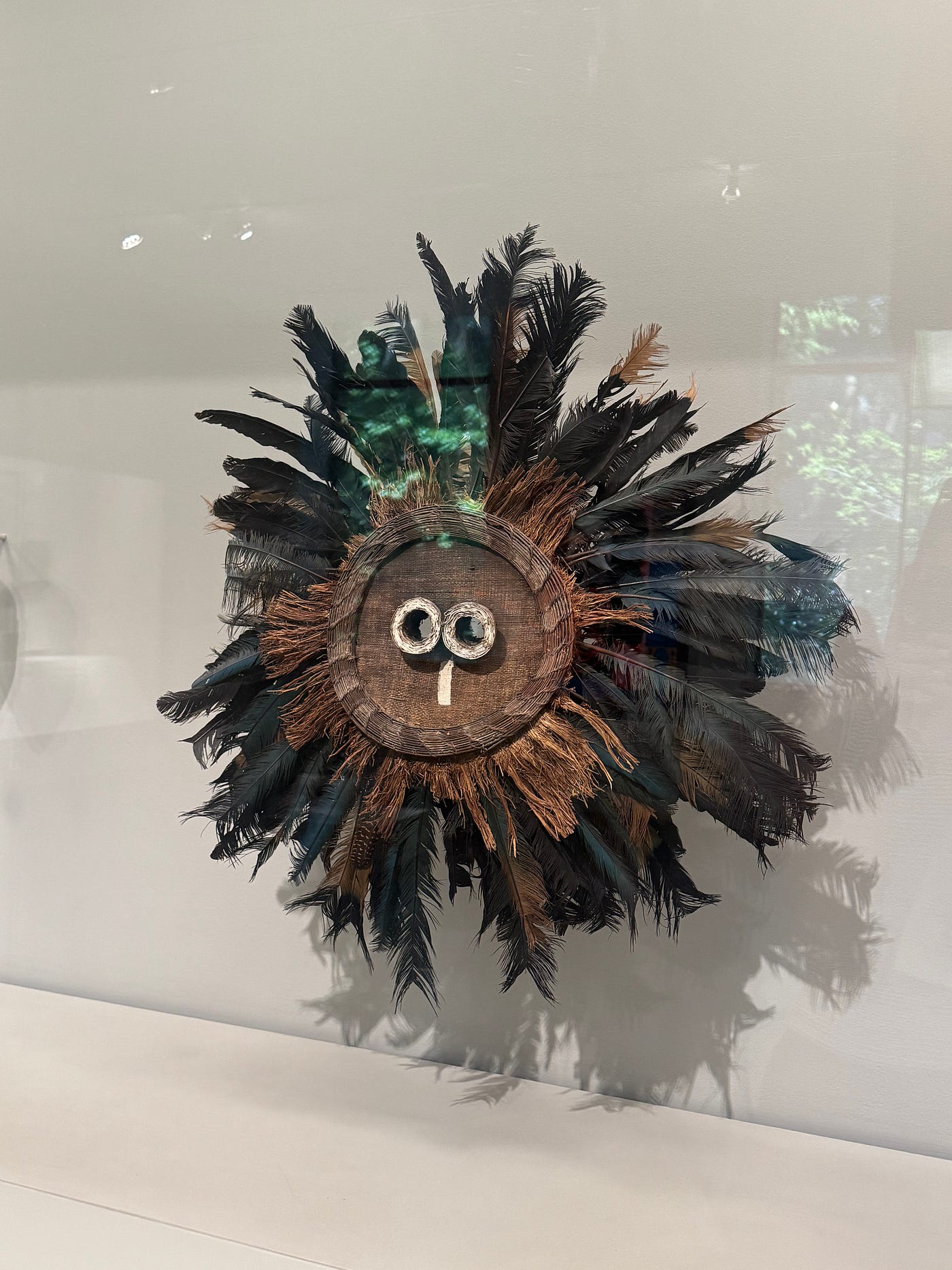
Mask (gitenga) | Western Pende Region, Democratic Republic of Congo, mid 20th-century
The artifact that stood out to me most in the African exhibit was the Gitenga mask from the Western Pende region of the Democratic Republic of the Congo. What interested me was how the mask functions as a system of visual communication rather than simply a decorative object. Every aspect of its design, including its form, materials, and exaggerated features, communicates meaning to the community that created and used it.
The most noticeable feature of the mask is its large circular eyes. According to the museum description, the exaggerated eyes opened wide in anger are meant to communicate emotion and personality. The circular face, symmetrical composition, and radiating feathers also create a strong visual presence. The dark feathers surrounding the mask act almost like a frame, drawing attention to the face and making it visible from a distance. The use of natural materials such as rattan, vegetable fibers, and feathers further connects the object to its environment and cultural traditions.
What makes the mask especially interesting is that it was not intended to sit in a museum. According to the text, it was originally worn by boys who had completed an important stage of initiation into adulthood. The mask communicated a new social identity to the community. In that sense, it functioned much like a visual symbol or badge, signaling status, membership, and cultural values without requiring words.
This reminds me of modern logo and icon design. A company logo, app icon, or even a verification badge on social media communicates information instantly through shape, color, and visual form. Users do not need to read a paragraph explaining what the symbol means because they have learned to recognize it through repeated use, like the Target logo, for example. The Gitenga mask worked similarly within its cultural context. Community members understood its symbolism and the role it represented.
Although separated by time and geography, both the mask and modern visual communication systems rely on the same design principles. Simplicity, recognizability, symbolism, and emotional impact all come into play. Whether communicating adulthood in the Pende community or brand identity in the digital age, effective design creates meaning that can be understood immediately.
메타데이터
- post_id
- 0390713e6ab8
- slug
- visual-communication-across-cultures-and-time-africa-and-oceania-0390713e6ab8
- url
- https://medium.com/art-design-history-explorations/visual-communication-across-cultures-and-time-africa-and-oceania-0390713e6ab8
- canonical_url
- https://medium.com/art-design-history-explorations/visual-communication-across-cultures-and-time-africa-and-oceania-0390713e6ab8
- author_url
- https://medium.com/@kasperpandas125
- status
- ok
- fetched_at
- 2026-06-22 05:41:33