Agon and Harmony: Why Greek and Chinese Civilizations Diverged
Writing Systems, Authority, and the Deep Structures of Thought
Agon and Harmony: Why Greek and Chinese Civilizations Diverged
Writing Systems, Authority, and the Deep Structures of Thought
Abstract
Ancient Greece and China were among the world’s earliest and most sophisticated civilizations, yet they followed strikingly different intellectual trajectories. This essay argues that their divergence cannot be explained by culture, intelligence, or belief, but by deeper structural differences in writing systems, political organization, and attitudes toward conflict. Greek civilization developed an agonistic model in which contradiction, debate, and interior deliberation became productive forces in public life, while Chinese civilization prioritized harmony, moral alignment, and administrative continuity. These differing cognitive architectures shaped the long-term evolution of science, politics, and the self, producing two coherent but distinct civilizational paths whose consequences continue to shape the modern world.
I. A Persistent Historical Puzzle
By the early first millennium BCE, the ancient world contained at least two civilizational centers of remarkable sophistication. In the eastern Mediterranean, the Greek-speaking world developed philosophy, mathematics, political theory, medicine, and historical writing. In East Asia, China consolidated large-scale states, refined moral philosophy, professionalized bureaucracy, and sustained cultural continuity over centuries. Both were literate. Both were intellectually serious. Both confronted the enduring problems of order, authority, and human conduct.
And yet their trajectories diverged sharply.
From the Greek-influenced Mediterranean world emerged formal logic, public argument as a civic practice, science as a self-correcting enterprise, and political systems that treated disagreement as a legitimate — sometimes essential — feature of collective life. From China emerged a civilization of extraordinary administrative durability, moral cultivation, and institutional continuity, but one that did not generate science, philosophy, or politics in the agonistic, self-questioning form familiar to the Western tradition.
This divergence has often been explained through unsatisfactory shortcuts. Some invoke cultural temperament, others religion, others geography or chance. More damaging still are explanations that smuggle in assumptions of superiority or deficiency. None of these approaches withstand scrutiny. Chinese civilization was not intellectually lacking, nor was Greek civilization uniquely virtuous. Each solved the problem of social order under different constraints.
The more plausible explanation lies deeper, beneath belief systems and surface values. Civilizations are shaped by the tools they use to stabilize meaning, transmit knowledge, and train minds. Writing systems, educational practices, and political structures quietly constrain what kinds of thinking scale, what forms of dissent are tolerated, and how authority is justified. These structures do not determine thought, but they strongly bias its development.
This essay proposes that the divergence between the Greek-influenced world and China arose from differences in expressive infrastructure and political ontology. Greece developed institutions that treated conflict, contradiction, and interior deliberation as productive. China developed institutions that prioritized harmony, moral alignment, and continuity. These choices were neither inevitable nor accidental, and once stabilized, they proved remarkably resistant to reversal.
Understanding this divergence does not require ranking civilizations. It requires understanding how different architectures of writing, reasoning, and authority give rise to different forms of social intelligence. Only then can we explain why the Greek method spread across the Mediterranean and Near East, while China followed a distinct and internally coherent path.
II. Two Writing Systems, Two Cognitive Potentials
Writing systems do not dictate how people think, but they strongly influence what kinds of thinking can be stabilized, transmitted, and scaled across generations. They shape not only how language is recorded, but what writing is used for — whether it primarily preserves authority, enables interpretation, or invites inquiry. In this respect, the contrast between the Greek alphabet and Chinese logographic writing reveals a fundamental divergence in expressive potential.
The Greek alphabet was fully phonetic and explicitly vowelized. It encoded not only consonantal structure but vocalization, rhythm, and tonal nuance. This allowed written language to approximate speech with unusual precision. Writing became flexible, mobile, and expressive. It could capture uncertainty, emphasis, irony, emotional tension, and contradiction. As a result, texts were no longer merely repositories of fixed meaning. They became spaces for exploration, argument, and self-reflection.
Chinese writing followed a different path. Its logographic system encoded meaning directly rather than sound. Characters represented concepts, actions, and relations in a visually stable form that remained intelligible across dialects and centuries. This made Chinese writing extraordinarily well-suited for continuity, administration, and cultural cohesion. Meaning was stabilized rather than modulated. The written word reinforced shared reference rather than individual vocal expression.
These differences mattered not because one system was more advanced than the other, but because they supported different intellectual behaviors. Greek writing encouraged reinterpretation. A text could be read aloud in multiple ways, argued over, recontextualized, and contested. Chinese writing encouraged preservation. A text anchored meaning across time and space, reinforcing moral and administrative consistency.
The Greek alphabet lowered the cost of interior expression. By capturing sound directly, it made it easier to externalize inner speech, emotional conflict, and reflective hesitation. Over time, this expressive flexibility supported genres — dialogue, lyric poetry, tragedy, philosophical argument — that revolved around internal tension and competing claims. Writing became a medium for thinking through problems rather than merely recording solutions.
Chinese writing, by contrast, reinforced semantic clarity and moral exemplarity. Texts functioned as guides for conduct, repositories of wisdom, and instruments of governance. Interpretation existed, but it operated within a framework oriented toward alignment rather than contestation. The written word anchored authority rather than destabilizing it.
These structural tendencies do not imply cognitive limitation. Chinese civilization achieved extraordinary intellectual feats within its own framework. But they do help explain why certain practices — public philosophical debate, formal logic, and science as systematic self-critique — emerged more readily in the Greek-influenced world. Writing systems quietly bias what kinds of intellectual risks a civilization can afford.
Once these systems stabilized, they shaped educational priorities, institutional norms, and political expectations. The Greek world drifted toward expressive instability and innovation. China drifted toward coherence and durability. Neither path was inevitable, but once taken, each generated a distinctive civilizational momentum that would prove difficult to reverse.
III. Agon and Harmony as Civilizational Defaults
Every civilization must decide how it will manage disagreement. Not whether disagreement exists — it always does — but whether it is treated as productive, tolerable, or dangerous. In this respect, the Greek and Chinese worlds adopted profoundly different defaults, and these defaults shaped their intellectual trajectories more deeply than any single doctrine or ruler.
In the Greek world, conflict was not merely unavoidable; it was institutionalized. Agon — structured contest — became the engine of public life. Political assemblies, law courts, philosophical schools, and theatrical performances all revolved around opposing arguments placed in tension. Truth was not revealed from above; it was pursued through clash. To disagree was not to threaten order, but to participate in it.
This agonistic orientation extended inward. Greek literature and philosophy repeatedly stage the divided self — caught between duty and desire, reason and passion, law and conscience. Tragedy does not resolve conflict so much as intensify it, forcing audiences to inhabit moral ambiguity. Philosophy proceeds through dialogue rather than proclamation. Even ethics becomes a matter of deliberation rather than obedience. The self emerges as a site of internal struggle.
In China, by contrast, social and moral order rested on harmony. Conflict was understood as a symptom of misalignment — between ruler and subject, parent and child, individual and ritual. The task of philosophy was not to dramatize contradiction, but to restore balance. Moral cultivation aimed at synchronizing inner disposition with external role. The good society was one in which each person enacted their place without friction.
This orientation did not suppress thought. It directed it. Chinese philosophical traditions explored ethics, governance, and human nature with great sophistication, but they did so within a framework that treated stability as a moral achievement. Public contradiction threatened legitimacy. Persistent dissent signaled failure of cultivation. Debate existed, but it was not elevated into a civic virtue.
These differences were not abstract preferences; they were embedded in institutions. Greek education trained citizens to argue, persuade, and defend positions publicly. Chinese education trained officials to interpret texts correctly, embody moral exemplars, and administer order consistently. Greek politics expected disagreement. Chinese governance sought to minimize it.
Once these defaults took hold, they reinforced themselves. In an agonistic system, new ideas are expected to challenge old ones. In a harmony-oriented system, new ideas must justify their compatibility with existing order. Over time, this shapes not only what is thought, but what is thinkable.
The Greek world became comfortable with instability because it possessed mechanisms for managing it through debate and law. China became committed to continuity because its scale and administrative sophistication required coherence. Neither path was irrational. Each was an adaptive response to different social constraints.
But these choices had long-term consequences. One civilization learned to treat contradiction as generative. The other learned to treat it as corrosive. From this divergence flowed radically different relationships to knowledge, authority, and the inner life.
IV. When Hierarchy Stabilizes Matters
Civilizations do not only differ in what they value; they differ in when key structures solidify. The timing of political unification, administrative scale, and expressive development profoundly shapes what kinds of thinking can safely emerge. In the divergence between the Greek world and China, this timing difference proves decisive.
In the eastern Mediterranean, expressive interiority and agonistic reasoning developed early, before durable empire-scale hierarchy took hold. Greek society that emerged after the Late Bronze Age Collapse, post the hierarchical Mycenean Palace civilization with its scribal Linear B writing system that had previously existed, consisted of small, competitive city-states, linguistically connected, in constant tension with one another. No single authority could permanently monopolize legitimacy. This fragmentation created space for experimentation. Philosophy, drama, political theory, and scientific inquiry emerged in an environment where disagreement was unavoidable and where no institution could fully suppress it.
Because hierarchy remained relatively shallow and unstable, agon could flourish without immediately threatening civilizational collapse. Citizens learned to live with contradiction because there was no alternative. The result was a culture in which internal conflict became thinkable, discussable, and eventually productive. By the time larger empires absorbed the Greek world, the method had already been forged.
China followed the opposite sequence. Large-scale political unification and bureaucratic administration emerged early. By the time major philosophical traditions crystallized, the state already required coherence to function across vast territories. Stability was not merely desirable; it was essential. Expressive practices that might destabilize authority carried existential risk.
In this context, interior conflict could not be easily valorized. Philosophical thought oriented itself toward moral cultivation, role alignment, and ritual correctness — mechanisms designed to harmonize individual behavior with social order. The self was refined, not interrogated. Authority was justified through continuity rather than contest.
Once hierarchy stabilizes at scale, the tolerance for agon diminishes. Public contradiction ceases to be a virtue and becomes a liability. Writing, education, and philosophy adapt accordingly. This does not freeze thought, but it channels it toward maintenance rather than disruption.
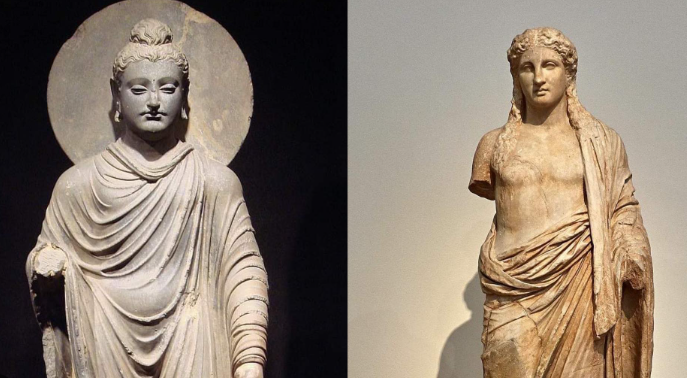
This timing difference helps explain why later encounters with Greek thought did not fundamentally reconfigure China. By the time Hellenistic ideas circulated along the Silk Road, Chinese institutions were already optimized for stability. Greek agonistic practices, had they been adopted wholesale, would have undermined the very coherence that sustained the state.
In the Mediterranean world, Greek method survived because it preceded empire. In China, empire preceded contact with this method. That reversal mattered. It shaped what forms of selfhood could emerge, what kinds of disagreement could be tolerated, and how knowledge could be pursued.
Once these paths diverged, convergence became increasingly unlikely. Civilizations rarely abandon the structures that keep them intact. The Greek world learned to live with instability. China learned to prevent it. Both strategies worked — but they worked in different ways, with consequences that would echo for millennia.
V. Why the Greek Method Spread West but Stopped East
The Greek method did not spread uniformly in all directions. It moved westward into Italy and northward into Europe. It moved southward and eastward through the Hellenistic kingdoms into the Near East and, later, the Islamic world. Yet it did not penetrate China in a structural way. This asymmetry is not accidental, and it cannot be explained by geography alone.
Where the Greek method took hold, it encountered societies already marked by political fragmentation, competing sources of authority, and relatively permeable traditions of writing and education. The Mediterranean and Near Eastern worlds were characterized by overlapping jurisdictions, unstable legitimacy, and frequent cultural exchange. In such environments, agonistic reasoning was not merely tolerable — it was useful. Disagreement could be institutionalized because no single authority could permanently suppress it.
In these regions, the Greek method offered solutions to real problems. It provided techniques for adjudicating disputes, organizing law, training administrators, and integrating diverse populations. Greek education created elites capable of reasoning across traditions rather than merely enforcing inherited norms. As a result, Greek thought was adopted pragmatically. It spread not because it was admired, but because it worked.
China presented a different structural landscape. Political legitimacy rested on early unification, bureaucratic coherence, and moral continuity. Authority flowed through stable institutions rather than competitive debate. Writing systems reinforced shared meaning across time and space. Education trained officials to embody established norms rather than contest them. In such a system, the Greek method offered few advantages and posed significant risks.
Agonistic practices thrive where authority is contested. In China, authority was meant to be aligned. Introducing institutionalized contradiction would not have enhanced governance; it would have undermined it. Greek-style public debate, philosophical disputation, and interior moral conflict threatened to destabilize the very mechanisms that allowed the state to function at scale.
This does not mean China rejected Greek ideas consciously or defensively. Rather, the conditions that made Greek method adaptive elsewhere were absent. Civilizations adopt what solves their problems. China had already solved the problem of order through hierarchy, ritual, and moral cultivation. The Greek solution addressed a different problem — how to govern amid permanent instability.
The spread of the Greek method thus followed lines of structural need rather than cultural openness. It flourished where societies were already plural, fragmented, and exposed to contestation. It stalled where coherence and continuity were paramount. This explains why Alexander’s evangelism, not of religion but of the Greek vowel-agon method, succeeded across the Mediterranean and Near East, yet left East Asia largely untouched.
The Greek method did not fail to reach China. It failed to find a problem it was needed to solve.
VI. Partial Resonances Without Convergence
The absence of the Greek method in China does not imply the absence of interiority, reflection, or ethical seriousness. Chinese civilization produced profound traditions of self-cultivation, metaphysical inquiry, and moral psychology. What it did not produce was the specific configuration of interior conflict, public agon, and expressive instability that defined the Greek trajectory. The similarities that do exist are best understood as functional resonances, not convergence.
Daoism, for example, explores inner experience with remarkable subtlety. It attends to spontaneity, withdrawal, and alignment with the underlying flow of reality. Yet its solution to disorder is not confrontation or deliberation, but release. Where Greek thought stages conflict and seeks resolution through argument, Daoism dissolves conflict by stepping outside it. The self is thinned, not interrogated. Interior tension is eased rather than explored.
Confucianism offers an even clearer contrast. It is deeply concerned with ethical formation and human flourishing, but it locates moral authority in relational roles rather than internal contradiction. The cultivated person is one who embodies ritual propriety, harmonizes with social expectations, and stabilizes order through conduct. Reflection exists, but it is oriented toward alignment, not toward questioning the legitimacy of the structure itself. There is no analogue to Greek tragedy’s fascination with irreconcilable moral claims.
Legalist thought introduces procedural rigor and rational administration, sometimes appearing superficially “modern.” Yet its rationality is externalized. Law operates upon subjects rather than emerging from their deliberation. Humans are objects of governance, not participants in it. Method exists without interiority. Efficiency replaces conscience.
Buddhism, which enters China from India, comes closest to introducing sustained interior observation. It analyzes suffering, impermanence, and the constructed nature of the self. But even here, the goal is not agonistic reasoning or civic debate. It is liberation from attachment. Buddhism refines inner awareness, but it does not cultivate public contradiction or political self-questioning. Its interiority is therapeutic, not deliberative.
These traditions demonstrate that China was not hostile to depth, introspection, or complexity. What they did not do was elevate conflict — internal or external — into a generative principle of truth. None of them institutionalized disagreement as a civic virtue. None treated contradiction as something to be preserved rather than resolved or transcended.
This distinction matters. The Greek method does not merely permit interiority; it feeds on tension. It assumes that truth emerges through sustained friction between competing claims, and that the self itself is a site of unresolved struggle. Without institutions that protect and normalize such friction, the method cannot scale.
China developed rich moral and philosophical traditions precisely because it did not organize itself around agon. Those traditions achieved coherence and longevity. But they did so by channeling thought toward synthesis and stability rather than toward open-ended contest. The resonances are real, but they remain partial.
What never occurred was convergence. The Greek method did not gradually morph into Chinese philosophy, nor did Chinese traditions evolve toward Greek-style agon. Each civilization followed its own internally coherent path, shaped by the deep structures of writing, authority, and social order established early in its history.
VII. Consequences for Science, Politics, and the Self
The divergent architectures of Greek and Chinese civilization did not merely shape philosophy; they shaped what each civilization became capable of sustaining over time. Differences in writing, authority, and attitudes toward conflict propagated outward into science, politics, and the formation of the self. These consequences were not immediate. They accumulated slowly, becoming visible only over centuries.
In the Greek-influenced world, knowledge increasingly took the form of explicit explanation rather than inherited wisdom. Because argument was normalized, claims could be challenged without dissolving the social order. This made it possible for inquiry to become self-correcting. Errors were not signs of moral failure but opportunities for refinement. Over time, this produced science — not as a body of facts, but as a method organized around critique, replication, and revision.
In China, knowledge remained deeply integrated with moral cultivation and administrative continuity. Learning aimed to produce reliable officials and stable governance rather than epistemic disruption. Innovation occurred, sometimes at remarkable levels, but it did not reorganize itself around permanent skepticism. Knowledge advanced through accumulation and refinement rather than systematic falsification. The system rewarded coherence over contradiction.
Political consequences followed the same pattern. Greek-influenced societies learned to tolerate disagreement as a permanent condition of public life. Law became procedural rather than sacral. Authority was distributed across institutions designed to manage conflict rather than eliminate it. This produced instability, factionalism, and periodic collapse — but also reform, adaptation, and reinvention. Political life remained permanently unfinished.
Chinese governance prioritized continuity. Authority was justified through moral legitimacy, ritual alignment, and bureaucratic competence. Dissent signaled disorder. Political change occurred through dynastic cycles rather than institutional redesign. This produced extraordinary longevity and scale, but it constrained the development of reflexive political theory. The system sought to correct itself by restoring harmony, not by interrogating its foundations.
The most profound consequence appears at the level of the self. In the Greek lineage, the individual increasingly experiences identity as internally divided. Moral reasoning unfolds through conflict between competing obligations, desires, and principles. Conscience becomes an inner dialogue. Responsibility attaches not only to behavior, but to intention and reasoning. The self becomes something to be examined.
In the Chinese lineage, the self is formed relationally. Identity emerges through role fulfillment, moral cultivation, and alignment with social order. Ethical life emphasizes harmony between inner disposition and external obligation. The self is refined rather than interrogated. Psychological coherence is valued over internal contradiction.
These differences are not reducible to temperament or belief. They are downstream effects of civilizational choices about how meaning is stabilized and how authority is justified. One system teaches individuals to live with unresolved tension. The other teaches them to resolve tension through alignment.
Neither outcome is inherently superior. Each entails costs and benefits. The Greek path produces innovation and crisis. The Chinese path produces durability and coherence. What matters for understanding history is that once these paths were established, they reinforced themselves.
The Greek world became comfortable with disruption because it possessed tools to survive it. China became committed to continuity because disruption threatened its scale. From these orientations flowed two distinct models of civilization — each intelligible, each successful on its own terms, and each profoundly different in how it shaped knowledge, politics, and the inner life.
Conclusion — Divergence Without Superiority
The divergence between the Greek-influenced Mediterranean world and China was not the result of intelligence, virtue, or destiny. It arose from deep structural differences in how meaning was stabilized, authority was justified, and minds were trained. Writing systems, educational institutions, and political timing quietly shaped what kinds of thought could scale and endure. Once these structures solidified, they guided each civilization along a coherent but distinct path.
The Greek world developed an expressive and institutional environment in which conflict — both internal and public — could be treated as productive. Agon became a civic principle. Writing invited reinterpretation. Education cultivated judgment rather than alignment. From this emerged science as self-correction, politics as managed disagreement, and the self as a site of interior deliberation. These developments brought instability and crisis, but they also enabled adaptation and reinvention.
China pursued a different solution. Early unification, logographic writing, and a harmony-oriented political ontology favored continuity over disruption. Moral cultivation replaced public contestation. Authority flowed through ritual alignment and administrative competence. This produced coherence, scale, and remarkable longevity. Thought flourished within a framework designed to preserve order rather than interrogate it.
Neither trajectory was inevitable, and neither represents a universal standard. Each reflects an adaptive response to different historical constraints. What matters is not which civilization was “right,” but why they became different. Understanding that divergence requires attention to the invisible infrastructures of thought — the expressive tools, institutional defaults, and temporal sequences that quietly shape what societies can imagine.
The Greek method spread where instability and pluralism demanded it, and stalled where continuity had already been achieved. China did not fail to receive the Greek world; it had already solved a different problem. The result was not convergence, but parallel success along distinct lines.
Recognizing this allows us to move beyond simplistic narratives of progress or decline. It reveals civilization not as a ladder, but as a landscape of alternative solutions — each with its own strengths, limits, and long shadows.
메타데이터
- post_id
- 039ddcc201d3
- slug
- agon-and-harmony-why-greek-and-chinese-civilizations-diverged-039ddcc201d3
- url
- https://medium.com/@bill.giannakopoulos/agon-and-harmony-why-greek-and-chinese-civilizations-diverged-039ddcc201d3
- canonical_url
- https://medium.com/@bill.giannakopoulos/agon-and-harmony-why-greek-and-chinese-civilizations-diverged-039ddcc201d3
- author_url
- https://medium.com/@bill.giannakopoulos
- status
- ok
- fetched_at
- 2026-06-25 12:15:08