The Hidden Cost of Connectivity: How Patent Wars Are Rewriting Supply Chain Rules
We are witnessing a structural shift where SEP holders bypass chip suppliers to target automakers directly — demanding royalties based on…
The Hidden Cost of Connectivity: How Patent Wars Are Rewriting Supply Chain Rules
We are witnessing a structural shift where SEP holders bypass chip suppliers to target automakers directly — demanding royalties based on the vehicle’s entire market value rather than the technology itself.
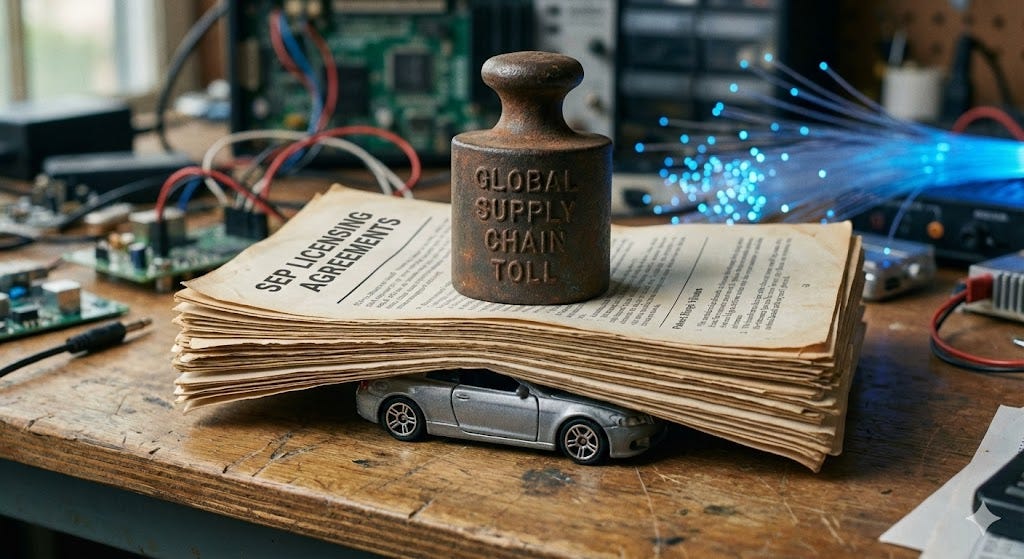
In the era of the Internet of Things (IoT) and 5G, we tend to focus on hardware specifications like processor speed, sensor range, and vehicle autonomy. Yet beneath this technological revolution’s surface, a silent war is being fought — one that is fundamentally reshaping the global supply chain and determining the cost of future innovation.
Drawing on my recent analysis published in the Journal of the Patent and Trademark Office Society, I explored a critical change in the licensing of standard essential patents (SEPs). The battlefield has shifted from silicon chips to end products, moving the front line from traditional telecommunications to connected cars.
The Breakdown of the Patent Exhaustion Doctrine
For many decades, global supply chain management operated under the relatively stable principle of the Patent Exhaustion Doctrine, also known as the First Sale Doctrine.
The logic was quite simple. Intellectual property rights were settled upstream. Once a chip manufacturer, such as MediaTek or Infineon, paid the licensing fees for communication technology, the patent rights on the chips were considered “exhausted.” The chips could then be sold to module makers and end-product manufacturers without further IP encumbrances. The toll had been paid at the gate.
However, in recent years, telecom giants have successfully dismantled this norm. They realized that collecting licensing fees and royalties for final products was more valuable than collecting them for components.
The Aggressive Variant: “No License, No Chips”
Qualcomm, a dominant holder of SEPs in the telecommunications industry, introduced a more specific and coercive model known as “No License, No Chips.”
As detailed in my analysis, the company leverages its dual role as both a patent holder and a key chip supplier to enforce this tactic. Essentially, Qualcomm reversed the supply chain logic by refusing to sell chips unless the smartphone manufacturer first signs a direct patent license agreement. This maneuver effectively circumvents the patent exhaustion doctrine, locking in higher royalty rates based on the handset’s total value.
The Core Conflict: Who Should Pay?
Traditionally, the supply chain operated under the patent exhaustion doctrine. According to this doctrine, once a chip is sold, the patent rights on the chip are exhausted. Suppliers paid royalties, and end-product manufacturers simply purchased the parts.
However, my analysis shows that SEP holders are increasingly bypassing chip suppliers to target end-product manufacturers. Why? The motive is economic. Basing royalties on the price of a $50,000 car generates significantly more revenue than basing them on a $25 communication chip.
Courts in the U.S. (notably in FTC v. Qualcomm) and Germany (notably in Nokia v. Daimler) have largely upheld patent holders’ freedom to choose their licensing targets. This legal shift means supply chain managers may no longer assume to buy “licensed components” to protect them from litigation.
My Proposal: The Principle of “Royalty Equivalence”
Given the current legal landscape where courts increasingly uphold a patent holder’s discretion to select their licensee, how do we navigate this impasse?
In my article, I propose a pragmatic yet critical solution: Royalty Equivalence. The core principle is that even if the licensee changes, the value of the patent right — and the royalty amount — must remain constant. This means that even if a patent holder chooses to collect royalties directly from an automaker, the fee should not exceed what would have been charged to the upstream chip supplier.
We must distinguish between industries. In the smartphone sector, where connectivity is the device’s core function, applying the Entire Market Value Rule (EMVR) might still be arguable. However, in the automotive sector, connectivity is merely an auxiliary feature, not the sole basis for a consumer’s purchase. Therefore, calculating royalties based on the entire vehicle’s value is fundamentally unreasonable.
True royalty calculations must strip away brand premiums and standard network effects, returning strictly to the intrinsic value of the patented technology itself.
Conclusion
Whether through the coercive “No License, No Chips” tactic or the rising wave of litigation against end-product manufacturers, it is evident that the traditional protective net of the global supply chain has been breached.
Through this research, I urge both the legal and industrial communities to confront this reality. While we must respect the patent holder’s freedom to choose their licensee, we must equally insist on the economic rationality of how royalties are calculated.
Only by establishing a fair valuation mechanism can we prevent innovative technology from becoming into a burdensome tax that stifles industrial growth.
(This article is synthesized from the author’s academic article published in the Journal of the Patent and Trademark Office Society, 2023: Huang-Chih Sung, A Critical Review of Current Trends in Licensing Standard Essential Patents from the Perspectives of Patent Law and Supply Chain Management, 103 J. PAT. & TRADEMARK Off. Soc. 431, 442 (2023).
메타데이터
- post_id
- 03a0b6bc2f1f
- slug
- the-hidden-cost-of-connectivity-how-patent-wars-are-rewriting-supply-chain-rules-03a0b6bc2f1f
- url
- https://medium.com/@sung.hc/the-hidden-cost-of-connectivity-how-patent-wars-are-rewriting-supply-chain-rules-03a0b6bc2f1f
- canonical_url
- https://medium.com/@sung.hc/the-hidden-cost-of-connectivity-how-patent-wars-are-rewriting-supply-chain-rules-03a0b6bc2f1f
- author_url
- https://medium.com/@sung.hc
- status
- ok
- fetched_at
- 2026-06-24 16:30:55