Inside Vredeburg After Hours: An Evening with History
I arrived just as the light began to soften. The sky over Malioboro had shifted into that familiar Yogyakarta blue-grey — neither day nor…
Inside Vredeburg After Hours: An Evening with History
I arrived just as the light began to soften. The sky over Malioboro had shifted into that familiar Yogyakarta blue-grey — neither day nor night — when the city seems to exhale. Across the street, Fort Vredeburg Museum looked different in the evening. Less touristic. More contemplative.
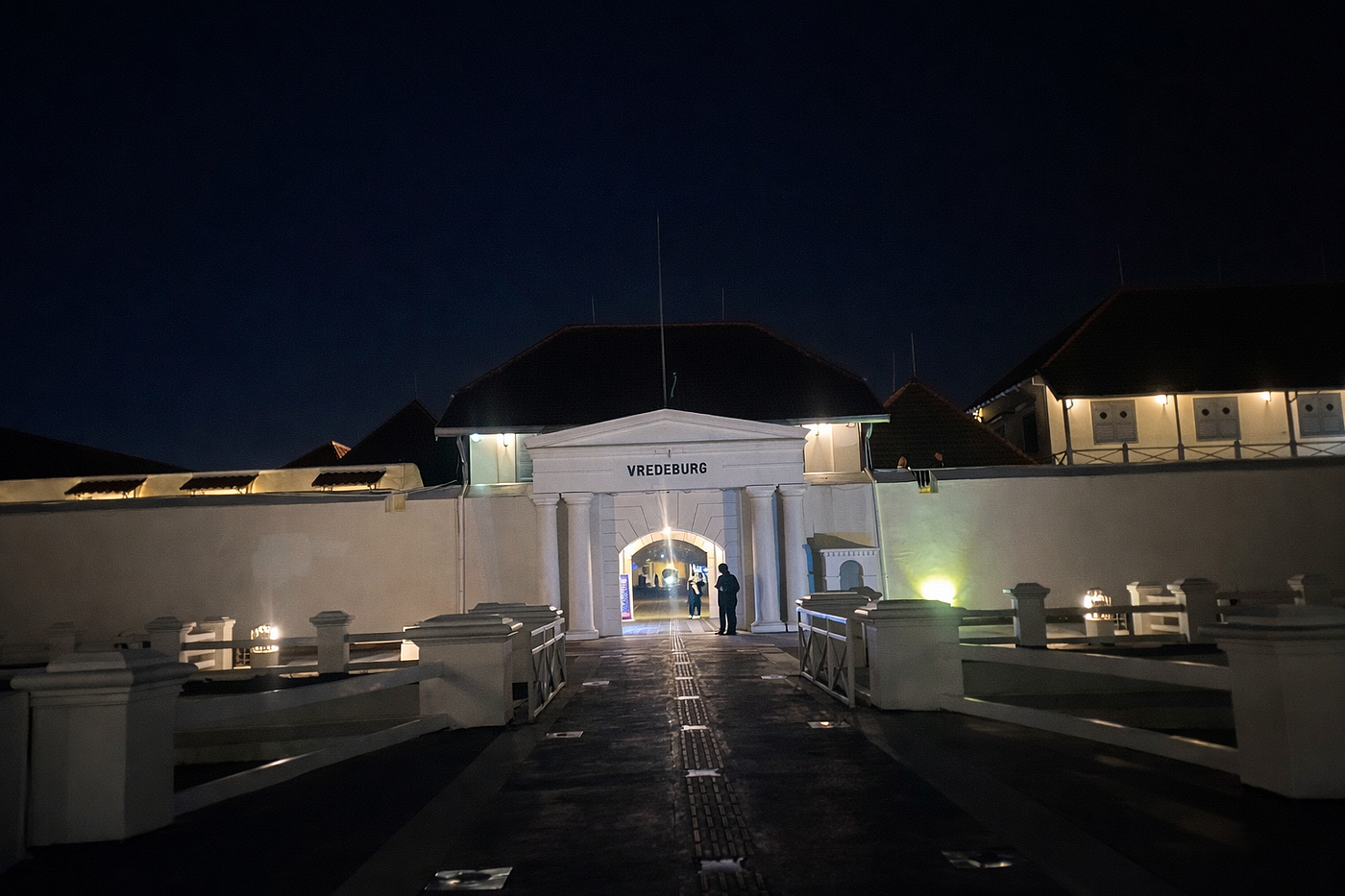
Evening access changes how the museum speaks. Vredeburg facing the royal axis as dusk settles over Yogyakarta.
This wasn’t a museum visit squeezed between errands. This was history, approached slowly. At first glance, the fort feels understated. But behind its thick walls and symmetrical layout lies a layered story of power, surveillance, resistance, occupation, and ultimately, independence.
Walking in during after-hours made that intention unmistakable. The fort’s square layout, the reconstructed moat, the four bastions at each corner, everything is measured, deliberate. Even now, the building seems to watch before it welcomes.
From Colonial Fortress to National Memory
Fort Vredeburg was first built in 1760, shortly after the establishment of the Yogyakarta Sultanate. At the request of Dutch colonial authorities, Sultan Hamengkubuwono I allowed the construction of a simple wooden fort with four bastions. The stated purpose was security. The strategic reality was control. Vredeburg was never just architecture. What the Dutch once framed as “protection” was, in reality, surveillance.
By 1767, the fort was expanded into a permanent structure under the supervision of Dutch architect Frans Haak, and by 1787, it was completed and named Fort Rustenburg — literally, “the resting fort.” Its position, just a cannon’s distance from the palace, made its true function unmistakable: monitoring the Sultanate.
After a devastating earthquake in 1867, the fort was rebuilt and renamed Fort Vredeburg, meaning “Fort of Peace.” The name suggested harmony between colonial authorities and the Sultanate, though the fort’s presence remained a constant reminder of unequal power.
The fort’s role shifted dramatically during the Japanese occupation (1942–1945), when it became a military headquarters and war prison under the Kempeitai. Detention rooms, weapons storage, and interrogation spaces turned the site into a symbol of fear rather than order.
Following Indonesia’s proclamation of independence in 1945, Fort Vredeburg was taken over by the Indonesian Army. It functioned variously as a military command post, barracks, and prison during the volatile early years of the Republic — including periods of internal political tension. This continuity of use — colonial, imperial, revolutionary — makes Fort Vredeburg more than a backdrop to history. It was an active participant in it.
The former prison spaces are small. Strikingly so. Standing inside one, I became aware of my own posture — how instinctively I adjusted my shoulders, how my voice softened even when I wasn’t speaking. These cells once held Dutch prisoners, Indonesian political figures, detainees during the Japanese occupation, and later, post-independence political prisoners.
Inside the Museum: Dioramas and Everyday Objects
One of Fort Vredeburg Museum’s defining features is its extensive use of dioramas. Rather than overwhelming visitors with text-heavy panels, the museum presents history through carefully staged scenes that depict key moments in Indonesia’s political and social transformation. The dioramas cover events ranging from 1830 to 1949.
Some rooms are heavier than others. During the Japanese occupation (1942–1945), Vredeburg functioned as a Kempeitai base, weapons depot, and prison. Standing there after hours, I understood why evening visits matter. Darkness restores gravity to history that daylight can unintentionally soften. This isn’t dark tourism. It’s honest history — uncomfortable, unresolved, and necessary.

Dioramas and Everyday Objects
With fewer visitors and dimmer lighting, the noise of explanation fades. I wasn’t being rushed from diorama to diorama. Instead, the museum invited pauses — moments where nothing demanded attention, but everything held it. This is where Vredeburg works best: not as a list of dates, but as a place that remembers.
All scenes are geographically anchored in Yogyakarta and its surrounding region, reinforcing the city’s role as a revolutionary capital. The collection is divided broadly into: Landmark historical moments, such as the founding of Muhammadiyah and Taman Siswa and Periods of armed struggle, including guerrilla warfare during the independence revolution. Complementing these scenes are photographs, replicas, and everyday objects that humanize the narrative reminding visitors that national history is built from individual lives.
In the evening quiet, absence becomes presence. The museum’s dioramas — often underestimated — felt especially effective in the evening. The lighting encourages proximity. I found myself leaning in, reading slowly, absorbing details rather than scanning for highlights. Even familiar stories felt newly weighted. Perhaps because evening invites reflection rather than consumption.
Vredeburg was bombed during the Second Dutch Military Aggression in 1948. It was also one of the strategic targets in 1949, when Indonesian forces reclaimed Yogyakarta for six crucial hours to prove the Republic still existed. Knowing this changed how I crossed the open spaces. These courtyards once held wounded soldiers, hurried plans, and the fragile logistics of a nation fighting to be seen. The building did not observe history. It participated in it.
The idea of transforming Fort Vredeburg into a cultural institution was first voiced publicly in 1947 . However, it was not until 1980 that a formal agreement between the Sultanate and the Ministry of Education and Culture set restoration plans in motion.
By 1992, the site officially opened as a museum dedicated to Indonesia’s struggle for independence. Today, it operates under the Ministry of Culture through the Indonesian Heritage Agency, while the land remains the property of the Yogyakarta Sultanate — a symbolic continuity between royal authority and national memory.
Architecture That Tells Its Own Story
Architecturally, Fort Vredeburg reflects its original military purpose. The square layout, four corner bastions, and surrounding moat (jagang) were designed for defense and visibility rather than aesthetics. Even today, the fort’s geometry communicates discipline and control. Unlike palaces built to inspire reverence, this is architecture meant to observe, contain, and respond swiftly. Walking through its corridors offers insight into how space itself was once used as a political tool.
Visiting Fort Vredeburg
Located at Jl. Ahmad Yani №6, Yogyakarta, Fort Vredeburg Museum is easily accessible via Trans Jogja bus. Its central position makes it one of the most approachable heritage sites in the city — both geographically and intellectually.
Beyond its exhibitions, the museum functions as an educational space, hosting discussions, cultural programs, and thematic events that continue to reinterpret Indonesia’s past for contemporary audiences.
If you’re planning to visit Museum Benteng Vredeburg in the evening, the museum offers extended opening hours on weekends, making it ideal for travelers who prefer a quieter and more reflective experience. The evening visiting slot runs from 18.01–20.00 WIB (6 PM to 8 PM), when the fort feels noticeably calmer compared to daytime hours.
Entrance ticket prices are affordable and clearly tiered: students are charged Rp10.000, adult visitors Rp15.000, and foreign visitors IDR100.000. Tickets can be purchased directly on-site, and the entry process is generally smooth, even during peak travel seasons in Yogyakarta.
Why Fort Vredeburg Still Matters
Fort Vredeburg Museum does not present history as a finished story. Instead, it shows how power changes hands, how resistance evolves, and how memory must be actively preserved.
Standing between the palace and the seat of modern government, the fort remains exactly where it was intended to be — at the center of Yogyakarta’s political landscape. Only now, it watches not to control, but to remind.
For travelers interested in slow travel, cultural heritage, or historical museums, an evening visit is highly recommended. Fewer crowds, softer lighting, and cooler temperatures make it easier to move through the exhibits at an unhurried pace — allowing the history of Fort Vredeburg to settle in, rather than rush past.
When I stepped back onto Malioboro, the contrast was immediate. Neon lights. Music. Movement. Commerce.But something stayed behind with me. Benteng Vredeburg doesn’t ask for admiration. It asks for attention. And in the evening — when the city slows just enough — it rewards that attention with clarity. History here isn’t distant. It’s patient.
Disclaimer: This article is written for cultural, historical, and travel reflection purposes. Historical facts and timelines referenced are drawn from publicly available sources, including museum materials and archival records, and are interpreted through the author’s personal experience as a visitor. Any opinions expressed are solely the author’s own and do not represent the views of Museum Benteng Vredeburg, the Yogyakarta Sultanate, or any affiliated institutions. Ticket prices, opening hours, and visitor information are accurate at the time of writing and may change without prior notice.
메타데이터
- post_id
- 03bbd2722cdf
- slug
- inside-vredeburg-after-hours-an-evening-with-history-03bbd2722cdf
- url
- https://medium.com/southeast-asia/inside-vredeburg-after-hours-an-evening-with-history-03bbd2722cdf
- canonical_url
- https://medium.com/southeast-asia/inside-vredeburg-after-hours-an-evening-with-history-03bbd2722cdf
- author_url
- https://medium.com/@fapermata
- status
- ok
- fetched_at
- 2026-06-12 18:14:10






