The direction Was Different. The Distance Wasn’t.
A routine evening walk made me question how we measure good experiences.
The direction Was Different. The Distance Wasn’t.
A routine evening walk made me question how we measure good experiences.
Every evening, if I’ve spent too much time sitting at my desk, I’d head out for a walk around my neighbourhood. It’s nothing special, just over three kilometres along a route I’ve walked so many times that I could probably complete it without thinking. I enter the loop from the same road, walk around it twice, and return home.
Like most routines, it has become automatic.
One evening, however, I did something different. Instead of following my usual path, I walked the loop in the opposite direction.
I wasn’t trying to optimise anything. I wasn’t experimenting with a new route or attempting to beat my previous time. It was simply one of those small, spontaneous decisions we make without much thought.
But by the time I got home, I realised something had changed.
The walk had felt easier.
Not physically. The distance hadn’t changed, the roads were the same, and I hadn’t suddenly become fitter overnight (pretty sure of that!). Yet the experience itself felt noticeably smoother.
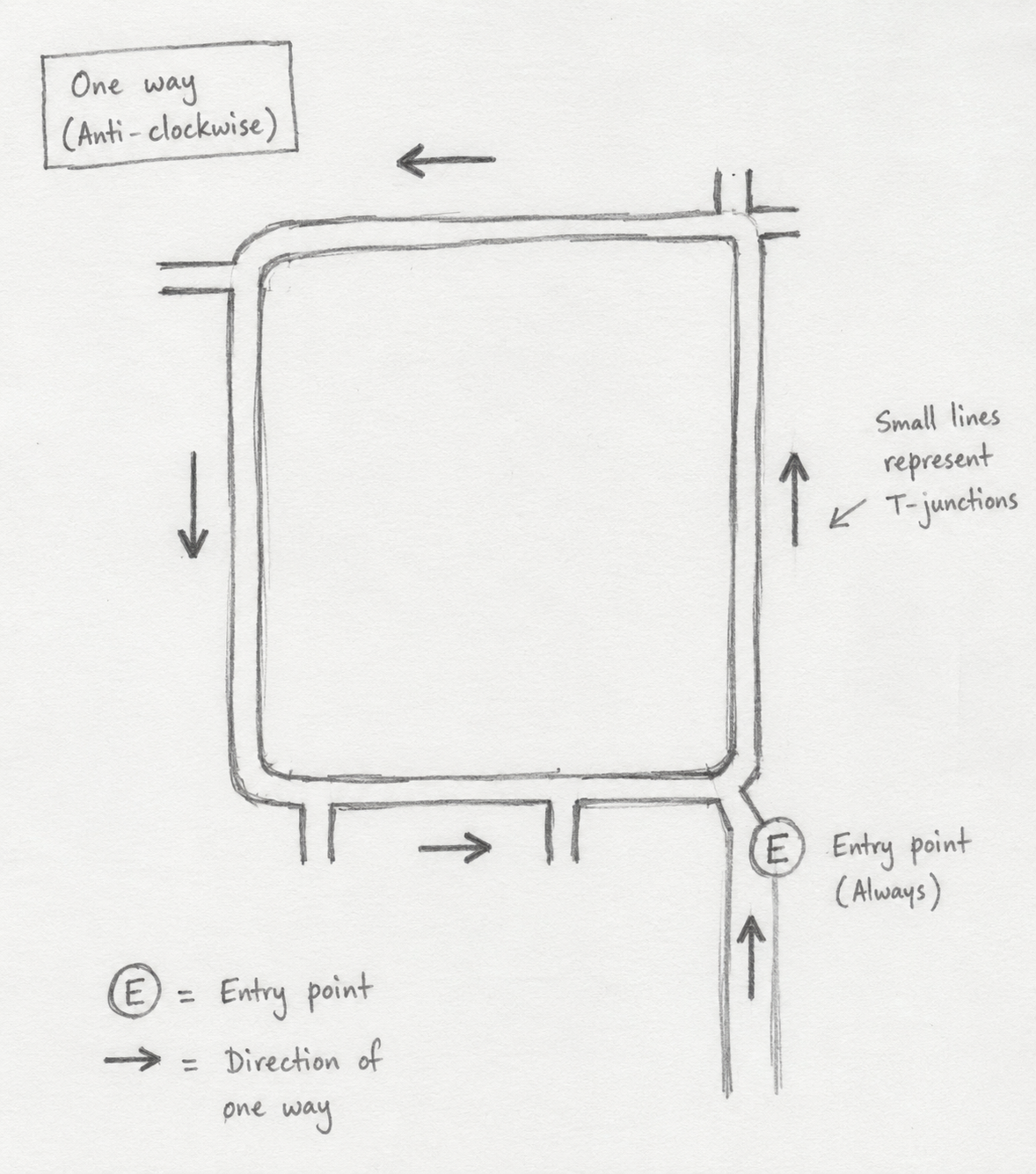
Figure 1: My usual walking loop. The roads are one-way in an anti-clockwise direction, and I always enter from the bottom-right corner. The only variable I changed was the direction in which I walked.
The more I replayed the walk in my head, the stranger it became.
Nothing measurable had changed. If someone had looked only at the numbers, both walks would have appeared identical. The distance was the same. I crossed the same number of junctions. I spent roughly the same amount of time walking.
So I started thinking less about the walk itself and more about what happened during the walk.
My route is essentially a rectangular loop made up of one-way roads. There are footpaths on either side, protected by guard rails, so I never have to worry about traffic approaching from behind. Along the way are several T-junctions where I need to cross the road.
When I walk in my usual direction, each junction interrupts my rhythm. I slow down, look in multiple directions, judge the speed of approaching vehicles, decide whether to wait, and then continue. None of these actions takes more than a few seconds, but together they form a repeated pattern of stopping and restarting.
Walking in the opposite direction changed that pattern.
Every turn became a right turn. The crossings aligned differently. Traffic appeared where I naturally expected it to. Instead of repeatedly pausing to evaluate each crossing, I often found myself walking through them with little hesitation.
The number of crossings hadn’t changed. The number of decisions had.
I was thinking in terms of user experience now.
As engineers, we’re trained to optimise things we can measure. All the improvements we make matter because they’re objective. They show up in dashboards, benchmarks and performance reports.
But users don’t experience products through dashboards. They experience them through moments.
Nobody has ever recommended a product to me by saying, “It only took five clicks to complete the checkout.” Instead, people say things like, “It was really easy,” or “It just made sense.” Those descriptions aren’t about efficiency in the strictest sense. They’re describing something much more subtle - how often the product interrupted their thinking.
My evening walk had done exactly that. It wasn’t shorter. It wasn’t faster. It simply asked less of my attention.
After getting home, I wondered whether this feeling had already been studied somewhere. As it turns out, it has.
Traffic engineers often analyse intersections using the idea of conflict points. Every place where the paths of vehicles, cyclists or pedestrians intersect creates an opportunity for hesitation, delay or accidents. The more conflict points an intersection has, the more decisions everyone using it must make.
That’s one of the reasons modern roundabouts often outperform traditional intersections. They don’t necessarily reduce the distance people travel, but they simplify the interactions between road users. By reducing points of conflict, they reduce uncertainty.
Without realising it, my reversed walking route had probably done something similar.
The physical route hadn’t changed. Its interaction design had.
Psychology offers another way of looking at this through the concept of cognitive load, which describes the amount of mental effort required to perform a task.
We often assume cognitive load comes from difficult decisions, but that’s only part of the story. It also comes from the accumulation of simple decisions.
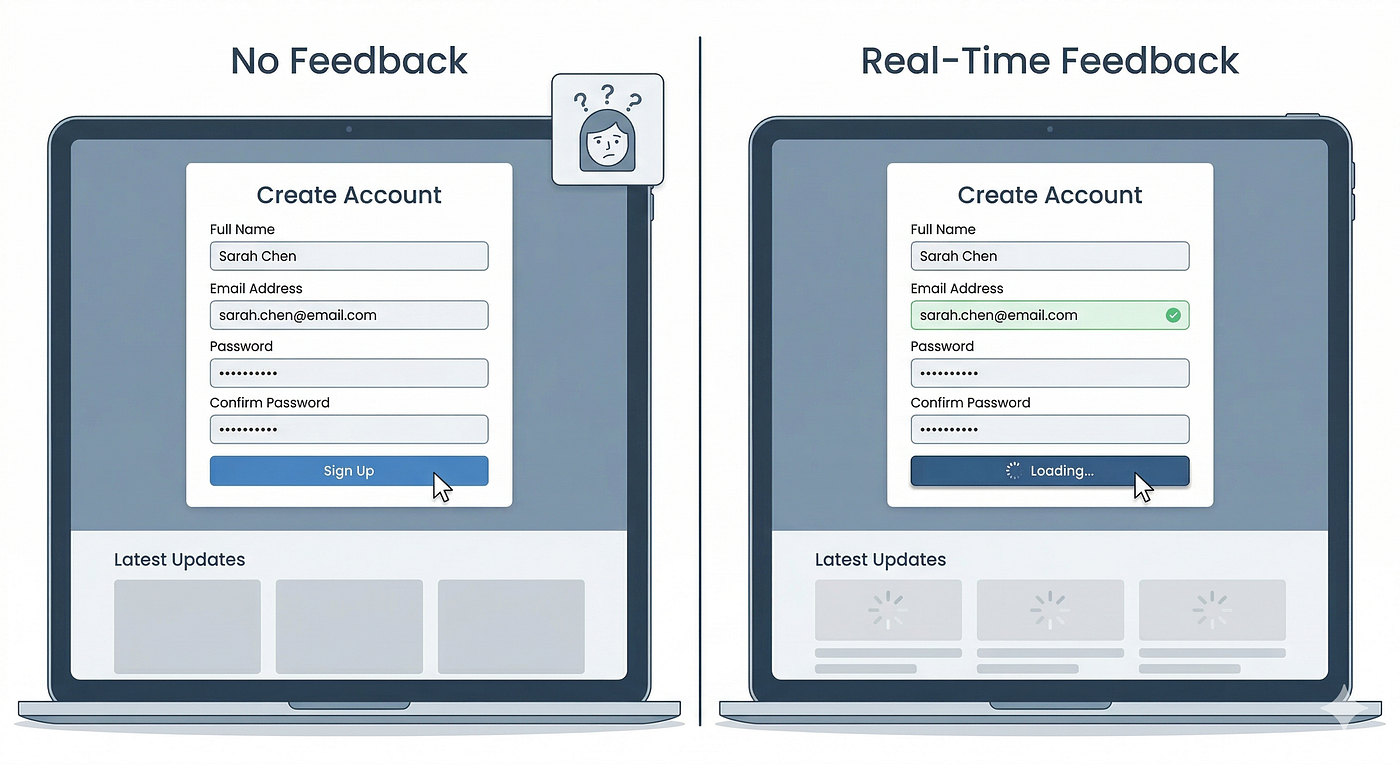
Imagine your Spotify or YouTube ads. Each ad lasts only a few seconds, but together they make the experience exhausting. Software works in much the same way. A loading spinner, a confirmation dialog, a CAPTCHA, or a permissions request rarely frustrates users on its own. Yet together they create a product that feels unnecessarily heavy because they repeatedly force users to stop, switch context, and think.
Walking my neighbourhood in reverse seemed to remove just enough interruptions for my brain to stay in rhythm.
The journey hadn’t changed. The mental effort had.
The more I reflected on it, the more I realised how often we optimise the wrong things.
When we talk about making products “better”, we instinctively think about making them faster or reducing the number of steps. Those are worthwhile goals, but they aren’t the whole story. Sometimes two workflows contain the same number of interactions, yet one feels dramatically easier simply because those interactions occur at more natural moments.
Good design isn’t always about removing work. Sometimes it’s about arranging work so that it barely feels like work at all. That’s a subtle distinction, but it’s one I won’t forget.
My decision to change things that day is almost insignificant in the grand scheme of things. Yet it has become a reminder that experiences are shaped by much more than measurable outcomes. They are shaped by rhythm, momentum, and the countless tiny decisions we ask people to make along the way.
As engineers and designers, we spend a great deal of time asking how we can make products faster.
Perhaps we should spend just as much time asking a different question.
Where are we unnecessarily interrupting our users?
Because sometimes the difference between a good experience and a great one isn’t fewer steps.
It’s fewer moments that make someone stop and think.
메타데이터
- post_id
- 03d83347cf62
- slug
- the-direction-was-different-the-distance-wasnt-03d83347cf62
- url
- https://medium.com/design-bootcamp/the-direction-was-different-the-distance-wasnt-03d83347cf62
- canonical_url
- https://medium.com/design-bootcamp/the-direction-was-different-the-distance-wasnt-03d83347cf62
- author_url
- https://medium.com/@iamsiddharths
- status
- ok
- fetched_at
- 2026-07-13 22:03:30