The Web as a Foolish Hope: How AT Protocol can shape a better future
The labours of men of genius, however erroneously directed, scarcely ever fail in ultimately turning to the solid advantage of mankind.
The Web as a Foolish Hope: How AT Protocol can shape a better future
The labours of men of genius, however erroneously directed, scarcely ever fail in ultimately turning to the solid advantage of mankind.
— Mary Shelley, Frankenstein
As part of my Advanced Master’s in Digital Strategy Management, I had a class about Digital Innovation taught by Kathryn Corrick. At some point, the teacher gave us room to talk about open source platforms and debate how particular they are and how distant this model is from what we have established on the digital scenario. You know, social media, big corporations, selfishness, and an apathetic way of interacting with the world…
When learning more about open-source, I couldn’t help but being struck by a foolish hope for the future. To imagine a bunch of people unknown to each other coming together to create or improve an online asset just for the sake of collectiveness did create in me some sympathy for the ones doing it and teared down some images of technology as a societal doom. When I shared my impressions with the teacher, she said something that stuck with me: “The web in many ways is a foolish hope.”

Photo by Raphael Gómez
This pleasant-but-weird feeling sparkled in me a reflection about how I regularly feel when approaching digital tools, whether we’re talking about AI, social platforms, online presence or new discovery and releases. I realized it felt odd being excited about technology because my automatic approach is now suspicion and uncertainty. Instead of seeing the possible benefits of a new tool, I instantly think about its risks: is it secure? Who will access to that? How will it be used? What about the data? Biometry? Why? Who’s profiting from it? How does it get our attention? What is the environmental cost?
But I guess the most important question from that day was: When did it begin? And why? And how to escape that?
I mean, growing up in the late 90’s and early 2000’s, I was surrounded by a hopeful vision of the future. Even from cartoons imagining futuristic scenarios — such as Jetsons, Astroboy, Code Llyoko or Zeta Project — to the optimistic approach to science, such as the Dolly sheep and the popularization of cellphones and computers. Of course, every single one of these developments came with warnings and protest from some groups, but there was a general trust in the future. It wasn’t just wishful thinking, it was a genuine belief in progress. More importantly, it was a future imagined as something collective, where technological development would lift everyone together.

Photo by Raphael Gómez
Now, compare that image with how we depict the future today. Ask any teenager how they view the future, how they imagine the world in 15, 20 or 30 years and I guarantee you the answers will not lift you up. Or open any streaming service and look for content released in the last 15 years that portrays the future and see how it is portrayed. I’m almost sure they will be some kind os dystopian narratives: totalitarian states, surveillance systems, environmental collapse, societies divided by technology rather than united by it. Shows like The Handmaid’s Tale or Black Mirror rule our cultural imagination, each showing variations on the same theme: the future is something to fear.
When did we stop believing in a better future? And what do we lose when we can only imagine apocalyptic futures?
This transformation did not happen overnight. Accelerated by the 9/11 terrorist attack, the surveillance state that began in the US easily spread around the world, and the fear was used to justify intrusive uses of technology. On top of that, there was the constant worries about environmental issues and energy crisis, which made people question what technology could really do for us. The tech optimism of before gave way to skepticism, which grew into the feeling that technology doesn’t just fail to solve our problems but actively creates new ones.

Photo by Raphael Gómez
The fact is that the tech landscape is not in a good place right now, and this pessimism reflects real and everyday experiences: social media promised connection but ended up isolating us more, platforms offered democratization but concentrated power, smartphones meant to free us but mostly surveil and drain our energy. It has been built on the sheer amount of power that big corporations have over our daily lives.
The problem is that if we can only imagine apocalyptic futures, we lose the ability to build better alternatives. Pessimism becomes a self-fulfilling prophecy. To escape this cycle of techno-pessimism, we must remember that not everything is as bad as it seems, and imagine other ways of building connections and managing digital platforms.
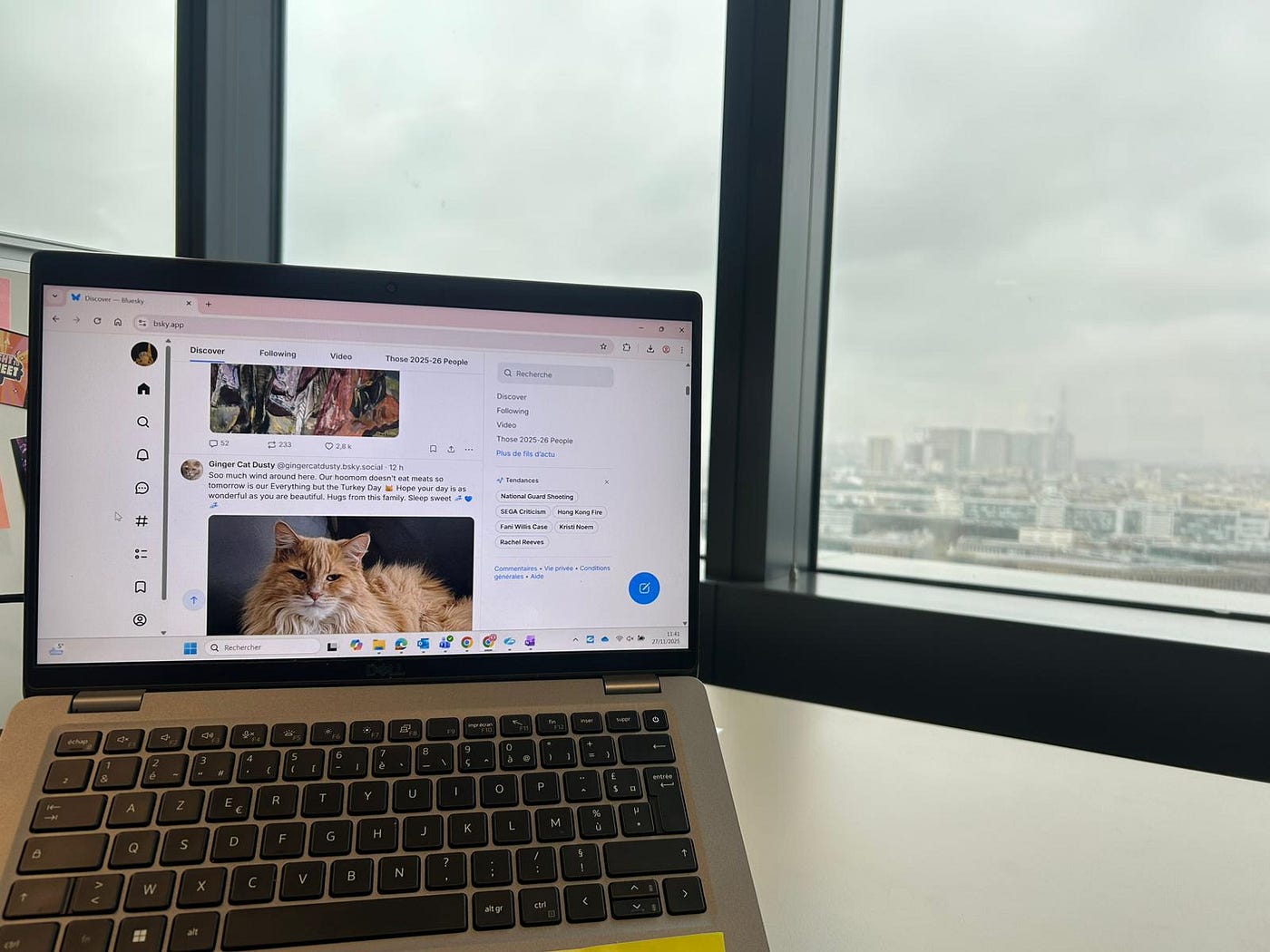
Just like the open source tools, I believe platforms built upon AT Protocol offer a new point of view of how the internet could be. Developed initially within Twitter, the AT Protocol came from people realizing that centralizing content and access/interaction creates problems platforms can’t solve. Think about it as a foundation: when you build your social connections on platforms owned by corporations, you’re building on rented land. Your network depends on the goodwill of those corporations.
The AT Protocol proposes something different, in a way that your identity isn’t locked to a single company. Your network can move with you from one platform to another. Instead of building on rented land, it’s like you have a trailer and get to park wherever you want, focusing on what you prioritize.

Photo by Raphael Gómez
In this sense, I believe the AT Protocol is also part of this foolish hope. It represents an alternative path to the way we interact online, raising different possibilities of creating content and engaging. with one another.
All things considered, the future is not predetermined. The concentration of power, the lack of governmental agency, the fragmentation of communities are not inevitable. These are choices that were made, and different choices are still possible. In the end we’re right to be worried. The question is what we do with that worry. Do we let it turns into fatalism, or do we use it as motivation to build something different?
Hope, after all, is always a little foolish. That’s what makes it hope.
The web doesn’t have to belong to a handful of corporations forever. What would a more open, collective internet look like to you?
About this article
This article has been written by a student on the Grenoble Ecole de Management’s Advanced Masters in Digital Strategy Management. As part of a content creation assignment, students are given the task of writing articles based on their digital interests and disseminating the articles online. Articles are marked but we make minimal changes to the content. Thanks for reading! James Barisic, Programme Director, MS DSM.
메타데이터
- post_id
- 03dd2bbbe2d3
- slug
- the-web-as-a-foolish-hope-how-at-protocol-can-shape-a-better-future-03dd2bbbe2d3
- url
- https://medium.com/digital-gems/the-web-as-a-foolish-hope-how-at-protocol-can-shape-a-better-future-03dd2bbbe2d3
- canonical_url
- https://medium.com/digital-gems/the-web-as-a-foolish-hope-how-at-protocol-can-shape-a-better-future-03dd2bbbe2d3
- author_url
- https://medium.com/@raphael.gomez
- status
- ok
- fetched_at
- 2026-06-26 12:24:55