The Kal-toh of the Soul — How Fragmentation Shifts into Higher Order
The soul seeks wholeness, not perfection. — C.G.Jung
The Kal-toh of the Soul — How Fragmentation Shifts into Higher Order
The soul seeks wholeness, not perfection. — C.G.Jung
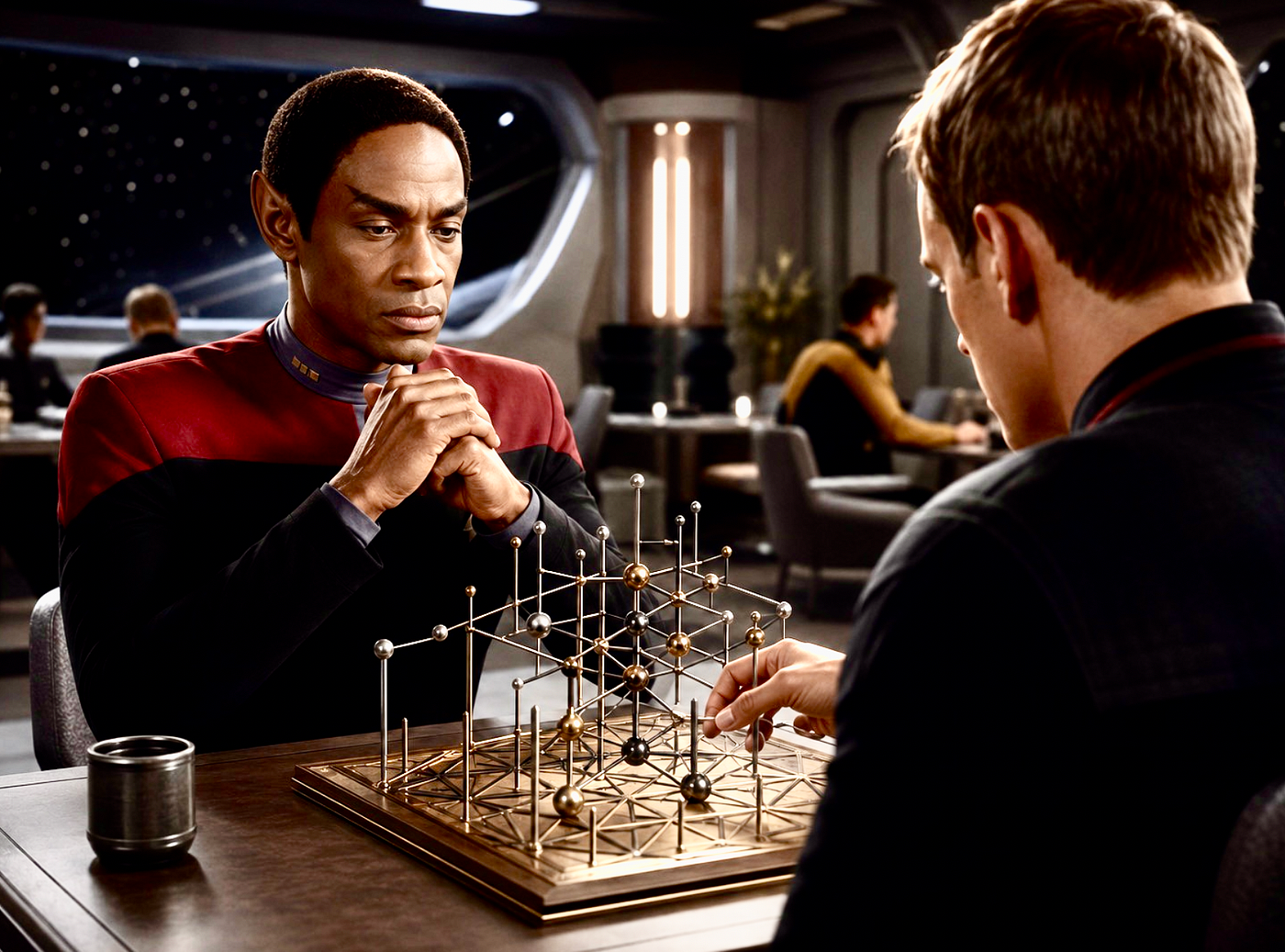
There is a game in Star Trek called Kal-toh. At first glance, it looks like a fragile construction of metallic rods, a strange Vulcan puzzle of geometry, patience, and precision. One rod is placed, then another, then another. For a long time, nothing seems complete. The structure appears unstable, almost arbitrary. But at a certain point, when enough elements have found their appropriate relationship, the whole configuration suddenly transforms into a more complex form. This image has stayed with me, because it resembles the human soul, and the completion process I went through some time ago.
We often imagine healing as the removal of fragments. We think we must get rid of our wounds, our contradictions, our inherited patterns, our strange obsessions, our spiritual detours, our unfinished longings. We look at the scattered elements of our lives and assume that something has gone wrong. Too many influences. Too many identities. Too many teachers. Too many failures. Too many selves.
Maybe the problem is not that the pieces exist or that they have not yet found their true relationship. A life is not a straight line. It is a field of fragments waiting for coherence. Childhood wounds, professional roles, mystical experiences, broken relationships, moments of beauty, shame, intelligence, longing, humor, silence. Each one may seem isolated until consciousness begins to perceive the deeper architecture. Then something changes. The fragments are no longer merely fragments. They become rods in a hidden structure.
Individuation is not the inflation of the ego. It is not the heroic construction of a special personality. It is the patient discovery of one’s inner architecture. And when this architecture becomes visible, something paradoxical happens: the individual becomes more unique and less separate at the same time.
The more authentically we inhabit our own form, the more transparent we become to something universal. Our uniqueness does not isolate us. It reveals the way the whole has chosen to appear through this particular angle of existence.
This is complex self-similarity. Like a fractal, the individual is not separate from the whole, but a local variation of it. The smaller pattern does not mechanically copy the larger one; it resonates with it. It translates it. It gives it color, history, voice, biography, vulnerability.

Perhaps every human life is such a Kal-toh. At first, there are only rods: memories, wounds, gifts, fears, dreams, ancestral traces, strange fascinations, spiritual practices, failures, books, loves, losses, encounters. At a certain moment of maturity, all these fragments fit together. Simply through presence. Through honest seeing without attachment.
At a certain point, the entire system undergoes a significant transformation. You are no longer merely managing fragments. A deeper coherence emerges. Life reveals its hidden grammar. It is not about perfection or enlightenment. It is more like a structure of fragments shifting into wholeness from within. The self does not disappear because it was false. It becomes transparent because it has fulfilled its function.
When we allow the fragments to become coherent a completion process points beyond itself. And when enough of its rods have found their place, the whole structure may suddenly transform into what it secretly was all along: a local expression of a higher order. A human Kal-toh. A new, complex geometry of arriving. A soul remembering the architecture of the whole.
If this resonates with you, you may enjoy my new book “Completion — Beyond Seeking. Into Wholeness”, which explores the shift from striving to a direct experience of wholeness and inner freedom.
“…I loved how reflective and calming the writing felt, almost like stepping into a thoughtful meditation. It made me slow down and really think about the idea that fulfillment might come from arriving rather than constantly striving.”
~Abigail L, Librarian
메타데이터
- post_id
- 040d6e75af9b
- slug
- the-kal-toh-of-the-soul-how-fragmentation-shifts-into-higher-order-040d6e75af9b
- url
- https://medium.com/@r.wilms/the-kal-toh-of-the-soul-how-fragmentation-shifts-into-higher-order-040d6e75af9b
- canonical_url
- https://medium.com/@r.wilms/the-kal-toh-of-the-soul-how-fragmentation-shifts-into-higher-order-040d6e75af9b
- author_url
- https://medium.com/@r.wilms
- status
- ok
- fetched_at
- 2026-06-09 15:37:30