Practical Software Supply-Chain Security (2026): SBOMs, Signing, SLSA & Reproducible Builds — A…
Modern breaches don’t usually target your app’s code — they attack the build pipeline, package registry, or CI artifacts. Fixing that…
Practical Software Supply-Chain Security (2026): SBOMs, Signing, SLSA & Reproducible Builds — A Developer Playbook
Modern breaches don’t usually target your app’s code — they attack the build pipeline, package registry, or CI artifacts. Fixing that starts with engineering practices you can adopt this sprint: generate and store SBOMs, sign and attest build artifacts, adopt SLSA-style controls, and push toward reproducible builds so binaries actually match the source you reviewed. This article gives a hands-on path (commands, CI recipes, and a rollout roadmap) so your team moves from “we hope it’s secure” to “we can prove it.”
Short context — the primitives that matter now
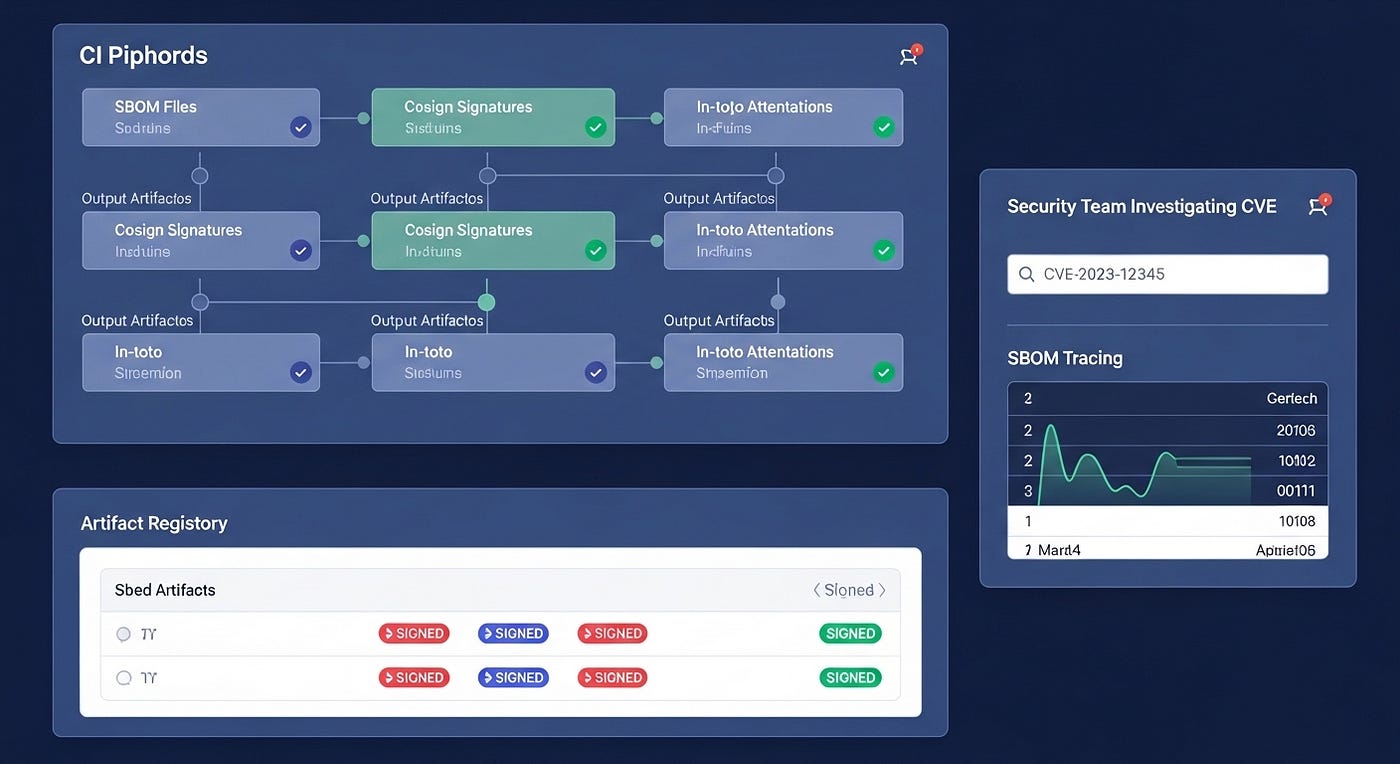
- SBOMs (Software Bill of Materials): a machine-readable inventory of components and versions used to build an artifact — the first line of incident triage.
- Artifact signing & attestations: cryptographic signatures and in-pipeline attestations prove who built what and how.
- Provenance frameworks: tools like in-toto capture the stepwise chain of custody for builds. in-toto. Sigstore and its tools simplify signing and verification in CI.
- SLSA (Supply-chain Levels for Software Artifacts): a maturity framework that tells you which controls to apply at each assurance level. SLSA.
- Reproducible builds: binary determinism so a user can verify that a published binary was produced from the reviewed source. Reproducible Builds.
(These are the five pillars we’ll act on in the playbook below.)
The quick wins — what to add this week (practical)
- Generate an SBOM for every build
- Tool:
syft(Anchore) is pragmatic and CI-friendly. Example: generate an SPDX JSON for a container or source tree. Syft. # container image SBOM (SPDX JSON) syft my-app:latest -o spdx-json > sbom-my-app.spdx.json # source or filesystem syft ./path/to/project -o cyclonedx-json > sbom-cdx.json
2. Sign artifacts & SBOMs during your CI build
- Tool:
cosignfrom Sigstore to sign images and blobs;cosign verifyto validate. See Sigstore quickstart for CI patterns. # sign an OCI image (keyless or key-backed) cosign sign --key ./cosign.key my-registry/my-app:sha256-abc123 # verify signature cosign verify --key cosign.pub my-registry/my-app:sha256-abc123
3. Attach attestations / provenance objects
- Emit an in-toto link/attestation for each step: build, test, package. Consumers can then verify the entire chain before deployment. (in-toto captures step metadata and expected commands.)
4. Block unsigned or unaudited artifacts at deploy time
- Enforce signature verification in your deployment tooling (cluster admission, package registry hooks, or CD pipeline pre-checks). Don’t let un-attested artifacts into production.
CI examples — SBOM + sign + attest (GitHub Actions)
name: build-and-attest
on: [push]

jobs:
  build:
    runs-on: ubuntu-latest
    steps:
      - uses: actions/checkout@v4
      - name: Build image
        run: docker build -t ghcr.io/org/my-app:${{ github.sha }} .
      - name: Generate SBOM (Syft)
        run: |
          curl -sSfL https://raw.githubusercontent.com/anchore/syft/main/install.sh | sh
          ./bin/syft ghcr.io/org/my-app:${{ github.sha }} -o spdx-json > sbom.json
      - name: Sign image & SBOM (Cosign)
        env:
          COSIGN_PASSWORD: ${{ secrets.COSIGN_PASSWORD }}
        run: |
          curl -sSfL https://raw.githubusercontent.com/sigstore/cosign/main/install.sh | sh
          cosign sign --key ${{ secrets.COSIGN_KEY }} ghcr.io/org/my-app:${{ github.sha }}
          cosign sign-blob --key ${{ secrets.COSIGN_KEY }} --output-signature sbom.json.sig sbom.json
      - name: Record attestation (in-toto)
        run: |
          # placeholder: create and upload in-toto link metadata for the build step
          in-toto-record --step build --materials sbom.json --products my-app:${{ github.sha }}
This workflow (1) produces an SBOM, (2) signs both binary and SBOM, and (3) emits an attestation you can later verify before deploy.
Verification at consumption — gating deploys on proofs
In your CD pipeline or admission controller:
- Verify the artifact signature (
cosign verify) and the SBOM signature. - Validate the in-toto provenance chain: that the
buildstep ran on authorized runners, with approved base images, and test coverage thresholds passed. - Check the SBOM for banned/blocked packages (license or CVE policy) before permitting deployment.
These checks implement the attest-then-trust pattern needed for SLSA Level 2+ assurance.
Reproducible builds — why you should care (and what to do)
If your binaries aren’t reproducible, signatures and SBOMs can still help — but attackers can insert non-deterministic build steps to slip in code. Reproducible builds remove this failure mode: anyone can rebuild from source and get the same binary, verifying the artifact truly came from the source you reviewed. The Reproducible Builds project coordinates tooling and CI patterns to make this achievable for many distro and app ecosystems.
Practical steps:
- Pin compilers and toolchains (Dockerfile base images with digest, not
latest). - Fix timestamps and locale/timezone influences (SOURCE_DATE_EPOCH).
- Stabilize build paths and strip nondeterministic metadata.
- Add a reproducible build verification job in CI that compares your artifact bit-for-bit to a “rebuild” artifact.
Roadmap — from zero to SLSA-aligned pipeline (90 days)
Sprint 0 (Week 0) — Inventory & baseline
- Catalog build inputs, CI runners, external registries, and publishing targets. Identify high-value artifacts (images, packages).
Sprint 1 (Weeks 1–2) — SBOMs everywhere
- Produce SBOMs for each build type (use
syftfor images/source,cyclonedx/spdxoutputs). Store SBOMs as build artifacts.
Sprint 2 (Weeks 3–4) — Sign & store proofs
- Integrate
cosignsignatures for images and SBOMs; push signatures and SBOMs to your artifact store. Protect signing keys (KMS/PKCS11 or keyless verification via Sigstore where acceptable).
Sprint 3 (Weeks 5–7) — Capture attestations (in-toto)
- Emit in-toto link metadata for key steps; keep detached logs for verification. Tie attestations to runner identities and PR numbers.
Sprint 4 (Weeks 8–10) — Gate deploys & run canaries
- Enforce verification in CD: require signature + attestation checks before deploy; run canary releases that perform automated reproducible-build checks.
Sprint 5 (Weeks 11–12) — Harden & automate
- Rotate signer keys, automate SBOM ingestion into vulnerability scanners, map SBOM/CVE alerts to ticketing, and run tabletop drills for supply-chain incidents.
Common pitfalls & how to avoid them
- Treating SBOMs as optional logs. SBOMs are only useful when generated, stored, and acted upon — wire them into your vulnerability triage.
- Signing keys poorly protected. Use KMS, hardware tokens, or Sigstore’s keyless model; never store private keys in repo.
- Thinking SLSA is a single tool. SLSA is a controls framework — you’ll implement multiple tools (SBOM, signing, attestations, runner protections).
- Ignoring reproducibility. Without reproducible builds, signatures can be misleading; attackers can insert non-deterministic backdoors — invest in reproducibility if you publish binaries.
Developer checklist (ship this sprint)
- Add
syftSBOM generation to build job for images and source. - Sign images/SBOMs with
cosignand store signatures as artifacts. - Emit an in-toto attestation for your build step.
- Require signature + attestation verification in at least one staging deployment.
- Start a reproducible-build feasibility test for a critical package.
Building trust into your software supply chain is engineering work: repeatable artifacts, verifiable signatures, and provenance attestations. Those practices let you answer the simple but critical question during incidents: did this binary come from the source and pipeline we reviewed? Start with SBOMs + signing, add attestations and gating, then invest in reproducibility to make the guarantee airtight.
The future belongs to teams that can prove the provenance of every build.
메타데이터
- post_id
- 0416cfac32dc
- slug
- practical-software-supply-chain-security-2026-sboms-signing-slsa-reproducible-builds-a-0416cfac32dc
- url
- https://medium.com/@kawaldeepsingh/practical-software-supply-chain-security-2026-sboms-signing-slsa-reproducible-builds-a-0416cfac32dc
- canonical_url
- https://medium.com/@kawaldeepsingh/practical-software-supply-chain-security-2026-sboms-signing-slsa-reproducible-builds-a-0416cfac32dc
- author_url
- https://medium.com/@kawaldeepsingh
- status
- ok
- fetched_at
- 2026-07-13 06:23:13