Rydberg Simulators: Exotic Physics on Demand
How programmable neutral-atom arrays let us test gauge theories, frustrated magnets, and other “impossible” models — before classical…
Rydberg Simulators: Exotic Physics on Demand
How programmable neutral-atom arrays let us test gauge theories, frustrated magnets, and other “impossible” models — before classical computers tap out.
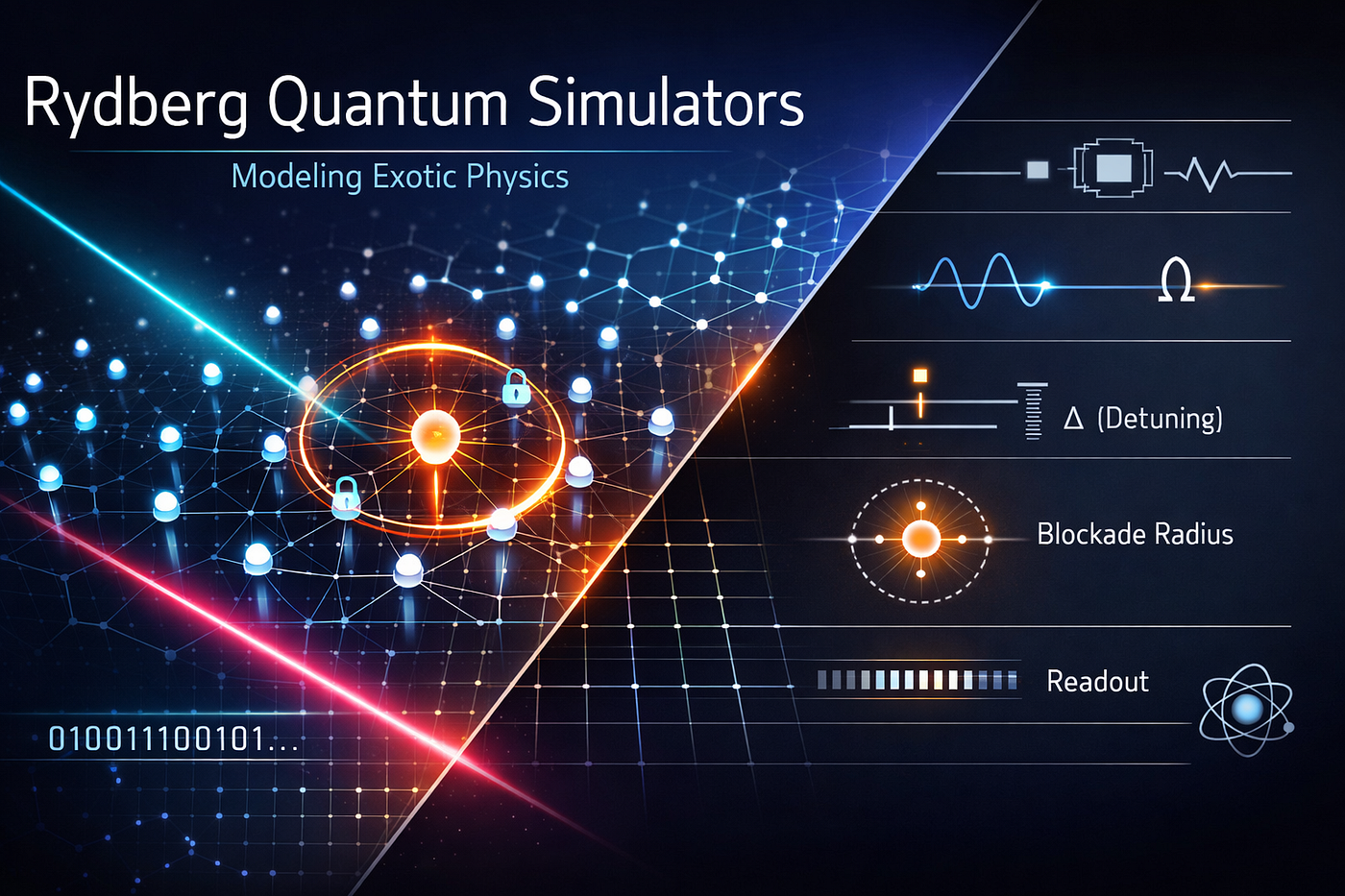
Rydberg atom quantum simulators model exotic physics — Ising magnets, frustration, gauge theories, even string breaking — using programmable neutral-atom arrays.
Let’s be real: most “interesting” quantum matter is interesting because it’s hard. Hard to compute, hard to predict, hard to even describe without waving your hands.
Rydberg atom quantum simulators are one of the rare platforms that don’t flinch at that difficulty — they lean into it. They turn exotic many-body physics into something you can program, run, and measure… with lasers, trapped atoms, and a dash of audacity.
Why Rydberg atoms became the simulator darling
The “giant atom” trick
A Rydberg atom is a normal atom whose outer electron has been excited to a very high energy level. That one change makes the atom feel… exaggerated. Bigger electric dipole moments, stronger interactions, and a sensitivity to fields that borders on dramatic.
If standard cold-atom physics is a well-tuned piano, Rydberg physics is a stadium speaker system.
Rydberg blockade: one excitation per neighborhood
Here’s the signature effect: excite one atom to a Rydberg state, and nearby atoms get “blocked” from being excited (because the interaction shifts their energy levels out of resonance). This is the Rydberg blockade, and it’s the workhorse behind both entangling gates and analog simulation.
Think of it like placing a loud person at a dinner table: suddenly, nobody within a few seats can have a normal conversation. That “radius” is what makes the physics programmable.
From lasers to Hamiltonians: what you actually program
At a high level, a Rydberg simulator is a translation engine:
- Geometry (where atoms sit)
- Laser parameters (how you drive them)
- Interactions (how strongly they repel/shift one another)
…become an effective Hamiltonian you can study.
A common mapping is to a spin model where:
- (|g\rangle) (ground state) ≈ spin-down
- (|r\rangle) (Rydberg state) ≈ spin-up
And the experiment implements something close to an extended transverse-field Ising model or related constrained models.
A simple architecture sketch
[Optical tweezers] -> place atoms on a graph (square/triangular/kagome)
        |
        v
[Lasers: Ω, Δ] -> drive |g> <-> |r> transitions (control “quantum flips”)
        |
        v
[Rydberg interactions] -> blockade + long-range couplings (the “physics”)
        |
        v
[Readout imaging] -> measure which atoms ended in |r> (a bitstring snapshot)
Where:
- Ω (Rabi frequency) acts like a controllable “flip strength”
- Δ (detuning) behaves like a tunable “bias field”
- Interactions add the crucial many-body coupling terms
This is why people call these platforms programmable quantum matter: you can rewrite the graph and rerun the universe.
Modeling exotic physics: three stories that show the range
1) Two-dimensional antiferromagnets at ~200 atoms
A landmark demonstration: programmable arrays implementing the 2D transverse-field Ising antiferromagnet — not in a toy regime, but pushing up to 196 atoms while probing emergent order and dynamics.
Why this matters: around ~100 particles, classical exact methods stop being comfortable. You can still approximate — but the “trust gap” grows fast. Experiments in this regime aren’t just confirming theory; they’re pressuring it.
Also: changing lattice geometry (square vs triangular) lets you dial in frustration, where interactions can’t all be satisfied at once — one of the classic factories for exotic phases.
2) String breaking and lattice gauge theory — on a kagome geometry
Here’s the moment where you realize these simulators aren’t only for condensed matter folks.
In June 2025, a Nature paper reported observation of string breaking in a programmable neutral-atom simulator, implementing a (2+1)D lattice gauge theory with dynamical matter — using atoms arranged on a kagome geometry, with local symmetry emerging from blockade constraints.
If your brain just went “wait, gauge theories like… particle physics?”, yes. That’s the point.
String breaking is tied to confinement — why quarks don’t roam free. Simulating these dynamics is brutal classically because the Hilbert space grows, and the interesting behavior lives in strongly coupled regimes. The experiment doesn’t “solve QCD,” obviously — but it’s a powerful proof that programmable arrays can explore high-energy-inspired phenomena in controlled settings.
3) Frustration meets light: cavity-QED phases
Now take a frustrated array and put it in an optical cavity. Suddenly you’ve added long-range, photon-mediated interactions on top of geometrical frustration.
A 2025 study explores how this combination reshapes phase structure — producing rich phase diagrams and new ordered phases driven by the interplay of frustration and quantized light.
Even if you don’t care about the specific phase names, the meta-lesson is huge: these platforms aren’t a single “model machine.” They’re a platform for composing interactions.
Where industry fits: “quantum value today” (without pretending it’s magic)
The commercial story is mostly analog simulation right now, and that’s not an insult — it’s honestly the sensible path.
- QuEra’s Aquila is positioned as a 256-qubit analog neutral-atom quantum computer, described as field-programmable and publicly accessible (including via Amazon Braket), with use cases spanning simulation, optimization, and ML-style workflows.
- Aquila’s ecosystem also highlights scientific applications like string breaking and other many-body demonstrations tied to neutral-atom arrays.
- Pasqal has publicly framed a roadmap that emphasizes deployable systems now while building toward fault-tolerant digital quantum computing, including installations in HPC contexts (GENCI in France and Forschungszentrum Jülich in Germany).
The honest framing is: these machines are already valuable as physics engines — specialized devices that generate data classical methods struggle to reproduce.
A tiny “simulator” you can run on your laptop
To make this concrete, here’s a minimal Python sketch of a common Rydberg-inspired toy model: a blockade-constrained chain, where adjacent excitations are forbidden (a cousin of what’s often called the PXP-style constraint).
This won’t replace a real device — but it will make the mapping feel real.
import numpy as np
from itertools import product

def allowed(bitstring):
    # blockade: no adjacent 1s
    return all(not (bitstring[i] == bitstring[i+1] == 1) for i in range(len(bitstring)-1))

def basis_states(n):
    states = [np.array(s, dtype=int) for s in product([0,1], repeat=n) if allowed(s)]
    return states

def hamiltonian(n, Omega=1.0, Delta=0.5):
    states = basis_states(n)
    dim = len(states)
    index = {tuple(s): i for i, s in enumerate(states)}
    H = np.zeros((dim, dim), dtype=float)

    for i, s in enumerate(states):
        # detuning term ~ -Delta * sum_i n_i
        H[i, i] += -Delta * np.sum(s)

        # drive term ~ (Omega/2) * sum_i (|g><r| + |r><g|)
        for site in range(n):
            s2 = s.copy()
            s2[site] ^= 1  # flip 0<->1
            if allowed(s2):
                j = index[tuple(s2)]
                H[i, j] += Omega / 2.0

    return H, states

H, states = hamiltonian(n=6, Omega=1.0, Delta=0.7)
eigs = np.linalg.eigvalsh(H)
print("Dimension (with blockade):", H.shape[0])
print("Ground energy:", eigs[0])
What this mirrors in hardware:
- The drive (Ω) is your laser coupling (|g\rangle \leftrightarrow |r\rangle)
- The detuning (Δ) is a controllable energy bias
- The constraint encodes blockade physics in the simplest possible way
And yes — real systems add longer-range interactions, imperfect blockade, noise, and spatial geometry. But this is the skeleton.
The limitations (because physics doesn’t do freebies)
You might be wondering: if this is so good, why aren’t we “done” with the many-body problem?
A few reasons:
- Analog errors are sneaky. Calibration drift, inhomogeneous fields, and finite temperature can bias outcomes.
- Verification is hard. If classical simulation is already difficult, how do you certify the result?
- Exotic claims need careful cross-checks. Even in cutting-edge studies, frustration can create long autocorrelation times and misleading signals — one reason hybrid approaches (QMC + autoregressive neural models) are getting attention in this space.
The good news is that the field is building a mature workflow: compare to solvable limits, use multiple diagnostics, and blend classical+ML tools where they genuinely help.
Conclusion: the new way we “do theory”
Rydberg atom quantum simulators are changing what it means to model physics.
Not by replacing theory — but by giving theory a sparring partner. A programmable system where geometry is a dial, interactions are a knob, and exotic phases are not just inferred but assembled.
If you’re tracking the future of neutral atom quantum computing, or you just like the idea of testing gauge theories with lasers and tweezers, this is a space worth following closely.
If you’ve got a favorite “exotic” model you wish we could simulate — spin liquids, gauge constraints, strange metals — drop it in the comments. And if you want more pieces like this, follow along.
메타데이터
- post_id
- 042b674ab2ff
- slug
- rydberg-simulators-exotic-physics-on-demand-042b674ab2ff
- url
- https://medium.com/@bhagyarana80/rydberg-simulators-exotic-physics-on-demand-042b674ab2ff
- canonical_url
- https://medium.com/@bhagyarana80/rydberg-simulators-exotic-physics-on-demand-042b674ab2ff
- author_url
- https://medium.com/@bhagyarana80
- status
- ok
- fetched_at
- 2026-09-13 00:27:29