Uranium Royalty: The Sweetwater Vote
Sweetwater may solve Uranium Royalty’s cash-flow problem, but shareholders must decide whether the new structure is worth the loss of…
Uranium Royalty: The Sweetwater Vote
Sweetwater may solve Uranium Royalty’s cash-flow problem, but shareholders must decide whether the new structure is worth the loss of purity.
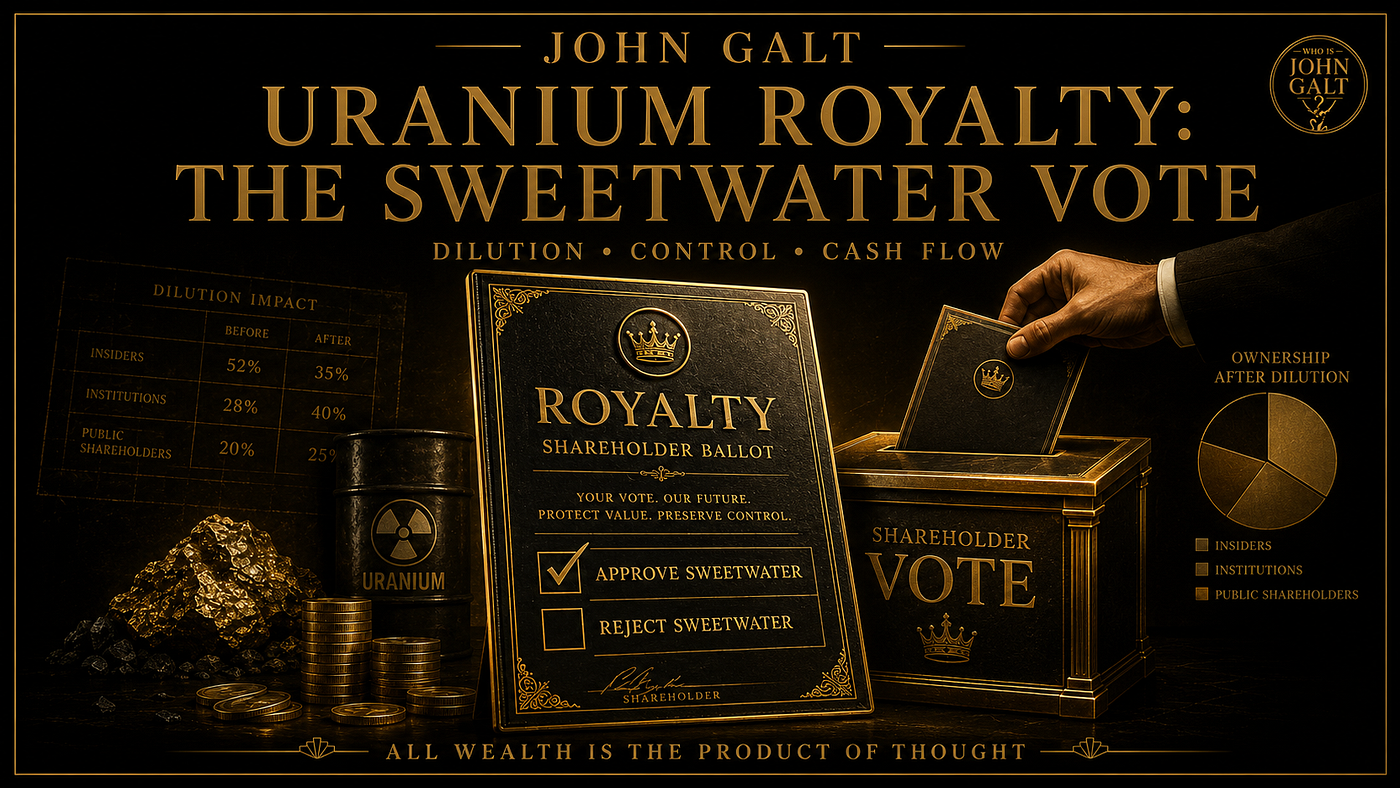
Shareholders Are Voting On A Different Stock
Uranium Royalty Corp shareholders are being asked to vote on a transaction that values Sweetwater at roughly US$1.9 billion of enterprise value, including about US$625 million of debt. That is the number that should stop investors from treating this as a normal acquisition.
This is not a small royalty package being added to the old URC story.
It is a vote on whether URC should become a larger, more complex, cash-flowing royalty platform where legacy shareholders own less, uranium matters less, and control shifts toward new institutional owners.
That may be the right move. Standalone URC had a clear problem: it had uranium exposure, but not enough current uranium royalty cash flow. Sweetwater may fix that problem quickly. It brings producing soda ash royalties, scale, land exposure, institutional backing and a much larger platform.
But a better business is not automatically a better stock.
For legacy uranium shareholders, the issue is simple: does Sweetwater create enough value per share to justify the dilution, reduced uranium purity, new governance structure and added complexity?
That is what the July vote is really about.
The special meeting is scheduled for July 20, 2026. The arrangement needs approval from 66⅔% of votes cast. On paper, shareholders are voting on Sweetwater. Economically, they are voting on whether URC should stop being a clean uranium vehicle and become something broader.
That broader company may be stronger. It may also be harder for uranium investors to own.
The stock-market risk is easy to understand. URC could lose part of its old pure-play uranium premium before the market gives it credit as a serious diversified royalty company. That dead zone is where shareholders can get stuck: not clean enough for uranium torque investors, not seasoned enough for diversified royalty investors, and too complex for retail holders who bought a simpler story.
The deal only works if the bigger company creates more value per share than the old uranium vehicle. That is not a slogan question.
It starts with the denominator.
The Denominator Comes First
Shareholders own percentages, not press releases.
The disclosed Sweetwater framework includes roughly US$330 million in cash and about 223.25 million New URC shares issued to the Sweetwater sellers. At the US$3.64 reference price, those shares are worth about US$813 million.
Standalone URC had about 146 million shares outstanding in the figures discussed around the deal. At US$2.81 per share, that implied a market value around US$410 million.
That comparison matters.
Sweetwater is not being folded into a much larger URC. Sweetwater is larger than the legacy public company. The deal changes the center of gravity.
Management has communicated a pro-forma ownership split of roughly:
- Existing URC shareholders: about 41%
- Orion: about 43%
- Ontario Teachers’: about 16%
That is before additional pre-closing financing.
But the simple outside math needs a clean bridge.
- Legacy URC shares: ~146 million
- Sweetwater seller shares: ~223.25 million
- Simple combined total: ~369.25 million
- Legacy ownership on that simple count: ~39.5%
Then add the US$40 million UEC subscription receipt financing.
A subscription receipt is basically a pre-closing financing instrument. Investors put money in before the deal closes, and the receipt converts into shares if the transaction is completed.
At US$3.64 per share, that financing implies roughly 11 million additional shares.
On that simple adjusted count:
- Combined shares after UEC receipts: ~380.25 million
- Legacy URC ownership: ~38.4%
That does not prove management’s 41% framework is wrong. It may be explainable through the exact treatment of exchangeable shares, financing assumptions, treasury shares, deal structure or other circular details.
But shareholders need the bridge.
Exchangeable shares also need plain-English treatment. They can give sellers economic exposure similar to common shares while using a different legal form. Investors need to know whether they are counted in ownership, voting power, dilution and future liquidity.
This is not technical noise. It is the ownership map.
Legacy shareholders are being asked to own a smaller piece of a bigger business. That can be a good trade. But only if the bigger business earns the dilution.
Uranium Inventory Became Funding Capacity
The most important funding detail is not the UEC subscription receipt.
It is uranium.
URC’s physical uranium was part of the old attraction. It gave shareholders direct commodity exposure. If the uranium price rose, the inventory value rose. That is much cleaner than waiting for a royalty on a future project to become cash flow.
The Sweetwater deal appears to change the role of that inventory.
URC had about US$90 million of cash as of January 31, 2026. It also disclosed that it had sold roughly US$151 million of uranium inventory after that date and still held about US$50 million of uranium inventory at current market prices.
Then came the US$40 million UEC subscription receipt financing.
Put the pieces together:
- Cash at January 31: ~US$90 million
- Uranium inventory sold after that date: ~US$151 million
- UEC subscription receipts: ~US$40 million
- Total before remaining uranium inventory: ~US$281 million
- Remaining uranium inventory value discussed: ~US$50 million
- Total including remaining inventory value: ~US$331 million
That lines up closely with the US$330 million cash component of the Sweetwater consideration.
This does not prove every dollar was mechanically earmarked for the deal. Company treasuries do not work that neatly from the outside.
But the disclosed treasury movements strongly suggest that uranium inventory sales helped create the financial capacity for the cash portion of Sweetwater.
That is a major shareholder point.
URC did not just issue shares. It appears to have used part of its direct uranium exposure to help fund a broader royalty platform.
Management may argue that this is smart capital allocation. If Sweetwater’s cash flow can be reinvested into better royalty opportunities, selling uranium inventory could prove rational.
But for uranium bulls, the trade is obvious.
Direct uranium exposure has been reduced today in exchange for a broader cash-flow platform tomorrow.
That is not automatically bad. It is a higher hurdle.
The company now has to prove that the cash flow bought with uranium-linked capital can create more per-share value than shareholders might have captured by keeping cleaner uranium leverage.
Sweetwater Is Real, But It Is Not Uranium
Sweetwater should not be dismissed because it is not uranium. That would be lazy.
The asset brings exposure to Wyoming trona and soda ash royalties. Trona is a natural mineral used to make soda ash, also called sodium carbonate. Soda ash is used in glass, chemicals, detergents and other industrial applications. URC has also pointed to demand links from solar glass, lithium production and sodium batteries.
That makes Sweetwater a real industrial-minerals royalty business.
It also makes it a different commodity story.
Soda ash does not have the same nuclear fuel security narrative. It does not offer the same uranium squeeze exposure. It has different buyers, different pricing dynamics and different cycle risk.
That difference may help URC as a company. Sweetwater gives the combined business current royalty exposure tied to producing soda ash mines in Wyoming. The transaction materials refer to five operating soda ash mines and two advanced greenfield projects. Operators include major industrial names such as WE Soda, Tata Chemicals, Şişecam and Solvay/American Soda.
Sweetwater also generated roughly US$74 million of average adjusted EBITDA over the last two fiscal years on a 100% basis. Adjusted EBITDA is a management earnings measure before interest, tax, depreciation, amortization and certain adjustments. It is useful, but it is not the same as free cash flow to shareholders.
That cash flow is still the strongest reason for the deal.
A royalty company with current cash flow can survive ugly markets better. It can fund deals. It can reduce dependence on repeated equity issuance. It can become less fragile.
But shareholders should not value soda ash royalties as if they are immune to the cycle.
The company’s royalty is described as the greater of 8% of the sales price of sodium mineral products or the highest royalty rate in comparable local leases, less certain costs. That sounds attractive. The details still matter: where operators mine, which lands are covered, how deductions work and how production volumes move over time.
There is also land complexity. The Wyoming land position is not one simple block. It includes checkerboarded ownership, meaning different land parcels can have different ownership and royalty coverage. A basin can be strong while a specific royalty only captures part of the economics.
That is why Sweetwater durability is the key asset question.
If soda ash prices weaken, volumes disappoint or operators mine outside the most valuable covered lands, the acquisition multiple looks worse and the dilution becomes harder to justify.
Sweetwater may be a good asset. Shareholders need it to be a good enough asset per share.
Control Changes Too
The transaction also changes who has influence.
Orion and Ontario Teachers’ are not ordinary investors buying a few shares in the market. They become large owners of New URC. According to the transaction framework, they receive governance rights that ordinary shareholders do not receive.
Those rights include board nomination rights, anti-dilution rights and registration rights.
In plain English:
Board nomination rights can influence who sits at the table.
Anti-dilution rights can help large holders maintain ownership in future financings.
Registration rights can help large holders resell shares more easily.
None of these rights automatically make the deal bad. They are common in large transactions. They can also bring benefits.
Orion and Ontario Teachers’ may reduce financing risk, improve market credibility and open doors to future deals. In a sector full of small companies that run from one financing to the next, serious institutional capital matters.
But ordinary shareholders should understand the bargain.
Large holders are not just bringing assets. They are receiving influence. That influence can shape future acquisitions, financing terms, board composition, resale pressure and capital allocation.
UEC adds another layer. Uranium Energy Corp participated through a US$40 million subscription receipt financing at the same US$3.64 reference price. UEC was already a major URC shareholder and provided voting support.
That does not prove a conflict. It does raise the standard for clean disclosure.
Minority shareholders should know who gets special rights, who gets liquidity rights and who can influence what New URC buys next.
The answer matters because future capital allocation decides what URC becomes after Sweetwater.
If Sweetwater cash flow is used to build a high-quality uranium royalty book, the deal may become easier to defend. If the company keeps moving into broader industrial minerals and land royalties, then the uranium story has not been upgraded. It has been replaced.
That may still be investable.
But investors should own it for the right reason.
Uranium Still Matters, But It Needs Sorting
URC is not leaving uranium behind.
It still has uranium royalties and uranium-linked exposure. Some assets are closer to cash flow. Some are development-stage. Some are long-dated optionality.
That distinction matters more than a long property list.
A producing royalty is different from a development royalty.
A development royalty is different from an exploration royalty.
A net profits interest or net proceeds interest can take years to pay if costs must be recovered first.
This is where uranium investors need to stay disciplined. Every line in a royalty table should not be valued as if it is already producing cash.
After Sweetwater, the uranium book has to be judged by quality.
The useful categories are:
- Current or nearer-term royalty exposure
- Development-stage exposure that may matter this cycle
- Long-dated optionality
- Royalty types that may look good on paper but need years of costs recovered before they pay
That is a better way to think than simply counting assets.
URC may still have meaningful uranium upside. But uranium will no longer lead the story alone. It will sit inside a broader royalty company where soda ash cash flow, institutional ownership and future capital allocation may drive the valuation.
That matters most if uranium runs.
A uranium bull will compare URC against SPUT, Yellow Cake, producers and developers. SPUT and Yellow Cake offer cleaner physical uranium exposure. Producers and developers offer more uranium torque, with more operating and financing risk.
New URC may offer something different: cash-flowing industrial royalties plus uranium optionality.
That blend can be attractive.
It is also less pure.
The Old Premium Is Not Guaranteed
This may be the most important stock-market risk.
URC could become a better company and still lose part of its old valuation support.
Before Sweetwater, the pitch was easy. Uranium royalties plus physical uranium exposure in a scarce public wrapper. That was simple enough for retail investors, uranium specialists and thematic buyers to understand.
After Sweetwater, the pitch needs more explanation.
Now the buyer must understand soda ash royalties, Wyoming land, exchangeable shares, subscription receipts, large-holder rights, remaining uranium inventory, uranium royalties and future capital allocation.
Longer stories can work. But they need more proof.
The danger is valuation confusion.
URC may no longer be clean enough for investors who want pure uranium torque. At the same time, it may not yet be proven enough for investors who want a mature diversified royalty company.
That is the dead zone.
Not pure enough for the uranium premium.
Not seasoned enough for the royalty premium.
Too complex for some retail holders.
Too unusual for some institutional holders.
That does not mean the stock must underperform. It means the old premium cannot be assumed.
Management is asking shareholders to accept dilution today in exchange for a broader platform tomorrow. That requires proof, not slogans.
A High-Hurdle Approval
This is not an automatic rejection.
Sweetwater may be a very good asset. URC needed cash flow. The company may become more durable. Institutional partners may improve access to capital. A larger royalty platform may be more financeable than the old uranium-only vehicle.
But this is also not a routine growth vote.
Legacy shareholders are giving up purity, ownership percentage and simplicity. They are accepting a new asset mix, new large holders and a more complex structure. The burden of proof is on management.
Before voting, shareholders should have clear answers to five questions:
- What is the fully diluted ownership after all instruments? Common shares, exchangeable shares, subscription receipts and any other relevant instruments should be reconciled clearly.
- How much uranium exposure remains per share? Not just total uranium assets. Per-share exposure after inventory sales and dilution.
- How durable is Sweetwater cash flow through the soda ash cycle? Average adjusted EBITDA is useful. Price, volume, operator and acreage sensitivity matter more.
- What rights do Orion, Ontario Teachers’ and UEC have? Board influence, anti-dilution protections, registration rights and resale mechanics should be easy to understand.
- Where will future capital go? Uranium royalties, broader industrial minerals, land royalties or whatever offers the best deal at the time?
The fifth answer may decide the stock.
If New URC uses Sweetwater as a cash engine to build better uranium exposure, the transaction could become a clever platform reset.
If Sweetwater becomes the start of a broad land-and-industrial-minerals strategy, the company may still be valuable, but it is no longer mainly a uranium vehicle.
Better Company, Harder Stock
The cleanest judgment is this:
Sweetwater may make Uranium Royalty Corp a stronger company. It has not yet proven that it makes URC a better uranium stock for legacy shareholders.
That is the correct standard.
A good asset can be bought at a bad price.
A good company can be diluted into mediocrity.
A stronger platform can lose the investor base that once gave it a premium.
The bull case is straightforward. Sweetwater performs. Soda ash royalties generate durable cash flow. The new institutional partners improve access to capital. Uranium royalties remain meaningful. Management uses the platform to acquire better uranium-linked royalties over time. The market eventually values New URC as a serious royalty company with uranium upside.
The base case is less exciting. URC becomes financially stronger but less explosive. The old uranium scarcity premium fades. The new diversified royalty premium takes time. Legacy holders own less of a broader business, and returns depend on execution.
The bear case is clean. URC sells down direct uranium exposure, issues a lot of equity, imports soda ash cyclicality, gives large holders more influence and ends up too complicated for uranium investors but not proven enough for diversified royalty investors.
That is why the July vote matters.
Shareholders are not just approving Sweetwater. They are approving a bargain: less uranium purity, more cash flow, less simplicity, more scale, less direct torque, more institutional control.
That bargain may work.
But it has to work per share.
Sweetwater may fix Uranium Royalty’s cash-flow problem. What remains unproven is whether it improves the stock for shareholders who bought URC because they wanted uranium.

https://johngalt88.substack.com/
📩 Join Investor’s Handbook Digest — get the best investing, markets, and wealth-building insights each week.
메타데이터
- post_id
- 04412c8d8086
- slug
- uranium-royalty-the-sweetwater-vote-04412c8d8086
- url
- https://medium.com/the-investors-handbook/uranium-royalty-the-sweetwater-vote-04412c8d8086
- canonical_url
- https://medium.com/the-investors-handbook/uranium-royalty-the-sweetwater-vote-04412c8d8086
- author_url
- https://medium.com/@johngalt88
- status
- ok
- fetched_at
- 2026-08-07 11:48:41