Advanced Technical Blueprint for Secure & Compliant Healthcare Environments
Introduction
Advanced Technical Blueprint for Secure & Compliant Healthcare Environments
Introduction
Healthcare organizations manage some of the most sensitive personal data in the world. Identity and Access Management (IAM), together with Identity Governance and Administration (IGA), forms the backbone of secure operations, regulatory compliance, and operational efficiency. Hospitals, clinics, telehealth providers, and integrated healthcare networks all face the same challenge: ensuring the right users — clinicians, staff, patients, and contractors — have secure, controlled access to critical systems while safeguarding patient data.
In 2022, over 45 million patient records were breached in the U.S., many due to weak identity controls or poorly governed privileged accounts. Real-world examples include:
- The ransomware attack on Universal Health Services (2020), which forced hundreds of facilities to revert to paper processes.
- Compromised EHR accounts in multiple hospital networks, leading to unauthorized access to sensitive patient records.
These incidents highlight why a structured, enterprise-grade IAM framework is essential for hospitals of all sizes.
Healthcare IAM Framework Overview
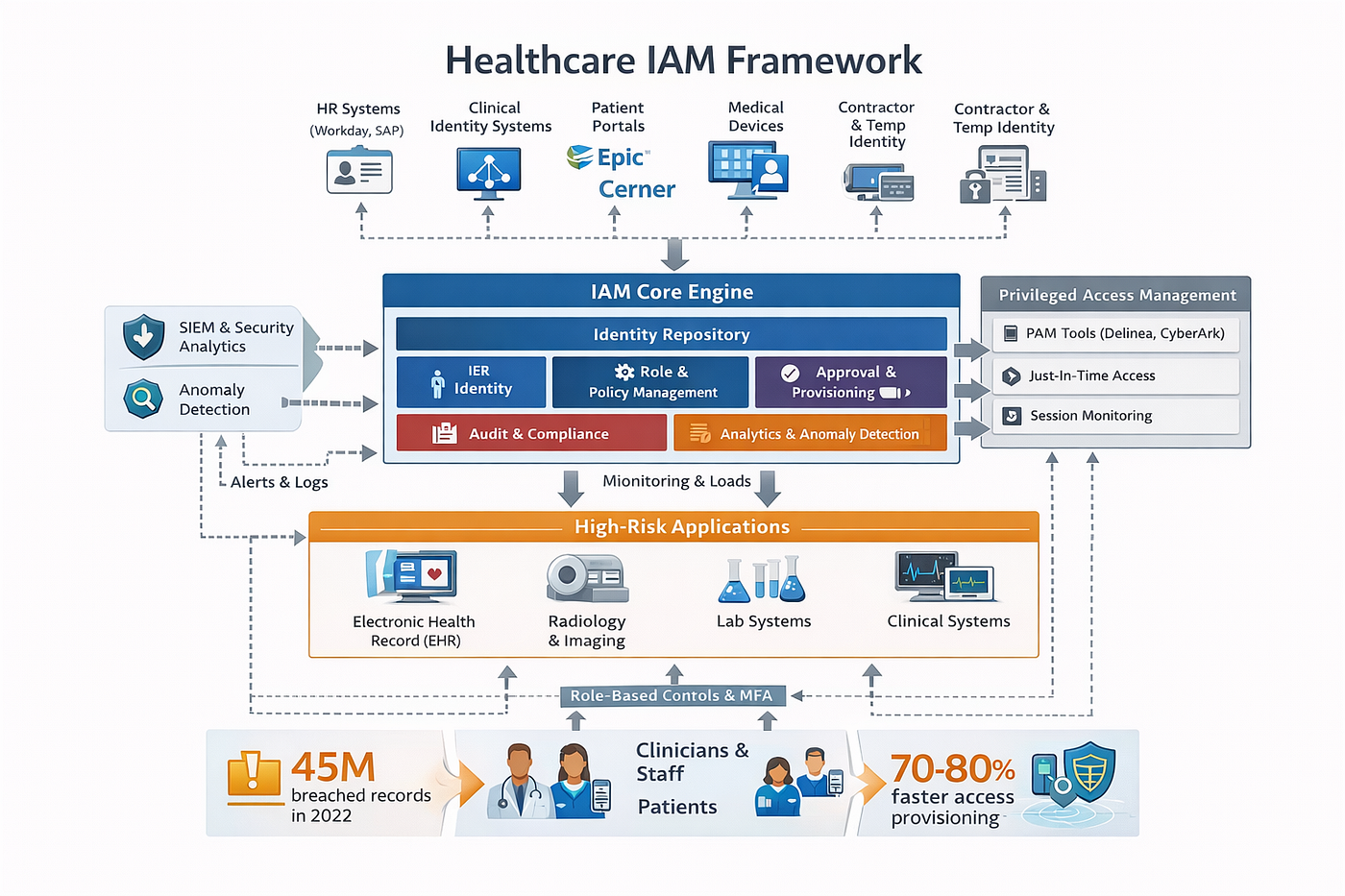
The figure below illustrates a comprehensive IAM framework tailored for hospitals but adaptable for almost any healthcare organization — from small clinics to large integrated delivery networks.
Components of the Framework
1. Identity Sources
The system ingests identities from multiple sources:
- HR Systems (Workday, SAP): Authoritative source for staff and contractor employment data.
- Clinical Identity Systems: Manage clinician credentials and permissions.
- Patient Portals (Epic, Cerner): Handle patient access to records and telehealth services.
- Medical Devices: IoT and connected devices requiring identity verification.
- Contractor & Temporary Staff: External users needing controlled, temporary access.
Implementation Tip: Standardizing identity attributes across these sources reduces errors, ensures compliance, and enables unified reporting.
2. IAM Core Engine
The core engine consolidates identities and enforces policies:
- Identity Repository (IER): Central store of all human and non-human accounts.
- Role & Policy Management: Role-based access, contextual rules for high-risk systems.
- Approval & Provisioning Workflows: Automated access requests with compliance oversight.
- Audit & Compliance Module: Captures logs for regulatory reporting.
- Analytics & Anomaly Detection: Detects suspicious activity and trends.
This centralization ensures consistent governance across all systems, while providing actionable insights for administrators and compliance officers.
3. Privileged Access Management
Privileged accounts are high-value targets. The framework integrates PAM tools (Delinea, CyberArk) to enable:
- Just-In-Time Access: Temporary privileges granted only when needed.
- Session Monitoring: Tracks clinician and admin activity in sensitive systems.
- Automated Revocation: Removes elevated access immediately after tasks are complete.
Example: If a lab technician accesses high-risk lab results systems, PAM ensures the session is logged, monitored, and revoked when the task ends.
4. High-Risk Applications
The IAM framework provisions and secures access to:
- EHR Systems (Epic, Cerner)
- Radiology & Imaging Platforms
- Laboratory Information Management Systems (LIMS)
- Clinical and Diagnostic Tools
Key Controls: Role-based access, MFA, approval workflows, audit logs, and real-time anomaly detection.
5. Monitoring & Security Overlay
Integration with SIEM and analytics platforms ensures continuous oversight:
- Alerts and logs are captured for suspicious access events.
- Automated anomaly detection identifies privilege escalation, off-hours logins, or unusual data access.
- Reports provide evidence for HIPAA compliance and risk reduction.
6. Feedback & Governance Loop
A closed-loop governance model continuously improves security:
- Policies are adjusted based on monitoring, analytics, and audit findings.
- Periodic access reviews ensure users maintain only the access required for their role.
- Regulatory reporting supports compliance audits, reducing organizational risk.
Why This Framework Works Across the Healthcare Industry
This framework is highly adaptable, making it suitable for:
- Large hospital networks (e.g., Kaiser Permanente, Mayo Clinic) with thousands of clinicians and patients.
- Regional hospitals and outpatient centers managing smaller user populations but still handling sensitive EHR and imaging systems.
- Telehealth and patient portal providers requiring secure remote access for patients and clinicians.
- Laboratory and diagnostic services where privileged access to sensitive test data must be controlled.
Benefits:
- Protects patient data from breaches and insider threats.
- Ensures HIPAA and HITECH compliance.
- Reduces operational overhead through automation.
- Provides scalable access governance across multiple facilities and system types.
- Detects and prevents identity-based attacks, such as credential stuffing or phishing targeting hospital staff.
Key Metrics and Outcomes
- 45M patient records breached (2022): highlights urgency of strong IAM.
- 70–80% faster access provisioning: achievable through automated workflows.
- 90% reduction in orphaned accounts: by centralizing identity repositories and automated deprovisioning.
- Real-time anomaly detection: prevents high-impact incidents before they escalate.
Conclusion
A hospital-grade IAM/IGA framework like the one illustrated empowers healthcare organizations to:
- Secure high-risk applications (EHRs, imaging, lab systems).
- Protect patient and staff data from cyber threats.
- Automate provisioning and access workflows.
- Demonstrate compliance and regulatory readiness.
- Scale governance across diverse facilities and systems.
This framework is universally applicable across healthcare — from community hospitals to nationwide integrated delivery networks — and represents a practical blueprint for modernizing identity management while strengthening cybersecurity.
메타데이터
- post_id
- 0449bc189a5f
- slug
- professional-iam-framework-for-identity-governance-administration-in-healthcare-0449bc189a5f
- url
- https://medium.com/@sheoranrajat/professional-iam-framework-for-identity-governance-administration-in-healthcare-0449bc189a5f
- canonical_url
- https://medium.com/@sheoranrajat/professional-iam-framework-for-identity-governance-administration-in-healthcare-0449bc189a5f
- author_url
- https://medium.com/@sheoranrajat
- status
- ok
- fetched_at
- 2026-06-15 20:49:13