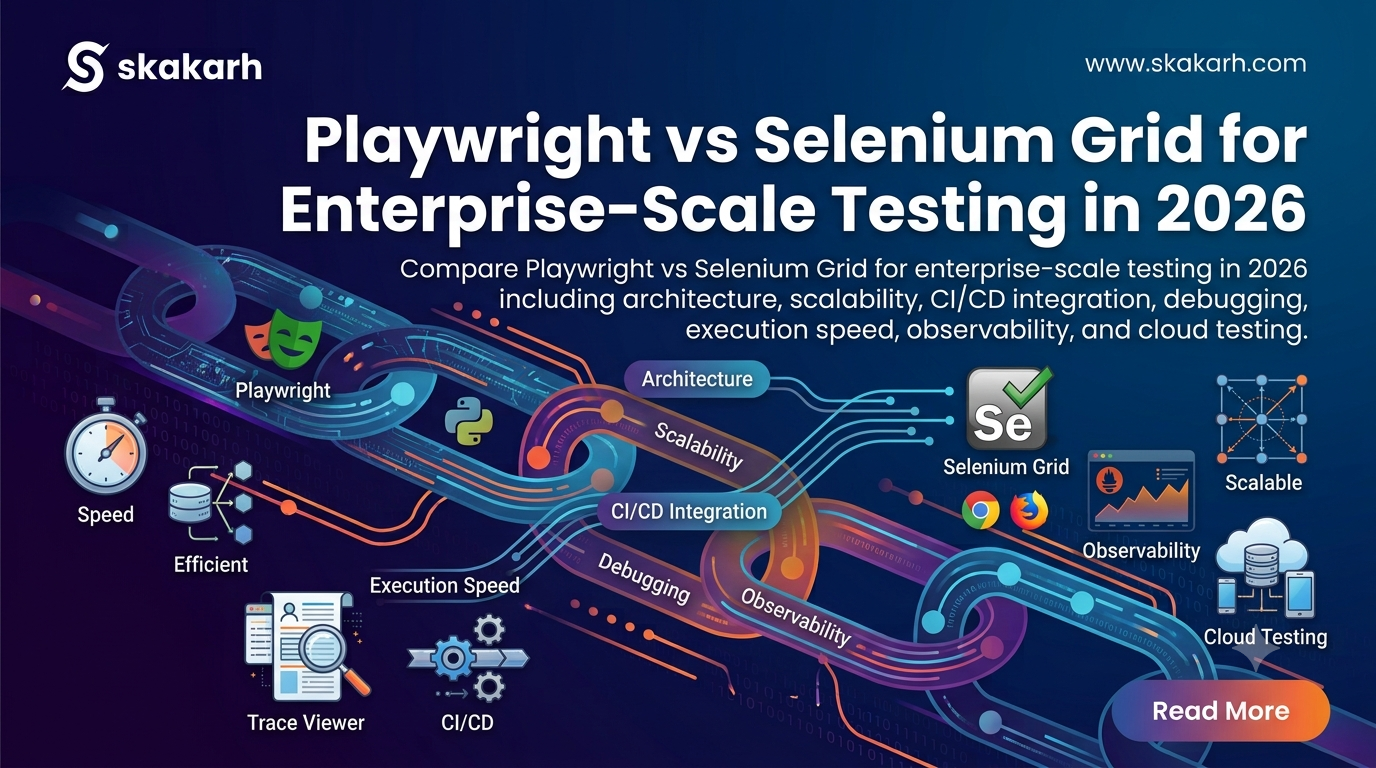
Playwright vs Selenium Grid for Enterprise-Scale Testing in 2026
Compare Playwright vs Selenium Grid for enterprise-scale testing in 2026 including architecture, scalability, CI/CD integration, debugging…
Playwright vs Selenium Grid for Enterprise-Scale Testing in 2026
Compare Playwright vs Selenium Grid for enterprise-scale testing in 2026 including architecture, scalability, CI/CD integration, debugging, execution speed, observability, and cloud testing.
Playwright vs Selenium Grid Is No Longer a Simple Framework Debate
For years, automation discussions looked like this:
Which testing tool is better?You can read this blog at:
**Playwright vs Selenium Grid for Enterprise-Scale Testing in 2026**
But in 2026, the conversation changed completely.
Modern QA engineering is no longer only about:
- writing scripts
- automating browsers
- validating UI flows
The real challenge now is:
building scalable testing infrastructureAnd that is exactly why the Playwright vs Selenium Grid discussion became so important.
Because this is no longer: 👉 a tool comparison
It is increasingly: 👉 an architecture decision
Modern enterprise systems now require:
- distributed execution
- cloud scalability
- parallel pipelines
- observability
- intelligent debugging
- AI-assisted analysis
- operational reliability
That changes how organizations evaluate automation platforms.
What is Playwright?
Short Answer
Microsoft Playwright is a modern browser automation framework designed for:
- fast execution
- modern web apps
- cross-browser automation
- cloud-native CI/CD pipelines
- reliable synchronization
Core Playwright Capabilities

What is Selenium Grid?
Short Answer
Selenium Project Selenium Grid is a distributed test execution platform that allows automation tests to run:
- across multiple browsers
- across multiple machines
- in parallel
- at enterprise scale
Why Selenium Grid Became Important
Large organizations needed:
- distributed execution
- parallel browser coverage
- scalable infrastructure
Selenium Grid solved this problem years before cloud-native automation became mainstream.
Playwright vs Selenium Grid — Core Difference
This is where many engineers misunderstand the comparison.
The Real Difference

This means:
they solve different layers of the testing ecosystemBut organizations often compare them because:
- both impact scalability
- both affect CI/CD
- both influence execution architecture
Playwright vs Selenium Grid — Enterprise Comparison Table
High-Level Comparison

Why Modern Enterprises Still Use Selenium Grid
Many engineers incorrectly assume Selenium Grid is “outdated.”
That is not true.
Large enterprises still heavily rely on Selenium Grid because they already invested:
- years of engineering effort
- massive test suites
- distributed infrastructure
- internal tooling ecosystems
Common Enterprise Selenium Grid Advantages

For many organizations:
migration cost becomes a bigger concern than framework capabilityWhy Playwright Is Growing So Fast
Playwright exploded in popularity because it aligns extremely well with:
- modern frontend systems
- CI/CD acceleration
- cloud-native workflows
- asynchronous web apps
Playwright Strengths
Key Advantages

This makes Playwright especially attractive for:
- startups
- fast-moving engineering teams
- cloud-native organizations
- modern frontend platforms
Architecture Matters More Than Framework Choice
Here is the most important insight in this article:
Most automation failures are not caused by:
- Selenium
- Playwright
- Cypress
They are caused by:
weak testing architectureBecause eventually every framework struggles if organizations ignore:
- observability
- orchestration
- telemetry
- execution visibility
- infrastructure scaling
Playwright Architecture Explained
Playwright uses a modern execution model directly connected to browser engines.
Playwright Architecture
Test Script
↓
Playwright API
↓
Browser Engine
↓
Application Under Test
This architecture enables:
- faster execution
- modern browser control
- reduced synchronization issues
Example Playwright Test
test('login test', async ({ page }) => {
  await page.goto('https://example.com');

await page.fill('#email', 'admin@test.com');
  await page.fill('#password', 'password');
  await page.click('#login');
});
Selenium Grid Architecture Explained
Selenium Grid uses distributed hub-node architecture.
Selenium Grid Workflow
Test Script
↓
WebDriver
↓
Grid Hub
↓
Grid Nodes
↓
Browsers
This architecture is powerful for:
- massive distributed execution
- enterprise browser farms
- large-scale parallel testing
But it introduces:
- infrastructure complexity
- maintenance overhead
- operational management requirements
Selenium Grid Example Setup
version: '3'

services:
  selenium-hub:
    image: selenium/hub
  chrome:
    image: selenium/node-chrome
    depends_on:
      - selenium-hub
This is powerful: but operationally heavier than Playwright’s simpler startup model.
Playwright vs Selenium Grid — Scalability Comparison
Parallel Execution Comparison

Important Insight
Playwright simplifies: 👉 modern execution
Selenium Grid optimizes: 👉 massive distributed scaling
These are different priorities.
Playwright vs Selenium Grid — CI/CD Performance Comparison
Modern CI/CD pipelines require:
- speed
- reliability
- deterministic execution
- debugging visibility
CI/CD Comparison Table

Example GitHub Actions with Playwright
name: Playwright Tests

on: [push]
jobs:
  test:
    runs-on: ubuntu-latest
    steps:
    - uses: actions/checkout@v3
    - run: npm install
    - run: npx playwright test
This simplicity is one reason many modern teams adopt Playwright rapidly.
Why Observability is Changing Enterprise Testing
Modern QA systems increasingly depend on:
- logs
- traces
- telemetry
- execution analytics
- AI-assisted debugging
This is where Playwright currently provides strong advantages.
Playwright Observability Strengths

Example Trace Configuration
use: {
  trace: 'on',
  screenshot: 'only-on-failure'
}
This dramatically improves debugging workflows.
Why Selenium Grid Still Wins in Some Enterprises
Despite Playwright’s growth, Selenium Grid remains extremely powerful for:
- regulated industries
- legacy systems
- enterprise governance
- massive browser farms
- internal infrastructure ecosystems
Enterprise Scenarios Favoring Selenium Grid

Why Cloud-Native Teams Prefer Playwright
Cloud-native engineering teams increasingly prioritize:
- fast feedback loops
- lightweight infrastructure
- modern browser architecture
- developer-friendly workflows
This is where Playwright shines.
Playwright Advantages for Modern Teams
Key Benefits
- simpler onboarding
- lower maintenance
- cleaner debugging
- faster CI/CD
- modern frontend compatibility
- strong developer experience
The Hidden Cost of Enterprise Testing
One major factor organizations underestimate is:
operational complexity costLarge-scale automation systems require:
- infrastructure maintenance
- debugging pipelines
- execution visibility
- orchestration engineering
- telemetry systems
That means testing eventually becomes: 👉 a platform engineering challenge
not simply: 👉 a framework choice
Playwright vs Selenium Grid — Performance Comparison
Speed Comparison

Important Clarification
Playwright often feels faster because:
- browser communication is modern
- auto-waiting reduces instability
- startup overhead is smaller
But Selenium Grid can still outperform in: 👉 huge distributed enterprise execution environments
Hybrid Enterprise Strategy Is Becoming Common
Many large organizations increasingly combine:
- Playwright
- Selenium Grid
- cloud execution
- AI debugging
- telemetry systems
instead of choosing only one.
Example Hybrid Strategy

This hybrid approach is becoming increasingly common.
AI is Quietly Changing Testing Infrastructure
Modern testing ecosystems increasingly integrate:
- AI-assisted debugging
- flaky detection
- telemetry analysis
- semantic failure classification
This changes platform requirements dramatically.
Modern Testing Infrastructure Requires

This shift favors: 👉 modern intelligent testing ecosystems
over: 👉 isolated automation frameworks
Frequently Asked Questions about Playwright vs Selenium Grid
Is Playwright Better Than Selenium Grid?
Not necessarily.
Playwright and Selenium Grid solve different problems.
Playwright focuses more on:
- modern automation
- developer experience
- fast execution
- cloud-native testing
Selenium Grid focuses more on:
- distributed execution
- enterprise scaling
- browser farms
- infrastructure orchestration
Can Playwright Replace Selenium Grid?
For some organizations: 👉 yes
For others: 👉 no
Especially enterprises with:
- massive legacy systems
- existing Grid ecosystems
- large operational investment
Which is Easier to Maintain?
Generally:
Playwright is easier operationallybecause:
- setup is simpler
- debugging is stronger
- synchronization is modern
Which is Better for Massive Enterprise Scale?
Selenium Grid still remains extremely strong for:
- distributed browser farms
- very large execution infrastructure
- enterprise governance ecosystems
Is Playwright the Future?
Playwright is definitely becoming one of the most important modern automation frameworks.
But enterprise ecosystems rarely change overnight.
The future will likely involve: 👉 hybrid testing architectures
Playwright vs Selenium Grid Is Really About Engineering Philosophy
The modern Playwright vs Selenium Grid debate is no longer simply about choosing a testing tool. In 2026, the real discussion increasingly involves execution architecture, distributed scalability, cloud-native engineering, observability maturity, CI/CD acceleration, debugging intelligence, operational complexity, and how organizations design scalable testing ecosystems for modern software delivery platforms.
More Relevant Articles
- The Self-Healing Load Test: How k6 + AI Auto-Tunes Thresholds & Fixes Performance Regressions
- Load Testing Microservices with AI Personas: k6 + LLM-Generated User Journeys
- How I Built a Postman Bot That Detects Breaking API Changes Before Deployment (Using LLM)
- From QA to AI Engineer: The REAL Roadmap Nobody Tells You (Complete Guide)
- How to Scrape Book Data & Turn It Into a Profitable Self-Published Book (2026 Guide)
External Resources
Recommended Video Section
Suggested embedded video topics:
- Selenium Grid setup tutorial
- Playwright enterprise architecture
- Playwright vs Selenium explained
- CI/CD scaling for automation
- Distributed testing infrastructure
Final Thoughts
Modern automation engineering is evolving rapidly.
The future is no longer simply about:
which framework writes tests fasterThe future increasingly belongs to teams that understand:
- scalability
- observability
- orchestration
- telemetry
- cloud-native architecture
- intelligent debugging systems
Because eventually: every large QA ecosystem becomes: 👉 an engineering platform problem
not merely: 👉 an automation framework decision.
The strongest QA teams in 2026 are not choosing tools blindly. They are designing scalable testing ecosystems around business scale, operational maturity, and modern software architecture.
메타데이터
- post_id
- 045111c0ef2d
- slug
- playwright-vs-selenium-grid-for-enterprise-scale-testing-in-2026-045111c0ef2d
- url
- https://medium.com/qapulse-by-sk/playwright-vs-selenium-grid-for-enterprise-scale-testing-in-2026-045111c0ef2d
- canonical_url
- https://medium.com/qapulse-by-sk/playwright-vs-selenium-grid-for-enterprise-scale-testing-in-2026-045111c0ef2d
- author_url
- https://medium.com/@skakarh
- status
- ok
- fetched_at
- 2026-07-11 08:43:39