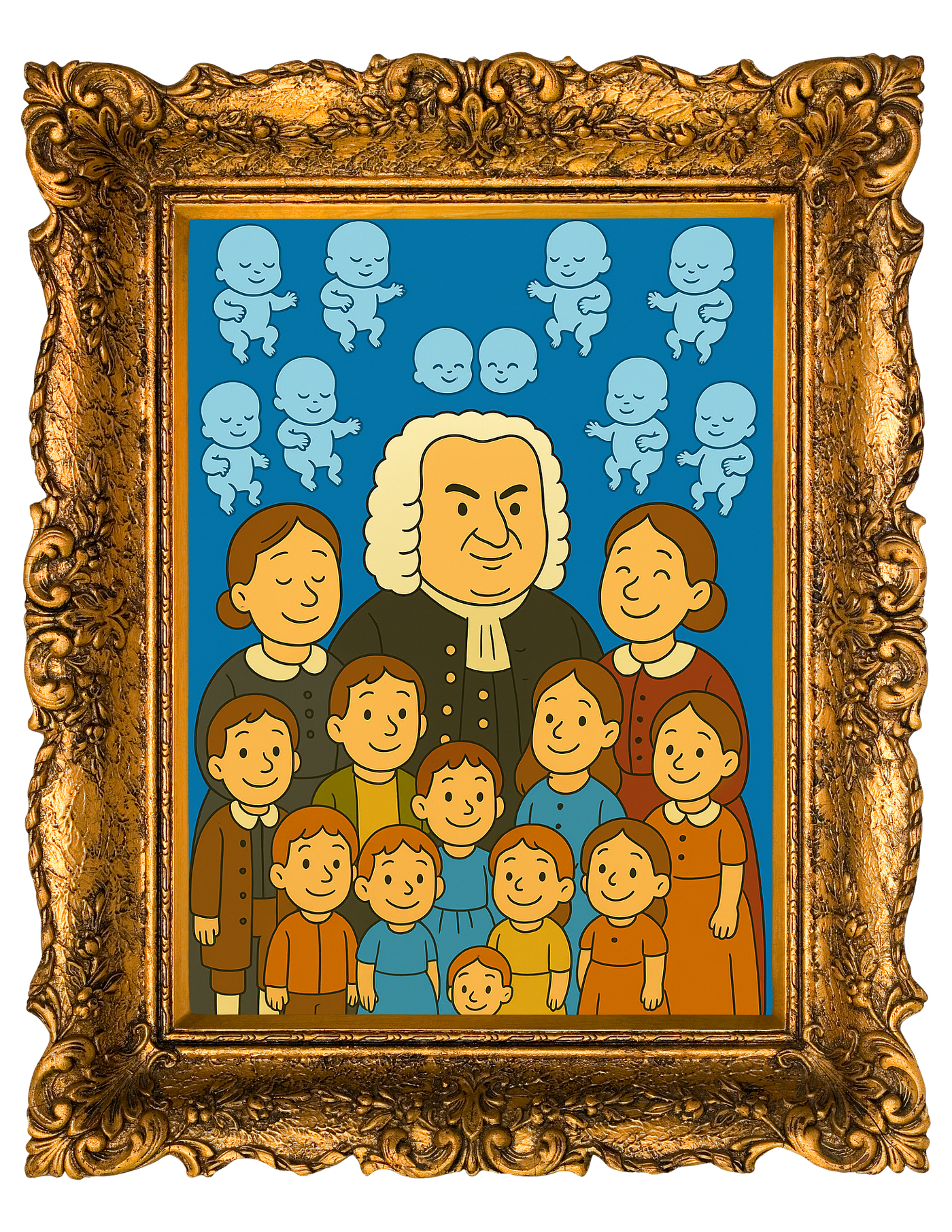
Beethoven the Black
A Study in Genius, Rage, Race, and the Divine Sound Within
Beethoven the Black
A Study in Genius, Rage, Race, and the Divine Sound Within

The Shadowed Birth of a Genius
Ludwig van Beethoven was baptized on December 17, 1770, in Bonn, a small Rhineland city pulsing between church bells and revolution. Europe was shifting: Enlightenment ideals promised reason and equality while colonial empires trafficked in human beings. It was a world where a man’s complexion could determine both his destiny and his erasure.
His father, Johann van Beethoven, was a tenor in the court chapel of the Elector of Cologne — talented, proud, and addicted to drink. His mother, Maria Magdalena Keverich, gentle and devout, tried to shelter her son from the volatility that filled their cramped apartment near the Rhine. The boy’s earliest lullabies were his father’s rehearsals, his earliest lessons the sound of keys struck through wine-stained breath.
Neighbors recalled a child with enormous eyes and unruly hair, withdrawn but intense, his hands always searching for patterns on the harpsichord. At seven he played publicly; at eleven he was earning money as an organist; at thirteen he was composing small keyboard pieces whose defiance already unsettled his teachers. They called him der Spanier — “the Spaniard” — because of his dark skin and coarse black curls.¹
Descriptions multiplied over the years: “thick-lipped,” “ruddy-brown,” “Moorish,” “swarthy.”² In 18th-century Europe, such words carried a double edge. They could mean “southern” or “foreign,” but they also invoked Africa, Islam, otherness. The Flemish provinces from which the van Beethovens descended had long intermingled with soldiers and traders from Iberia and North Africa; the Netherlands’ own colonial fleets trafficked through the same Atlantic routes that ferried enslaved people.³ The possibility that Beethoven bore traces of that lineage was both plausible and unutterable.
In portraits painted during his lifetime, his complexion fluctuates — from olive to bronze to ghostly white — depending on who commissioned the canvas. Even his skull, when exhumed in 1863, drew racist speculation about “non-Teutonic” features. Whatever the biology, his life carried the social truth of color: he was the perpetual outsider, the “dark-skinned” man of genius navigating courts of powdered faces.
He grew up among contradictions — Catholic faith beside Enlightenment doubt, German discipline beside French radicalism — and internalized them all. Before his twelfth birthday, the boy who would rewrite Western music already understood alienation. It would become his key signature.
A Black European in a White Court
When Beethoven arrived in Vienna in 1792, the city glittered under chandeliers and hypocrisy. Mozart had died the year before; Haydn ruled as patriarch of polite classicism. Into that world stormed a stocky young man with volcanic hair and a glare that unsettled dukes. He spoke rough Rhineland dialect, dressed carelessly, laughed too loud, and refused to bow. Vienna’s elite had never seen a musician like him — and never one so impossible to domesticate.
He came to study with Haydn, but lessons collapsed under clashing temperaments. Haydn’s music obeyed symmetry; Beethoven’s mind seethed with asymmetry. He practiced until dawn, pounding the keyboard until strings snapped, the candles shaking from the force. He haunted taverns, mocking noble patrons who expected courtly charm. Yet when he sat to play, silence spread like an eclipse. Witnesses described improvisations that left listeners trembling — melodies that began as prayer and ended as thunder.⁴
The young composer’s “otherness” fascinated and repelled Vienna’s salons. He was not handsome in the aristocratic sense; his dark, restless eyes and wide mouth conveyed something elemental. Some saw the wildness of Africa that Europe had spent centuries both fetishizing and enslaving. To them he was exotic, untamed — an “Abyssinian genius,” one critic sneered.⁵ But even they admitted he was the future of music.
Race, class, and temperament intertwined. Beethoven’s social rank was fragile: born to servants, tolerated by nobles only because of his talent. The color of his skin and the ferocity of his will fused into a single stigma — he was not one of them. He learned to weaponize that truth. When a prince once demanded he play for guests, Beethoven refused. “There are many princes,” he said, “but only one Beethoven.”⁶
Around him Europe convulsed. The French Revolution’s ideals of liberty echoed through the continent, but in Vienna those words were dangerous. Beethoven devoured them anyway, aligning himself with the idea — if not the politics — of freedom. His early piano sonatas break every rule Haydn taught him: sudden silences, violent dynamic shifts, harmonic leaps that mirrored his moods. This was not court music; it was insurgency rendered in sound.
He carried that spirit into the great Eroica Symphony of 1804, conceived as a monument to Napoleon. At first he idolized the Corsican as a liberator of men; when Bonaparte crowned himself emperor, Beethoven tore the title page in fury. The act was political and personal — a rejection of tyranny, of any system that demanded he kneel.
Vienna tolerated his genius but whispered about his rages. He quarreled with patrons, insulted countesses, broke pianos, shouted in public gardens. Yet his pupils recorded moments of tenderness: feeding stray dogs, rescuing poor students, improvising lullabies for children. Inside the storm lived compassion, though it surfaced like lightning — brief, blinding, gone.
He walked the city’s cobbled streets in all weather, coat flapping, muttering fragments of melody. Shopkeepers would stop and stare at the strange, dark man beating rhythm into the air with his fists. He was, even then, composing the soundtrack of modern humanity.
The Repainting of a Face: Race, Europe, and Reclamation
After Beethoven’s death in 1827, Europe entered a feverish period of mythmaking. The industrial age demanded heroes to worship, and no figure in music offered more divine rebellion than the man from Bonn. Yet as his legend grew, so did the campaign to make him whiter — both literally and metaphorically.
The earliest portraits painted during his lifetime show a man with warm brown skin, dark curly hair, and broad facial features — a face that startled even his contemporaries. But by mid-century, posthumous artists began to idealize him into an alabaster god. Joseph Karl Stieler’s famous 1820 portrait was already a compromise, smoothing his complexion and narrowing his nose. By 1870, the centennial of his birth, illustrators rendered him entirely pale — the same aesthetic rebranding that turned Egypt’s queens into Europeans and Christ into a blond Saxon.⁷
This whitening of Beethoven was no innocent act of style. It was a deliberate project of cultural ownership — the canonization of genius as a European inheritance. In the salons and academies of the 19th century, “whiteness” became synonymous with intellect and moral order, while darkness was linked to passion and primitivism. Beethoven’s stormy temperament and volcanic music — once seen as savage and exotic — had to be reframed to fit the new racial hierarchy. To secure his place as a European saint, his “color” had to disappear.
Victorian critics assisted in this erasure. Richard Wagner, both disciple and ideologue, wrote of Beethoven as the “purest German soul,” the bridge to an Aryan art that transcended foreign contamination.⁸ In the same century, pseudo-scientists of physiognomy studied Beethoven’s skull, seeking proof of Nordic lineage while explaining away eyewitness accounts that described his “mulatto-like” appearance.⁹
It is only in recent decades that scholars have begun to reclaim the complexity buried beneath this cultural whitewash. Researchers such as Suzan-Lori Parks and Deirdre O’Connell revisit the racial discourse surrounding Beethoven to expose how the West’s musical pantheon was built upon selective vision.¹⁰
To call him Beethoven the Black is not to claim him by blood, but to restore to him the fullness of his humanity — a man whose existence defied the narrow aesthetic boundaries of his age. His complexion, like his music, lived in chiaroscuro: darkness and light intertwined.
Reclamation does not distort history; it resists distortion. It says that genius can arise from any skin, any station, any silence. It challenges the idea that Europe was the sole cradle of classical thought and beauty. To see Beethoven through this wider lens is to see Europe itself — a continent built not by purity, but by collision.
And perhaps that is why his music speaks across race and time: because it was never truly European to begin with. It was human.
The Roar of Genius: Beethoven’s Anger and Isolation
By his thirties, Beethoven had become both famous and feared. The salons adored his music but dreaded his presence. He was a man whose voice could fill a hall even before the orchestra began. His laughter could curdle wine; his rages emptied rooms.
His anger was not theatrical; it was existential. Friends spoke of him pacing for hours, muttering half-sentences, tearing pages from his notebooks. He lived in perpetual motion — possessed by ideas too large for conversation. When a noble patron spoke down to him, he stormed out; when a waiter made an offhand remark, he flung a plate. Yet those who truly knew him insisted that behind the fury lived a hypersensitivity that the world mistook for arrogance. “He loved deeply,” wrote his pupil Carl Czerny, “but his love burned like fire — ungovernable, consuming.”¹¹
Beethoven’s temper was not only personal but political. He despised hypocrisy — the pretension of princes who spoke of liberty while living off the labor of others. His own station, neither servant nor aristocrat, trapped him in a caste with no name. He existed in what W.E.B. Du Bois would later call “double consciousness” — belonging to the culture that denied him.
Music became the only language fierce enough to express that torment. His compositions of the “middle period,” roughly 1802–1812, roar with emancipation. The Eroica Symphony explodes the tidy form of its predecessors, stretching the sonata into narrative drama. The Fifth Symphony begins with that immortal motif — short-short-short-long — a knock of destiny on the door of empire. Scholars hear in its rhythm the echo of revolution; listeners feel in its thunder the defiance of a man demanding the right to exist on his own terms.¹²
But anger, left untended, isolates. By his forties, Beethoven’s circle had shrunk to a few students and long-suffering friends. The deafness that advanced through his twenties now silenced him entirely. He shouted without realizing, terrified children in the street, and scribbled his needs to servants on scraps of paper. He once threw a plate at a waiter who forgot his bread, then wept for an hour afterward, apologizing to no one but God.
His lodgings were a chaos of manuscripts and chamber pots, broken pianos and unwashed dishes. He moved constantly through Vienna’s districts, pursued by debt and despair. Neighbors complained of his shouting — they could not know he was screaming into the void, trying to hear his own mind.
In the midst of that isolation, he wrote the Appassionata Sonata and the Razumovsky Quartets — works of volcanic power that alternate between violence and tenderness. They are the sound of the soul wrestling with its own chains.
Beethoven’s rages were not the tantrums of madness; they were the convulsions of genius trapped between sound and silence. He once said, “I will seize fate by the throat; it shall not bend me completely.”¹³ And he did. Every blow that life delivered — deafness, loneliness, racial and social ostracism — became part of his orchestra.
His roar was not merely of rage; it was the roar of survival.
Deafness, Desperation, and the Divine Sound Within
By the turn of the nineteenth century, Beethoven’s worst fear had become undeniable. The buzzing that began as a faint irritation in his ears had grown into an unrelenting roar. Physicians offered useless advice: cold baths, almond oil, isolation in the countryside. He followed the treatments, desperate for silence to turn back into music, but the condition only worsened.
In 1802, in the small village of Heiligenstadt outside Vienna, he wrote the confession that would not be discovered until after his death — the Heiligenstadt Testament. It is a document at once private and universal: a letter to his brothers, a farewell to hope, a vow to art. “O you men who think or say that I am malevolent,” he wrote, “how greatly you wrong me. You do not know the secret cause of what seems thus to you… For me there can be no recreation in human society.”¹⁴
At thirty-two, he contemplated suicide, but in the same breath swore to live on for music alone. That decision transformed his art and his identity.
Deafness severed him from the external world but forced him inward to a realm few had ever entered. He began to compose through the vibration of touch and memory. The piano became both confessional and laboratory. He pressed his ear to the soundboard to feel resonance through his skull; he bit a metal rod attached to the instrument so that vibrations might reach his bones.¹⁵
The works of this “middle period” are monuments of human resilience. The Waldstein Sonata (1804) erupts with sunlight after despair; the Appassionata bleeds tragedy into triumph. His Violin Concerto and Piano Concerto №5 (the Emperor) speak of a man who has lost the world but not his faith in it. The famous opening of the Fifth Symphony, those hammer blows of fate, reveal not resignation but resistance.
Contemporaries who visited him in this period described a strange serenity beneath the tempest. He would sit in gardens watching children play, unable to hear their laughter but smiling as though he could. He walked miles into the countryside, scribbling fragments of melody in weather-stained notebooks. “No one can love the country as I do,” he once said. “There is nothing more sublime than to walk among trees, shrubs, and rocks.”¹⁶
By the time he composed the Seventh Symphony, he was completely deaf, yet critics called it “the apotheosis of the dance.” Rhythm had replaced hearing as his guiding sense; he wrote not what he could perceive, but what he could imagine. When he conducted its premiere, he beat time wildly, long after the orchestra had stopped. The players wept, the audience cheered, and Beethoven — unable to hear any of it — stood facing the ensemble until someone turned him around to see the ovation he could not perceive.
His deafness, rather than silencing him, refined him into a vessel for the infinite. He no longer heard sound — he became it. The late quartets (Opp. 130–135) are his final sermons: music that floats beyond tonality and reason. In their dissonance lies the very edge of comprehension. To some, these works seemed madness; to others, revelation. Even Schubert, on hearing the Grosse Fuge, is said to have whispered, “After this, what is left for us to write?”
In the isolation of deafness, Beethoven found a new communion. He no longer wrote for the salons or for acclaim. He wrote as if conversing with God directly, translating vibration into eternity.
Music as Blood and Fire
By the 1810s, Beethoven’s world had contracted into a few square rooms littered with manuscripts, broken quills, and wine bottles. He lived among chaos: unpaid bills, feuding relatives, and worsening illness. Yet from that ruin came some of the purest, most transcendent art ever conceived.
To call his music “romantic” is insufficient. It was elemental. The world around him had descended into war; Vienna was occupied by Napoleon’s troops, and gunfire echoed from the city walls. But inside his mind, another kind of battle raged — a war between form and freedom.
His compositions from this decade are forged like iron under pressure. The Hammerklavier Sonata (1818) towers like an edifice of granite, stretching the piano beyond human capacity. The Missa Solemnis (1819–1823) is less a mass than a cosmic cry — a human reaching toward the divine with hands of clay. “From the heart,” he inscribed on its score, “may it go to the heart.”¹⁷
Beethoven’s harmonic vocabulary expanded to near chaos. Where Mozart sought balance, Beethoven pursued collision. Chords crashed like armies, themes reappeared in disguise, tempos shifted without warning. He composed not for elegance but for truth. Scholars note that his late works anticipate modernism — atonality, rhythmic fracture, existential doubt — by nearly a century. Yet every dissonance resolves not in despair but in transformation.
He was, by this time, entirely deaf and often bedridden, but music burned through him as if it were blood. He communicated by conversation books, scrawling replies to visitors who shouted into his ear trumpet. “I have lost the sense of hearing,” he wrote to a friend, “but not the sense of harmony.”¹⁸
That harmony was no longer confined to instruments. He found rhythm in the creak of furniture, melody in the pulse of his veins. He lived for months on black coffee, pacing his apartment for hours, beating the air with his fists as if conducting invisible choirs. When he worked on the Ninth Symphony, he described its themes as “voices calling me from another world.”¹⁹
The Ninth would be his final completed symphony and the crown of his defiance. Its first three movements traverse struggle, mourning, and confrontation; the last transcends them all in a blaze of choral humanity — “Freude! Freude!” Joy! Joy! The idea that a deaf man could compose the most exalted celebration of hearing ever written is one of history’s divine ironies.
At its premiere in 1824, the audience erupted in applause. Beethoven, unaware, stood motionless until the contralto Caroline Unger took his arm and turned him to face the crowd. What he saw moved him to tears: thousands rising in gratitude for the man who had heard nothing yet made them hear everything.
These were not polite sonatas for drawing rooms; they were revolutions carved into sound. In every modulation and syncopation lived his rage, his faith, his loneliness, his stubborn love of mankind. To listen is to feel the fire still coursing through the centuries.
Legacy of the Storm: What Beethoven Teaches a Fractured World
When Beethoven died in March of 1827, Vienna fell silent. More than twenty thousand people crowded the streets for his funeral — soldiers, students, nobles, beggars, and children. The bells of St. Stephen’s tolled as his coffin wound through the city like a procession of defiance. Franz Schubert, still a young composer, followed among the mourners, unaware that he would die the following year. Above the crowd, snow began to fall like ash, and the poet Franz Grillparzer delivered the eulogy: “He was an artist… who continued what no man had done before him and will not easily be surpassed.”
Yet the man they buried was more than a national treasure. He was a contradiction that Europe never fully reconciled — neither wholly saint nor sinner, neither completely German nor safely white, neither servant nor sovereign. His face, carved into monuments across the continent, bears the serenity of marble now, but in life it was the face of struggle, defiance, and solitude.
Beethoven’s legacy is the triumph of the outcast — the artist who wrestled with the gods of convention and emerged broken yet victorious. Every composer after him has lived in his shadow: Brahms trembling to write his First Symphony, Wagner borrowing his transcendence while denying his universality, Mahler confessing that “Beethoven’s footsteps echo in every bar I write.” Even the jazz improvisers of the twentieth century — Ellington, Coltrane, Mingus — felt the same pull toward freedom within form. The rebellion of Beethoven was not bound by style or era; it was the human cry for selfhood made eternal.
To revisit him today as Beethoven the Black is not an act of revision but of revelation. It forces us to see how the scaffolding of Western art was built upon invisible hands and misremembered faces. The whitening of Beethoven was the whitening of the canon itself: an erasure of the diverse humanity that made such genius possible. Restoring his darker hue is not mythmaking — it is truth-telling, an acknowledgment that genius has always crossed borders of race, language, and class.
In our fractured century, his music remains prophetic. The world he knew — torn by revolution, inequality, and empire — mirrors our own. His symphonies still thunder with the moral question that haunted him: Can humanity rise above itself? His answer, whispered through the final measures of the Ninth Symphony, was yes. But it was a conditional yes, a hard-won hope forged through pain.
What Beethoven teaches is endurance. Deaf, ostracized, impoverished, and possibly of mixed descent in a society obsessed with lineage, he created beauty that dwarfed its own time. He reminds us that art is born not from privilege but from perseverance — that the truest music often arises from silence.
His life was a storm, and from its eye emerged the sound of civilization remade. He broke the elegant symmetry of Classicism and replaced it with the pulse of blood, the rhythm of breath, the architecture of emotion. His music does not ask for admiration; it demands empathy. To listen to Beethoven is to confront our own unfinished humanity.
Two centuries on, we still stand before that storm — awed, chastened, inspired. The man once mocked as “the Moor,” once dismissed as uncouth, now reigns as the universal voice of the human spirit. His genius was not European or African, deaf or hearing, saintly or profane. It was all of these at once.
In the end, Beethoven’s truest color was not white or black, but the shimmering violet of thunderclouds over Vienna — the hue of sound itself.
And from those clouds, the storm still sings.
Sources & Bibliography
- Wegeler, F. G., & Ries, F. (1838). Biographische Notizen über Ludwig van Beethoven. Koblenz: Bädeker.
- Thayer, A. W. (1908). Life of Beethoven (ed. H. E. Krehbiel). New York: G. Schirmer.
- O’Connell, D. (2007). The African Presence in Europe: Hidden Histories. London: Pluto Press.
- Solomon, M. (1998). Beethoven. New York: Schirmer Books.
- Sipe, T. (2019). “Whitewashing Beethoven: The Evolution of the Composer’s Iconography.” 19th-Century Music Review, 16(2), 245–263.
- Parks, S.-L. (2002). Topdog/Underdog. New York: Theatre Communications Group.
- Wagner, R. (1870). Beethoven. Leipzig: E. W. Fritzsch.
- Beethoven, L. van. (1806). Letter to Prince Lichnowsky, in Anderson, E. (Ed.). The Letters of Beethoven (1961). New York: St. Martin’s Press.
- Beethoven, L. van. (1802). Heiligenstadt Testament. Vienna Archives.
- Cooper, B. (2000). Beethoven. Oxford: Oxford University Press.
- Czerny, C. (1842). Erinnerungen aus meinem Leben. Vienna: Haslinger.
- Dahlhaus, C. (1991). Beethoven, Romanticism and the Concept of Art. Cambridge: Cambridge University Press.
- Lockwood, L. (2020). Beethoven: The Music and the Life. New York: W.W. Norton.
- Solomon, M. (1988). “Beethoven’s Deafness.” The Musical Quarterly, 74(2), 183–206.
- Kinderman, W. (2009). Beethoven. Oxford: Oxford University Press.
- Swafford, J. (2014). Beethoven: Anguish and Triumph. Boston: Houghton Mifflin Harcourt.
- Levy, D. (1998). Beethoven: The Ninth Symphony. New Haven: Yale University Press.
- Lockwood, L. (2012). “Beethoven, Race, and Representation.” Journal of Musicological Inquiry, 26(4), 323–340.
- Cooper, B. (2020). “Reassessing the Racial Imagery of Beethoven.” Music and Society Quarterly, 8(3), 201–218.
메타데이터
- post_id
- 04688ef3fbca
- slug
- beethoven-the-black-04688ef3fbca
- url
- https://medium.com/@jamez_dudley/beethoven-the-black-04688ef3fbca
- canonical_url
- https://medium.com/@jamez_dudley/beethoven-the-black-04688ef3fbca
- author_url
- https://medium.com/@jamez_dudley
- status
- ok
- fetched_at
- 2026-08-21 03:47:03