Less Known Stoics — Cato the Younger
The Man Who Stood Up to Julius Caesar
Less Known Stoics — Cato the Younger
The Man Who Stood Up to Julius Caesar
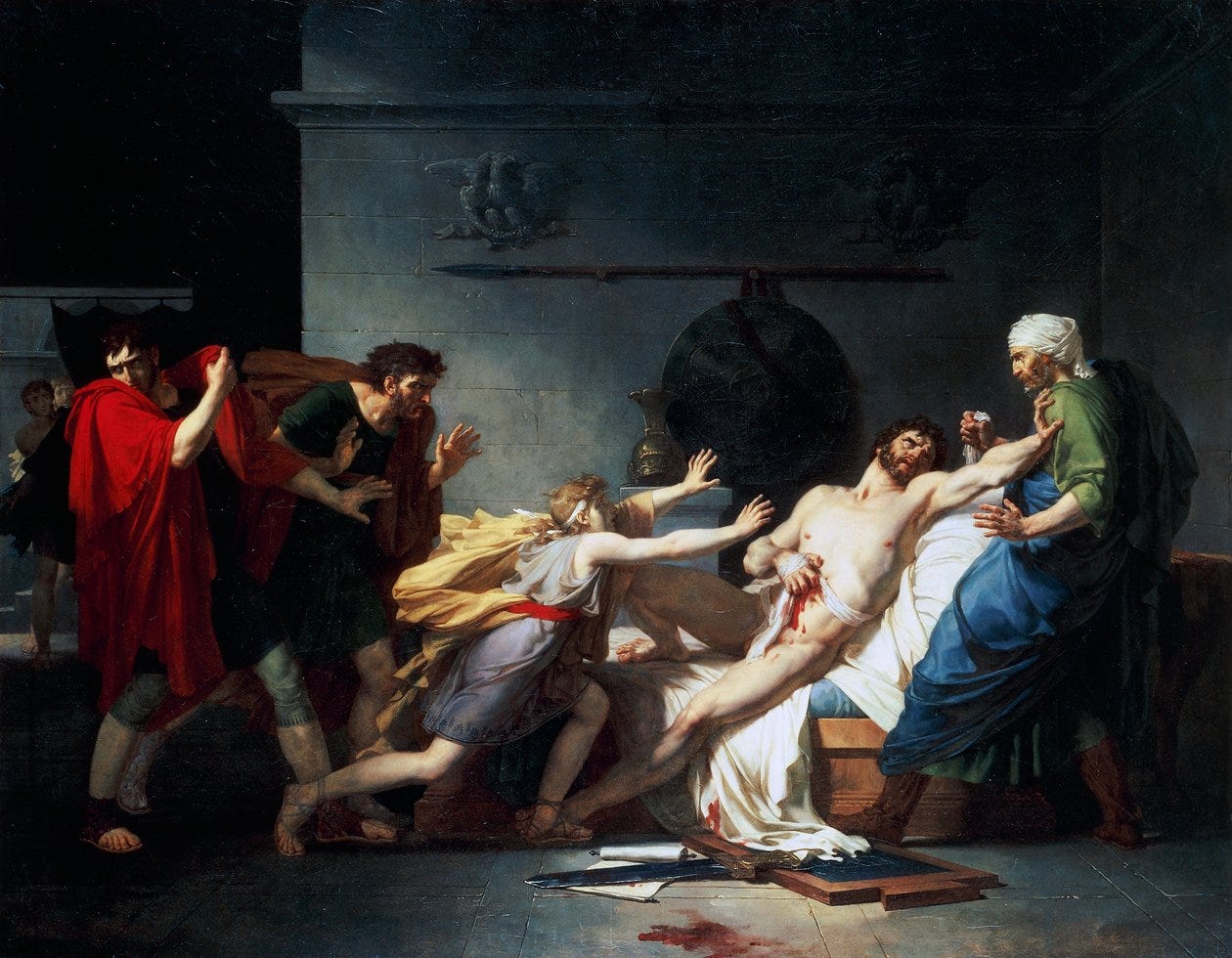
The death of Cato the Younger by Baron Pierre-Narcisse Guerin, Public Episcopal Library, Barcelona, Spain
When you hear Stoicism, you automatically think of Marcus Aurelius and his Meditations. Maybe Seneca or Epictetus. If you know your history, you might even be able to summon the name of Zeno of Citium, the founder of Stoicism. But there is a lot more to the philosophy of Stoicism and the lives of prominent Stoics. I have previously written two articles about lesser-known Stoics — one about Musonius Rufus, and the other about Cleanthes and Crysippus. Today, we review the life and lessons of Cato the Younger, the man who stood up to Julius Caesar.
It is interesting to observe how Rome adopted and adapted Greek Stoicism. While Greek Stoicism was a philosophy of life, often personal life, Roman Stoicism became a philosophy tested in public life. Greek Stoicism built the doctrine, Roman Stoicism gave us senators and emperors. Rome was the battlefield where Stoicism was tested — in the Senate, in exile, under emperors, and in the face of danger and death. Cato the Younger, the reluctant politician, was the man who did a lot of testing.
The Grandpa
But before Cato the Younger, there was Cato the Elder.
Cato the Elder, or Marcus Porcius Cato (234–149 BCE), was a Roman from a relatively modest background and rose through military service, discipline, and political talent. He was severe, practical, suspicious of luxury, devoted to the Republic, and fiercely attached to the old Roman ideals of hard work, austerity, patriotism, and moral discipline. As censor, he tried to fight corruption and moral decline among Rome’s elite. Unlike Cato the Younger, who became a Stoic symbol of resistance to Caesar, Cato the Elder represented an older Roman ideal: tough, conservative, patriotic, blunt, and often harsh.
Yes, Cato the Younger did not invent his persona from nothing. He inherited a name already associated with severity, simplicity, and a sort of moral stubbornness. Then he added Stoicism to it.
The Man
Cato the Younger (95 BCE — 46 BCE), or Marcus Porcius Cato, is a towering figure of Roman history. Among Rome’s many generals, orators, rebels, and statesmen, he remains one of the most famous non-emperor Romans, not because he conquered nations, but because of what he came to represent. The incorruptible man. The conscience of the Republic. The one man Julius Caesar could not buy or bully.
Cato was born into an old Roman aristocratic family, but he lost both parents while still a child and was raised in the household of his uncle, Marcus Livius Drusus. Ancient writers describe him as unusually serious, stubborn, and morally rigid from an early age — the sort of boy who asked uncomfortable questions and refused easy answers.
During the bloody dictatorship of Sulla, Cato supposedly asked his tutor why Sulla was still alive. The tutor replied that men feared Sulla more than they hated him. Cato’s answer was chilling: “Give me a sword, so I might kill him and set my country free from slavery.” Maybe Plutarch embellished the story. Ancient biography was not modern journalism. But the story tells us something important about the Cato image. Tyranny, even if convenient — after all, Cato was part of Sulla’s circle — was a moral emergency.
Cato studied philosophy under Antipater of Tyre. He trained his body with deliberate hardship — lived simply despite his noble background, wore plain clothing, walked long distances, ate simply, and exposed himself to discomfort. Cato developed an indifference to luxury and a fierce hatred of corruption. Long before he entered the Senate or opposed Caesar, Cato had already put in the work to shape himself into a man of principle — austere and almost impossible to bend.
Stoicism can prepare one for the worst in politics. But Cato was also trained in rhetoric, learning how to defend both sides of an argument and to speak with composure in public, in high-stakes situations. So, Cato was not a philosopher hiding in a library. He was bred for politics, trained for public life, and in doing so, also armed with a philosophy that prepared him for the ups and downs of public life.
He served as a military tribune, quaestor, and eventually a senator. As a military commander, he quickly realized that the Stoic teachings were ideally suited to military life, and his simplicity earned him the respect of the troops. As quaestor, he became famous for his obsessive honesty and seriousness in managing public funds. In a system where bribery and favoritism were normal, Cato treated the treasury as a sacred trust. As a senator, his vote had no price. The phrase once used about his grandfather, “We cannot all be Catos”, started being used about him too.
But that was also the problem.
Cato treated compromise as a dirty word. He refused to give an inch when he believed principle was at stake. He achieved power by disdaining power. He became, in a sense, a politician above politics — admired by many, followed by few, and often ignored by those who applauded him.
Rome liked having Cato around. It was comfortable knowing someone was there to say “no” when most were too corrupt or cowardly. But barely anyone wanted to live by that “no.”
The Myth
Cato’s myth developed while he was still alive.
He understood, perhaps better than some give him credit for, the power of public gestures. Already a senator, he went barefoot. He wore rough clothes. He walked without the usual entourage. He surrounded himself with philosophers rather than political operators. He slept and marched with his soldiers instead of separating himself from them. He turned austerity into a public language.
A glance at Cato told people what he stood for.
These were smart choices. Roman politics was theatre as much as argument. Cicero had eloquence. Pompey had prestige and looks. Caesar had glamour, luck, military genius, and terrifying energy. Cato had something less exciting but more morally potent: visible integrity. He turned his whole life into an argument.
The old Romans were, in his imagination, purer, wiser, harder, and braver. His life became a project of calculated anachronism. He tried to live as if the Republic could be saved by a return to older virtues. Funnily enough, while Cato the Elder rejected Greek influence, Cato the Younger took Greek Stoicism and made it Roman.
But it was not pure performance. Cato really did live austerely. He really did say no to bribes. He really did speak against corruption. He really did shun friends who asked him to bend the rules.
But the myth also had limits. Cato tried to shame Rome back into virtue. He tried to influence by being an example. He often succeeded in making corruption look ugly, but he rarely succeeded in building durable political solutions. He could force people to admire him. He could not always make them obey him.
That was the strange Roman verdict on Cato, as authors Goodman and Soni put it: “admired and ignored at the same time.”
The Legend
Cato’s final confrontation with Caesar turned him into a legend.
Long before it came to civil war, Cato saw Caesar not merely as an ambitious politician, but as an existential threat to the Republic. Caesar represented personal rule, military charisma, populist manipulation, and the slow death of republican liberty. Before Caesar, Cato had resisted others with similar ambitions. But Caesar was such a danger that Cato decided to side with Caesar’s rival Pompey. After Pompey’s defeat, Cato continued resistance in North Africa, helping to organize what remained of the anti-Caesar cause.
Then came Utica.
When Caesar’s victory became unavoidable, Cato refused to wait for mercy. He arranged for his family and followers to be safe. He spent his final hours reading Plato’s Phaedo, the dialogue about the death of Socrates. The symbolism was obvious. Socrates had died rather than betray philosophy. Cato would die rather than accept Caesar’s rule.
He then took his own life.
We should not romanticize suicide. But in the political and philosophical context of Cato’s life, the act had a precise meaning. Caesar would have pardoned him. In fact, Caesar wanted to pardon him. It would have made Caesar look merciful, magnanimous, almost kingly. But for Cato, accepting Caesar’s pardon meant accepting Caesar’s right to pardon. It meant recognizing him as master.
Cato refused.
Caesar was reportedly furious. Cato had denied him the final victory: the chance to defeat his enemy and then display mercy. Caesar could conquer armies and cities. He could not make Cato consent.
After Cato’s death, the legend grew quickly. Cicero wrote a work praising him, turning Cato into the republican martyr. Caesar answered with an Anti-Cato, but attacking a dead man is usually a bad strategy. It often strengthens the myth rather than weakening it.
The conspiracy against Caesar later gathered around Cato’s family, especially Brutus, who was both Cato’s nephew and son-in-law. Brutus may not have been the pure republican hero of later imagination, but the symbolism was irresistible. As Goodman and Soni point out, “if the sword that killed Cato was, figuratively, held by Caesar, then the daggers that killed Caesar were, in some sense, held by Cato.”
Yes, perhaps Caesar would have been assassinated anyway, even if Cato had never existed. But Cato’s death helped create the moral atmosphere in which Caesar could be killed not merely as a rival, but as a tyrant.
Cato’s legend was later picked up by other authors, in Rome, by Seneca, Lucan, and Plutarch, then by Renaissance humanists, Enlightenment republicans, and even the American Founding Fathers as a symbol of civic virtue, resistance to tyranny, and the moral grandeur of a defeated but unbroken man.
Quite a legacy for a man who lost.
The Lessons
Yes, Cato was not a philosopher in the usual sense. He did not write books and did not leave us a system, a handbook, or a set of meditations. He preferred that philosophy be lived rather than written, in fact, just as the Greek Stoics intended it. This makes him harder to study, but perhaps more interesting to learn from.
Here are a few lessons from Cato the Younger:
- Integrity in Small Things. Cato’s most famous quality was incorruptibility. Integrity. As quaestor, he examined treasury records, forced officials to follow the law, recovered money owed to the state, and refused to treat public funds as private property. This was not glamorous work. It was not battlefield glory. It was paperwork, accounting, procedure, and discipline. And that is the point. Virtue is often tested in boring places. In budgets. In signatures. In small favors. In quiet opportunities to cheat when no one is watching. In a political culture where bribery, patronage, favors, and backroom deals were normal, Cato understood that public office was not a ladder for personal advancement. It was a trust. And that is a lesson many, many public officials would need to be reminded of. Integrity is not proven only in dramatic moments. It is proven in administration, money, habits, and the little decisions that slowly reveal who we are.
- Reduce the Number of Things That Can Own You. Cato deliberately trained himself against softness. He came from wealth, but he chose plain clothes, simple food, physical hardship, and exposure to discomfort. He walked barefoot. He endured heat and cold. He lived in ways that made luxury less necessary. Perhaps some of it was theatrical. But there was also a philosophical point to this. If you are ruled by comfort, you are not free. If you need praise, luxury, convenience, status, and approval, then you can be bought or frightened. A person who needs little is harder to manipulate. This is a powerful lesson. Yes, comfort is not evil. But dependence on comfort weakens judgment. Ask yourself: what could someone use to control me? My vanity? Lifestyle? Need to be liked? Fear of discomfort? In a true Stoic fashion, Cato’s answer was to train before the crisis came. This served him well when he had to lead the troops across the North African desert. He refused special treatment. Instead, he chose to march alongside everyone else, eat the same food, and endure the same hardships.
- Public Gestures Matter. No, ideas don’t win by logic alone. Cato understood the power of visible conduct. In a noisy political world, actions are easier to hear than words. His clothes, habits, austerity, walking, marching, and refusal of special treatment all communicated a message: I am not like the others. Of course, politics is full of fake simplicity, fake toughness, and fake virtue. But gestures are not meaningless. The question is whether the gestures are authentic. Cato’s gestures worked because they matched his character. He did not merely talk about austerity. He lived it. He did not merely condemn corruption. He refused bribes. He did not merely praise courage. He walked alone to the polls after being attacked. In leadership, symbolic action matters. People notice who takes the largest office, who takes responsibility, who eats first, who accepts blame, who avoids privilege, and who shares hardship. A leader’s small gestures often speak louder than official speeches. Even in his death, Cato made sure everyone understood the parallels between his and Socrates’ deaths.
- Courage Needs Practice. One famous story tells of Cato being attacked on the way to an election. His party was ambushed, his torchbearer killed, and Cato himself wounded. The purpose was intimidation. Others withdrew. Cato continued. Any modern reader will think this was reckless. Perhaps. But Cato’s physical courage was not accidental. He had spent years training himself to treat pain, ridicule, discomfort, and danger as things outside the core of the self. Epictetus would later refer to this as a “hard winter’s training.” In the ancient Mediterranean, warfare stopped during the winter. A mediocre arm would use the winter to rest. Elite military forces used the winter to drill and prepare for the summer campaigns. Epictetus used this to argue that when your life is calm and comfortable (winter), you should intentionally practice discomfort so as not to get soft. When a sudden disaster strikes (summer war), you are prepared. Long before Epictetus, Cato intuitively understood this. Courage does not suddenly appear in a crisis. It is prepared in advance — by small acts of discomfort, honesty, discipline, and resistance.
- Remain Upright in Defeat. Cato lost. A lot. This is essential to understanding him. He failed to stop corruption. He failed to stop Caesar. He failed to save the Republic. His side lost the civil war. His political project collapsed. But defeat does not cancel duty. Stoicism does not promise victory. It promises that one can remain upright in defeat. You might ask, what about the suicide? Well, it took A LOT to get Cato to that point. A LOT. Cato remained principled when principle became expensive, lonely, and, eventually, doomed. We do not control outcomes. We control conduct. We do not always get to choose whether our cause wins — something Cato, too painfully, experienced. But we do get to choose whether defeat makes us smaller.
- Moral Clarity is a Superpower. A potent, but also dangerous one. Cato had a target on his back his entire life, precisely because he brought moral clarity to Roman politics. He spoke not as a clever operator, but as the severe conscience of a collapsing Republic. He argued from law, precedent, duty, and the foundations of Rome. This gave him enormous authority. When Cato spoke, people listened. One vote, one speech could sway an entire election. The downside, of course, is moral rigidity. Cato often seemed unable to bend, even when bending might have served the greater good. He refused alliances that might have helped. He denied Cicero a triumph when Cicero’s support was politically useful. He refused to court popular favor, even when Rome needed someone like him in office. He declined opportunities for command because rank and procedure mattered to him more than practical necessity. He refused when Pompey asked for his daughter’s hand in marriage. He was frustrating. Cicero captured it well: when affairs demanded a man like Cato, Cato would not always do what was needed to win people over. Yes, integrity is essential. But you are never on your own in politics. Politics requires the art of acting on a scene where other people exist. If you cannot persuade, organize, compromise, or build coalitions, even your virtue becomes a monument rather than a force. Cato’s reputation was far greater than his effectiveness.
- Every Extreme is Costly. Was Cato great? Inspirational? Powerful? Virtuous? Yes, yes, yes, and yes. Was he perfect? No. He had a volcanic temper. He could drink too much. He struggled to admit mistakes. He could be harsh, rigid, and politically self-defeating. Opponents spoke of the time his Stoicism failed him when extreme grief overtook Cato after the death of his beloved brother Caepio. Plutarch’s line about the grandfather, Cato the Elder, is devastating when you think about the grandson: “Whether these things should be set down to greatness of spirit or smallness of mind is an open question.” His uncompromising virtue made him an example to follow. His uncompromising nature limited him and his real-world achievements. He showed the power of principle, but also the danger of absolutism. The lesson is not “never compromise.” Nor is it “always compromise.” The lesson is harder: know what must never be sold, and know what can be negotiated in service of the greater good. Extreme flexibility is basically corruption. Extreme rigidity results in futility. True wisdom lies in knowing the difference.
- Your Legacy Is Never Fully Yours. This is a truly Stoic lesson (which I picked up from Ryan Holiday). Cato spent his life building a public image. Yet after death, he became the property of others. Cicero used him. Caesar attacked him. He was proclaimed, at different points, as a symbol of republican virtue and civic courage. The same person was seen as a traditionalist and a revolutionary (!). With time, the sharp edges softened. The mistakes faded. Would Cato have approved of all this? Probably not. But that is the point. Once we are gone, our reputation belongs to the living. Wealth, health, success, reputation, and legacy are never fully under our control. Even if people talk about you two thousand years later, they may misunderstand you, simplify you, or use you for causes you would not recognize. The only reward for virtue is virtue. Sounds harsh? Yes. But also liberating. Do the right thing because it is right. Do not expect history to be fair.
Cato the Younger is one of those historic figures who becomes less and less simple the more you study him. I first read tidbits about him in Ryan Holiday’s Lives of the Stoics, then read two books, Rome’s Last Citizen by Rob Goodman and Jimmy Soni, and Cato the Younger: Life and Death at the End of the Roman Republic by Fred K. Drogula.
At first glance, he is the perfect Stoic hero: incorruptible, courageous, austere, principled, and willing to die rather than submit to tyranny. Look closer, and he becomes more complicated. He was admired but often ineffective. He was morally clear but politically rigid. He saw corruption clearly but did not always understand how to reform the system that produced it. He stood against Caesar with extraordinary courage, but he also helped create a situation in which compromise became nearly impossible and, as such, caused (not only him, of course, but still) the end of the Roman Republic.
History rewards winners, they say. There are hundreds of books about Caesar — biographies, military histories, books on the fall of the Republic, Shakespeare studies, historical novels, and academic works. For Cato, perhaps a couple of dozen, but only a few major dedicated modern biographies. But the disparity says nothing about the moral shadow he cast over Caesar’s age.
And yet, even in failure, Cato stands tall.
Despite political failures, Cato’s success was personal. He did not save the Republic. He did not defeat Caesar. He did not reform Rome. He missed opportunity after opportunity. But he proved that a person can be unafraid before power. That he could remain incorruptible in a corrupt age. That some things should not be for sale.
There is a lot we can learn from Cato. No, we should not imitate him completely. As I mentioned, any extreme is dangerous. Even the extreme of virtue when it functions without wisdom. But we should learn about him, study him, because he forces us to ask the right questions.
- What is your integrity worth?
- What comforts own you?
- Where do you bend too easily?
- Where are you too rigid?
- Are you practicing courage?
- And if the world around you begins to fall apart, will you stand tall?
That is Cato the Younger. A man who lost almost everything, except himself. Simultaneously an example, and a warning.
If you enjoyed this read, be sure to visit my homepage for articles on philosophy, learning, self-improvement, literature, Brazilian Jiu-Jitsu, and more. Here are some you may be interested in:
- On Power. A Stoic Reflection
- Leadership Without Rank. Lessons from Ellen Ripley, Aragorn, and Optimus Prime
- Service: The Purpose of Power
- Less Known Stoics — Musonius Rufus
- Less Known Stoics — Cleanthes and Chrysippus
- It Is Supposed To Be Hard
- Cosmic Morality. The Case for Planetary-Scale Ethics
- Where Does Morality Come From?
- The Metaphor of Stoic Archer
- Carpe Diem Revisited
- My 7 Takeaways from Comfort Crisis by Michael Easter
- Your Most Important Job
- My 7 Takeaways from the Obstacle is the Way by Ryan Holiday
- My 7 Takeaways from Antifragile by Nassim Nicholas Taleb
- My 7 Takeaways from Meditations by Marcus Aurelius
메타데이터
- post_id
- 04791fe00928
- slug
- less-known-stoics-cato-the-younger-04791fe00928
- url
- https://medium.com/@RationalBadger/less-known-stoics-cato-the-younger-04791fe00928
- canonical_url
- https://medium.com/@RationalBadger/less-known-stoics-cato-the-younger-04791fe00928
- author_url
- https://medium.com/@RationalBadger
- status
- ok
- fetched_at
- 2026-06-09 15:37:30