Thomas Kuhn Did and Did Not Believe in Many Worlds
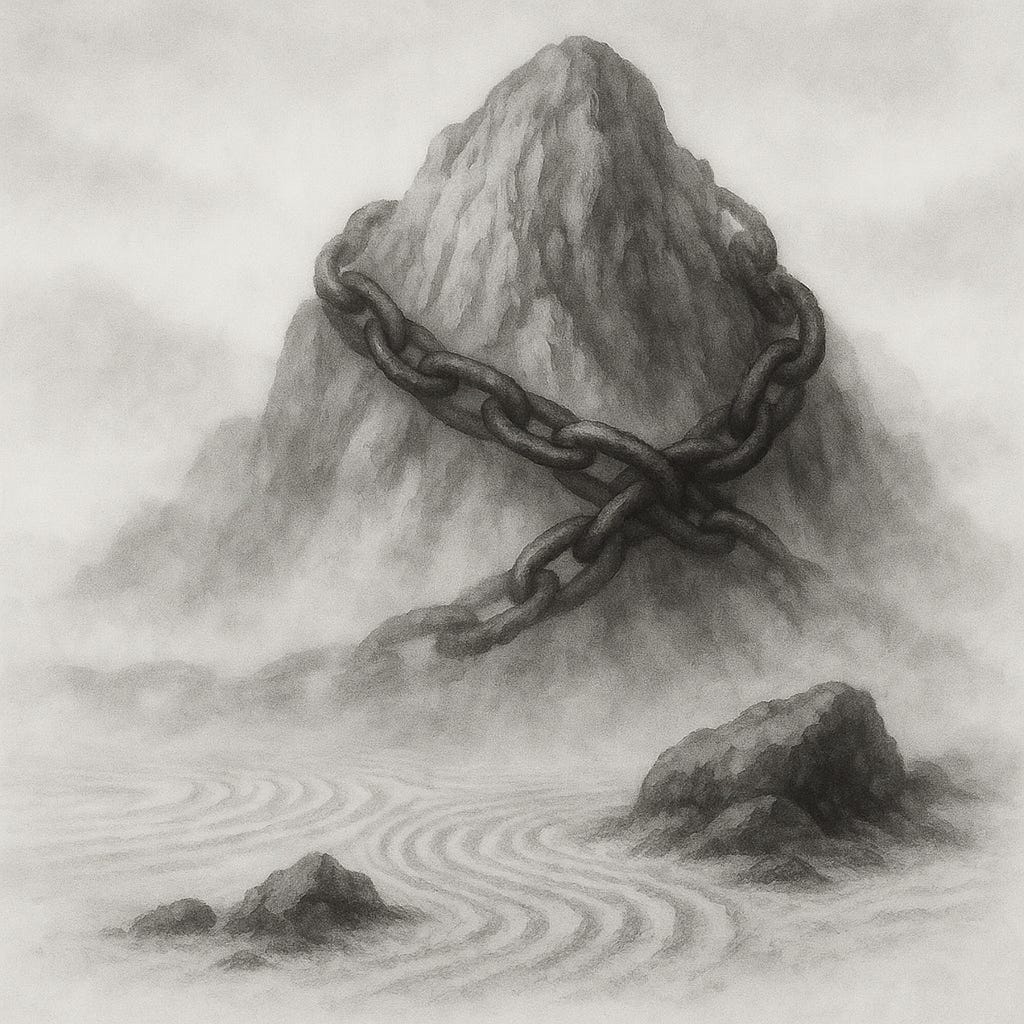
Kuhn was caught between the rock of realism, and the hard place of relativism.
Thomas Kuhn Did and Did Not Believe in Many Worlds
Kuhn was caught between the rock of realism, and the hard place of relativism.
Photo by the author. Source here.
The historian and philosopher of science Thomas Kuhn cited many examples from the history of science to substantiate what I call his “many-worlds theory”. (This is a term which is obviously borrowed from theoretical physics.) In fact, Kuhn spent far more time on historical examples than he did on philosophical argument. No doubt he wanted his examples to speak for themselves. What this essay does, however, is miss out Kuhn’s many examples in order to find the logical core of his argument.
Kuhn’s Many Qualifications of the Words “Different Worlds”
Even the title of the chapter ‘Revolutions as Changes of World View’ (from Kuhn’s *The Structure of Scientific Revolutions) isn’t called ‘Revolutions as Changes of World’. The words ‘world view’ are hardly new or peculiar to Kuhn. To state the obvious: different world views are usually regarded as being different views of the same world*.
The most clear expression of Kuhn’s many-worlds theory is given at the beginning of the chapter ‘Revolutions as Changes of World View’. After a revolutionary change of paradigm,
“[i]t is rather as if the professional community had been suddenly transported to another planet where familiar objects are seen in a different light and are joined by unfamiliar ones as well”.
Firstly, note the words “as if” (as in “as if the professional community had been suddenly transported to another planet”). Kuhn was obviously not claiming that the professional community had been transported to another planet. It was only as if they had been.
What’s more, in this as-if world there are still familiar objects, even if they’re seen in a different light. Thus, even Kuhn’s as-if worlds aren’t that different from, well, the world.
Kuhn qualified his position even more in the same paragraph when he wrote that
“we may want to say that after a revolution scientists are responding to a different world”.
Sure. We may want to say that… if we like. Yet that doesn’t mean that there’s any actual commitment to literal different worlds. Perhaps this way of speaking simply helps us to think about these matters.
Kuhn used a variation on his words “we may want to say” six pages later when he wrote that matters “may make us wish to say that, after Copernicus, astronomers lived in a different world”… Yes, we may wish to say that, and for all sorts of reasons. Yet, here again, it’s not being said that astronomers after Copernicus did literally live in a different world to their predecessors.
Kuhn made his point clearer when he concluded by saying that “their research responded as though that were the case”. Now we have as though, rather than the earlier as if.
Kuhn again qualified his position (or at least asked himself questions) when it came to talk of “different worlds”. When discussing “what separates Galileo from Aristotle, or Lavoisier from Priestley”, Kuhn asked:
“Is there any legitimate sense in which we can say that they pursued their research in a different world?”
Kuhn continued:
“Many readers will surely want to say that what changes with a paradigm is only the scientist’s interpretation of observations that are themselves are fixed once and for all by the nature of the environment and of the perceptual apparatus.”
Instead of the words “fixed nature”, here we have the words “fixed by the nature of the environment and of the perceptual apparatus”. Thus, it’s not simply:
*(i)* fixed nature vs* scientists’ different worlds*
It’s:
*(ii)* observations that are fixed by the nature of the environment and of the perceptual apparatus vs* scientists’ different worlds*
In (i) we have a two-way process which includes fixed nature and the different ways that it is interpreted. Whereas in (ii) there is a three-way process in which we have a fixed nature + a fixed perceptual apparatus which both lead to fixed observations, and which then lead to unfixed interpretations.
So we’ve moved from fixed nature to fixed observations (i.e., “observations that are themselves fixed…”).
Both (i) and (ii) can be deemed to be scientifically realist in nature. Kuhn was against both. According to (i) and (ii), interpretations of fixed nature (or fixed observations) can be many in number. Most scientific realists don’t deny that. They accept both the fixed nature (fixed observations) part of the equation, as well as the subsequent interpretations.
Kuhn moved on from talk about fixed nature (or fixed observations) to “fixed data”. His point is simple. Only the notion of fixed data can make sense of the corresponding notion of interpretation. If the data aren’t fixed, then what is there to interpret? Consequently, if there are no fixed data, then we must have… different worlds.
Kuhn believed in data, just not in fixed data. After a paradigm shift, “[t]he data themselves had changed”. Kuhn’s last sentence in this chapter is the following:
“That is the last of the senses in which we may want to say that after a revolution scientists work in a different world.”
If data changes after a scientific revolution, then we have no right to speak of fixed nature. Yet Kuhn is still using the locution “we may want to say”!
Kuhn on Observation-Languages
Kuhn didn’t believe that talk of observations or “the given” (i.e., instead of “fixed nature” or “the world”) solves these problems. Still, Kuhn did raise the issue:
“[P]erhaps the analysis should be carried further still from the immediately given. It might, for example, be conducted in terms of some neutral observation-language, perhaps one designed to conform to the retinal imprints that mediate what the scientist sees.”
There’s a reason for Kuhn offering his readers this description of a (former) project to create a *neutral observation-language*:
“Only in one of these ways can we hope to retrieve a realm in which experience is again stable once and for all — in which the pendulum and constrained fall are not different perceptions but rather different interpretations of the unequivocal data provided by observation of a swinging stone.”
There’s yet more movement from Kuhn here. He moved from fixed nature (or fixed observations) to stable experience (or stable perceptions). So, instead of nature being fixed, we now have experience (or perception) which is fixed.
Kuhn argued that nothing is “fixed and neutral”!
Not nature, not observation, not experience.
It’s here that Kuhn pits himself against the “epistemological viewpoint that has most often guided Western philosophy for three centuries”. That viewpoint had it that the “given data [are] immediate and unequivocal”.
Kuhn stated that he didn’t entirely relinquish that viewpoint. Many commentators believe that he did. Indeed, Kuhn himself attacked that viewpoint in the very next paragraph. (Kuhn denied that there is such a thing as “the given”. He then spent some time telling his readers why he did so.)
Kuhn Takes Back His Qualifications
Now we have Kuhn telling his readers that he’s talking about something more than mere as-if worlds. Here he is discussing the French chemist Antoine Lavoisier:
“[I]n the absence of some recourse to that hypothetical fixed nature that he ‘saw differently,’ the principle of economy will urge us to say that after discovering oxygen Lavoisier worked in a different world.”
In simple terms, in order for all scientists to be living in the same world (or simply talking about the same world), that world must have a “fixed nature”. In this case, then, the fixed nature of the (same) world is seen (or interpreted) differently by different scientists.
Kuhn clearly rejected the claim that the world has a fixed nature.
Did that automatically commit him to literal different worlds?
Yet even here Kuhn wasn’t talking ontology.
He mentioned “the principle of economy” (see here), and that too hints at as-if worlds… Or does it?
The principle of economy favours the simplest explanation with the fewest assumptions. In the same way in which Bertrand Russell (in his The Problems of Philosophy) argued that the view that an independent physical world exists is simpler than its sceptical alternatives, so Kuhn’s critics have argued that Kuhn actually picked the least economical option of many different worlds.
The scientific realist believes that the world has a fixed nature. He accepts that our theories (or interpretations) may be, and have been, wrong. However, his position still only requires a single world.
According to Kuhn, on the other hand, we require different worlds. Even if there’s no commitment to literal different worlds here, plural worlds are still required for his theory.
Kuhn’s Ontological Position?
It’s true that Kuhn wanted to keep well away from any ontological claims. However, any outright claim that the world has no fixed nature seems pretty ontological. The problem is that Kuhn never said that “the world has no fixed nature”. Instead, he said that (to paraphrase) “in the absence of any access to that hypothetical fixed nature, we must talk of different worlds instead”. This can be seen as an anti-realist, rather than an idealist, position. To rework another argument from Bertrand Russell, there may well be a teapot floating around a distant planet. However, scientists can safely ignore it.
On the realist side again. We can be economic or pragmatic about the world and how we view/interpret it, and yet still believe that it has a fixed nature! In other words, no one can prove (or even know) that the world doesn’t have a fixed nature.
Moreover, no matter how many problems there are, and have been, when it comes to describing things, the world may still have a fixed nature. Indeed, it’s hard to imagine what a world without a fixed nature would be like.
Conclusion
In order to move away from scientific realism, Kuhn had to take his own words “different worlds” literally, lest he slipped back into some kind of disguised scientific realism. Yet that position took him toward relativism. Moreover, Kuhn seemed to realise that.
In Kuhn’s work, some commentators have argued that he backtracked on his earlier positions. If the argument in my own essay is correct, then that’s understandable. The bottom line is that when Kuhn was originally writing in 1952, he would have had no idea that his ideas would have been taken up by poststructuralists and postmodernists. And that explains his later paper, for example, ‘Objectivity, Value Judgment, and Theory Choice’ from 1977, which goes into more detail about his earlier arguments.
메타데이터
- post_id
- 04897a4e02a7
- slug
- thomas-kuhn-did-and-did-not-believe-in-many-worlds-04897a4e02a7
- url
- https://medium.com/philosophytoday/thomas-kuhn-did-and-did-not-believe-in-many-worlds-04897a4e02a7
- canonical_url
- https://medium.com/philosophytoday/thomas-kuhn-did-and-did-not-believe-in-many-worlds-04897a4e02a7
- author_url
- https://medium.com/@paulaustinmurphy2000
- status
- ok
- fetched_at
- 2026-08-08 06:34:36